In der Vielfalt der C#-Programmierung ist die effektive Zeichenfolgenbearbeitung eine Grundlage für die Anzeige klarer und dynamischer Ausgaben. Die String.Format-Methode erweist sich als leistungsstarkes Werkzeug, das Entwicklern eine vielseitige und ausdrucksstarke Möglichkeit zur Formatierung von Zeichenfolgen bietet. Um die String.Format-Methode richtig zu nutzen und benutzerdefinierte Formatzeichenfolgen in C# zu erstellen, beziehen Sie sich auf die Dokumentation auf der offiziellen .NET-Dokumentationsseite von Microsoft: String.Format Method.
In diesem umfassenden Leitfaden werden wir die Komplexität des String.Format, seine Syntax, Verwendung und die effizienten Möglichkeiten untersuchen, wie es die Zeichenfolgenformatierung in C# verbessert.
Grundlagen verstehen:
Im Kern ist String.Format eine Methode, die dazu dient, Zeichenfolgen zu formatieren, indem Platzhalter durch entsprechende Werte ersetzt werden. Diese Methode ist Teil der System.String-Klasse in C# und spielt eine entscheidende Rolle bei der Erstellung gut strukturierter, anpassbarer Zeichenfolgen.
Die Syntax der String.Format-Methode beinhaltet die Verwendung eines Formatobjekts mit Platzhaltern, gefolgt von den zu ersetzenden Werten. Hier ist ein einfaches Beispiel:
// String.Format example demonstrating basic placeholder usage
string formattedString = string.Format("Hello, {0}! Today is {1}.", "John", DateTime.Now.DayOfWeek);
// String.Format example demonstrating basic placeholder usage
string formattedString = string.Format("Hello, {0}! Today is {1}.", "John", DateTime.Now.DayOfWeek);
' String.Format example demonstrating basic placeholder usage
Dim formattedString As String = String.Format("Hello, {0}! Today is {1}.", "John", DateTime.Now.DayOfWeek)
' String.Format example demonstrating basic placeholder usage
Dim formattedString As String = String.Format("Hello, {0}! Today is {1}.", "John", DateTime.Now.DayOfWeek)
In diesem Beispiel sind {0} und 1 Platzhalter, und die nachfolgenden Argumente ("John" und DateTime.Now.DayOfWeek) ersetzen diese Platzhalter in der formatierten Zeichenfolge.
Eine der leistungsstarken Funktionen von String.Format ist die Fähigkeit, numerische Werte und Datums-/Uhrzeitwerte gemäß spezifischer Muster zu formatieren. Zum Beispiel:
// Formatting numeric and date/time values
decimal price = 19.95m;
DateTime currentDate = DateTime.Now;

string formattedNumeric = string.Format("Price: {0:C}", price); // Formats the numeric value as currency
string formattedDate = string.Format("Today's date: {0:yyyy-MM-dd}", currentDate); // Formats the date
// Formatting numeric and date/time values
decimal price = 19.95m;
DateTime currentDate = DateTime.Now;

string formattedNumeric = string.Format("Price: {0:C}", price); // Formats the numeric value as currency
string formattedDate = string.Format("Today's date: {0:yyyy-MM-dd}", currentDate); // Formats the date
' Formatting numeric and date/time values
Dim price As Decimal = 19.95D
Dim currentDate As DateTime = DateTime.Now
Dim formattedNumeric As String = String.Format("Price: {0:C}", price) ' Formats the numeric value as currency
Dim formattedDate As String = String.Format("Today's date: {0:yyyy-MM-dd}", currentDate) ' Formats the date
' Formatting numeric and date/time values
Dim price As Decimal = 19.95D
Dim currentDate As DateTime = DateTime.Now

Dim formattedNumeric As String = String.Format("Price: {0:C}", price) ' Formats the numeric value as currency
Dim formattedDate As String = String.Format("Today's date: {0:yyyy-MM-dd}", currentDate) ' Formats the date
In diesem Codeausschnitt formatiert {0} den numerischen Wert als Währung, und {0:yyyy-MM-dd} formatiert das Datum nach dem angegebenen Muster.
In C# erlaubt die string.Format-Methode Entwicklern, numerische Indizes als Platzhalter innerhalb einer Formatzeichenfolge zu verwenden. Dies hilft beim Einfügen der entsprechenden Werte in einer bestimmten Reihenfolge.
// Demonstrating multiple format items with numerical indices
string formattedNamed = string.Format("Hello, {0}! Your age is {1}.", "Alice", 30);
// Demonstrating multiple format items with numerical indices
string formattedNamed = string.Format("Hello, {0}! Your age is {1}.", "Alice", 30);
' Demonstrating multiple format items with numerical indices
Dim formattedNamed As String = String.Format("Hello, {0}! Your age is {1}.", "Alice", 30)
' Demonstrating multiple format items with numerical indices
Dim formattedNamed As String = String.Format("Hello, {0}! Your age is {1}.", "Alice", 30)
Hier sind {0} und {1} numerische Platzhalter, und die Werte werden in der Reihenfolge der an die string.Format-Methode übergebenen Argumente bereitgestellt.
C# unterstützt keine benannten Platzhalter in der string.Format-Methode wie die oben gezeigten numerischen Indizes. Wenn Sie benannte Platzhalter benötigen, sollten Sie String-Interpolation oder andere Methoden verwenden, die von externen Bibliotheken bereitgestellt werden. Hier ist ein Beispiel für String-Interpolationsausdrücke:
Ausdrücke zur Zeicheninterpolation
Mit der Einführung in C# 6.0 ermöglicht die String-Interpolation Entwicklern, Ausdrücke direkt innerhalb des Zeichenfolgenliterals zu verwenden, wodurch der Code lesbarer wird und das Risiko von Fehlern beim Umordnen von Argumenten verringert wird.
// String interpolation example demonstrating direct variable use
var name = "Alice";
var age = 30;
string formattedNamed = $"Hello, {name}! Your age is {age}.";
// String interpolation example demonstrating direct variable use
var name = "Alice";
var age = 30;
string formattedNamed = $"Hello, {name}! Your age is {age}.";
' String interpolation example demonstrating direct variable use
Dim name = "Alice"
Dim age = 30
Dim formattedNamed As String = $"Hello, {name}! Your age is {age}."
' String interpolation example demonstrating direct variable use
Dim name = "Alice"
Dim age = 30
Dim formattedNamed As String = $"Hello, {name}! Your age is {age}."
In diesem Beispiel werden {name} und {age} direkt innerhalb der Zeichenfolge ausgewertet, und die Werte werden von den jeweiligen Variablen bereitgestellt.
Ausrichtung und Abstände
String.Format bietet präzise Kontrolle über die Ausrichtung und Abstände von formatierten Werten. Durch Hinzufügen von Ausrichtungs- und Breitenangaben zu Formatobjekten können Entwickler sauber ausgerichtete Ausgaben erstellen. Die Steuerung der Abstände in C# mit String.Format beinhaltet die Angabe der Breite der eingefügten Zeichenfolgen, wodurch eine präzise Steuerung über führende oder nachgestellte Leerzeichen ermöglicht wird. Beispielsweise können Produktnamen und Preise in einem Verkaufsbericht ausgerichtet werden:
// Using String.Format for aligning product names and prices
string[] products = { "Laptop", "Printer", "Headphones" };
decimal[] prices = { 1200.50m, 349.99m, 99.95m };

Console.WriteLine(String.Format("{0,-15} {1,-10}\n", "Product", "Price"));

for (int index = 0; index < products.Length; index++)
{
    string formattedProduct = String.Format("{0,-15} {1,-10:C}", products[index], prices[index]);
    Console.WriteLine(formattedProduct);
}
// Using String.Format for aligning product names and prices
string[] products = { "Laptop", "Printer", "Headphones" };
decimal[] prices = { 1200.50m, 349.99m, 99.95m };

Console.WriteLine(String.Format("{0,-15} {1,-10}\n", "Product", "Price"));

for (int index = 0; index < products.Length; index++)
{
    string formattedProduct = String.Format("{0,-15} {1,-10:C}", products[index], prices[index]);
    Console.WriteLine(formattedProduct);
}
Imports Microsoft.VisualBasic
' Using String.Format for aligning product names and prices
Dim products() As String = { "Laptop", "Printer", "Headphones" }
Dim prices() As Decimal = { 1200.50D, 349.99D, 99.95D }
Console.WriteLine(String.Format("{0,-15} {1,-10}" & vbLf, "Product", "Price"))
For index As Integer = 0 To products.Length - 1
Dim formattedProduct As String = String.Format("{0,-15} {1,-10:C}", products(index), prices(index))
Console.WriteLine(formattedProduct)
Next index
Imports Microsoft.VisualBasic

' Using String.Format for aligning product names and prices
Dim products() As String = { "Laptop", "Printer", "Headphones" }
Dim prices() As Decimal = { 1200.50D, 349.99D, 99.95D }

Console.WriteLine(String.Format("{0,-15} {1,-10}" & vbLf, "Product", "Price"))

For index As Integer = 0 To products.Length - 1
	Dim formattedProduct As String = String.Format("{0,-15} {1,-10:C}", products(index), prices(index))
	Console.WriteLine(formattedProduct)
Next index
In diesem Beispiel steuern {0,-15} und {1,-10} Formatierungen die Breite der "Produkt"- und "Preis"-Beschriftungen, wobei eine linke Ausrichtung sichergestellt wird und führende oder nachgestellte Leerzeichen ermöglicht werden. Die Schleife füllt dann die Tabelle mit Produktnamen und Preisen, wodurch ein sauber formatierter Verkaufsbericht mit präziser Steuerung der Abstände erstellt wird. Durch Anpassen dieser Breitenparameter können Sie die Ausrichtung und die Abstände der angezeigten Daten effektiv verwalten.
Die Nutzung des ternären Operators innerhalb von String.Format ermöglicht eine bedingte Formatierung basierend auf bestimmten Kriterien. Zum Beispiel:
// Using ternary operator for conditional formatting
int temperature = 25;
string weatherForecast = string.Format("The weather is {0}.", temperature > 20 ? "warm" : "cool");
// Using ternary operator for conditional formatting
int temperature = 25;
string weatherForecast = string.Format("The weather is {0}.", temperature > 20 ? "warm" : "cool");
' Using ternary operator for conditional formatting
Dim temperature As Integer = 25
Dim weatherForecast As String = String.Format("The weather is {0}.",If(temperature > 20, "warm", "cool"))
' Using ternary operator for conditional formatting
Dim temperature As Integer = 25
Dim weatherForecast As String = String.Format("The weather is {0}.",If(temperature > 20, "warm", "cool"))
Hier ändert sich die Wetterbeschreibung basierend auf der Temperatur.
Um die Darstellung von Objekten in C# zu verfeinern, fügen Sie eine Formatzeichenfolge, auch als "Composite-Formatzeichenfolge" bekannt, ein, um die Zeichenfolgenrepräsentation zu steuern. Bei der Verwendung der {0:d}-Notation wird beispielsweise der "d"-Formatspezifizierer auf das erste Objekt in der Liste angewendet. In der Kontext der formatierten Zeichenfolge oder der Composite-Formatierungsfunktion leiten diese Formatspezifizierer an, wie verschiedene Typen, einschließlich numerischer, Dezimalpunkt-, Datums- und Uhrzeit- sowie benutzerdefinierter Typen, präsentiert werden.
Hier ist ein Beispiel mit einem einzelnen Objekt und zwei Formatobjekten, das Composite-Formatzeichenfolgen und String-Interpolation kombiniert:
// Combining composite format strings and string interpolation
string formattedDateTime = $"It is now {DateTime.Now:d} at {DateTime.Now:t}";
Console.WriteLine(formattedDateTime); // Output similar to: 'It is now 4/10/2015 at 10:04 AM'
// Combining composite format strings and string interpolation
string formattedDateTime = $"It is now {DateTime.Now:d} at {DateTime.Now:t}";
Console.WriteLine(formattedDateTime); // Output similar to: 'It is now 4/10/2015 at 10:04 AM'
' Combining composite format strings and string interpolation
Dim formattedDateTime As String = $"It is now {DateTime.Now:d} at {DateTime.Now:t}"
Console.WriteLine(formattedDateTime) ' Output similar to: 'It is now 4/10/2015 at 10:04 AM'
' Combining composite format strings and string interpolation
Dim formattedDateTime As String = $"It is now {DateTime.Now:d} at {DateTime.Now:t}"
Console.WriteLine(formattedDateTime) ' Output similar to: 'It is now 4/10/2015 at 10:04 AM'
In diesem Ansatz kann die Darstellung von Objekten auf spezifische Formate abgestimmt werden, um eine kontrolliertere und ansprechendere Ausgabe zu erzeugen. Die interpolierte Zeichenfolge enthält Variablen direkt, was eine sauberere Syntax bietet.
Einführung in IronPDF
IronPDF ist eine C#-Bibliothek, die die Erstellung von PDF-Dokumenten mit HTML, das Extrahieren von Text aus PDF-Dateien und Revision und Versionsverwaltung in PDFs erleichtert. Sie bietet Entwicklern ein umfassendes Set an Werkzeugen, um PDF-Dateien in ihren C#-Anwendungen zu erzeugen, zu ändern und darzustellen. Mit IronPDF können Entwickler anspruchsvolle und optisch ansprechende PDF-Dokumente erstellen, die auf ihre spezifischen Anforderungen zugeschnitten sind.
Installation von IronPDF: Ein Schnellstart
Um die IronPDF-Bibliothek in Ihrem C#-Projekt zu nutzen, können Sie einfach das IronPDF NuGet-Paket installieren. Verwenden Sie den folgenden Befehl in Ihrer Paket-Manager-Konsole:
# Install the IronPdf NuGet package
Install-Package IronPdf
# Install the IronPdf NuGet package
Install-Package IronPdf
SHELL
Alternativ können Sie im NuGet-Paketmanager nach 'IronPDF' suchen und es von dort aus installieren.
Die String.Format-Methode in C# ist bekannt für ihre Vielseitigkeit bei der Erstellung formatierter Zeichenfolgen. Sie ermöglicht es Entwicklern, Platzhalter innerhalb einer Formatzeichenfolge zu definieren und sie mit entsprechenden Werten zu ersetzen, was eine präzise Kontrolle über die Zeichenfolgenausgabe bietet. Die Fähigkeit, numerische Werte, Datums-/Zeitinformationen zu formatieren und Text auszurichten, macht String.Format zu einem unverzichtbaren Werkzeug für die Erstellung klarer und strukturierter textlicher Inhalte.
Wenn es um die Integration von String.Format mit IronPDF geht, ist die Antwort ein klares Ja. Die von String.Format bereitgestellten Formatierungsfähigkeiten können genutzt werden, um Inhalte dynamisch zu erzeugen, die dann mit den Funktionen von IronPDF in das PDF-Dokument eingebunden werden.
Betrachten wir ein einfaches Beispiel:
using IronPdf;

// Class to generate PDF with formatted content
class PdfGenerator
{
    // Method to generate a PDF for a customer's invoice
    public static void GeneratePdf(string customerName, decimal totalAmount)
    {
        // Format the content dynamically using String.Format
        string formattedContent = string.Format("Thank you, {0}, for your purchase! Your total amount is: {1:C}.", customerName, totalAmount);

        // Create a new PDF document using IronPDF
        var pdfDocument = new ChromePdfRenderer();

        // Add the dynamically formatted content to the PDF and save it
        pdfDocument.RenderHtmlAsPdf(formattedContent).SaveAs("Invoice.pdf");
    }
}

public class Program
{
    // Main method to execute PDF generation
    public static void Main(string[] args)
    {
        PdfGenerator.GeneratePdf("John Doe", 1204.23m);
    }
}
using IronPdf;

// Class to generate PDF with formatted content
class PdfGenerator
{
    // Method to generate a PDF for a customer's invoice
    public static void GeneratePdf(string customerName, decimal totalAmount)
    {
        // Format the content dynamically using String.Format
        string formattedContent = string.Format("Thank you, {0}, for your purchase! Your total amount is: {1:C}.", customerName, totalAmount);

        // Create a new PDF document using IronPDF
        var pdfDocument = new ChromePdfRenderer();

        // Add the dynamically formatted content to the PDF and save it
        pdfDocument.RenderHtmlAsPdf(formattedContent).SaveAs("Invoice.pdf");
    }
}

public class Program
{
    // Main method to execute PDF generation
    public static void Main(string[] args)
    {
        PdfGenerator.GeneratePdf("John Doe", 1204.23m);
    }
}
Imports IronPdf
' Class to generate PDF with formatted content
Friend Class PdfGenerator
' Method to generate a PDF for a customer's invoice
Public Shared Sub GeneratePdf(ByVal customerName As String, ByVal totalAmount As Decimal)
' Format the content dynamically using String.Format
Dim formattedContent As String = String.Format("Thank you, {0}, for your purchase! Your total amount is: {1:C}.", customerName, totalAmount)
' Create a new PDF document using IronPDF
Dim pdfDocument = New ChromePdfRenderer()
' Add the dynamically formatted content to the PDF and save it
pdfDocument.RenderHtmlAsPdf(formattedContent).SaveAs("Invoice.pdf")
End Sub
End Class
Public Class Program
' Main method to execute PDF generation
Public Shared Sub Main(ByVal args() As String)
PdfGenerator.GeneratePdf("John Doe", 1204.23D)
End Sub
End Class
Imports IronPdf

' Class to generate PDF with formatted content
Friend Class PdfGenerator
	' Method to generate a PDF for a customer's invoice
	Public Shared Sub GeneratePdf(ByVal customerName As String, ByVal totalAmount As Decimal)
		' Format the content dynamically using String.Format
		Dim formattedContent As String = String.Format("Thank you, {0}, for your purchase! Your total amount is: {1:C}.", customerName, totalAmount)

		' Create a new PDF document using IronPDF
		Dim pdfDocument = New ChromePdfRenderer()

		' Add the dynamically formatted content to the PDF and save it
		pdfDocument.RenderHtmlAsPdf(formattedContent).SaveAs("Invoice.pdf")
	End Sub
End Class

Public Class Program
	' Main method to execute PDF generation
	Public Shared Sub Main(ByVal args() As String)
		PdfGenerator.GeneratePdf("John Doe", 1204.23D)
	End Sub
End Class
In diesem Beispiel wird die String.Format-Methode verwendet, um eine personalisierte Nachricht für die Rechnung eines Kunden dynamisch zu generieren. Der formatierte Inhalt wird dann mithilfe der ChromePdfRenderer-Funktionalität von IronPDF in ein PDF-Dokument eingebunden.
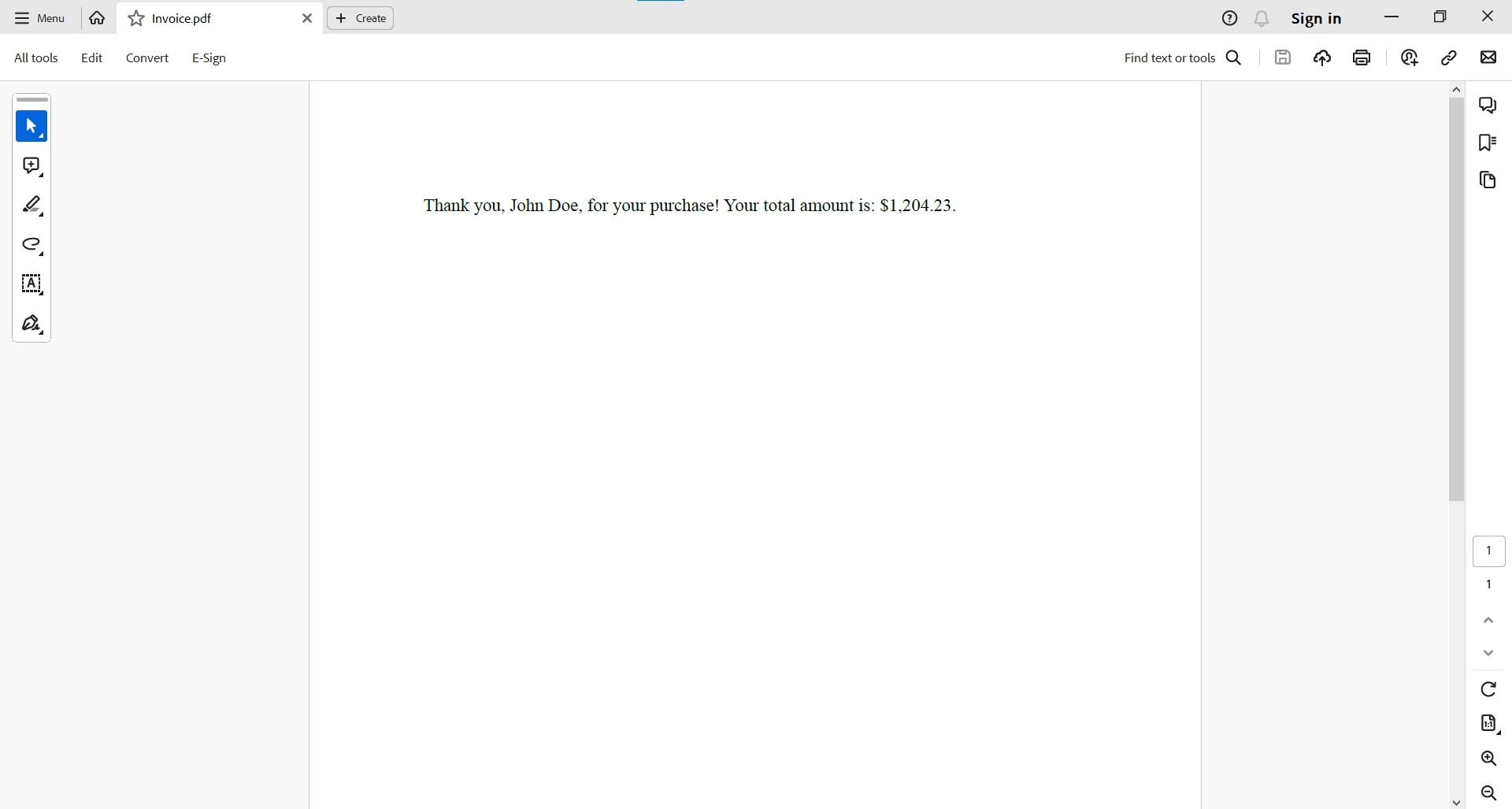
Für detailliertere Informationen zur Erstellung von PDFs mit HTML-String-Darstellung verweisen Sie bitte auf die IronPDF-Dokumentationsseite.
Abschluss
Zusammenfassend steht String.Format als fester Bestandteil der C#-Programmierung und bietet Entwicklern einen robusten Mechanismus zur Erstellung formatierter Zeichenfolgen. Ob es sich um numerische Werte, Datums-/Uhrzeitinformationen oder benutzerdefinierte Muster handelt, String.Format bietet eine vielseitige und effiziente Lösung. Wenn Sie die Vielzahl der C#-Entwicklungsmöglichkeiten erkunden, wird das Beherrschen der Kunst der Zeichenfolgenformatierung mit String.Format zweifellos Ihre Fähigkeit verbessern, klare, dynamische und optisch ansprechende Ausgaben in Ihren Anwendungen zu erstellen.
Entwickler können die leistungsstarken Formatierungsfunktionen von String.Format nutzen, um Inhalte dynamisch zu gestalten, die dann nahtlos in PDF-Dokumente mit IronPDF integriert werden können. Dieser kollaborative Ansatz ermöglicht es Entwicklern, stark angepasste und optisch ansprechende PDFs zu produzieren, wodurch eine Ebene der Raffinesse zu ihren Dokumentenerstellungsfähigkeiten hinzugefügt wird.
IronPDF bietet eine kostenlose Testversion der vollständigen Funktionen von IronPDF an, um dessen vollständige Funktionalität wie im kommerziellen Modus zu testen. Sie benötigen jedoch eine Lizenz für IronPDF, sobald der Testzeitraum abgelaufen ist.