using IronPdf;

// Disable local disk access or cross-origin requests
Installation.EnableWebSecurity = true;

// Instantiate Renderer
var renderer = new ChromePdfRenderer();

// Create a PDF from a HTML string using C#
var pdf = renderer.RenderHtmlAsPdf("<h1>Hello World</h1>");

// Export to a file or Stream
pdf.SaveAs("output.pdf");

// Advanced Example with HTML Assets
// Load external html assets: Images, CSS and JavaScript.
// An optional BasePath 'C:\site\assets\' is set as the file location to load assets from
var myAdvancedPdf = renderer.RenderHtmlAsPdf("<img src='icons/iron.png'>", @"C:\site\assets\");
myAdvancedPdf.SaveAs("html-with-assets.pdf");
using IronPdf;// Disable local disk access or cross-origin requestsInstallation.EnableWebSecurity = true;// Instantiate Renderervar renderer = new ChromePdfRenderer();// Create a PDF from a HTML string using C#var pdf = renderer.RenderHtmlAsPdf("<h1>Hello World</h1>");// Export to a file or Streampdf.SaveAs("output.pdf");// Advanced Example with HTML Assets// Load external html assets: Images, CSS and JavaScript.// An optional BasePath 'C:\site\assets\' is set as the file location to load assets fromvar myAdvancedPdf = renderer.RenderHtmlAsPdf("<img src='icons/iron.png'>", @"C:\site\assets\");myAdvancedPdf.SaveAs("html-with-assets.pdf");
Im Bereich der Programmierung dienen Schleifen als unverzichtbare Konstrukte, die die wiederholte Ausführung von Codeblöcken basierend auf angegebenen Bedingungen ermöglichen. Unter der Vielzahl von Schleifentypen, die in C# verfügbar sind, ragt die 'while'-Schleife durch ihre Einfachheit und Vielseitigkeit heraus. Mit ihrer einfachen Syntax und den leistungsstarken Fähigkeiten befähigt die 'while'-Schleife Entwickler, Code wiederholt iterativ auszuführen, solange eine angegebene Bedingung oder Iterationserklärung zutrifft.
Dieser umfassende Leitfaden taucht tief in die Feinheiten der [C# 'while' Schleife](https://www.w3schools.com/cs/cs_while_loop.php) ein und bietet ausführliche Erklärungen, praktische Codebeispiele und bewährte Praktiken, um Entwicklern zu helfen, dieses grundlegende Konstrukt zu beherrschen. Es wird auch diskutiert, wie man das Schlüsselwort `while` in C# verwendet, um PDF-Berichtsdaten mit [IronPDF](https://ironpdf.com) zu erstellen.
## 1. Verständnis der C# 'While'-Schleife
Im Kern führt die C# 'while'-Schleife einen Codeblock wiederholt aus, solange die angegebene Bedingung oder der Iterationswert als wahr bewertet wird. Die Syntax einer 'while'-Schleifenerklärung lautet wie folgt:
```csharp
// while loop
while (condition)
{
    // Code block to execute
}
```
Hier steht `condition` für den Booleschen Ausdruck oder die Schleifenvariable, die bestimmt, ob die Schleife weiter iterieren soll. Solange `condition` wahr bleibt, wird der in den 'while'-Schleifenklammern eingeschlossene Codeblock wiederholt ausgeführt. Sobald `condition` als falsch bewertet wird, wird die Schleife beendet und die Programmkontrollfluss bewegt sich zur Anweisung nach der 'while'-Schleife.
## 2. praktische Code-Beispiele
Lassen Sie uns praktische Beispiele untersuchen, um die Verwendung von 'while'-Schleifen in verschiedenen Szenarien zu veranschaulichen.
### Beispiel 1: Countdown-Timer
```csharp
// Countdown Timer Example
int count = 5;
// Loop while count is greater than 0
while (count > 0)
{
Console.WriteLine($"Countdown: {count}");
count--; // Decrement count
}
Console.WriteLine("Blastoff!");
```
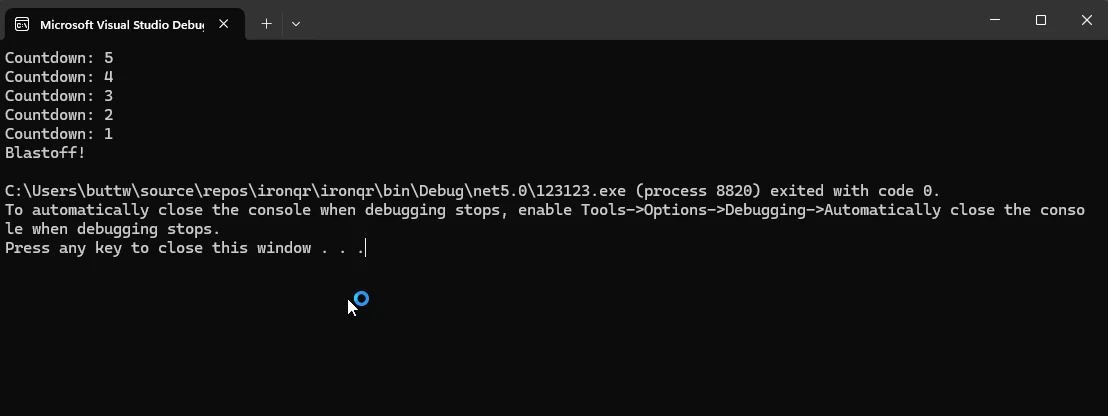
In diesem Beispiel iteriert die 'while'-Schleife, solange die `count`-Variable größer als 0 ist. `count` wird bei jeder Iteration um 1 verringert und der Countdown-Wert wird ausgegeben. Sobald `count` 0 wird, endet die Schleife und "Blastoff!" wird angezeigt.
##### AUSGABE
### Beispiel 2: Validierung von Benutzereingaben
```csharp
// User Input Validation Example
string userInput;
// Infinite loop until a valid input is received
while (true)
{
Console.Write("Enter a positive number: ");
userInput = Console.ReadLine();
// Try to parse input and check if it's a positive number
if (int.TryParse(userInput, out int number) && number > 0)
{
Console.WriteLine($"You entered: {number}");
break; // Exit loop if valid input
}
else
{
Console.WriteLine("Invalid input. Please try again.");
}
}
```
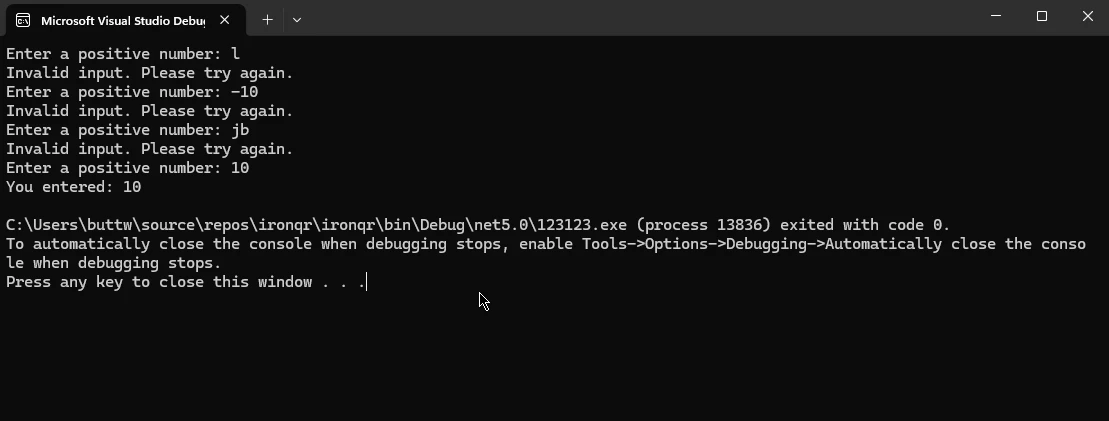
In diesem Beispiel läuft die 'while'-Schleife unendlich weiter, bis der Benutzer eine gültige positive Zahl eingibt. Sie fordert den Benutzer zur Eingabe auf, validiert die Eingabe und bricht aus der Schleife aus, wenn die Eingabe eine gültige positive Zahl ist.
##### Ausgabe
### Beispiel 3: Generierung von Fibonacci-Reihen
```csharp
// Generating Fibonacci Series Example
int a = 0, b = 1, nextTerm;
Console.WriteLine("Fibonacci Series:");
// Compute Fibonacci numbers up to 1000
while (a <= 1000)
{
Console.WriteLine(a); // Print current Fibonacci number
nextTerm = a + b; // Calculate next term
a = b; // Update a to the next term
b = nextTerm; // Update b to nextTerm
}
```
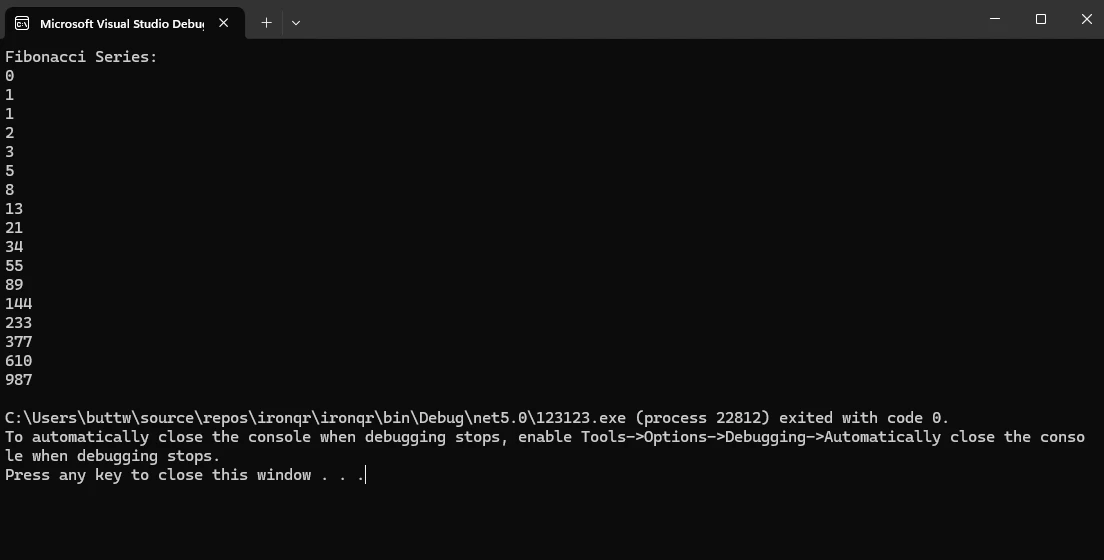
Dieses Code-Snippet generiert die Fibonacci-Reihe bis zu einem Maximalwert von 1000 mit einer 'while'-Schleife. Es initialisiert zwei Variablen `a` und `b` mit den ersten beiden Fibonacci-Zahlen und berechnet iterativ die nachfolgenden Terme, bis `a` 1000 überschreitet.
##### Ausgabe
## 3. Beste Praktiken für die Verwendung von C# 'While'-Schleifen
Während 'while'-Schleifen Flexibilität und Komfort bieten, ist es wichtig, sich an bewährte Praktiken zu halten, um effizienten und wartbaren Code zu gewährleisten:
1. **Sicherstellen der Beendigung:** Stellen Sie stets sicher, dass die Bedingung der Schleife irgendwann nicht mehr erfüllt ist, um Endlosschleifen zu vermeiden, die zum Einfrieren oder Absturz des Programms führen können.
2. **Schleifenvariablen initialisieren:** Initialisieren Sie die Schleifensteuerungsvariablen außerhalb der Schleife, um unerwartetes Verhalten oder Endlosschleifen aufgrund nicht initialisierter Variablen zu vermeiden.
3. **Schleifenvariablen aktualisieren:** Aktualisieren Sie die Schleifensteuerungsvariablen innerhalb des Schleifenkörpers, um den Fortschritt in Richtung der Abbruchbedingung der Schleife sicherzustellen.
4. **Verwenden Sie Break und Continue sparsam:** Während `break` und `continue`-Anweisungen nützlich sein können, kann übermäßiger Gebrauch zu verworrenem und schwer lesbarem Code führen. Erwägen Sie alternative Ansätze oder refaktorisieren Sie komplexe Schleifen, wenn `break` und `continue` stark genutzt werden.
5. **Schleifenbedingungen einfach halten:** Schleifenbedingungen sollten prägnant und unkompliziert sein, um die Lesbarkeit zu verbessern und das Risiko von Logikfehlern zu minimieren.
## 4. IronPDF
IronPDF ist eine Eckpfeiler-Lösung im Bereich der C#-Entwicklung und bietet Entwicklern ein leistungsstarkes Toolkit zum nahtlosen Erstellen, Bearbeiten und Verarbeiten von PDF-Dokumenten innerhalb ihrer Anwendungen. Mit seiner intuitiven API und umfassenden Feature-Set befähigt IronPDF Entwickler, PDF-Funktionen mühelos in ihre C#-Projekte zu integrieren und eine Vielzahl von Möglichkeiten in der Dokumentenerstellung, Berichterstellung und Inhaltsverteilung zu eröffnen.
### 4.1. Installieren von IronPDF
IronPDF kann einfach mit der NuGet-Paket-Manager-Konsole installiert werden. Führen Sie einfach den folgenden Befehl aus, um IronPDF zu installieren:
```shell
:ProductInstall
```
### 4.2. Integration von IronPDF mit C# 'While'-Schleifen
Betrachten wir ein Beispiel, bei dem wir eine 'while'-Schleife verwenden, um Daten dynamisch zu füllen und einen PDF-Bericht mit IronPDF zu erstellen.
```csharp
using IronPdf;
using System;
class Program
{
static void Main(string[] args)
{
// Initialize PDF Renderer
var pdfRenderer = new ChromePdfRenderer();
// Initialize HTML content
string htmlContent = "<h1>Dynamic Data Report</h1><ul>";
// Generate dynamic data using a while loop
int count = 1;
while (count <= 10)
{
htmlContent += $"<li>Data Point {count}</li>";
count++;
}
htmlContent += "</ul>";
// Render HTML content as PDF
var pdfOutput = pdfRenderer.RenderHtmlAsPdf(htmlContent);
// Save PDF to file
var outputPath = "Dynamic_Data_Report.pdf";
pdfOutput.SaveAs(outputPath);
// Display success message
Console.WriteLine($"PDF report generated successfully: {outputPath}");
}
}
```
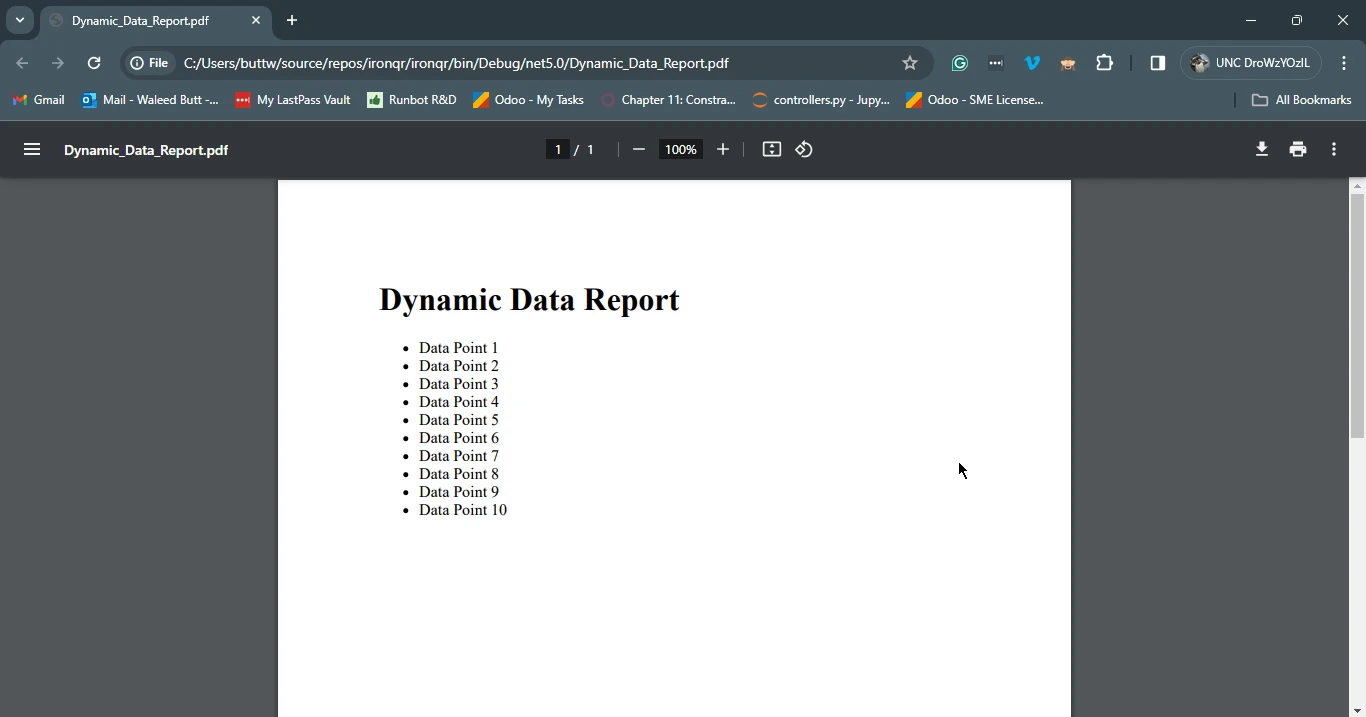
In diesem Beispiel initialisieren wir eine HTML-Zeichenfolge, die eine Überschrift und eine ungeordnete Liste enthält. Anschließend verwenden wir eine 'while'-Anweisung, um Listenelemente mit inkrementellen Datenpunkten dynamisch zu erzeugen. Der HTML-Inhalt wird als PDF mit IronPDF's `ChromePdfRenderer` gerendert und das resultierende PDF-Bericht wird in einer Datei mit dem Namen "Dynamic_Data_Report.pdf" gespeichert. Dies zeigt, wie 'while'-Schleifen nahtlos mit IronPDF integriert werden können, um dynamische und anpassbare PDF-Dokumente innerhalb von C#-Anwendungen zu erzeugen.
##### Ausgabe
## 5. Fazit
Abschließend ist die 'while'-Schleife ein grundlegendes Konstrukt in der C#-Programmierung, das Entwicklern einen flexiblen und leistungsstarken Mechanismus bietet, um Code iterativ basierend auf angegebenen Bedingungen auszuführen. Durch das Verstehen der Syntax, Verwendung und bewährten Praktiken im Zusammenhang mit 'while'-Schleifen können Entwickler dieses Konstrukt effektiv nutzen, um eine Vielzahl von Programmierherausforderungen anzugehen. Von einfachen Countdown-Timern bis hin zu komplexen Datenverarbeitungsaufgaben befähigen 'while'-Schleifen Entwickler, effizienten und wartbaren Code zu schreiben.
Darüber hinaus können 'while'-Schleifen in Kombination mit Tools wie [IronPDF](https://ironpdf.com) verwendet werden, um dynamische und optisch ansprechende PDF-Dokumente zu erzeugen und so die Fähigkeiten von C#-Anwendungen zu erweitern. Da Entwickler weiterhin die Möglichkeiten der C#-Programmierung erkunden, bleibt das Beherrschen der 'while'-Schleife essenziell für den Aufbau robuster und skalierbarer Softwarelösungen.
Die Dokumentation zu IronPDF ist auf der [IronPDF-Dokumentationsseite](/docs/) zu finden.
Im Bereich der Programmierung dienen Schleifen als unverzichtbare Konstrukte, die die wiederholte Ausführung von Codeblöcken basierend auf angegebenen Bedingungen ermöglichen. Unter der Vielzahl von Schleifentypen, die in C# verfügbar sind, ragt die 'while'-Schleife durch ihre Einfachheit und Vielseitigkeit heraus. Mit ihrer einfachen Syntax und den leistungsstarken Fähigkeiten befähigt die 'while'-Schleife Entwickler, Code wiederholt iterativ auszuführen, solange eine angegebene Bedingung oder Iterationserklärung zutrifft.
Dieser umfassende Leitfaden taucht tief in die Feinheiten der C# 'while' Schleife ein und bietet ausführliche Erklärungen, praktische Codebeispiele und bewährte Praktiken, um Entwicklern zu helfen, dieses grundlegende Konstrukt zu beherrschen. Es wird auch diskutiert, wie man das Schlüsselwort while in C# verwendet, um PDF-Berichtsdaten mit IronPDF zu erstellen.
1. Verständnis der C# 'While'-Schleife
Im Kern führt die C# 'while'-Schleife einen Codeblock wiederholt aus, solange die angegebene Bedingung oder der Iterationswert als wahr bewertet wird. Die Syntax einer 'while'-Schleifenerklärung lautet wie folgt:
// while loopwhile (condition){ // Code block to execute}
// while loop
while (condition)
{
    // Code block to execute
}
' while loopDo While condition ' Code block to executeLoop
' while loop
Do While condition
	' Code block to execute
Loop
Hier steht condition für den Booleschen Ausdruck oder die Schleifenvariable, die bestimmt, ob die Schleife weiter iterieren soll. Solange condition wahr bleibt, wird der in den 'while'-Schleifenklammern eingeschlossene Codeblock wiederholt ausgeführt. Sobald condition als falsch bewertet wird, wird die Schleife beendet und die Programmkontrollfluss bewegt sich zur Anweisung nach der 'while'-Schleife.
2. praktische Code-Beispiele
Lassen Sie uns praktische Beispiele untersuchen, um die Verwendung von 'while'-Schleifen in verschiedenen Szenarien zu veranschaulichen.
Beispiel 1: Countdown-Timer
// Countdown Timer Exampleint count = 5;// Loop while count is greater than 0while (count > 0){Console.WriteLine($"Countdown: {count}"); count--; // Decrement count}Console.WriteLine("Blastoff!");
// Countdown Timer Example
int count = 5;

// Loop while count is greater than 0
while (count > 0)
{
    Console.WriteLine($"Countdown: {count}");
    count--; // Decrement count
}

Console.WriteLine("Blastoff!");
' Countdown Timer ExampleDim count AsInteger = 5' Loop while count is greater than 0Do While count > 0Console.WriteLine($"Countdown: {count}") count -= 1 ' Decrement countLoopConsole.WriteLine("Blastoff!")
' Countdown Timer Example
Dim count As Integer = 5

' Loop while count is greater than 0
Do While count > 0
	Console.WriteLine($"Countdown: {count}")
	count -= 1 ' Decrement count
Loop

Console.WriteLine("Blastoff!")
In diesem Beispiel iteriert die 'while'-Schleife, solange die count-Variable größer als 0 ist. count wird bei jeder Iteration um 1 verringert und der Countdown-Wert wird ausgegeben. Sobald count 0 wird, endet die Schleife und "Blastoff!" wird angezeigt.
AUSGABE
Beispiel 2: Validierung von Benutzereingaben
// User Input Validation Examplestring userInput;// Infinite loop until a valid input is receivedwhile (true){Console.Write("Enter a positive number: "); userInput = Console.ReadLine(); // Try to parse input and check if it's a positive number if (int.TryParse(userInput, out int number) && number > 0) {Console.WriteLine($"You entered: {number}"); break; // Exit loop if valid input } else {Console.WriteLine("Invalid input. Please try again."); }}
// User Input Validation Example
string userInput;

// Infinite loop until a valid input is received
while (true)
{
    Console.Write("Enter a positive number: ");
    userInput = Console.ReadLine();

    // Try to parse input and check if it's a positive number
    if (int.TryParse(userInput, out int number) && number > 0)
    {
        Console.WriteLine($"You entered: {number}");
        break; // Exit loop if valid input
    }
    else
    {
        Console.WriteLine("Invalid input. Please try again.");
    }
}
' User Input Validation ExampleDim userInput AsString' Infinite loop until a valid input is receivedDoConsole.Write("Enter a positive number: ") userInput = Console.ReadLine() ' Try to parse input and check if it's a positive number Dim number AsInteger IfInteger.TryParse(userInput, number) AndAlso number > 0 ThenConsole.WriteLine($"You entered: {number}") Exit Do ' Exit loop if valid input ElseConsole.WriteLine("Invalid input. Please try again.") End IfLoop
' User Input Validation Example
Dim userInput As String

' Infinite loop until a valid input is received
Do
	Console.Write("Enter a positive number: ")
	userInput = Console.ReadLine()

	' Try to parse input and check if it's a positive number
	Dim number As Integer
	If Integer.TryParse(userInput, number) AndAlso number > 0 Then
		Console.WriteLine($"You entered: {number}")
		Exit Do ' Exit loop if valid input
	Else
		Console.WriteLine("Invalid input. Please try again.")
	End If
Loop
In diesem Beispiel läuft die 'while'-Schleife unendlich weiter, bis der Benutzer eine gültige positive Zahl eingibt. Sie fordert den Benutzer zur Eingabe auf, validiert die Eingabe und bricht aus der Schleife aus, wenn die Eingabe eine gültige positive Zahl ist.
Ausgabe
Beispiel 3: Generierung von Fibonacci-Reihen
// Generating Fibonacci Series Exampleint a = 0, b = 1, nextTerm;Console.WriteLine("Fibonacci Series:");// Compute Fibonacci numbers up to 1000while (a <= 1000){Console.WriteLine(a); // Print current Fibonacci number nextTerm = a + b; // Calculate next term a = b; // Update a to the next term b = nextTerm; // Update b to nextTerm}
// Generating Fibonacci Series Example
int a = 0, b = 1, nextTerm;

Console.WriteLine("Fibonacci Series:");

// Compute Fibonacci numbers up to 1000
while (a <= 1000)
{
    Console.WriteLine(a); // Print current Fibonacci number
    nextTerm = a + b; // Calculate next term
    a = b; // Update a to the next term
    b = nextTerm; // Update b to nextTerm
}
' Generating Fibonacci Series ExampleDim a AsInteger = 0, b AsInteger = 1, nextTerm AsIntegerConsole.WriteLine("Fibonacci Series:")' Compute Fibonacci numbers up to 1000Do While a <= 1000Console.WriteLine(a) ' Print current Fibonacci number nextTerm = a + b ' Calculate next term a = b ' Update a to the next term b = nextTerm ' Update b to nextTermLoop
' Generating Fibonacci Series Example
Dim a As Integer = 0, b As Integer = 1, nextTerm As Integer

Console.WriteLine("Fibonacci Series:")

' Compute Fibonacci numbers up to 1000
Do While a <= 1000
	Console.WriteLine(a) ' Print current Fibonacci number
	nextTerm = a + b ' Calculate next term
	a = b ' Update a to the next term
	b = nextTerm ' Update b to nextTerm
Loop
Dieses Code-Snippet generiert die Fibonacci-Reihe bis zu einem Maximalwert von 1000 mit einer 'while'-Schleife. Es initialisiert zwei Variablen a und b mit den ersten beiden Fibonacci-Zahlen und berechnet iterativ die nachfolgenden Terme, bis a 1000 überschreitet.
Ausgabe
3. Beste Praktiken für die Verwendung von C# 'While'-Schleifen
Während 'while'-Schleifen Flexibilität und Komfort bieten, ist es wichtig, sich an bewährte Praktiken zu halten, um effizienten und wartbaren Code zu gewährleisten:
Sicherstellen der Beendigung: Stellen Sie stets sicher, dass die Bedingung der Schleife irgendwann nicht mehr erfüllt ist, um Endlosschleifen zu vermeiden, die zum Einfrieren oder Absturz des Programms führen können.
Schleifenvariablen initialisieren: Initialisieren Sie die Schleifensteuerungsvariablen außerhalb der Schleife, um unerwartetes Verhalten oder Endlosschleifen aufgrund nicht initialisierter Variablen zu vermeiden.
Schleifenvariablen aktualisieren: Aktualisieren Sie die Schleifensteuerungsvariablen innerhalb des Schleifenkörpers, um den Fortschritt in Richtung der Abbruchbedingung der Schleife sicherzustellen.
Verwenden Sie Break und Continue sparsam: Während break und continue-Anweisungen nützlich sein können, kann übermäßiger Gebrauch zu verworrenem und schwer lesbarem Code führen. Erwägen Sie alternative Ansätze oder refaktorisieren Sie komplexe Schleifen, wenn break und continue stark genutzt werden.
Schleifenbedingungen einfach halten: Schleifenbedingungen sollten prägnant und unkompliziert sein, um die Lesbarkeit zu verbessern und das Risiko von Logikfehlern zu minimieren.
4. IronPDF
IronPDF ist eine Eckpfeiler-Lösung im Bereich der C#-Entwicklung und bietet Entwicklern ein leistungsstarkes Toolkit zum nahtlosen Erstellen, Bearbeiten und Verarbeiten von PDF-Dokumenten innerhalb ihrer Anwendungen. Mit seiner intuitiven API und umfassenden Feature-Set befähigt IronPDF Entwickler, PDF-Funktionen mühelos in ihre C#-Projekte zu integrieren und eine Vielzahl von Möglichkeiten in der Dokumentenerstellung, Berichterstellung und Inhaltsverteilung zu eröffnen.
4.1. Installieren von IronPDF
IronPDF kann einfach mit der NuGet-Paket-Manager-Konsole installiert werden. Führen Sie einfach den folgenden Befehl aus, um IronPDF zu installieren:
PM > Install-Package IronPdf
Install-Package IronPdf
4.2. Integration von IronPDF mit C# 'While'-Schleifen
Betrachten wir ein Beispiel, bei dem wir eine 'while'-Schleife verwenden, um Daten dynamisch zu füllen und einen PDF-Bericht mit IronPDF zu erstellen.
using IronPdf;using System;class Program{ static voidMain(string[] args) { // Initialize PDF Renderer var pdfRenderer = new ChromePdfRenderer(); // Initialize HTML content string htmlContent = "<h1>Dynamic Data Report</h1><ul>"; // Generate dynamic data using a while loop int count = 1; while (count <= 10) { htmlContent += $"<li>Data Point {count}</li>"; count++; } htmlContent += "</ul>"; // Render HTML content as PDF var pdfOutput = pdfRenderer.RenderHtmlAsPdf(htmlContent); // Save PDF to file var outputPath = "Dynamic_Data_Report.pdf"; pdfOutput.SaveAs(outputPath); // Display success messageConsole.WriteLine($"PDF report generated successfully: {outputPath}"); }}
using IronPdf;
using System;

class Program
{
    static void Main(string[] args)
    {
        // Initialize PDF Renderer
        var pdfRenderer = new ChromePdfRenderer();

        // Initialize HTML content
        string htmlContent = "<h1>Dynamic Data Report</h1><ul>";

        // Generate dynamic data using a while loop
        int count = 1;
        while (count <= 10)
        {
            htmlContent += $"<li>Data Point {count}</li>";
            count++;
        }
        htmlContent += "</ul>";

        // Render HTML content as PDF
        var pdfOutput = pdfRenderer.RenderHtmlAsPdf(htmlContent);

        // Save PDF to file
        var outputPath = "Dynamic_Data_Report.pdf";
        pdfOutput.SaveAs(outputPath);

        // Display success message
        Console.WriteLine($"PDF report generated successfully: {outputPath}");
    }
}
ImportsIronPdfImportsSystemFriend Class ProgramShared Sub Main(ByVal args() AsString) ' Initialize PDF Renderer Dim pdfRenderer = New ChromePdfRenderer() ' Initialize HTML content Dim htmlContent AsString = "<h1>Dynamic Data Report</h1><ul>" ' Generate dynamic data using a while loop Dim count AsInteger = 1 Do While count <= 10 htmlContent &= $"<li>Data Point {count}</li>" count += 1 Loop htmlContent &= "</ul>" ' Render HTML content as PDF Dim pdfOutput = pdfRenderer.RenderHtmlAsPdf(htmlContent) ' Save PDF to file Dim outputPath = "Dynamic_Data_Report.pdf" pdfOutput.SaveAs(outputPath) ' Display success messageConsole.WriteLine($"PDF report generated successfully: {outputPath}") End SubEnd Class
Imports IronPdf
Imports System

Friend Class Program
	Shared Sub Main(ByVal args() As String)
		' Initialize PDF Renderer
		Dim pdfRenderer = New ChromePdfRenderer()

		' Initialize HTML content
		Dim htmlContent As String = "<h1>Dynamic Data Report</h1><ul>"

		' Generate dynamic data using a while loop
		Dim count As Integer = 1
		Do While count <= 10
			htmlContent &= $"<li>Data Point {count}</li>"
			count += 1
		Loop
		htmlContent &= "</ul>"

		' Render HTML content as PDF
		Dim pdfOutput = pdfRenderer.RenderHtmlAsPdf(htmlContent)

		' Save PDF to file
		Dim outputPath = "Dynamic_Data_Report.pdf"
		pdfOutput.SaveAs(outputPath)

		' Display success message
		Console.WriteLine($"PDF report generated successfully: {outputPath}")
	End Sub
End Class
In diesem Beispiel initialisieren wir eine HTML-Zeichenfolge, die eine Überschrift und eine ungeordnete Liste enthält. Anschließend verwenden wir eine 'while'-Anweisung, um Listenelemente mit inkrementellen Datenpunkten dynamisch zu erzeugen. Der HTML-Inhalt wird als PDF mit IronPDF's ChromePdfRenderer gerendert und das resultierende PDF-Bericht wird in einer Datei mit dem Namen "Dynamic_Data_Report.pdf" gespeichert. Dies zeigt, wie 'while'-Schleifen nahtlos mit IronPDF integriert werden können, um dynamische und anpassbare PDF-Dokumente innerhalb von C#-Anwendungen zu erzeugen.
Ausgabe
5. Fazit
Abschließend ist die 'while'-Schleife ein grundlegendes Konstrukt in der C#-Programmierung, das Entwicklern einen flexiblen und leistungsstarken Mechanismus bietet, um Code iterativ basierend auf angegebenen Bedingungen auszuführen. Durch das Verstehen der Syntax, Verwendung und bewährten Praktiken im Zusammenhang mit 'while'-Schleifen können Entwickler dieses Konstrukt effektiv nutzen, um eine Vielzahl von Programmierherausforderungen anzugehen. Von einfachen Countdown-Timern bis hin zu komplexen Datenverarbeitungsaufgaben befähigen 'while'-Schleifen Entwickler, effizienten und wartbaren Code zu schreiben.
Darüber hinaus können 'while'-Schleifen in Kombination mit Tools wie IronPDF verwendet werden, um dynamische und optisch ansprechende PDF-Dokumente zu erzeugen und so die Fähigkeiten von C#-Anwendungen zu erweitern. Da Entwickler weiterhin die Möglichkeiten der C#-Programmierung erkunden, bleibt das Beherrschen der 'while'-Schleife essenziell für den Aufbau robuster und skalierbarer Softwarelösungen.
Jacob Mellor ist Chief Technology Officer bei Iron Software und ein visionärer Ingenieur, der Pionierarbeit in der C# PDF-Technologie leistet. Als der ursprüngliche Entwickler hinter der Kern-Codebasis von Iron Software hat er die Produktarchitektur des Unternehmens seit seiner Gründung geprägt und es zusammen mit CEO Cameron Rimington in ein Unternehmen mit mehr als 50 Mitarbeitern verwandelt, das die NASA, Tesla und globale Regierungsbehörden beliefert.