using IronPdf;

// Disable local disk access or cross-origin requests
Installation.EnableWebSecurity = true;

// Instantiate Renderer
var renderer = new ChromePdfRenderer();

// Create a PDF from a HTML string using C#
var pdf = renderer.RenderHtmlAsPdf("<h1>Hello World</h1>");

// Export to a file or Stream
pdf.SaveAs("output.pdf");

// Advanced Example with HTML Assets
// Load external html assets: Images, CSS and JavaScript.
// An optional BasePath 'C:\site\assets\' is set as the file location to load assets from
var myAdvancedPdf = renderer.RenderHtmlAsPdf("<img src='icons/iron.png'>", @"C:\site\assets\");
myAdvancedPdf.SaveAs("html-with-assets.pdf");
using IronPdf;// Disable local disk access or cross-origin requestsInstallation.EnableWebSecurity = true;// Instantiate Renderervar renderer = new ChromePdfRenderer();// Create a PDF from a HTML string using C#var pdf = renderer.RenderHtmlAsPdf("<h1>Hello World</h1>");// Export to a file or Streampdf.SaveAs("output.pdf");// Advanced Example with HTML Assets// Load external html assets: Images, CSS and JavaScript.// An optional BasePath 'C:\site\assets\' is set as the file location to load assets fromvar myAdvancedPdf = renderer.RenderHtmlAsPdf("<img src='icons/iron.png'>", @"C:\site\assets\");myAdvancedPdf.SaveAs("html-with-assets.pdf");
PM >Install-Package IronPdf
Install-Package IronPdf
ENTWICKLER-UPDATES
Swashbuckle ASP .NET Core (Wie es für Entwickler funktioniert)
Swashbuckle ist ein C# .NET Core [NuGet](https://www.nuget.org/)-Paket, das hilft, RESTful Web-APIs automatisch zu dokumentieren. In diesem Blog werden wir die Swashbuckle ASP.NET Core und [IronPDF Installationsanweisungen](/docs/#installation) NuGet-Pakete erkunden, die die moderne Entwicklung von ASP.NET Core Web-APIs ermöglichen. Zusammen bieten sie eine Vielzahl von Funktionen, die mit minimalem Code erreicht werden können.
Die API-Dokumentationsseiten werden mit dem Swagger UI-Tool angezeigt, das eine `swagger.json`-Datei verwendet, die aus dem Web-API-Projekt generiert wurde. Das generierte JSON-Dokument folgt dem Open API-Standard. Swashbuckle ist als NuGet-Paket [Swashbuckle.AspNetCore](https://www.nuget.org/packages/Swashbuckle.AspNetCore) verfügbar, das bei Installation und Konfiguration automatisch das Swagger JSON freilegt. Das Swagger UI-Tool liest die Swagger JSON-Datei, die aus XML-Kommentaren generiert wird, die auf den APIs geschrieben sind. Zusätzlich kann eine XML-Dokumentationsdatei erstellt werden, indem sie in der Projektdatei aktiviert wird. XML-Kommentare werden in eine XML-Dokumentationsdatei konvertiert, aus der das Swagger JSON generiert wird. Dann liest die Swagger-Middleware das JSON und stellt Swagger JSON-Endpunkte bereit.
## Implementierung in einem .NET Core Web API-Projekt
Lassen Sie uns mit einem Web-API-Projekt beginnen:
```shell
dotnet new webapi -n SwashbuckleDemo
cd SwashbuckleDemo
dotnet build
dotnet add package Swashbuckle.AspNetCore --version 6.5.0
dotnet build
```
Hier erstellen wir ein Web-API-Projekt namens "SwashbuckleDemo" und installieren dann das Swashbuckle-Paket in das .NET Core Web-API-Projekt über die Paket-Manager-Konsole.
## Swagger-Middleware konfigurieren
Konfigurieren Sie die Swagger-Dienste in der `Startup.cs`-Datei.
```csharp
using System.Reflection;
using Microsoft.Extensions.DependencyInjection;
using Microsoft.AspNetCore.Builder;
public class Startup
{
public void ConfigureServices(IServiceCollection services)
{
// Other service configurations...
// Register the Swagger generator
services.AddSwaggerGen(c =>
{
c.SwaggerDoc("v1", new OpenApiInfo { Title = "My API", Version = "v1" });
// Optionally, include XML comments for additional information
var xmlFile = $"{Assembly.GetExecutingAssembly().GetName().Name}.xml";
var xmlPath = Path.Combine(AppContext.BaseDirectory, xmlFile);
c.IncludeXmlComments(xmlPath);
});
}
public void Configure(IApplicationBuilder app, IHostingEnvironment env)
{
// Other app configurations...
// Enable middleware to serve generated Swagger as a JSON endpoint.
app.UseSwagger();
// Enable Swagger UI (HTML, JS, CSS, etc.), specifying the Swagger JSON endpoint.
app.UseSwaggerUI(c =>
{
c.SwaggerEndpoint("/swagger/v1/swagger.json", "My API V1");
});
}
}
```
Fügen Sie einen Controller für todo-Liste-APIs hinzu:
```csharp
using Microsoft.AspNetCore.Http.HttpResults;
using Microsoft.AspNetCore.Builder;
using Microsoft.EntityFrameworkCore;
using Microsoft.AspNetCore.Mvc;
using System.Threading.Tasks;
// Example to define an entity class
public class Todo
{
public int Id { get; set; }
public string Name { get; set; }
public bool IsComplete { get; set; }
}
// Example to define a DbContext class
public class TodoDb : DbContext
{
public DbSet<Todo> Todos => Set<Todo>();
}
var builder = WebApplication.CreateBuilder(args);
var app = builder.Build();
app.MapGet("/", () => "SwashbuckleDemo!");
app.MapGet("/todoitems", async (TodoDb db) =>
await db.Todos.ToListAsync());
app.MapGet("/todoitems/complete", async (TodoDb db) =>
await db.Todos.Where(t => t.IsComplete).ToListAsync());
app.MapGet("/todoitems/{id}", async (int id, TodoDb db) =>
await db.Todos.FindAsync(id) is Todo todo
? Results.Ok(todo)
: Results.NotFound());
app.MapPost("/todoitems", async (Todo todo, TodoDb db) =>
{
db.Todos.Add(todo);
await db.SaveChangesAsync();
return Results.Created($"/todoitems/{todo.Id}", todo);
});
app.MapPut("/todoitems/{id}", async (int id, Todo inputTodo, TodoDb db) =>
{
var todo = await db.Todos.FindAsync(id);
if (todo is null) return Results.NotFound();
todo.Name = inputTodo.Name;
todo.IsComplete = inputTodo.IsComplete;
await db.SaveChangesAsync();
return Results.NoContent();
});
app.MapDelete("/todoitems/{id}", async (int id, TodoDb db) =>
{
if (await db.Todos.FindAsync(id) is Todo todo)
{
db.Todos.Remove(todo);
await db.SaveChangesAsync();
return Results.Ok(todo);
}
return Results.NotFound();
});
app.Run();
```
Ein Controller kann auch wie unten hinzugefügt werden:
```csharp
using Microsoft.AspNetCore.Mvc;
using Microsoft.Extensions.Logging;
using System.Collections.Generic;
using System;
using System.Linq;
namespace RestFullMinimalApi.Controllers
{
[ApiController]
[Route("[controller]")]
public class WeatherForecastController : ControllerBase
{
private static readonly string[] Summaries = new[]
{
"Freezing", "Bracing", "Chilly", "Cool", "Mild", "Warm", "Balmy", "Hot", "Sweltering", "Scorching"
};
private readonly ILogger<WeatherForecastController> _logger;
public WeatherForecastController(ILogger<WeatherForecastController> logger)
{
_logger = logger;
}
/// <summary>
/// Retrieves WeatherForecast
/// </summary>
/// <remarks>Awesomeness!</remarks>
/// <response code="200">Retrieved</response>
/// <response code="404">Not found</response>
/// <response code="500">Oops! Can't lookup your request right now</response>
[HttpGet(Name = "GetWeatherForecast")]
public IEnumerable<WeatherForecast> Get()
{
return Enumerable.Range(1, 5).Select(index => new WeatherForecast
{
Date = DateTime.Now.AddDays(index),
TemperatureC = Random.Shared.Next(-20, 55),
Summary = Summaries[Random.Shared.Next(Summaries.Length)]
})
.ToArray();
}
}
public class WeatherForecast
{
public DateTime Date { get; set; }
public int TemperatureC { get; set; }
public string Summary { get; set; }
}
}
```
Der obige Code ist auf [GitHub - Swashbuckle Demo](https://github.com/santoshkaranam/swashbuckle-demo) verfügbar.
## Swashbuckle bietet die folgenden Funktionen
### Swagger UI-Werkzeug
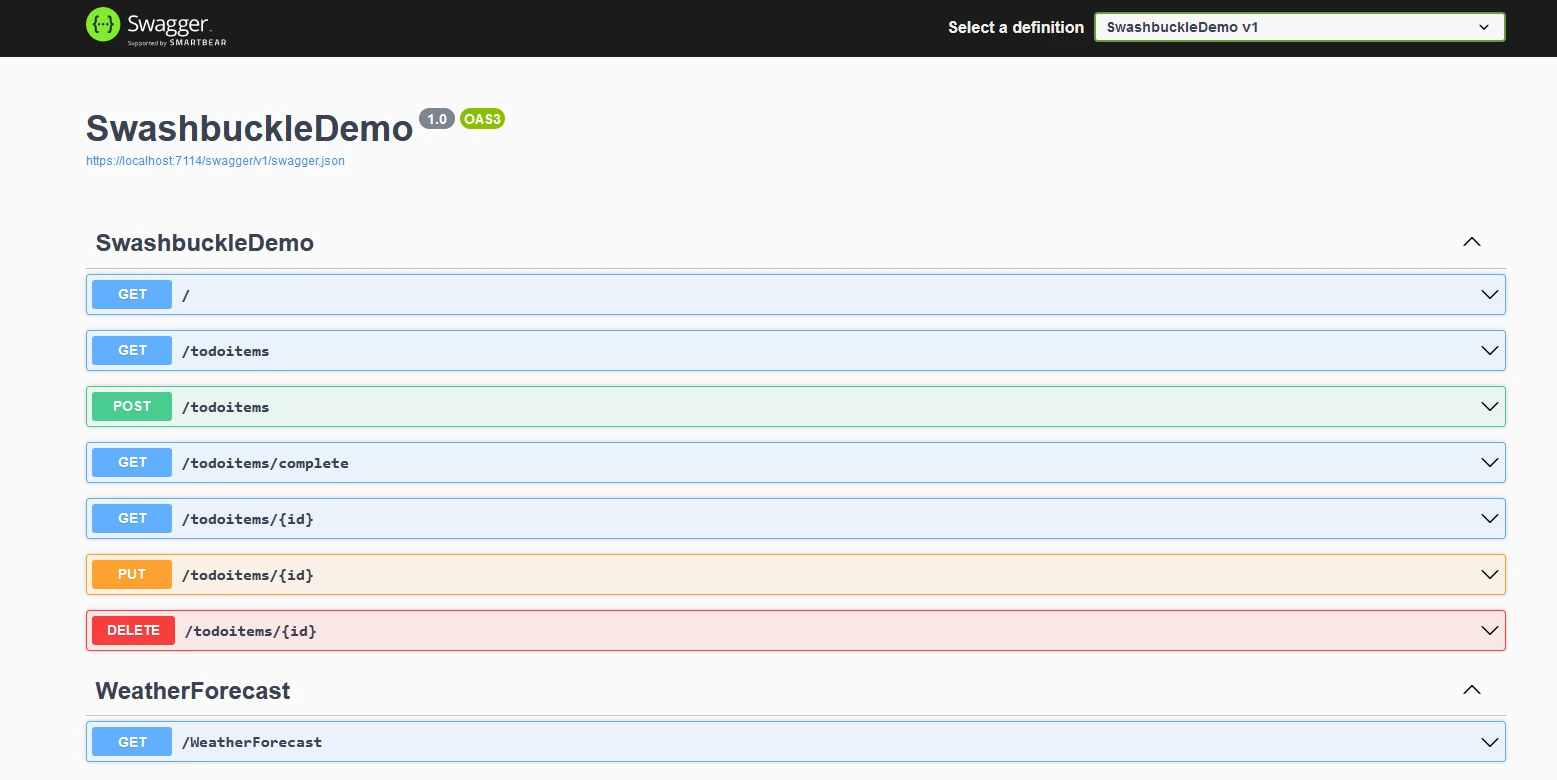
Swagger UI ist von der Basis-URL der Web-API-Anwendung unter "/swagger/index.html" verfügbar. Es listet alle REST-APIs aus dem Code auf. Der Swagger-Generator liest die JSON-Datei und füllt die Benutzeroberfläche aus.
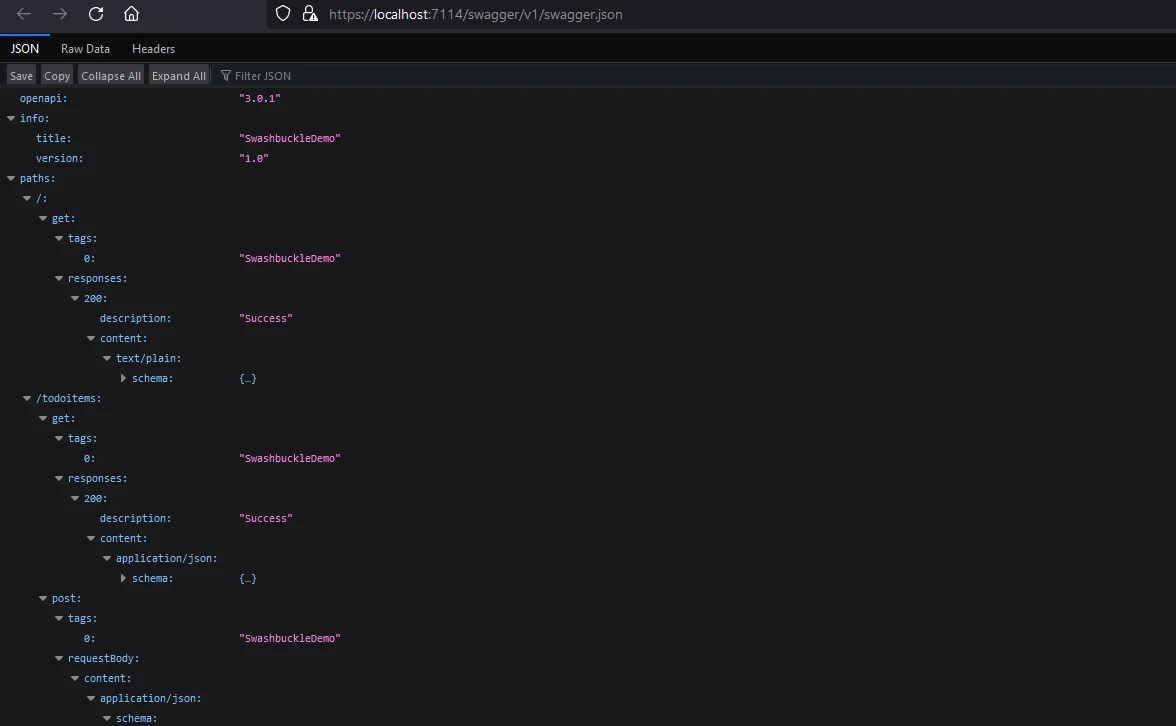
### Swagger JSON
Swashbuckle.AspNetCore generiert automatisch die Swagger JSON-Datei, die Informationen über die API-Struktur enthält, einschließlich Details wie Endpunkte, Anforderungs- und Antworttypen und mehr. Diese JSON-Datei kann von anderen Werkzeugen und Diensten verwendet werden, die den Swagger/OpenAPI-Standard unterstützen.
Die Swagger JSON-Datei ist von der Basis-URL der Web-API-Anwendung unter "/swagger/v1/swagger.json" verfügbar.
### Code-Anmerkungen
Entwickler können XML-Kommentare und Attribute in ihren [ASP.NET](https://dotnet.microsoft.com/en-us/apps/aspnet) Core-Controllern verwenden, um zusätzliche Informationen für die Swagger-Dokumentation bereitzustellen. Dies umfasst Beschreibungen, Beispiele und andere Metadaten, die die generierte Swagger-Dokumentation verbessern.
```csharp
[ApiController]
[Route("[controller]")]
public class WeatherForecastController : ControllerBase
{
private static readonly string[] Summaries = new[]
{
"Freezing", "Bracing", "Chilly", "Cool", "Mild", "Warm", "Balmy", "Hot", "Sweltering", "Scorching"
};
private readonly ILogger<WeatherForecastController> _logger;
public WeatherForecastController(ILogger<WeatherForecastController> logger)
{
_logger = logger;
}
/// <summary>
/// Retrieves WeatherForecast
/// </summary>
/// <remarks>Awesomeness!</remarks>
/// <response code="200">Retrieved</response>
/// <response code="404">Not found</response>
/// <response code="500">Oops! Can't lookup your request right now</response>
[HttpGet(Name = "GetWeatherForecast")]
public IEnumerable<WeatherForecast> Get()
{
return Enumerable.Range(1, 5).Select(index => new WeatherForecast
{
Date = DateTime.Now.AddDays(index),
TemperatureC = Random.Shared.Next(-20, 55),
Summary = Summaries[Random.Shared.Next(Summaries.Length)]
})
.ToArray();
}
}
```
### Konfigurationsoptionen
Swashbuckle.AspNetCore bietet verschiedene Konfigurationsoptionen, um anzupassen, wie die Swagger-Dokumentation generiert wird. Entwickler können steuern, welche APIs dokumentiert werden, Namenskonventionen konfigurieren und andere Einstellungen anpassen.
Hier sind einige der wichtigsten Konfigurationsoptionen, die von Swashbuckle.AspNetCore bereitgestellt werden:
#### SwaggerGen Optionen
```csharp
c.SwaggerDoc("v1", new OpenApiInfo { Title = "My API", Version = "v1" });
```
Diese Zeile gibt die Swagger-Dokumentversion an und enthält Metadaten wie Titel und Version Ihrer API.
```csharp
c.IncludeXmlComments(xmlPath);
```
Diese Option ermöglicht es Ihnen, XML-Kommentare aus Ihrem Code einzubeziehen, um zusätzliche Informationen in der Swagger-Dokumentation bereitzustellen. Die `xmlPath`-Variable sollte auf den Speicherort Ihrer XML-Kommentardatei verweisen.
```csharp
c.DescribeAllParametersInCamelCase();
```
Diese Option konfiguriert den Swagger-Generator, Parametername in camelCase zu verwenden.
```csharp
c.OperationFilter<CustomOperationFilter>();
```
Sie können benutzerdefinierte Operationsfilter registrieren, um die Swagger-Dokumentation für bestimmte Operationen zu ändern. `CustomOperationFilter` ist eine Klasse, die `IOperationFilter` implementiert.
#### Swagger UI Optionen
```csharp
c.SwaggerEndpoint("/swagger/v1/swagger.json", "My API V1");
```
Diese Zeile konfiguriert das Swagger UI, um Dokumentation anzuzeigen. Der erste Parameter ist die URL der Swagger JSON-Datei und der zweite Parameter ist ein benutzerfreundlicher Name für die API-Version.
```csharp
c.RoutePrefix = "swagger";
```
Sie können das Routen-Präfix für das Swagger UI festlegen. In diesem Beispiel wird das Swagger UI unter /swagger verfügbar sein.
```csharp
c.DocExpansion(DocExpansion.None);
```
Diese Option steuert, wie das Swagger UI die API-Dokumentation anzeigt. `DocExpansion.None` klappt standardmäßig alle Operationen ein.
#### SwaggerOptionen
```csharp
c.SerializeAsV2 = true;
```
Diese Option gibt an, ob das Swagger-Dokument im Format Version 2.0 (`true`) oder 3.0 (`false`) serialisiert werden soll. Stellen Sie es auf `true` ein, wenn Sie Swagger 2.0 verwenden möchten.
```csharp
c.DisplayOperationId();
```
Diese Option zeigt die Vorgangs-ID im Swagger UI an, was für das Debugging und das Verstehen der Architektur Ihrer API nützlich sein kann.
```csharp
c.OAuthClientId("swagger-ui");
```
Wenn Ihre API OAuth-Authentifizierung verwendet, können Sie die OAuth-Client-ID für Swagger UI konfigurieren.
Die Swashbuckle.AspNetCore-Bibliothek ist anpassbar; kombinieren Sie Optionen und Filter, um die Swagger-Dokumentation anzupassen. Die Swashbuckle.AspNetCore-Bibliothek ist hochgradig anpassbar, und Sie können die Swagger-Dokumentation auf Ihre speziellen Bedürfnisse zugeschnitten durch die Kombination verschiedener Optionen und Filter abstimmen. Bitte immer auf die offizielle Dokumentation oder IntelliSense in Ihrer Entwicklungsumgebung zurückgreifen, um die aktuellsten und umfassendsten Informationen zu den verfügbaren Optionen zu erhalten.
# Einführung in IronPDF
[IronPDF-Produktübersicht](/docs/) ist die C# PDF-Bibliothek von [Iron Software-Website](https://ironsoftware.com/), die hilft, PDF-Dokumente zu lesen und zu erstellen. Es kann formatierten Dokumente mit Stilinformationen problemlos in PDF umwandeln. IronPDF kann mühelos PDFs aus HTML-Inhalten generieren. Es kann HTML-Inhalte von einer URL herunterladen und dann PDFs generieren.
IronPDF ist ein großartiges Tool zum Konvertieren von Webseiten, URLs und [HTML in PDFs](/tutorials/html-to-pdf/), die die Quelle perfekt replizieren. Es ist ideal, um PDFs von Online-Inhalten wie Berichten und Rechnungen zu erstellen und mühelos PDF-Versionen jeder Webseite zu erzeugen.
```csharp
using IronPdf;
class Program
{
static void Main(string[] args)
{
var renderer = new ChromePdfRenderer();
// 1. Convert HTML String to PDF
var htmlContent = "<h1>Hello, IronPDF!</h1><p>This is a PDF from an HTML string.</p>";
var pdfFromHtmlString = renderer.RenderHtmlAsPdf(htmlContent);
pdfFromHtmlString.SaveAs("HTMLStringToPDF.pdf");
// 2. Convert HTML File to PDF
var htmlFilePath = "path_to_your_html_file.html"; // Specify the path to your HTML file
var pdfFromHtmlFile = renderer.RenderHtmlFileAsPdf(htmlFilePath);
pdfFromHtmlFile.SaveAs("HTMLFileToPDF.pdf");
// 3. Convert URL to PDF
var url = "http://ironpdf.com"; // Specify the URL
var pdfFromUrl = renderer.RenderUrlAsPdf(url);
pdfFromUrl.SaveAs("URLToPDF.pdf");
}
}
```
## Installation
[Installieren Sie IronPDF über NuGet](https://www.nuget.org/packages/IronPdf/) mit den [NuGet Paketverwaltungsdetails](https://www.nuget.org/) oder der [Visual Studio-Installationsanleitung](https://visualstudio.microsoft.com/) Paketverwaltungs-Konsole.
Geben Sie in die Paketverwaltungs-Konsole den Befehl ein:
```shell
:ProductInstall
```
**Verwendung von Visual Studio**

Nun, lassen Sie uns unsere Anwendung ändern, um die Funktionalität hinzuzufügen, Website-Inhalte als PDF-Datei herunterzuladen.
```csharp
using Microsoft.AspNetCore.Mvc;
using Microsoft.Extensions.Logging;
using IronPdf;
using System;
using System.Collections.Generic;
using System.IO;
using System.Linq;
namespace RestFullMinimalApi.Controllers
{
[ApiController]
[Route("[controller]")]
public class WeatherForecastController : ControllerBase
{
private static readonly string[] Summaries = new[]
{
"Freezing", "Bracing", "Chilly", "Cool", "Mild", "Warm", "Balmy", "Hot", "Sweltering", "Scorching"
};
private readonly ILogger<WeatherForecastController> _logger;
public WeatherForecastController(ILogger<WeatherForecastController> logger)
{
_logger = logger;
}
/// <summary>
/// Retrieves WeatherForecast
/// </summary>
/// <remarks>Awesomeness!</remarks>
/// <response code="200">Retrieved</response>
/// <response code="404">Not found</response>
/// <response code="500">Oops! Can't lookup your request right now</response>
[HttpGet(Name = "GetWeatherForecast")]
public IEnumerable<WeatherForecast> Get()
{
return Enumerable.Range(1, 5).Select(index => new WeatherForecast
{
Date = DateTime.Now.AddDays(index),
TemperatureC = Random.Shared.Next(-20, 55),
Summary = Summaries[Random.Shared.Next(Summaries.Length)]
})
.ToArray();
}
/// <summary>
/// Retrieves WeatherForecast as Pdf
/// </summary>
/// <remarks>Awesomeness!</remarks>
/// <response code="200">Retrieved</response>
/// <response code="404">Not found</response>
/// <response code="500">Oops! Can't lookup your request right now</response>
[HttpGet("download", Name = "DownloadWeatherForecast")]
public IActionResult GetWeatherPdf()
{
var results = Enumerable.Range(1, 5).Select(index => new WeatherForecast
{
Date = DateTime.Now.AddDays(index),
TemperatureC = Random.Shared.Next(-20, 55),
Summary = Summaries[Random.Shared.Next(Summaries.Length)]
}).ToArray();
var html = GetHtml(results);
var renderer = new ChromePdfRenderer();
var pdf = renderer.RenderHtmlAsPdf(html);
var fileName = "WeatherReport.pdf";
pdf.SaveAs(fileName);
var stream = new FileStream(fileName, FileMode.Open);
// Return the PDF file for download
return new FileStreamResult(stream, "application/octet-stream") { FileDownloadName = fileName };
}
private static string GetHtml(WeatherForecast[] weatherForecasts)
{
string header = @"
<html>
<head><title>WeatherForecast</title></head>
<body>
<h1>WeatherForecast</h1>
";
var footer = @"
</body>
</html>";
var htmlContent = header;
foreach (var weather in weatherForecasts)
{
htmlContent += $@"
<h2>{weather.Date}</h2>
<p>Summary: {weather.Summary}</p>
<p>Temperature in Celsius: {weather.TemperatureC}</p>
<p>Temperature in Fahrenheit: {weather.TemperatureF}</p>
";
}
htmlContent += footer;
return htmlContent;
}
}
public class WeatherForecast
{
public DateTime Date { get; set; }
public int TemperatureC { get; set; }
public string Summary { get; set; }
public int TemperatureF => 32 + (int)(TemperatureC / 0.5556);
}
}
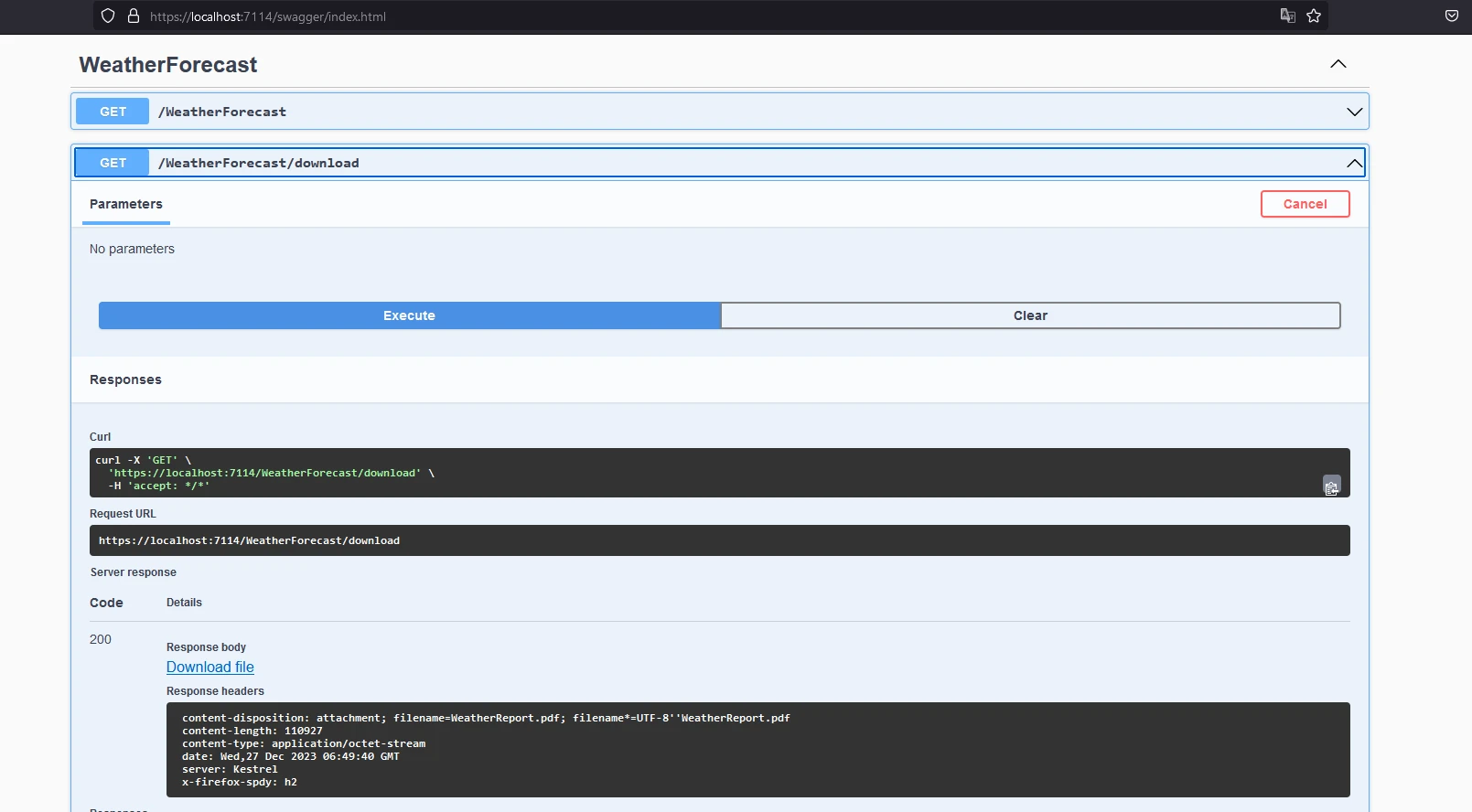
```
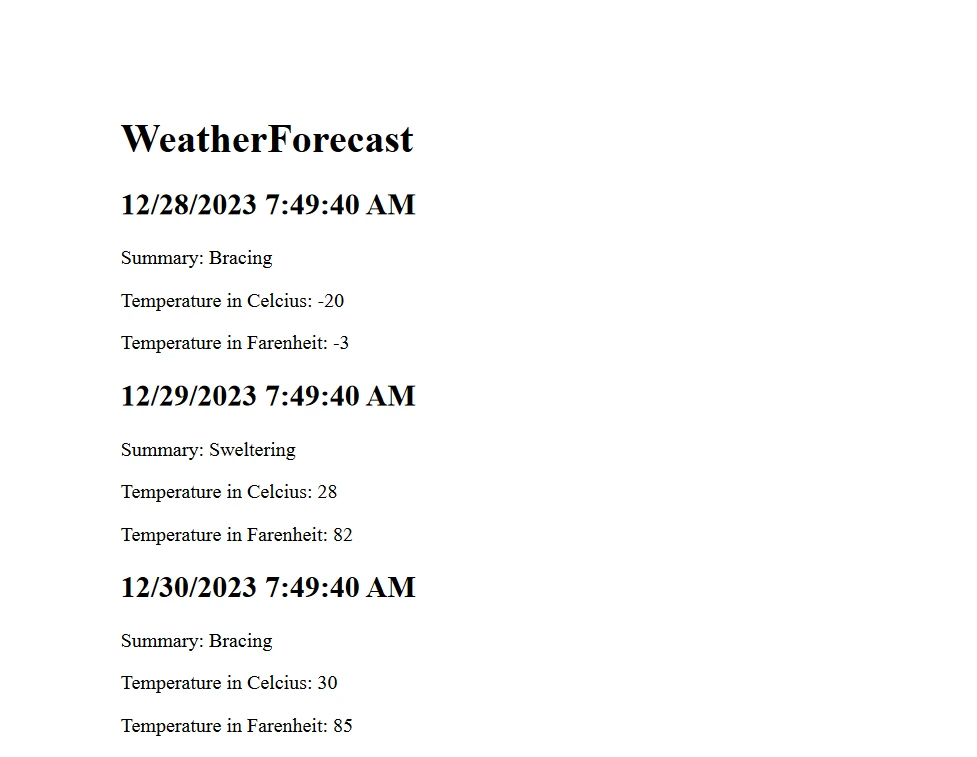
Hier verwenden wir die Wetterdaten, um eine HTML-Zeichenfolge zu generieren, die dann verwendet wird, um ein PDF-Dokument zu erstellen.
#### HTML-Inhalt
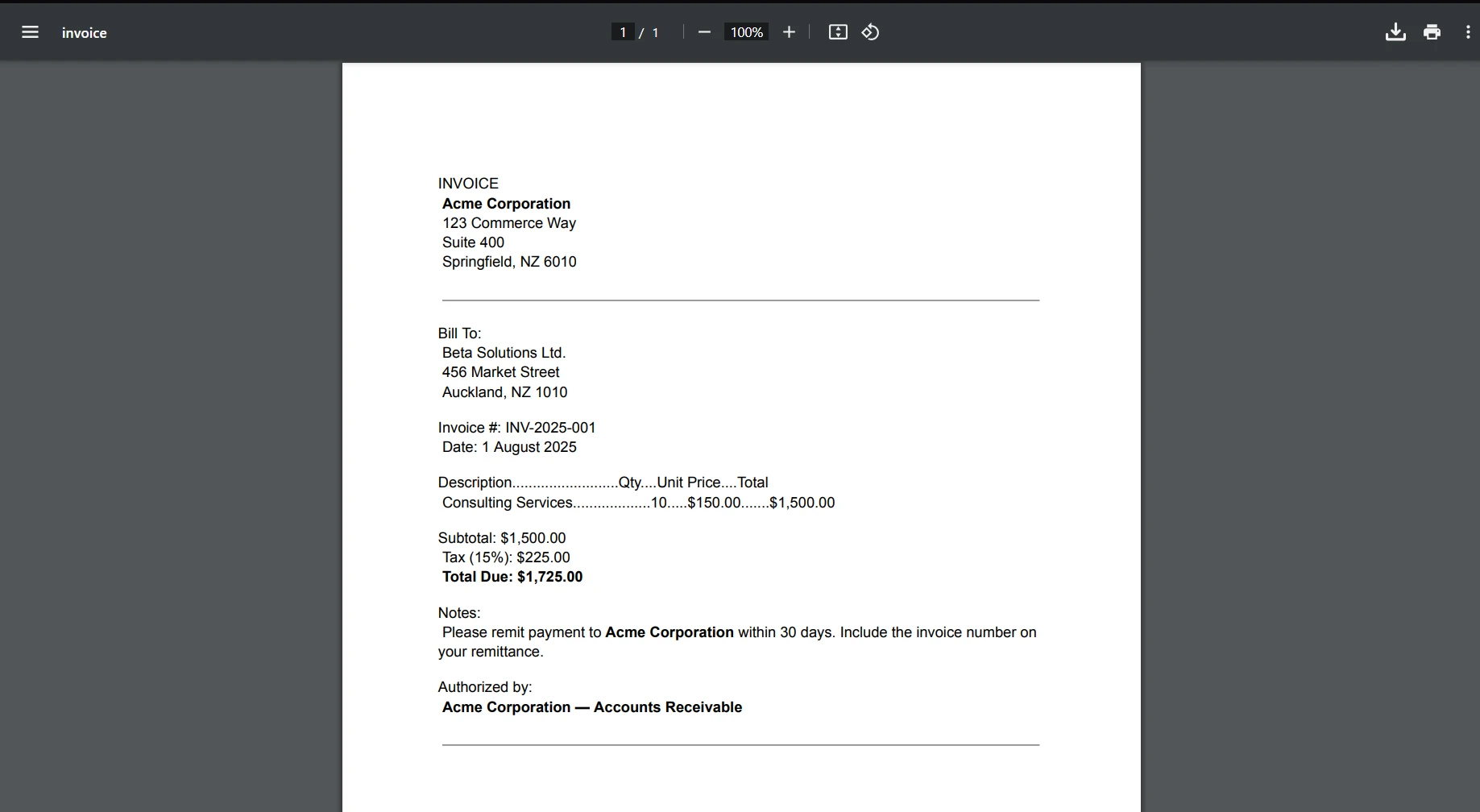
Und der PDF-Bericht sieht so aus:
Der komplette Code ist auf GitHub - [Swashbuckle Demo Quellcode](https://github.com/santoshkaranam/swashbuckle-demo) zu finden.
Das Dokument hat ein kleines Wasserzeichen für Testlizenzen, das mit einer gültigen Lizenz entfernt werden kann.
### Lizenzierung (Kostenlose Testversion verfügbar)
Für das obige Codebeispiel ist ein Lizenzschlüssel erforderlich. Platzieren Sie diesen Schlüssel in der `appsettings.json`-Datei.
```json
{
"IronPdf": {
"LicenseKey": "your license key"
}
}
```
Eine Testlizenz ist für Entwickler nach der Registrierung bei [IronPDF Testregistrierung](trial-license) verfügbar. Für eine Testlizenz wird keine Kreditkarte benötigt. Registrieren Sie sich mit Ihrer E-Mail für eine kostenlose Testversion.
# Abschluss
Das Verständnis von Swashbuckle und IronPDF ermöglicht es Ihnen, API-Dokumentations- und PDF-Erstellungsmöglichkeiten effektiv in Ihre ASP.NET Core-Anwendungen zu integrieren. IronPDF bietet auch eine umfassende Dokumentation für [Erste Schritte](/docs/) zusammen mit verschiedenen [Beispielcode für die PDF-Erstellung](/examples/using-html-to-create-a-pdf/).
Zusätzlich können Sie [verwandte Softwareprodukte von Iron Software erkunden](https://ironsoftware.com/enterprise/), die Ihnen helfen, Ihre Programmierkenntnisse zu erweitern und den modernen Anforderungen von Anwendungen gerecht zu werden.
Swashbuckle ist ein C# .NET Core NuGet-Paket, das hilft, RESTful Web-APIs automatisch zu dokumentieren. In diesem Blog werden wir die Swashbuckle ASP.NET Core und IronPDF Installationsanweisungen NuGet-Pakete erkunden, die die moderne Entwicklung von ASP.NET Core Web-APIs ermöglichen. Zusammen bieten sie eine Vielzahl von Funktionen, die mit minimalem Code erreicht werden können.
Die API-Dokumentationsseiten werden mit dem Swagger UI-Tool angezeigt, das eine swagger.json-Datei verwendet, die aus dem Web-API-Projekt generiert wurde. Das generierte JSON-Dokument folgt dem Open API-Standard. Swashbuckle ist als NuGet-Paket Swashbuckle.AspNetCore verfügbar, das bei Installation und Konfiguration automatisch das Swagger JSON freilegt. Das Swagger UI-Tool liest die Swagger JSON-Datei, die aus XML-Kommentaren generiert wird, die auf den APIs geschrieben sind. Zusätzlich kann eine XML-Dokumentationsdatei erstellt werden, indem sie in der Projektdatei aktiviert wird. XML-Kommentare werden in eine XML-Dokumentationsdatei konvertiert, aus der das Swagger JSON generiert wird. Dann liest die Swagger-Middleware das JSON und stellt Swagger JSON-Endpunkte bereit.
Implementierung in einem .NET Core Web API-Projekt
Lassen Sie uns mit einem Web-API-Projekt beginnen:
dotnet new webapi -n SwashbuckleDemo
cd SwashbuckleDemo
dotnet build
dotnet add package Swashbuckle.AspNetCore --version 6.5.0
dotnet build
SHELL
Hier erstellen wir ein Web-API-Projekt namens "SwashbuckleDemo" und installieren dann das Swashbuckle-Paket in das .NET Core Web-API-Projekt über die Paket-Manager-Konsole.
Swagger-Middleware konfigurieren
Konfigurieren Sie die Swagger-Dienste in der Startup.cs-Datei.
using System.Reflection;using Microsoft.Extensions.DependencyInjection;using Microsoft.AspNetCore.Builder;public class Startup{ public voidConfigureServices(IServiceCollection services) { // Other service configurations... // Register the Swagger generator services.AddSwaggerGen(c => { c.SwaggerDoc("v1", new OpenApiInfo { Title = "My API", Version = "v1" }); // Optionally, include XML comments for additional information var xmlFile = $"{Assembly.GetExecutingAssembly().GetName().Name}.xml"; var xmlPath = Path.Combine(AppContext.BaseDirectory, xmlFile); c.IncludeXmlComments(xmlPath); }); } public voidConfigure(IApplicationBuilder app, IHostingEnvironment env) { // Other app configurations... // Enable middleware to serve generated Swagger as a JSON endpoint. app.UseSwagger(); // Enable Swagger UI (HTML, JS, CSS, etc.), specifying the Swagger JSON endpoint. app.UseSwaggerUI(c => { c.SwaggerEndpoint("/swagger/v1/swagger.json", "My API V1"); }); }}
using System.Reflection;
using Microsoft.Extensions.DependencyInjection;
using Microsoft.AspNetCore.Builder;

public class Startup
{
    public void ConfigureServices(IServiceCollection services)
    {
        // Other service configurations...

        // Register the Swagger generator
        services.AddSwaggerGen(c =>
        {
            c.SwaggerDoc("v1", new OpenApiInfo { Title = "My API", Version = "v1" });

            // Optionally, include XML comments for additional information
            var xmlFile = $"{Assembly.GetExecutingAssembly().GetName().Name}.xml";
            var xmlPath = Path.Combine(AppContext.BaseDirectory, xmlFile);
            c.IncludeXmlComments(xmlPath);
        });
    }

    public void Configure(IApplicationBuilder app, IHostingEnvironment env)
    {
        // Other app configurations...

        // Enable middleware to serve generated Swagger as a JSON endpoint.
        app.UseSwagger();

        // Enable Swagger UI (HTML, JS, CSS, etc.), specifying the Swagger JSON endpoint.
        app.UseSwaggerUI(c =>
        {
            c.SwaggerEndpoint("/swagger/v1/swagger.json", "My API V1");
        });
    }
}
ImportsSystem.ReflectionImportsMicrosoft.Extensions.DependencyInjectionImportsMicrosoft.AspNetCore.BuilderPublic Class Startup Public Sub ConfigureServices(ByVal services AsIServiceCollection) ' Other service configurations... ' Register the Swagger generator services.AddSwaggerGen(Sub(c) c.SwaggerDoc("v1", New OpenApiInfoWith { .Title = "My API", .Version = "v1" }) ' Optionally, include XML comments for additional information Dim xmlFile = $"{System.Reflection.Assembly.GetExecutingAssembly().GetName().Name}.xml" Dim xmlPath = Path.Combine(AppContext.BaseDirectory, xmlFile) c.IncludeXmlComments(xmlPath) End Sub) End Sub Public Sub Configure(ByVal app AsIApplicationBuilder, ByVal env AsIHostingEnvironment) ' Other app configurations... ' Enable middleware to serve generated Swagger as a JSON endpoint. app.UseSwagger() ' Enable Swagger UI (HTML, JS, CSS, etc.), specifying the Swagger JSON endpoint. app.UseSwaggerUI(Sub(c) c.SwaggerEndpoint("/swagger/v1/swagger.json", "My API V1") End Sub) End SubEnd Class
Imports System.Reflection
Imports Microsoft.Extensions.DependencyInjection
Imports Microsoft.AspNetCore.Builder

Public Class Startup
	Public Sub ConfigureServices(ByVal services As IServiceCollection)
		' Other service configurations...

		' Register the Swagger generator
		services.AddSwaggerGen(Sub(c)
			c.SwaggerDoc("v1", New OpenApiInfo With {
				.Title = "My API",
				.Version = "v1"
			})

			' Optionally, include XML comments for additional information
			Dim xmlFile = $"{System.Reflection.Assembly.GetExecutingAssembly().GetName().Name}.xml"
			Dim xmlPath = Path.Combine(AppContext.BaseDirectory, xmlFile)
			c.IncludeXmlComments(xmlPath)
		End Sub)
	End Sub

	Public Sub Configure(ByVal app As IApplicationBuilder, ByVal env As IHostingEnvironment)
		' Other app configurations...

		' Enable middleware to serve generated Swagger as a JSON endpoint.
		app.UseSwagger()

		' Enable Swagger UI (HTML, JS, CSS, etc.), specifying the Swagger JSON endpoint.
		app.UseSwaggerUI(Sub(c)
			c.SwaggerEndpoint("/swagger/v1/swagger.json", "My API V1")
		End Sub)
	End Sub
End Class
Fügen Sie einen Controller für todo-Liste-APIs hinzu:
using Microsoft.AspNetCore.Http.HttpResults;using Microsoft.AspNetCore.Builder;using Microsoft.EntityFrameworkCore;using Microsoft.AspNetCore.Mvc;using System.Threading.Tasks;// Example to define an entity classpublic class Todo{ public intId { get; set; } public stringName { get; set; } public boolIsComplete { get; set; }}// Example to define a DbContext classpublic class TodoDb : DbContext{ public DbSet<Todo> Todos => Set<Todo>();}var builder = WebApplication.CreateBuilder(args);var app = builder.Build();app.MapGet("/", () => "SwashbuckleDemo!");app.MapGet("/todoitems", async (TodoDb db) => await db.Todos.ToListAsync());app.MapGet("/todoitems/complete", async (TodoDb db) => await db.Todos.Where(t => t.IsComplete).ToListAsync());app.MapGet("/todoitems/{id}", async (int id, TodoDb db) => await db.Todos.FindAsync(id) is Todo todo ? Results.Ok(todo) : Results.NotFound());app.MapPost("/todoitems", async (Todo todo, TodoDb db) =>{ db.Todos.Add(todo); await db.SaveChangesAsync(); returnResults.Created($"/todoitems/{todo.Id}", todo);});app.MapPut("/todoitems/{id}", async (int id, Todo inputTodo, TodoDb db) =>{ var todo = await db.Todos.FindAsync(id); if (todo is null) returnResults.NotFound(); todo.Name = inputTodo.Name; todo.IsComplete = inputTodo.IsComplete; await db.SaveChangesAsync(); returnResults.NoContent();});app.MapDelete("/todoitems/{id}", async (int id, TodoDb db) =>{ if (await db.Todos.FindAsync(id) is Todo todo) { db.Todos.Remove(todo); await db.SaveChangesAsync(); returnResults.Ok(todo); } returnResults.NotFound();});app.Run();
using Microsoft.AspNetCore.Http.HttpResults;
using Microsoft.AspNetCore.Builder;
using Microsoft.EntityFrameworkCore;
using Microsoft.AspNetCore.Mvc;
using System.Threading.Tasks;

// Example to define an entity class
public class Todo
{
    public int Id { get; set; }
    public string Name { get; set; }
    public bool IsComplete { get; set; }
}

// Example to define a DbContext class
public class TodoDb : DbContext
{
    public DbSet<Todo> Todos => Set<Todo>();
}

var builder = WebApplication.CreateBuilder(args);
var app = builder.Build();

app.MapGet("/", () => "SwashbuckleDemo!");

app.MapGet("/todoitems", async (TodoDb db) =>
    await db.Todos.ToListAsync());

app.MapGet("/todoitems/complete", async (TodoDb db) =>
    await db.Todos.Where(t => t.IsComplete).ToListAsync());

app.MapGet("/todoitems/{id}", async (int id, TodoDb db) =>
    await db.Todos.FindAsync(id) is Todo todo
        ? Results.Ok(todo)
        : Results.NotFound());

app.MapPost("/todoitems", async (Todo todo, TodoDb db) =>
{
    db.Todos.Add(todo);
    await db.SaveChangesAsync();
    return Results.Created($"/todoitems/{todo.Id}", todo);
});

app.MapPut("/todoitems/{id}", async (int id, Todo inputTodo, TodoDb db) =>
{
    var todo = await db.Todos.FindAsync(id);
    if (todo is null) return Results.NotFound();
    todo.Name = inputTodo.Name;
    todo.IsComplete = inputTodo.IsComplete;
    await db.SaveChangesAsync();
    return Results.NoContent();
});

app.MapDelete("/todoitems/{id}", async (int id, TodoDb db) =>
{
    if (await db.Todos.FindAsync(id) is Todo todo)
    {
        db.Todos.Remove(todo);
        await db.SaveChangesAsync();
        return Results.Ok(todo);
    }

    return Results.NotFound();
});

app.Run();
ImportsMicrosoft.AspNetCore.Http.HttpResultsImportsMicrosoft.AspNetCore.BuilderImportsMicrosoft.EntityFrameworkCoreImportsMicrosoft.AspNetCore.MvcImportsSystem.Threading.Tasks' Example to define an entity classPublic Class Todo Public Property Id() AsInteger Public Property Name() AsString Public Property IsComplete() AsBooleanEnd Class' Example to define a DbContext classPublic Class TodoDbInheritsDbContext PublicReadOnlyPropertyTodos() AsDbSet(OfTodo) Get Return [Set](OfTodo)()End Get End PropertyEnd ClassPrivate builder = WebApplication.CreateBuilder(args)Private app = builder.Build()app.MapGet("/", Function() "SwashbuckleDemo!")app.MapGet("/todoitems", Async Function(db AsTodoDb) Await db.Todos.ToListAsync())app.MapGet("/todoitems/complete", Async Function(db AsTodoDb) Await db.Todos.Where(Function(t) t.IsComplete).ToListAsync())Dim tempVar AsBoolean = TypeOf db.Todos.FindAsync(id) IsTodoDim todo AsTodo = If(tempVar, CType(db.Todos.FindAsync(id), Todo), Nothing)app.MapGet("/todoitems/{id}", Async Function(id AsInteger, db AsTodoDb)If(Await tempVar, Results.Ok(todo), Results.NotFound()))app.MapPost("/todoitems", Async Function(todo AsTodo, db AsTodoDb) db.Todos.Add(todo)Await db.SaveChangesAsync() ReturnResults.Created($"/todoitems/{todo.Id}", todo)End Function)app.MapPut("/todoitems/{id}", Async Function(id AsInteger, inputTodo AsTodo, db AsTodoDb) Dim todo = Await db.Todos.FindAsync(id) If todo Is Nothing Then ReturnResults.NotFound() End If todo.Name = inputTodo.Name todo.IsComplete = inputTodo.IsCompleteAwait db.SaveChangesAsync() ReturnResults.NoContent()End Function)app.MapDelete("/todoitems/{id}", Async Function(id AsInteger, db AsTodoDb) Dim tempVar2 AsBoolean = TypeOf db.Todos.FindAsync(id) IsTodo Dim todo AsTodo = If(tempVar2, CType(db.Todos.FindAsync(id), Todo), Nothing) IfAwait tempVar2 Then db.Todos.Remove(todo)Await db.SaveChangesAsync() ReturnResults.Ok(todo) End If ReturnResults.NotFound()End Function)app.Run()
Imports Microsoft.AspNetCore.Http.HttpResults
Imports Microsoft.AspNetCore.Builder
Imports Microsoft.EntityFrameworkCore
Imports Microsoft.AspNetCore.Mvc
Imports System.Threading.Tasks

' Example to define an entity class
Public Class Todo
	Public Property Id() As Integer
	Public Property Name() As String
	Public Property IsComplete() As Boolean
End Class

' Example to define a DbContext class
Public Class TodoDb
	Inherits DbContext

	Public ReadOnly Property Todos() As DbSet(Of Todo)
		Get
			Return [Set](Of Todo)()
		End Get
	End Property
End Class

Private builder = WebApplication.CreateBuilder(args)
Private app = builder.Build()

app.MapGet("/", Function() "SwashbuckleDemo!")

app.MapGet("/todoitems", Async Function(db As TodoDb) Await db.Todos.ToListAsync())

app.MapGet("/todoitems/complete", Async Function(db As TodoDb) Await db.Todos.Where(Function(t) t.IsComplete).ToListAsync())

Dim tempVar As Boolean = TypeOf db.Todos.FindAsync(id) Is Todo
Dim todo As Todo = If(tempVar, CType(db.Todos.FindAsync(id), Todo), Nothing)
app.MapGet("/todoitems/{id}", Async Function(id As Integer, db As TodoDb)If(Await tempVar, Results.Ok(todo), Results.NotFound()))

app.MapPost("/todoitems", Async Function(todo As Todo, db As TodoDb)
	db.Todos.Add(todo)
	Await db.SaveChangesAsync()
	Return Results.Created($"/todoitems/{todo.Id}", todo)
End Function)

app.MapPut("/todoitems/{id}", Async Function(id As Integer, inputTodo As Todo, db As TodoDb)
	Dim todo = Await db.Todos.FindAsync(id)
	If todo Is Nothing Then
		Return Results.NotFound()
	End If
	todo.Name = inputTodo.Name
	todo.IsComplete = inputTodo.IsComplete
	Await db.SaveChangesAsync()
	Return Results.NoContent()
End Function)

app.MapDelete("/todoitems/{id}", Async Function(id As Integer, db As TodoDb)
	Dim tempVar2 As Boolean = TypeOf db.Todos.FindAsync(id) Is Todo
	Dim todo As Todo = If(tempVar2, CType(db.Todos.FindAsync(id), Todo), Nothing)
	If Await tempVar2 Then
		db.Todos.Remove(todo)
		Await db.SaveChangesAsync()
		Return Results.Ok(todo)
	End If

	Return Results.NotFound()
End Function)

app.Run()
Ein Controller kann auch wie unten hinzugefügt werden:
using Microsoft.AspNetCore.Mvc;using Microsoft.Extensions.Logging;using System.Collections.Generic;using System;using System.Linq;namespace RestFullMinimalApi.Controllers{ [ApiController] [Route("[controller]")] public class WeatherForecastController : ControllerBase { private static readonly string[] Summaries = new[] { "Freezing", "Bracing", "Chilly", "Cool", "Mild", "Warm", "Balmy", "Hot", "Sweltering", "Scorching" }; private readonly ILogger<WeatherForecastController> _logger; publicWeatherForecastController(ILogger<WeatherForecastController> logger) { _logger = logger; } /// <summary> /// Retrieves WeatherForecast /// </summary> /// <remarks>Awesomeness!</remarks> /// <response code="200">Retrieved</response> /// <response code="404">Not found</response> /// <response code="500">Oops! Can't lookup your request right now</response> [HttpGet(Name = "GetWeatherForecast")] public IEnumerable<WeatherForecast> Get() { returnEnumerable.Range(1, 5).Select(index => new WeatherForecast {Date = DateTime.Now.AddDays(index),TemperatureC = Random.Shared.Next(-20, 55),Summary = Summaries[Random.Shared.Next(Summaries.Length)] }) .ToArray(); } } public class WeatherForecast { public DateTimeDate { get; set; } public intTemperatureC { get; set; } public stringSummary { get; set; } }}
using Microsoft.AspNetCore.Mvc;
using Microsoft.Extensions.Logging;
using System.Collections.Generic;
using System;
using System.Linq;

namespace RestFullMinimalApi.Controllers
{
    [ApiController]
    [Route("[controller]")]
    public class WeatherForecastController : ControllerBase
    {
        private static readonly string[] Summaries = new[]
        {
            "Freezing", "Bracing", "Chilly", "Cool", "Mild", "Warm", "Balmy", "Hot", "Sweltering", "Scorching"
        };

        private readonly ILogger<WeatherForecastController> _logger;

        public WeatherForecastController(ILogger<WeatherForecastController> logger)
        {
            _logger = logger;
        }

        /// <summary>
        /// Retrieves WeatherForecast
        /// </summary>
        /// <remarks>Awesomeness!</remarks>
        /// <response code="200">Retrieved</response>
        /// <response code="404">Not found</response>
        /// <response code="500">Oops! Can't lookup your request right now</response>
        [HttpGet(Name = "GetWeatherForecast")]
        public IEnumerable<WeatherForecast> Get()
        {
            return Enumerable.Range(1, 5).Select(index => new WeatherForecast
            {
                Date = DateTime.Now.AddDays(index),
                TemperatureC = Random.Shared.Next(-20, 55),
                Summary = Summaries[Random.Shared.Next(Summaries.Length)]
            })
            .ToArray();
        }
    }

    public class WeatherForecast
    {
        public DateTime Date { get; set; }
        public int TemperatureC { get; set; }
        public string Summary { get; set; }
    }
}
ImportsMicrosoft.AspNetCore.MvcImportsMicrosoft.Extensions.LoggingImportsSystem.Collections.GenericImportsSystemImportsSystem.LinqNamespaceRestFullMinimalApi.Controllers <ApiController> <Route("[controller]")> Public Class WeatherForecastControllerInheritsControllerBase PrivateSharedReadOnlySummaries() AsString = { "Freezing", "Bracing", "Chilly", "Cool", "Mild", "Warm", "Balmy", "Hot", "Sweltering", "Scorching" } PrivateReadOnly _logger AsILogger(OfWeatherForecastController) Public Sub New(ByVal logger AsILogger(OfWeatherForecastController)) _logger = logger End Sub ''' <summary> ''' Retrieves WeatherForecast ''' </summary> ''' <remarks>Awesomeness!</remarks> ''' <response code="200">Retrieved</response> ''' <response code="404">Not found</response> ''' <response code="500">Oops! Can't lookup your request right now</response> <HttpGet(Name := "GetWeatherForecast")> Public Function [Get]() AsIEnumerable(OfWeatherForecast) ReturnEnumerable.Range(1, 5).Select(Function(index) New WeatherForecastWith { .Date = DateTime.Now.AddDays(index), .TemperatureC = Random.Shared.Next(-20, 55), .Summary = Summaries(Random.Shared.Next(Summaries.Length)) }).ToArray() End Function End Class Public Class WeatherForecast Public Property [Date]() AsDateTime Public Property TemperatureC() AsInteger Public Property Summary() AsString End ClassEndNamespace
Imports Microsoft.AspNetCore.Mvc
Imports Microsoft.Extensions.Logging
Imports System.Collections.Generic
Imports System
Imports System.Linq

Namespace RestFullMinimalApi.Controllers
	<ApiController>
	<Route("[controller]")>
	Public Class WeatherForecastController
		Inherits ControllerBase

		Private Shared ReadOnly Summaries() As String = { "Freezing", "Bracing", "Chilly", "Cool", "Mild", "Warm", "Balmy", "Hot", "Sweltering", "Scorching" }

		Private ReadOnly _logger As ILogger(Of WeatherForecastController)

		Public Sub New(ByVal logger As ILogger(Of WeatherForecastController))
			_logger = logger
		End Sub

		''' <summary>
		''' Retrieves WeatherForecast
		''' </summary>
		''' <remarks>Awesomeness!</remarks>
		''' <response code="200">Retrieved</response>
		''' <response code="404">Not found</response>
		''' <response code="500">Oops! Can't lookup your request right now</response>
		<HttpGet(Name := "GetWeatherForecast")>
		Public Function [Get]() As IEnumerable(Of WeatherForecast)
			Return Enumerable.Range(1, 5).Select(Function(index) New WeatherForecast With {
				.Date = DateTime.Now.AddDays(index),
				.TemperatureC = Random.Shared.Next(-20, 55),
				.Summary = Summaries(Random.Shared.Next(Summaries.Length))
			}).ToArray()
		End Function
	End Class

	Public Class WeatherForecast
		Public Property [Date]() As DateTime
		Public Property TemperatureC() As Integer
		Public Property Summary() As String
	End Class
End Namespace
Swagger UI ist von der Basis-URL der Web-API-Anwendung unter "/swagger/index.html" verfügbar. Es listet alle REST-APIs aus dem Code auf. Der Swagger-Generator liest die JSON-Datei und füllt die Benutzeroberfläche aus.
Swagger JSON
Swashbuckle.AspNetCore generiert automatisch die Swagger JSON-Datei, die Informationen über die API-Struktur enthält, einschließlich Details wie Endpunkte, Anforderungs- und Antworttypen und mehr. Diese JSON-Datei kann von anderen Werkzeugen und Diensten verwendet werden, die den Swagger/OpenAPI-Standard unterstützen.
Die Swagger JSON-Datei ist von der Basis-URL der Web-API-Anwendung unter "/swagger/v1/swagger.json" verfügbar.
Code-Anmerkungen
Entwickler können XML-Kommentare und Attribute in ihren ASP.NET Core-Controllern verwenden, um zusätzliche Informationen für die Swagger-Dokumentation bereitzustellen. Dies umfasst Beschreibungen, Beispiele und andere Metadaten, die die generierte Swagger-Dokumentation verbessern.
<ApiController><Route("[controller]")>Public Class WeatherForecastControllerInheritsControllerBase PrivateSharedReadOnlySummaries() AsString = { "Freezing", "Bracing", "Chilly", "Cool", "Mild", "Warm", "Balmy", "Hot", "Sweltering", "Scorching" } PrivateReadOnly _logger AsILogger(OfWeatherForecastController) Public Sub New(ByVal logger AsILogger(OfWeatherForecastController)) _logger = logger End Sub ''' <summary> ''' Retrieves WeatherForecast ''' </summary> ''' <remarks>Awesomeness!</remarks> ''' <response code="200">Retrieved</response> ''' <response code="404">Not found</response> ''' <response code="500">Oops! Can't lookup your request right now</response> <HttpGet(Name := "GetWeatherForecast")> Public Function [Get]() AsIEnumerable(OfWeatherForecast) ReturnEnumerable.Range(1, 5).Select(Function(index) New WeatherForecastWith { .Date = DateTime.Now.AddDays(index), .TemperatureC = Random.Shared.Next(-20, 55), .Summary = Summaries(Random.Shared.Next(Summaries.Length)) }).ToArray() End FunctionEnd Class
<ApiController>
<Route("[controller]")>
Public Class WeatherForecastController
	Inherits ControllerBase

	Private Shared ReadOnly Summaries() As String = { "Freezing", "Bracing", "Chilly", "Cool", "Mild", "Warm", "Balmy", "Hot", "Sweltering", "Scorching" }

	Private ReadOnly _logger As ILogger(Of WeatherForecastController)

	Public Sub New(ByVal logger As ILogger(Of WeatherForecastController))
		_logger = logger
	End Sub

	''' <summary>
	''' Retrieves WeatherForecast
	''' </summary>
	''' <remarks>Awesomeness!</remarks>
	''' <response code="200">Retrieved</response>
	''' <response code="404">Not found</response>
	''' <response code="500">Oops! Can't lookup your request right now</response>
	<HttpGet(Name := "GetWeatherForecast")>
	Public Function [Get]() As IEnumerable(Of WeatherForecast)
		Return Enumerable.Range(1, 5).Select(Function(index) New WeatherForecast With {
			.Date = DateTime.Now.AddDays(index),
			.TemperatureC = Random.Shared.Next(-20, 55),
			.Summary = Summaries(Random.Shared.Next(Summaries.Length))
		}).ToArray()
	End Function
End Class
Konfigurationsoptionen
Swashbuckle.AspNetCore bietet verschiedene Konfigurationsoptionen, um anzupassen, wie die Swagger-Dokumentation generiert wird. Entwickler können steuern, welche APIs dokumentiert werden, Namenskonventionen konfigurieren und andere Einstellungen anpassen.
Hier sind einige der wichtigsten Konfigurationsoptionen, die von Swashbuckle.AspNetCore bereitgestellt werden:
SwaggerGen Optionen
c.SwaggerDoc("v1", new OpenApiInfo { Title = "My API", Version = "v1" });
c.SwaggerDoc("v1", new OpenApiInfo { Title = "My API", Version = "v1" });
c.SwaggerDoc("v1", New OpenApiInfoWith { .Title = "My API", .Version = "v1"})
c.SwaggerDoc("v1", New OpenApiInfo With {
	.Title = "My API",
	.Version = "v1"
})
Diese Zeile gibt die Swagger-Dokumentversion an und enthält Metadaten wie Titel und Version Ihrer API.
c.IncludeXmlComments(xmlPath);
c.IncludeXmlComments(xmlPath);
c.IncludeXmlComments(xmlPath)
c.IncludeXmlComments(xmlPath)
Diese Option ermöglicht es Ihnen, XML-Kommentare aus Ihrem Code einzubeziehen, um zusätzliche Informationen in der Swagger-Dokumentation bereitzustellen. Die xmlPath-Variable sollte auf den Speicherort Ihrer XML-Kommentardatei verweisen.
c.DescribeAllParametersInCamelCase();
c.DescribeAllParametersInCamelCase();
c.DescribeAllParametersInCamelCase()
c.DescribeAllParametersInCamelCase()
Diese Option konfiguriert den Swagger-Generator, Parametername in camelCase zu verwenden.
c.OperationFilter<CustomOperationFilter>();
c.OperationFilter<CustomOperationFilter>();
c.OperationFilter(OfCustomOperationFilter)()
c.OperationFilter(Of CustomOperationFilter)()
Sie können benutzerdefinierte Operationsfilter registrieren, um die Swagger-Dokumentation für bestimmte Operationen zu ändern. CustomOperationFilter ist eine Klasse, die IOperationFilter implementiert.
Swagger UI Optionen
c.SwaggerEndpoint("/swagger/v1/swagger.json", "My API V1");
c.SwaggerEndpoint("/swagger/v1/swagger.json", "My API V1");
c.SwaggerEndpoint("/swagger/v1/swagger.json", "My API V1")
c.SwaggerEndpoint("/swagger/v1/swagger.json", "My API V1")
Diese Zeile konfiguriert das Swagger UI, um Dokumentation anzuzeigen. Der erste Parameter ist die URL der Swagger JSON-Datei und der zweite Parameter ist ein benutzerfreundlicher Name für die API-Version.
c.RoutePrefix = "swagger";
c.RoutePrefix = "swagger";
c.RoutePrefix = "swagger"
c.RoutePrefix = "swagger"
Sie können das Routen-Präfix für das Swagger UI festlegen. In diesem Beispiel wird das Swagger UI unter /swagger verfügbar sein.
c.DocExpansion(DocExpansion.None);
c.DocExpansion(DocExpansion.None);
c.DocExpansion(DocExpansion.None)
c.DocExpansion(DocExpansion.None)
Diese Option steuert, wie das Swagger UI die API-Dokumentation anzeigt. DocExpansion.None klappt standardmäßig alle Operationen ein.
SwaggerOptionen
c.SerializeAsV2 = true;
c.SerializeAsV2 = true;
c.SerializeAsV2 = True
c.SerializeAsV2 = True
Diese Option gibt an, ob das Swagger-Dokument im Format Version 2.0 (true) oder 3.0 (false) serialisiert werden soll. Stellen Sie es auf true ein, wenn Sie Swagger 2.0 verwenden möchten.
c.DisplayOperationId();
c.DisplayOperationId();
c.DisplayOperationId()
c.DisplayOperationId()
Diese Option zeigt die Vorgangs-ID im Swagger UI an, was für das Debugging und das Verstehen der Architektur Ihrer API nützlich sein kann.
c.OAuthClientId("swagger-ui");
c.OAuthClientId("swagger-ui");
c.OAuthClientId("swagger-ui")
c.OAuthClientId("swagger-ui")
Wenn Ihre API OAuth-Authentifizierung verwendet, können Sie die OAuth-Client-ID für Swagger UI konfigurieren.
Die Swashbuckle.AspNetCore-Bibliothek ist anpassbar; kombinieren Sie Optionen und Filter, um die Swagger-Dokumentation anzupassen. Die Swashbuckle.AspNetCore-Bibliothek ist hochgradig anpassbar, und Sie können die Swagger-Dokumentation auf Ihre speziellen Bedürfnisse zugeschnitten durch die Kombination verschiedener Optionen und Filter abstimmen. Bitte immer auf die offizielle Dokumentation oder IntelliSense in Ihrer Entwicklungsumgebung zurückgreifen, um die aktuellsten und umfassendsten Informationen zu den verfügbaren Optionen zu erhalten.
Einführung in IronPDF
IronPDF-Produktübersicht ist die C# PDF-Bibliothek von Iron Software-Website, die hilft, PDF-Dokumente zu lesen und zu erstellen. Es kann formatierten Dokumente mit Stilinformationen problemlos in PDF umwandeln. IronPDF kann mühelos PDFs aus HTML-Inhalten generieren. Es kann HTML-Inhalte von einer URL herunterladen und dann PDFs generieren.
IronPDF ist ein großartiges Tool zum Konvertieren von Webseiten, URLs und HTML in PDFs, die die Quelle perfekt replizieren. Es ist ideal, um PDFs von Online-Inhalten wie Berichten und Rechnungen zu erstellen und mühelos PDF-Versionen jeder Webseite zu erzeugen.
using IronPdf;class Program{ static voidMain(string[] args) { var renderer = new ChromePdfRenderer(); // 1. Convert HTML String to PDF var htmlContent = "<h1>Hello, IronPDF!</h1><p>This is a PDF from an HTML string.</p>"; var pdfFromHtmlString = renderer.RenderHtmlAsPdf(htmlContent); pdfFromHtmlString.SaveAs("HTMLStringToPDF.pdf"); // 2. Convert HTML File to PDF var htmlFilePath = "path_to_your_html_file.html"; // Specify the path to your HTML file var pdfFromHtmlFile = renderer.RenderHtmlFileAsPdf(htmlFilePath); pdfFromHtmlFile.SaveAs("HTMLFileToPDF.pdf"); // 3. Convert URL to PDF var url = "http://ironpdf.com"; // Specify the URL var pdfFromUrl = renderer.RenderUrlAsPdf(url); pdfFromUrl.SaveAs("URLToPDF.pdf"); }}
using IronPdf;

class Program
{
    static void Main(string[] args)
    {
        var renderer = new ChromePdfRenderer();

        // 1. Convert HTML String to PDF
        var htmlContent = "<h1>Hello, IronPDF!</h1><p>This is a PDF from an HTML string.</p>";
        var pdfFromHtmlString = renderer.RenderHtmlAsPdf(htmlContent);
        pdfFromHtmlString.SaveAs("HTMLStringToPDF.pdf");

        // 2. Convert HTML File to PDF
        var htmlFilePath = "path_to_your_html_file.html"; // Specify the path to your HTML file
        var pdfFromHtmlFile = renderer.RenderHtmlFileAsPdf(htmlFilePath);
        pdfFromHtmlFile.SaveAs("HTMLFileToPDF.pdf");

        // 3. Convert URL to PDF
        var url = "http://ironpdf.com"; // Specify the URL
        var pdfFromUrl = renderer.RenderUrlAsPdf(url);
        pdfFromUrl.SaveAs("URLToPDF.pdf");
    }
}
ImportsIronPdfFriend Class ProgramShared Sub Main(ByVal args() AsString) Dim renderer = New ChromePdfRenderer() ' 1. Convert HTML String to PDF Dim htmlContent = "<h1>Hello, IronPDF!</h1><p>This is a PDF from an HTML string.</p>" Dim pdfFromHtmlString = renderer.RenderHtmlAsPdf(htmlContent) pdfFromHtmlString.SaveAs("HTMLStringToPDF.pdf") ' 2. Convert HTML File to PDF Dim htmlFilePath = "path_to_your_html_file.html" ' Specify the path to your HTML file Dim pdfFromHtmlFile = renderer.RenderHtmlFileAsPdf(htmlFilePath) pdfFromHtmlFile.SaveAs("HTMLFileToPDF.pdf") ' 3. Convert URL to PDF Dim url = "http://ironpdf.com" ' Specify the URL Dim pdfFromUrl = renderer.RenderUrlAsPdf(url) pdfFromUrl.SaveAs("URLToPDF.pdf") End SubEnd Class
Imports IronPdf

Friend Class Program
	Shared Sub Main(ByVal args() As String)
		Dim renderer = New ChromePdfRenderer()

		' 1. Convert HTML String to PDF
		Dim htmlContent = "<h1>Hello, IronPDF!</h1><p>This is a PDF from an HTML string.</p>"
		Dim pdfFromHtmlString = renderer.RenderHtmlAsPdf(htmlContent)
		pdfFromHtmlString.SaveAs("HTMLStringToPDF.pdf")

		' 2. Convert HTML File to PDF
		Dim htmlFilePath = "path_to_your_html_file.html" ' Specify the path to your HTML file
		Dim pdfFromHtmlFile = renderer.RenderHtmlFileAsPdf(htmlFilePath)
		pdfFromHtmlFile.SaveAs("HTMLFileToPDF.pdf")

		' 3. Convert URL to PDF
		Dim url = "http://ironpdf.com" ' Specify the URL
		Dim pdfFromUrl = renderer.RenderUrlAsPdf(url)
		pdfFromUrl.SaveAs("URLToPDF.pdf")
	End Sub
End Class
Geben Sie in die Paketverwaltungs-Konsole den Befehl ein:
PM > Install-Package IronPdf
Install-Package IronPdf
Verwendung von Visual Studio
Nun, lassen Sie uns unsere Anwendung ändern, um die Funktionalität hinzuzufügen, Website-Inhalte als PDF-Datei herunterzuladen.
using Microsoft.AspNetCore.Mvc;using Microsoft.Extensions.Logging;using IronPdf;using System;using System.Collections.Generic;using System.IO;using System.Linq;namespace RestFullMinimalApi.Controllers{ [ApiController] [Route("[controller]")] public class WeatherForecastController : ControllerBase { private static readonly string[] Summaries = new[] { "Freezing", "Bracing", "Chilly", "Cool", "Mild", "Warm", "Balmy", "Hot", "Sweltering", "Scorching" }; private readonly ILogger<WeatherForecastController> _logger; publicWeatherForecastController(ILogger<WeatherForecastController> logger) { _logger = logger; } /// <summary> /// Retrieves WeatherForecast /// </summary> /// <remarks>Awesomeness!</remarks> /// <response code="200">Retrieved</response> /// <response code="404">Not found</response> /// <response code="500">Oops! Can't lookup your request right now</response> [HttpGet(Name = "GetWeatherForecast")] public IEnumerable<WeatherForecast> Get() { returnEnumerable.Range(1, 5).Select(index => new WeatherForecast {Date = DateTime.Now.AddDays(index),TemperatureC = Random.Shared.Next(-20, 55),Summary = Summaries[Random.Shared.Next(Summaries.Length)] }) .ToArray(); } /// <summary> /// Retrieves WeatherForecast as Pdf /// </summary> /// <remarks>Awesomeness!</remarks> /// <response code="200">Retrieved</response> /// <response code="404">Not found</response> /// <response code="500">Oops! Can't lookup your request right now</response> [HttpGet("download", Name = "DownloadWeatherForecast")] public IActionResultGetWeatherPdf() { var results = Enumerable.Range(1, 5).Select(index => new WeatherForecast {Date = DateTime.Now.AddDays(index),TemperatureC = Random.Shared.Next(-20, 55),Summary = Summaries[Random.Shared.Next(Summaries.Length)] }).ToArray(); var html = GetHtml(results); var renderer = new ChromePdfRenderer(); var pdf = renderer.RenderHtmlAsPdf(html); var fileName = "WeatherReport.pdf"; pdf.SaveAs(fileName); var stream = new FileStream(fileName, FileMode.Open); // Return the PDF file for download return new FileStreamResult(stream, "application/octet-stream") { FileDownloadName = fileName }; } private static stringGetHtml(WeatherForecast[] weatherForecasts) { string header = @"<html><head><title>WeatherForecast</title></head><body><h1>WeatherForecast</h1>"; var footer = @"</body></html>"; var htmlContent = header; foreach (var weather in weatherForecasts) { htmlContent += $@" <h2>{weather.Date}</h2> <p>Summary: {weather.Summary}</p> <p>Temperature in Celsius: {weather.TemperatureC}</p> <p>Temperature in Fahrenheit: {weather.TemperatureF}</p>"; } htmlContent += footer; return htmlContent; } } public class WeatherForecast { public DateTimeDate { get; set; } public intTemperatureC { get; set; } public stringSummary { get; set; } public intTemperatureF => 32 + (int)(TemperatureC / 0.5556); }}
using Microsoft.AspNetCore.Mvc;
using Microsoft.Extensions.Logging;
using IronPdf;
using System;
using System.Collections.Generic;
using System.IO;
using System.Linq;

namespace RestFullMinimalApi.Controllers
{
    [ApiController]
    [Route("[controller]")]
    public class WeatherForecastController : ControllerBase
    {
        private static readonly string[] Summaries = new[]
        {
            "Freezing", "Bracing", "Chilly", "Cool", "Mild", "Warm", "Balmy", "Hot", "Sweltering", "Scorching"
        };

        private readonly ILogger<WeatherForecastController> _logger;

        public WeatherForecastController(ILogger<WeatherForecastController> logger)
        {
            _logger = logger;
        }

        /// <summary>
        /// Retrieves WeatherForecast
        /// </summary>
        /// <remarks>Awesomeness!</remarks>
        /// <response code="200">Retrieved</response>
        /// <response code="404">Not found</response>
        /// <response code="500">Oops! Can't lookup your request right now</response>
        [HttpGet(Name = "GetWeatherForecast")]
        public IEnumerable<WeatherForecast> Get()
        {
            return Enumerable.Range(1, 5).Select(index => new WeatherForecast
            {
                Date = DateTime.Now.AddDays(index),
                TemperatureC = Random.Shared.Next(-20, 55),
                Summary = Summaries[Random.Shared.Next(Summaries.Length)]
            })
            .ToArray();
        }

        /// <summary>
        /// Retrieves WeatherForecast as Pdf
        /// </summary>
        /// <remarks>Awesomeness!</remarks>
        /// <response code="200">Retrieved</response>
        /// <response code="404">Not found</response>
        /// <response code="500">Oops! Can't lookup your request right now</response>
        [HttpGet("download", Name = "DownloadWeatherForecast")]
        public IActionResult GetWeatherPdf()
        {
            var results = Enumerable.Range(1, 5).Select(index => new WeatherForecast
            {
                Date = DateTime.Now.AddDays(index),
                TemperatureC = Random.Shared.Next(-20, 55),
                Summary = Summaries[Random.Shared.Next(Summaries.Length)]
            }).ToArray();

            var html = GetHtml(results);
            var renderer = new ChromePdfRenderer();
            var pdf = renderer.RenderHtmlAsPdf(html);
            var fileName = "WeatherReport.pdf";
            pdf.SaveAs(fileName);

            var stream = new FileStream(fileName, FileMode.Open);
            // Return the PDF file for download
            return new FileStreamResult(stream, "application/octet-stream") { FileDownloadName = fileName };
        }

        private static string GetHtml(WeatherForecast[] weatherForecasts)
        {
            string header = @"
<html>
<head><title>WeatherForecast</title></head>
<body>
<h1>WeatherForecast</h1>
";

            var footer = @"
</body>
</html>";

            var htmlContent = header;
            foreach (var weather in weatherForecasts)
            {
                htmlContent += $@"
    <h2>{weather.Date}</h2>
    <p>Summary: {weather.Summary}</p>
    <p>Temperature in Celsius: {weather.TemperatureC}</p>
    <p>Temperature in Fahrenheit: {weather.TemperatureF}</p>
";
            }
            htmlContent += footer;
            return htmlContent;
        }
    }

    public class WeatherForecast
    {
        public DateTime Date { get; set; }
        public int TemperatureC { get; set; }
        public string Summary { get; set; }

        public int TemperatureF => 32 + (int)(TemperatureC / 0.5556);
    }
}
ImportsMicrosoft.AspNetCore.MvcImportsMicrosoft.Extensions.LoggingImportsIronPdfImportsSystemImportsSystem.Collections.GenericImportsSystem.IOImportsSystem.LinqNamespaceRestFullMinimalApi.Controllers <ApiController> <Route("[controller]")> Public Class WeatherForecastControllerInheritsControllerBase PrivateSharedReadOnlySummariesAsString() = {"Freezing", "Bracing", "Chilly", "Cool", "Mild", "Warm", "Balmy", "Hot", "Sweltering", "Scorching"} PrivateReadOnly _logger AsILogger(OfWeatherForecastController) Public Sub New(logger AsILogger(OfWeatherForecastController)) _logger = logger End Sub ''' <summary> ''' Retrieves WeatherForecast ''' </summary> ''' <remarks>Awesomeness!</remarks> ''' <response code="200">Retrieved</response> ''' <response code="404">Not found</response> ''' <response code="500">Oops! Can't lookup your request right now</response> <HttpGet(Name:="GetWeatherForecast")> Public Function [Get]() AsIEnumerable(OfWeatherForecast) ReturnEnumerable.Range(1, 5).Select(Function(index) New WeatherForecastWith { .Date = DateTime.Now.AddDays(index), .TemperatureC = Random.Shared.Next(-20, 55), .Summary = Summaries(Random.Shared.Next(Summaries.Length)) }).ToArray() End Function ''' <summary> ''' Retrieves WeatherForecast as Pdf ''' </summary> ''' <remarks>Awesomeness!</remarks> ''' <response code="200">Retrieved</response> ''' <response code="404">Not found</response> ''' <response code="500">Oops! Can't lookup your request right now</response> <HttpGet("download", Name:="DownloadWeatherForecast")> Public Function GetWeatherPdf() AsIActionResult Dim results = Enumerable.Range(1, 5).Select(Function(index) New WeatherForecastWith { .Date = DateTime.Now.AddDays(index), .TemperatureC = Random.Shared.Next(-20, 55), .Summary = Summaries(Random.Shared.Next(Summaries.Length)) }).ToArray() Dim html = GetHtml(results) Dim renderer = New ChromePdfRenderer() Dim pdf = renderer.RenderHtmlAsPdf(html) Dim fileName = "WeatherReport.pdf" pdf.SaveAs(fileName) Dim stream = New FileStream(fileName, FileMode.Open) ' Return the PDF file for download Return New FileStreamResult(stream, "application/octet-stream") With {.FileDownloadName = fileName} End Function PrivateShared Function GetHtml(weatherForecasts AsWeatherForecast()) AsString Dim header AsString = "<html><head><title>WeatherForecast</title></head><body><h1>WeatherForecast</h1>" Dim footer AsString = "</body></html>" Dim htmlContent AsString = header For Each weather In weatherForecasts htmlContent += $" <h2>{weather.Date}</h2> <p>Summary: {weather.Summary}</p> <p>Temperature in Celsius: {weather.TemperatureC}</p> <p>Temperature in Fahrenheit: {weather.TemperatureF}</p>" Next htmlContent += footer Return htmlContent End Function End Class Public Class WeatherForecast Public Property [Date] AsDateTime Public Property TemperatureCAsInteger Public Property SummaryAsString PublicReadOnlyPropertyTemperatureFAsInteger Get Return 32 + CInt(TemperatureC / 0.5556)End Get End Property End ClassEndNamespace
Imports Microsoft.AspNetCore.Mvc
Imports Microsoft.Extensions.Logging
Imports IronPdf
Imports System
Imports System.Collections.Generic
Imports System.IO
Imports System.Linq

Namespace RestFullMinimalApi.Controllers
    <ApiController>
    <Route("[controller]")>
    Public Class WeatherForecastController
        Inherits ControllerBase

        Private Shared ReadOnly Summaries As String() = {"Freezing", "Bracing", "Chilly", "Cool", "Mild", "Warm", "Balmy", "Hot", "Sweltering", "Scorching"}

        Private ReadOnly _logger As ILogger(Of WeatherForecastController)

        Public Sub New(logger As ILogger(Of WeatherForecastController))
            _logger = logger
        End Sub

        ''' <summary>
        ''' Retrieves WeatherForecast
        ''' </summary>
        ''' <remarks>Awesomeness!</remarks>
        ''' <response code="200">Retrieved</response>
        ''' <response code="404">Not found</response>
        ''' <response code="500">Oops! Can't lookup your request right now</response>
        <HttpGet(Name:="GetWeatherForecast")>
        Public Function [Get]() As IEnumerable(Of WeatherForecast)
            Return Enumerable.Range(1, 5).Select(Function(index) New WeatherForecast With {
                .Date = DateTime.Now.AddDays(index),
                .TemperatureC = Random.Shared.Next(-20, 55),
                .Summary = Summaries(Random.Shared.Next(Summaries.Length))
            }).ToArray()
        End Function

        ''' <summary>
        ''' Retrieves WeatherForecast as Pdf
        ''' </summary>
        ''' <remarks>Awesomeness!</remarks>
        ''' <response code="200">Retrieved</response>
        ''' <response code="404">Not found</response>
        ''' <response code="500">Oops! Can't lookup your request right now</response>
        <HttpGet("download", Name:="DownloadWeatherForecast")>
        Public Function GetWeatherPdf() As IActionResult
            Dim results = Enumerable.Range(1, 5).Select(Function(index) New WeatherForecast With {
                .Date = DateTime.Now.AddDays(index),
                .TemperatureC = Random.Shared.Next(-20, 55),
                .Summary = Summaries(Random.Shared.Next(Summaries.Length))
            }).ToArray()

            Dim html = GetHtml(results)
            Dim renderer = New ChromePdfRenderer()
            Dim pdf = renderer.RenderHtmlAsPdf(html)
            Dim fileName = "WeatherReport.pdf"
            pdf.SaveAs(fileName)

            Dim stream = New FileStream(fileName, FileMode.Open)
            ' Return the PDF file for download
            Return New FileStreamResult(stream, "application/octet-stream") With {.FileDownloadName = fileName}
        End Function

        Private Shared Function GetHtml(weatherForecasts As WeatherForecast()) As String
            Dim header As String = "
<html>
<head><title>WeatherForecast</title></head>
<body>
<h1>WeatherForecast</h1>
"
            Dim footer As String = "
</body>
</html>"

            Dim htmlContent As String = header
            For Each weather In weatherForecasts
                htmlContent += $"
    <h2>{weather.Date}</h2>
    <p>Summary: {weather.Summary}</p>
    <p>Temperature in Celsius: {weather.TemperatureC}</p>
    <p>Temperature in Fahrenheit: {weather.TemperatureF}</p>
"
            Next
            htmlContent += footer
            Return htmlContent
        End Function
    End Class

    Public Class WeatherForecast
        Public Property [Date] As DateTime
        Public Property TemperatureC As Integer
        Public Property Summary As String

        Public ReadOnly Property TemperatureF As Integer
            Get
                Return 32 + CInt(TemperatureC / 0.5556)
            End Get
        End Property
    End Class
End Namespace
Hier verwenden wir die Wetterdaten, um eine HTML-Zeichenfolge zu generieren, die dann verwendet wird, um ein PDF-Dokument zu erstellen.
HTML-Inhalt
Und der PDF-Bericht sieht so aus:
Der komplette Code ist auf GitHub - Swashbuckle Demo Quellcode zu finden.
Das Dokument hat ein kleines Wasserzeichen für Testlizenzen, das mit einer gültigen Lizenz entfernt werden kann.
Lizenzierung (Kostenlose Testversion verfügbar)
Für das obige Codebeispiel ist ein Lizenzschlüssel erforderlich. Platzieren Sie diesen Schlüssel in der appsettings.json-Datei.
Eine Testlizenz ist für Entwickler nach der Registrierung bei IronPDF Testregistrierung verfügbar. Für eine Testlizenz wird keine Kreditkarte benötigt. Registrieren Sie sich mit Ihrer E-Mail für eine kostenlose Testversion.
Abschluss
Das Verständnis von Swashbuckle und IronPDF ermöglicht es Ihnen, API-Dokumentations- und PDF-Erstellungsmöglichkeiten effektiv in Ihre ASP.NET Core-Anwendungen zu integrieren. IronPDF bietet auch eine umfassende Dokumentation für Erste Schritte zusammen mit verschiedenen Beispielcode für die PDF-Erstellung.
Jacob Mellor ist Chief Technology Officer bei Iron Software und ein visionärer Ingenieur, der Pionierarbeit in der C# PDF-Technologie leistet. Als der ursprüngliche Entwickler hinter der Kern-Codebasis von Iron Software hat er die Produktarchitektur des Unternehmens seit seiner Gründung geprägt und es zusammen mit CEO Cameron Rimington in ein Unternehmen mit mehr als 50 Mitarbeitern verwandelt, das die NASA, Tesla und globale Regierungsbehörden beliefert.