using IronPdf;

// Disable local disk access or cross-origin requests
Installation.EnableWebSecurity = true;

// Instantiate Renderer
var renderer = new ChromePdfRenderer();

// Create a PDF from a HTML string using C#
var pdf = renderer.RenderHtmlAsPdf("<h1>Hello World</h1>");

// Export to a file or Stream
pdf.SaveAs("output.pdf");

// Advanced Example with HTML Assets
// Load external html assets: Images, CSS and JavaScript.
// An optional BasePath 'C:\site\assets\' is set as the file location to load assets from
var myAdvancedPdf = renderer.RenderHtmlAsPdf("<img src='icons/iron.png'>", @"C:\site\assets\");
myAdvancedPdf.SaveAs("html-with-assets.pdf");
using IronPdf;// Disable local disk access or cross-origin requestsInstallation.EnableWebSecurity = true;// Instantiate Renderervar renderer = new ChromePdfRenderer();// Create a PDF from a HTML string using C#var pdf = renderer.RenderHtmlAsPdf("<h1>Hello World</h1>");// Export to a file or Streampdf.SaveAs("output.pdf");// Advanced Example with HTML Assets// Load external html assets: Images, CSS and JavaScript.// An optional BasePath 'C:\site\assets\' is set as the file location to load assets fromvar myAdvancedPdf = renderer.RenderHtmlAsPdf("<img src='icons/iron.png'>", @"C:\site\assets\");myAdvancedPdf.SaveAs("html-with-assets.pdf");
PM >Install-Package IronPdf
Install-Package IronPdf
ACTUALIZACIONES PARA DESARROLLADORES
C# Directory.GetFiles (Cómo Funciona: Una guía para desarrolladores)
C# `out` parámetro. Al emparejar esta funcionalidad con IronPDF, los desarrolladores pueden automatizar flujos de trabajo PDF a gran escala. Por ejemplo, puede usar `Directory.GetFiles` para localizar todos los archivos PDF en una carpeta, luego procesarlos en bloque usando [IronPDF](https://ironpdf.com) para tareas como combinar, agregar anotaciones o generar informes. Esta combinación permite operaciones simplificadas, especialmente al manejar muchos archivos en el sistema de archivos.
### ¿Qué es IronPDF?
[IronPDF](https://ironpdf.com) es una robusta biblioteca .NET que proporciona a los desarrolladores herramientas para trabajar sin problemas con archivos PDF. Con IronPDF, puedes crear, editar, combinar, dividir y manipular PDFs usando métodos simples e intuitivos. Incluye potentes características como la [conversión de HTML a PDF](/how-to/html-string-to-pdf/), estilos avanzados y manejo de metadatos. Para los desarrolladores .NET que trabajan en aplicaciones que requieren procesamiento de PDF, IronPDF es una herramienta invaluable que simplifica los flujos de trabajo y mejora la productividad.
## Empezando
### Instalación de IronPDF
#### Instalación de paquetes NuGet
Para empezar, añade IronPDF a tu proyecto a través de NuGet:
1. Abra su proyecto en Visual Studio.
2. Ve al menú **Herramientas** y selecciona **Administrador de Paquetes NuGet** > **Administrar Paquetes NuGet para la Solución**.
3. Busca IronPDF en el administrador de paquetes NuGet.
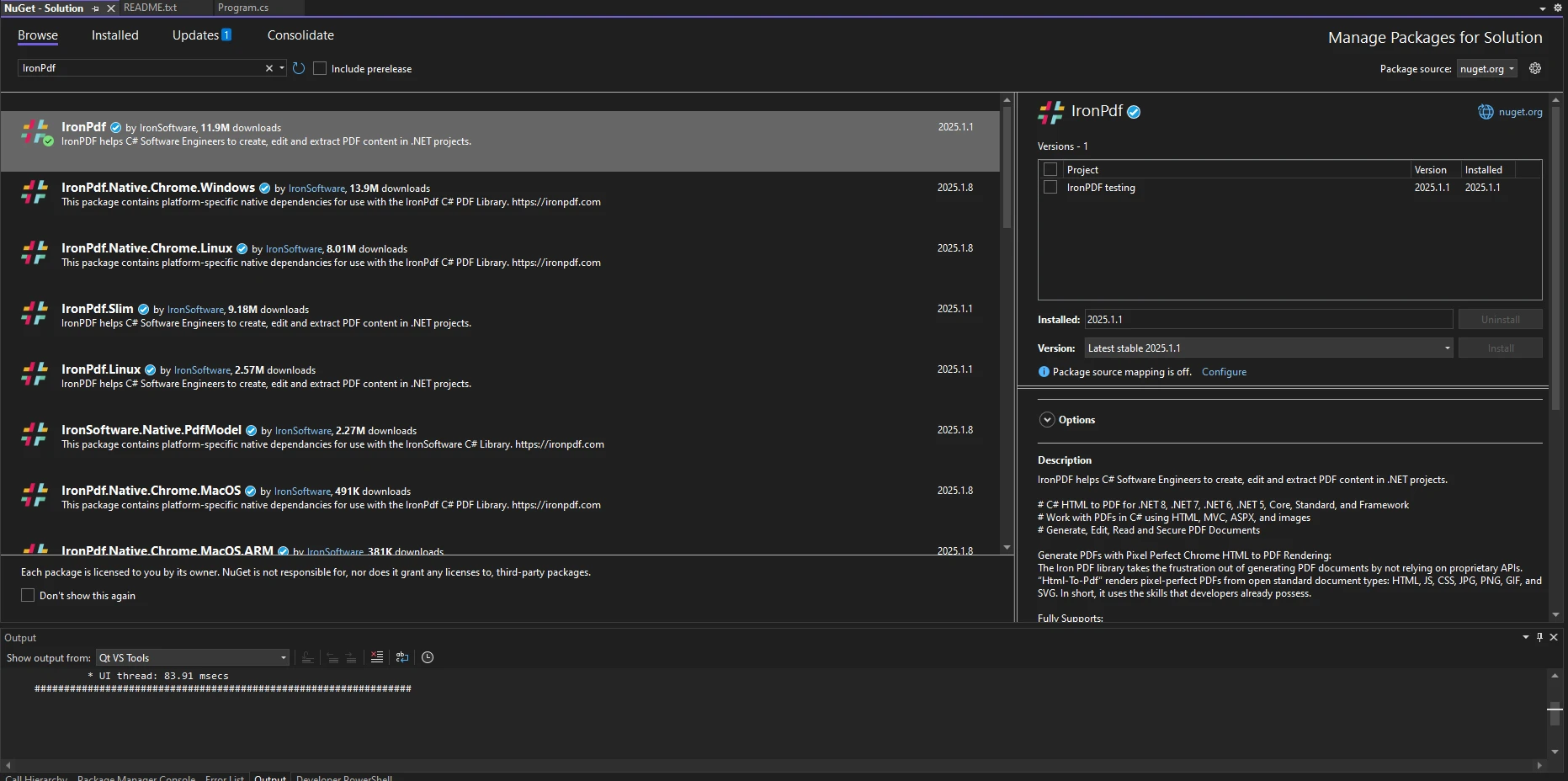
4. Instala la última versión de IronPDF.
Alternativamente, usa la Consola del Administrador de Paquetes NuGet:
```shell
:ProductInstall
```
### Basics of Directory.GetFiles in C#
El método `Directory.GetFiles` es parte del espacio de nombres `System.IO` y se utiliza para recuperar nombres de archivos de un sistema de archivos. Este método, un miembro estático público de la clase Directory, simplifica el acceso a rutas de archivos. Por ejemplo:
```csharp
string[] pdfFiles = Directory.GetFiles("C:\\Documents\\PDFs", "*.pdf");
```
Este fragmento recupera todos los archivos PDF dentro del directorio actual. Combinando este método con IronPDF, puedes crear soluciones automatizadas para procesar múltiples archivos a la vez. También puedes aplicar un patrón de búsqueda especificado, definido como un patrón de cadena, para filtrar archivos según sus extensiones o nombres.
Puedes refinar aún más tu lógica de recuperación de archivos especificando opciones de búsqueda, como incluir subdirectorios de búsqueda:
```csharp
string[] pdfFiles = Directory.GetFiles("C:\\Documents\\PDFs", "*.pdf", SearchOption.AllDirectories);
```
Esto asegura que los archivos en carpetas anidadas también se incluyan, recuperando la ruta absoluta de cada archivo y haciendo que el enfoque sea versátil para varios escenarios.
## Casos prácticos
### Obtención y procesamiento de archivos PDF desde un directorio
#### Ejemplo: Carga de todos los archivos PDF para su procesamiento
Usando `Directory.GetFiles`, puede iterar sobre todos los archivos PDF en un directorio y procesarlos con IronPDF:
```csharp
string[] pdfFiles = Directory.GetFiles("C:\\Documents\\PDFs", "*.pdf");
foreach (string file in pdfFiles)
{
    // Load the PDF with IronPDF
    var pdf = PdfDocument.FromFile(file);
    Console.WriteLine($"Processing file: {Path.GetFileName(file)}");
}
```
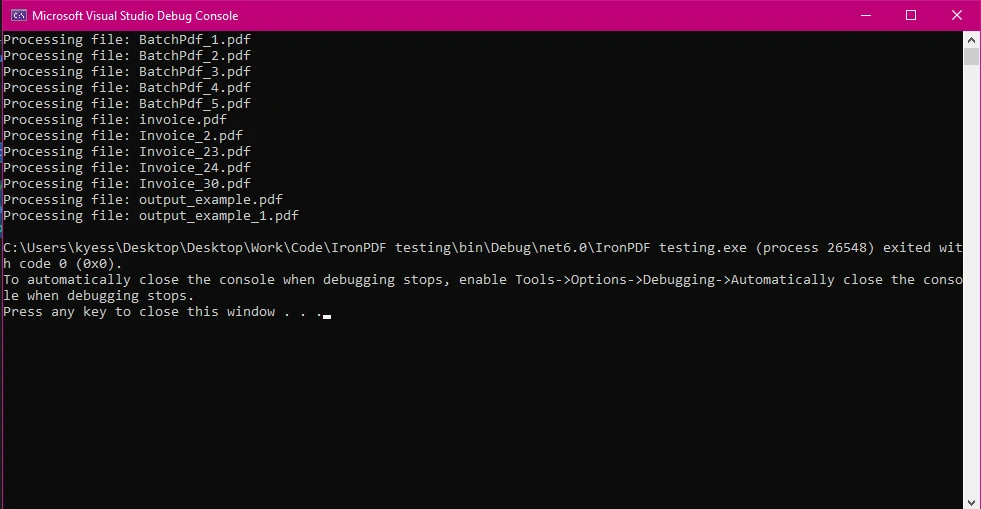
Este ejemplo demuestra cómo cargar múltiples PDFs desde un directorio para su procesamiento. Una vez cargados, puedes realizar una variedad de operaciones, como extraer texto, añadir anotaciones o generar nuevos PDFs basados en su contenido.
### Filtrado de archivos mediante patrones de búsqueda
#### Ejemplo: Selección de PDF por nombre o fecha
Puede combinar `Directory.GetFiles` con LINQ para filtrar archivos según criterios como la fecha de creación o modificación:
```csharp
string[] pdfFiles = Directory.GetFiles("C:\\Documents\\PDFs", "*.pdf");
var recentFiles = pdfFiles.Where(file => File.GetLastWriteTime(file) > DateTime.Now.AddDays(-7));
foreach (string file in recentFiles)
{
Console.WriteLine($"Recent file: {Path.GetFileName(file)}");
}
```
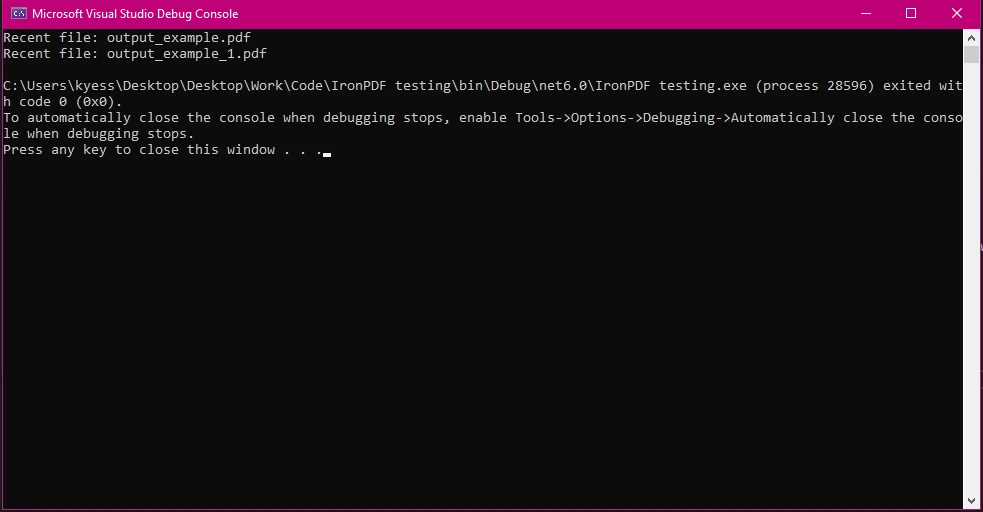
Este enfoque asegura que solo se procesen archivos relevantes, ahorrando tiempo y recursos computacionales. Por ejemplo, podrías usar este método para procesar solo las últimas facturas o informes generados en la última semana.
### Operaciones por lotes con IronPDF y Directory.GetFiles
#### Ejemplo: Añadir varios PDF
Puedes agregar múltiples PDFs desde un directorio en un solo archivo:
```csharp
string[] pdfFiles = Directory.GetFiles("C:\\Documents\\PDFs", "*.pdf");
var pdfAppend = new PdfDocument(200, 200);
foreach (string file in pdfFiles)
{
var pdf = PdfDocument.FromFile(file);
pdfAppend.AppendPdf(pdf);
}
pdfAppend.SaveAs("LargePdf.pdf");
Console.WriteLine("PDFs Appended successfully!");
```
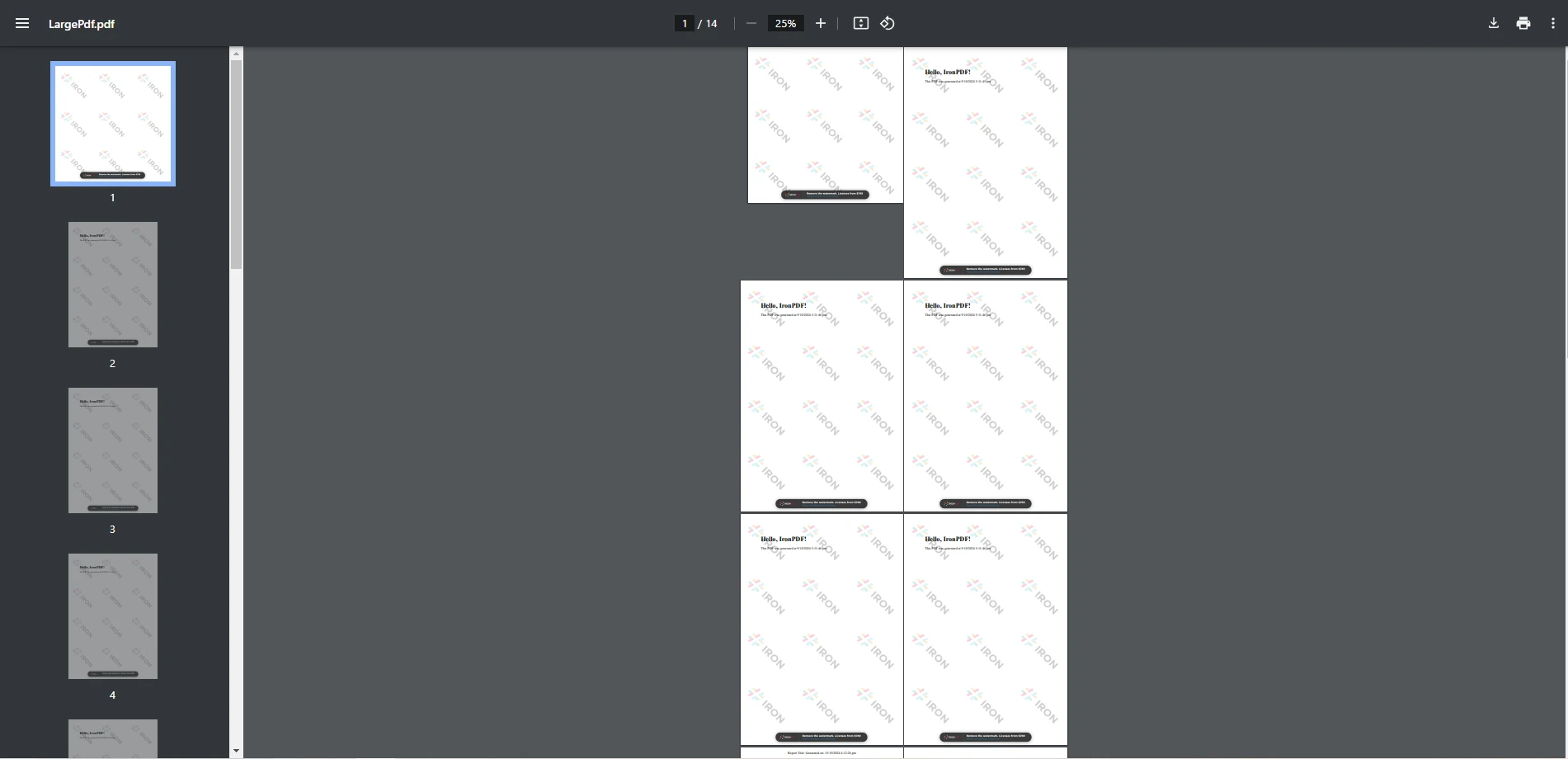
Este enfoque es particularmente útil para crear informes consolidados, archivar múltiples documentos o preparar presentaciones. Automatizando este proceso, puedes manejar grandes colecciones de archivos sin esfuerzo.
## Ejecución paso a paso
### Configuración del proyecto
#### Raspado de código: Inicializar IronPDF y trabajar con archivos PDF
El siguiente código demuestra cómo se puede usar IronPDF junto a Directory.GetFiles para cargar y trabajar con documentos PDF.
```csharp
using IronPdf;
using System;
using System.IO;
class Program
{
static void Main()
{
// Retrieve all PDF file paths from the specified directory
string[] pdfFiles = Directory.GetFiles("C:\\Users\\kyess\\Documents\\PDFs", "*.pdf");
// Initialize a PdfDocument
var pdfAppend = new PdfDocument(200, 200);
// Create a text annotation to add to each PDF
TextAnnotation annotation = new TextAnnotation(0)
{
Contents = "Processed by IronPDF",
X = 50,
Y = 50,
};
// Iterate over each file path, load, annotate, and save
foreach (string file in pdfFiles)
{
var pdf = PdfDocument.FromFile(file);
pdf.Annotations.Add(annotation);
pdf.SaveAs(file);
}
}
}
```
### Salida de consola
### Explicación
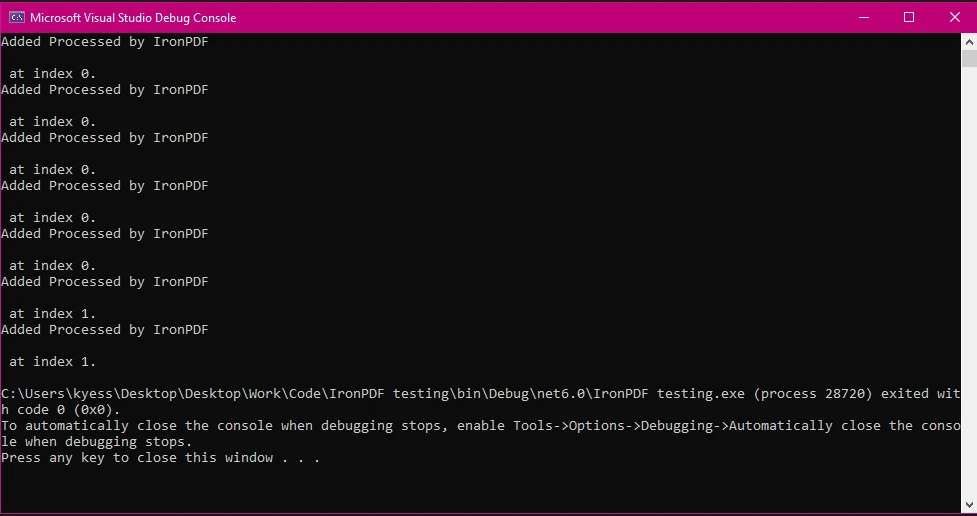
Este código muestra cómo agregar una anotación de texto a todos los archivos PDF en un directorio especificado usando IronPDF en C#. El programa comienza recuperando todas las rutas de archivos PDF de la carpeta proporcionada usando el método `Directory.GetFiles`, que se basa en una ruta de cadena para especificar el directorio y admite el filtrado por extensión de archivo, devolviendo una matriz de nombres de archivos de cadena que contiene las rutas de todos los archivos PDF con la extensión ".pdf".
Luego, el código inicializa un objeto `PdfDocument` (`pdfAppend`) con dimensiones 200x200, aunque esta instancia específica no se utiliza directamente en el bucle. Luego crea un `TextAnnotation` con el texto "Procesado por IronPDF" posicionado en las coordenadas (50, 50). Esta anotación se añadirá a cada archivo PDF.
En el bucle foreach, el programa itera a través de cada ruta de archivo en la matriz `pdfFiles`. Para cada archivo, carga el PDF usando `PdfDocument.FromFile(file)`, agrega la anotación previamente creada a la colección de anotaciones del PDF, y luego guarda el PDF actualizado de nuevo a su ruta absoluta usando `pdf.SaveAs(file)`.
Este proceso asegura que cada PDF en el directorio especificado reciba la misma anotación y se guarden con la anotación incluida.
## Consejos de rendimiento y buenas prácticas
### Optimización de la recuperación de archivos con Directory.GetFiles
Utilice métodos asíncronos como `Directory.EnumerateFiles` para un mejor rendimiento con directorios grandes.
### Gestión eficaz de un gran número de archivos
Procesa archivos en lotes más pequeños para reducir el consumo de memoria:
```csharp
foreach (var batch in pdfFiles.Batch(10))
{
foreach (string file in batch)
{
var pdf = PdfDocument.FromFile(file);
// Process PDF
}
}
```
### Manejo de errores en el procesamiento de archivos y la generación de PDF
Envuelve el procesamiento de archivos en un bloque try-catch para manejar excepciones:
```csharp
try
{
var pdf = PdfDocument.FromFile(file);
// Process PDF
}
catch (Exception ex)
{
Console.WriteLine($"Error processing {file}: {ex.Message}");
}
```
## Conclusión
Combinar el poder de `Directory.GetFiles` con IronPDF permite a los desarrolladores gestionar y procesar archivos PDF eficientemente a gran escala. Con este enfoque, tareas como el procesamiento por lotes, la fusión, el filtrado y la transformación de PDFs se vuelven fluídas, reduciendo significativamente el esfuerzo manual y mejorando la productividad. Aprovechando las capacidades avanzadas de IronPDF, incluyendo la adición de encabezados, metadatos y estilos, los desarrolladores pueden crear documentos PDF de alta calidad y profesionales adaptados a sus requerimientos.
A lo largo de esta guía, hemos explorado cómo usar `Directory.GetFiles` para recuperar y manipular PDFs con IronPDF. Desde la configuración de un proyecto hasta la implementación de casos prácticos de uso, cubrimos técnicas esenciales que pueden aplicarse a escenarios del mundo real. Ya sea que estés trabajando en la automatización de flujos de trabajo de documentos o mejorando la funcionalidad de tus aplicaciones .NET, esta combinación ofrece una solución robusta y escalable.
Si estás listo para profundizar más en IronPDF y explorar características avanzadas, considera consultar la [documentación oficial](/docs/), permitiéndote probar la biblioteca en tus propios proyectos.
C# out parámetro. Al emparejar esta funcionalidad con IronPDF, los desarrolladores pueden automatizar flujos de trabajo PDF a gran escala. Por ejemplo, puede usar Directory.GetFiles para localizar todos los archivos PDF en una carpeta, luego procesarlos en bloque usando IronPDF para tareas como combinar, agregar anotaciones o generar informes. Esta combinación permite operaciones simplificadas, especialmente al manejar muchos archivos en el sistema de archivos.
¿Qué es IronPDF?
IronPDF es una robusta biblioteca .NET que proporciona a los desarrolladores herramientas para trabajar sin problemas con archivos PDF. Con IronPDF, puedes crear, editar, combinar, dividir y manipular PDFs usando métodos simples e intuitivos. Incluye potentes características como la conversión de HTML a PDF, estilos avanzados y manejo de metadatos. Para los desarrolladores .NET que trabajan en aplicaciones que requieren procesamiento de PDF, IronPDF es una herramienta invaluable que simplifica los flujos de trabajo y mejora la productividad.
Empezando
Instalación de IronPDF
Instalación de paquetes NuGet
Para empezar, añade IronPDF a tu proyecto a través de NuGet:
Abra su proyecto en Visual Studio.
Ve al menú Herramientas y selecciona Administrador de Paquetes NuGet > Administrar Paquetes NuGet para la Solución.
Busca IronPDF en el administrador de paquetes NuGet.
Instala la última versión de IronPDF.
Alternativamente, usa la Consola del Administrador de Paquetes NuGet:
PM > Install-Package IronPdf
Install-Package IronPdf
Basics of Directory.GetFiles in C#
El método Directory.GetFiles es parte del espacio de nombres System.IO y se utiliza para recuperar nombres de archivos de un sistema de archivos. Este método, un miembro estático público de la clase Directory, simplifica el acceso a rutas de archivos. Por ejemplo:
Dim pdfFiles() AsString = Directory.GetFiles("C:\Documents\PDFs", "*.pdf")
Dim pdfFiles() As String = Directory.GetFiles("C:\Documents\PDFs", "*.pdf")
Este fragmento recupera todos los archivos PDF dentro del directorio actual. Combinando este método con IronPDF, puedes crear soluciones automatizadas para procesar múltiples archivos a la vez. También puedes aplicar un patrón de búsqueda especificado, definido como un patrón de cadena, para filtrar archivos según sus extensiones o nombres.
Puedes refinar aún más tu lógica de recuperación de archivos especificando opciones de búsqueda, como incluir subdirectorios de búsqueda:
Dim pdfFiles() AsString = Directory.GetFiles("C:\Documents\PDFs", "*.pdf", SearchOption.AllDirectories)
Dim pdfFiles() As String = Directory.GetFiles("C:\Documents\PDFs", "*.pdf", SearchOption.AllDirectories)
Esto asegura que los archivos en carpetas anidadas también se incluyan, recuperando la ruta absoluta de cada archivo y haciendo que el enfoque sea versátil para varios escenarios.
Casos prácticos
Obtención y procesamiento de archivos PDF desde un directorio
Ejemplo: Carga de todos los archivos PDF para su procesamiento
Usando Directory.GetFiles, puede iterar sobre todos los archivos PDF en un directorio y procesarlos con IronPDF:
string[] pdfFiles = Directory.GetFiles("C:\\Documents\\PDFs", "*.pdf");foreach (string file in pdfFiles){ // Load the PDF with IronPDF var pdf = PdfDocument.FromFile(file);Console.WriteLine($"Processing file: {Path.GetFileName(file)}");}
string[] pdfFiles = Directory.GetFiles("C:\\Documents\\PDFs", "*.pdf");
foreach (string file in pdfFiles)
{
    // Load the PDF with IronPDF
    var pdf = PdfDocument.FromFile(file);
    Console.WriteLine($"Processing file: {Path.GetFileName(file)}");
}
Dim pdfFiles() AsString = Directory.GetFiles("C:\Documents\PDFs", "*.pdf")For Each file AsStringIn pdfFiles ' Load the PDF with IronPDF Dim pdf = PdfDocument.FromFile(file)Console.WriteLine($"Processing file: {Path.GetFileName(file)}")Next file
Dim pdfFiles() As String = Directory.GetFiles("C:\Documents\PDFs", "*.pdf")
For Each file As String In pdfFiles
	' Load the PDF with IronPDF
	Dim pdf = PdfDocument.FromFile(file)
	Console.WriteLine($"Processing file: {Path.GetFileName(file)}")
Next file
Este ejemplo demuestra cómo cargar múltiples PDFs desde un directorio para su procesamiento. Una vez cargados, puedes realizar una variedad de operaciones, como extraer texto, añadir anotaciones o generar nuevos PDFs basados en su contenido.
Filtrado de archivos mediante patrones de búsqueda
Ejemplo: Selección de PDF por nombre o fecha
Puede combinar Directory.GetFiles con LINQ para filtrar archivos según criterios como la fecha de creación o modificación:
Dim pdfFiles() AsString = Directory.GetFiles("C:\Documents\PDFs", "*.pdf")Dim recentFiles = pdfFiles.Where(Function(file) File.GetLastWriteTime(file) > DateTime.Now.AddDays(-7))For Each file AsStringIn recentFilesConsole.WriteLine($"Recent file: {Path.GetFileName(file)}")Next file
Dim pdfFiles() As String = Directory.GetFiles("C:\Documents\PDFs", "*.pdf")
Dim recentFiles = pdfFiles.Where(Function(file) File.GetLastWriteTime(file) > DateTime.Now.AddDays(-7))
For Each file As String In recentFiles
	Console.WriteLine($"Recent file: {Path.GetFileName(file)}")
Next file
Este enfoque asegura que solo se procesen archivos relevantes, ahorrando tiempo y recursos computacionales. Por ejemplo, podrías usar este método para procesar solo las últimas facturas o informes generados en la última semana.
Operaciones por lotes con IronPDF y Directory.GetFiles
Ejemplo: Añadir varios PDF
Puedes agregar múltiples PDFs desde un directorio en un solo archivo:
string[] pdfFiles = Directory.GetFiles("C:\\Documents\\PDFs", "*.pdf");var pdfAppend = new PdfDocument(200, 200);foreach (string file in pdfFiles){ var pdf = PdfDocument.FromFile(file); pdfAppend.AppendPdf(pdf);}pdfAppend.SaveAs("LargePdf.pdf");Console.WriteLine("PDFs Appended successfully!");
string[] pdfFiles = Directory.GetFiles("C:\\Documents\\PDFs", "*.pdf");
var pdfAppend = new PdfDocument(200, 200);
foreach (string file in pdfFiles)
{
    var pdf = PdfDocument.FromFile(file);
    pdfAppend.AppendPdf(pdf);
}
pdfAppend.SaveAs("LargePdf.pdf");
Console.WriteLine("PDFs Appended successfully!");
Dim pdfFiles() AsString = Directory.GetFiles("C:\Documents\PDFs", "*.pdf")Dim pdfAppend = New PdfDocument(200, 200)For Each file AsStringIn pdfFiles Dim pdf = PdfDocument.FromFile(file) pdfAppend.AppendPdf(pdf)Next filepdfAppend.SaveAs("LargePdf.pdf")Console.WriteLine("PDFs Appended successfully!")
Dim pdfFiles() As String = Directory.GetFiles("C:\Documents\PDFs", "*.pdf")
Dim pdfAppend = New PdfDocument(200, 200)
For Each file As String In pdfFiles
	Dim pdf = PdfDocument.FromFile(file)
	pdfAppend.AppendPdf(pdf)
Next file
pdfAppend.SaveAs("LargePdf.pdf")
Console.WriteLine("PDFs Appended successfully!")
Este enfoque es particularmente útil para crear informes consolidados, archivar múltiples documentos o preparar presentaciones. Automatizando este proceso, puedes manejar grandes colecciones de archivos sin esfuerzo.
Ejecución paso a paso
Configuración del proyecto
Raspado de código: Inicializar IronPDF y trabajar con archivos PDF
El siguiente código demuestra cómo se puede usar IronPDF junto a Directory.GetFiles para cargar y trabajar con documentos PDF.
using IronPdf;using System;using System.IO;class Program{ static voidMain() { // Retrieve all PDF file paths from the specified directory string[] pdfFiles = Directory.GetFiles("C:\\Users\\kyess\\Documents\\PDFs", "*.pdf"); // Initialize a PdfDocument var pdfAppend = new PdfDocument(200, 200); // Create a text annotation to add to each PDF TextAnnotation annotation = new TextAnnotation(0) {Contents = "Processed by IronPDF",X = 50,Y = 50, }; // Iterate over each file path, load, annotate, and save foreach (string file in pdfFiles) { var pdf = PdfDocument.FromFile(file); pdf.Annotations.Add(annotation); pdf.SaveAs(file); } }}
using IronPdf;
using System;
using System.IO;

class Program
{
    static void Main()
    {
        // Retrieve all PDF file paths from the specified directory
        string[] pdfFiles = Directory.GetFiles("C:\\Users\\kyess\\Documents\\PDFs", "*.pdf");

        // Initialize a PdfDocument
        var pdfAppend = new PdfDocument(200, 200);

        // Create a text annotation to add to each PDF
        TextAnnotation annotation = new TextAnnotation(0)
        {
            Contents = "Processed by IronPDF",
            X = 50,
            Y = 50,
        };

        // Iterate over each file path, load, annotate, and save
        foreach (string file in pdfFiles)
        {
            var pdf = PdfDocument.FromFile(file);
            pdf.Annotations.Add(annotation);
            pdf.SaveAs(file);
        }
    }
}
ImportsIronPdfImportsSystemImportsSystem.IOFriend Class ProgramShared Sub Main() ' Retrieve all PDF file paths from the specified directory Dim pdfFiles() AsString = Directory.GetFiles("C:\Users\kyess\Documents\PDFs", "*.pdf") ' Initialize a PdfDocument Dim pdfAppend = New PdfDocument(200, 200) ' Create a text annotation to add to each PDF Dim annotation As New TextAnnotation(0) With { .Contents = "Processed by IronPDF", .X = 50, .Y = 50 } ' Iterate over each file path, load, annotate, and save For Each file AsStringIn pdfFiles Dim pdf = PdfDocument.FromFile(file) pdf.Annotations.Add(annotation) pdf.SaveAs(file) Next file End SubEnd Class
Imports IronPdf
Imports System
Imports System.IO

Friend Class Program
	Shared Sub Main()
		' Retrieve all PDF file paths from the specified directory
		Dim pdfFiles() As String = Directory.GetFiles("C:\Users\kyess\Documents\PDFs", "*.pdf")

		' Initialize a PdfDocument
		Dim pdfAppend = New PdfDocument(200, 200)

		' Create a text annotation to add to each PDF
		Dim annotation As New TextAnnotation(0) With {
			.Contents = "Processed by IronPDF",
			.X = 50,
			.Y = 50
		}

		' Iterate over each file path, load, annotate, and save
		For Each file As String In pdfFiles
			Dim pdf = PdfDocument.FromFile(file)
			pdf.Annotations.Add(annotation)
			pdf.SaveAs(file)
		Next file
	End Sub
End Class
Salida de consola
Explicación
Este código muestra cómo agregar una anotación de texto a todos los archivos PDF en un directorio especificado usando IronPDF en C#. El programa comienza recuperando todas las rutas de archivos PDF de la carpeta proporcionada usando el método Directory.GetFiles, que se basa en una ruta de cadena para especificar el directorio y admite el filtrado por extensión de archivo, devolviendo una matriz de nombres de archivos de cadena que contiene las rutas de todos los archivos PDF con la extensión ".pdf".
Luego, el código inicializa un objeto PdfDocument (pdfAppend) con dimensiones 200x200, aunque esta instancia específica no se utiliza directamente en el bucle. Luego crea un TextAnnotation con el texto "Procesado por IronPDF" posicionado en las coordenadas (50, 50). Esta anotación se añadirá a cada archivo PDF.
En el bucle foreach, el programa itera a través de cada ruta de archivo en la matriz pdfFiles. Para cada archivo, carga el PDF usando PdfDocument.FromFile(file), agrega la anotación previamente creada a la colección de anotaciones del PDF, y luego guarda el PDF actualizado de nuevo a su ruta absoluta usando pdf.SaveAs(file).
Este proceso asegura que cada PDF en el directorio especificado reciba la misma anotación y se guarden con la anotación incluida.
Consejos de rendimiento y buenas prácticas
Optimización de la recuperación de archivos con Directory.GetFiles
Utilice métodos asíncronos como Directory.EnumerateFiles para un mejor rendimiento con directorios grandes.
Gestión eficaz de un gran número de archivos
Procesa archivos en lotes más pequeños para reducir el consumo de memoria:
foreach (var batch in pdfFiles.Batch(10)){ foreach (string file in batch) { var pdf = PdfDocument.FromFile(file); // Process PDF }}
foreach (var batch in pdfFiles.Batch(10))
{
    foreach (string file in batch)
    {
        var pdf = PdfDocument.FromFile(file);
        // Process PDF
    }
}
For Each batch In pdfFiles.Batch(10) For Each file AsStringIn batch Dim pdf = PdfDocument.FromFile(file) ' Process PDF Next fileNext batch
For Each batch In pdfFiles.Batch(10)
	For Each file As String In batch
		Dim pdf = PdfDocument.FromFile(file)
		' Process PDF
	Next file
Next batch
Manejo de errores en el procesamiento de archivos y la generación de PDF
Envuelve el procesamiento de archivos en un bloque try-catch para manejar excepciones:
try{ var pdf = PdfDocument.FromFile(file); // Process PDF}catch (Exception ex){Console.WriteLine($"Error processing {file}: {ex.Message}");}
try
{
    var pdf = PdfDocument.FromFile(file);
    // Process PDF
}
catch (Exception ex)
{
    Console.WriteLine($"Error processing {file}: {ex.Message}");
}
Try Dim pdf = PdfDocument.FromFile(file) ' Process PDFCatch ex AsExceptionConsole.WriteLine($"Error processing {file}: {ex.Message}")EndTry
Try
	Dim pdf = PdfDocument.FromFile(file)
	' Process PDF
Catch ex As Exception
	Console.WriteLine($"Error processing {file}: {ex.Message}")
End Try
Conclusión
Combinar el poder de Directory.GetFiles con IronPDF permite a los desarrolladores gestionar y procesar archivos PDF eficientemente a gran escala. Con este enfoque, tareas como el procesamiento por lotes, la fusión, el filtrado y la transformación de PDFs se vuelven fluídas, reduciendo significativamente el esfuerzo manual y mejorando la productividad. Aprovechando las capacidades avanzadas de IronPDF, incluyendo la adición de encabezados, metadatos y estilos, los desarrolladores pueden crear documentos PDF de alta calidad y profesionales adaptados a sus requerimientos.
A lo largo de esta guía, hemos explorado cómo usar Directory.GetFiles para recuperar y manipular PDFs con IronPDF. Desde la configuración de un proyecto hasta la implementación de casos prácticos de uso, cubrimos técnicas esenciales que pueden aplicarse a escenarios del mundo real. Ya sea que estés trabajando en la automatización de flujos de trabajo de documentos o mejorando la funcionalidad de tus aplicaciones .NET, esta combinación ofrece una solución robusta y escalable.
Si estás listo para profundizar más en IronPDF y explorar características avanzadas, considera consultar la documentación oficial, permitiéndote probar la biblioteca en tus propios proyectos.
Jacob Mellor es Director de Tecnología de Iron Software y un ingeniero visionario pionero en la tecnología C# PDF. Como desarrollador original de la base de código principal de Iron Software, ha dado forma a la arquitectura de productos de la empresa desde su creación, transformándola, junto con el director ejecutivo Cameron Rimington, en una empresa de más de 50 personas que presta servicios a la NASA, Tesla y organismos gubernamentales de todo el mundo.