using IronPdf;

// Disable local disk access or cross-origin requests
Installation.EnableWebSecurity = true;

// Instantiate Renderer
var renderer = new ChromePdfRenderer();

// Create a PDF from a HTML string using C#
var pdf = renderer.RenderHtmlAsPdf("<h1>Hello World</h1>");

// Export to a file or Stream
pdf.SaveAs("output.pdf");

// Advanced Example with HTML Assets
// Load external html assets: Images, CSS and JavaScript.
// An optional BasePath 'C:\site\assets\' is set as the file location to load assets from
var myAdvancedPdf = renderer.RenderHtmlAsPdf("<img src='icons/iron.png'>", @"C:\site\assets\");
myAdvancedPdf.SaveAs("html-with-assets.pdf");
using IronPdf;// Disable local disk access or cross-origin requestsInstallation.EnableWebSecurity = true;// Instantiate Renderervar renderer = new ChromePdfRenderer();// Create a PDF from a HTML string using C#var pdf = renderer.RenderHtmlAsPdf("<h1>Hello World</h1>");// Export to a file or Streampdf.SaveAs("output.pdf");// Advanced Example with HTML Assets// Load external html assets: Images, CSS and JavaScript.// An optional BasePath 'C:\site\assets\' is set as the file location to load assets fromvar myAdvancedPdf = renderer.RenderHtmlAsPdf("<img src='icons/iron.png'>", @"C:\site\assets\");myAdvancedPdf.SaveAs("html-with-assets.pdf");
En las aplicaciones modernas de .NET, la generación dinámica de PDFs es un requisito común. Ya sea que estés creando informes, facturas u otros documentos, tener una forma simplificada de generar condicionalmente diferentes formatos de PDF es esencial. La [instrucción switch](https://learn.microsoft.com/en-us/dotnet/csharp/language-reference/statements/selection-statements#the-switch-statement) (también conocida como Select Case en algunos lenguajes) en C# es una herramienta poderosa para implementar tal lógica eficientemente. El switch case tomará alguna forma de tipo de dato (char, int, string, etc.) y lo comparará con los valores de los casos para ver si alguno coincide. Si coinciden, el código dentro de ese bloque de caso se ejecutará; de lo contrario, lo hará el caso predeterminado si los otros patrones de caso no coinciden.
[**IronPDF**](https://ironpdf.com) es una biblioteca robusta para la generación y manipulación de PDFs para desarrolladores .NET, permitiéndote convertir HTML, imágenes y varios otros contenidos en PDFs. Aprovechando la instrucción switch de C#, puedes personalizar tus PDFs en base a diferentes condiciones, como la entrada del usuario o el estado de los datos.
Este artículo te guiará a través del uso de la instrucción switch case de C# con IronPDF para crear contenido PDF dinámico y condicional con un buen nivel de control de flujo dentro del programa, elevando en última instancia la eficiencia y legibilidad de tus programas.
## ¿Qué es Select Case (Switch) en C#?
### Descripción general de Select Case en C#
En C#, la instrucción switch (que no debe confundirse con la expresión switch) proporciona una forma limpia y estructurada de manejar la lógica condicional basada en el valor de una variable. En lugar de usar múltiples instrucciones, como las instrucciones if-else, las instrucciones switch case permiten un código más fácil de leer y mantener. La instrucción switch buscará un patrón que coincida con la expresión de coincidencia pasada a la instrucción, antes de ejecutar el código dentro del caso predeterminado si no se encuentra ninguna coincidencia.
Aquí está la estructura básica de una instrucción switch en C#:
```csharp
switch (variable)
{
    case value1:
        // action for value1
        break;
    case value2:
        // action for value2
        break;
    default:
        // default action if no case matches
        break;
}
```
Cada caso representa un valor posible para la variable, y cuando se encuentra una coincidencia, se ejecuta el código dentro de ese bloque. Esto es particularmente útil cuando tienes múltiples resultados basados en una sola variable, como determinar qué tipo de documento generar en un PDF.
### Integración de Select Case con IronPDF para la generación dinámica de PDF
#### Uso de Select Case para la personalización del contenido PDF
Imagina que estás desarrollando un sistema donde se necesitan generar diferentes tipos de documentos dependiendo de la entrada del usuario. Por ejemplo, podrías necesitar crear un informe para un usuario y una factura para otro. Con la instrucción switch de C#, puedes fácilmente determinar qué tipo de PDF generar usando IronPDF.
Aquí hay un escenario de ejemplo: Basado en la selección de un usuario, puedes usar una instrucción switch para decidir qué contenido HTML renderizar en un documento PDF al coincidir la elección del usuario con el mismo tipo de valor de caso.
```csharp
switch (userChoice)
{
case "report":
// Code to generate a report PDF using IronPDF
break;
case "invoice":
// Code to generate an invoice PDF using IronPDF
break;
default:
// Code to generate a default PDF document using IronPDF
break;
}
```
En este ejemplo, el sistema puede generar múltiples tipos de documentos reutilizando las poderosas capacidades de renderización de PDFs de IronPDF mientras simplifica la toma de decisiones usando la instrucción switch.
## Ejecución paso a paso
Vamos a recorrer cómo integrar el switch de C# con IronPDF para generar PDFs. Para este ejemplo, manejaremos dos tipos de documentos: **Informes** y **Facturas**.
1. **Instalar IronPDF:** Primero, necesitarás instalar IronPDF para comenzar a usarlo en tus proyectos.
2. **Configurar contenido HTML para diferentes tipos de documentos:**
Crea plantillas HTML para tu informe y factura. Esto permite que IronPDF renderice estas plantillas en un PDF.
3. **Utilizar la instrucción switch para selección dinámica:**
Basado en la entrada del usuario (o cualquier otra variable), usa la instrucción switch para determinar qué plantilla HTML usar y pásala a IronPDF para la renderización del PDF.
### Instalación de IronPDF
Para comenzar a usar [IronPDF](https://ironpdf.com), primero deberá instalarlo. Si ya está instalado, puede pasar a la siguiente sección. De lo contrario, los siguientes pasos cubren cómo instalar la biblioteca IronPDF.
#### A través de la consola del gestor de paquetes NuGet
Para [instalar IronPDF](https://www.nuget.org/packages/IronPdf/) utilizando la Consola del Administrador de Paquetes NuGet, abra Visual Studio y navegue a la Consola del Administrador de Paquetes. Luego ejecute el siguiente comando:
```shell
:ProductInstall
```
#### Mediante el gestor de paquetes NuGet para la solución
Abriendo Visual Studio, ve a "Herramientas -> Administrador de Paquetes NuGet -> Administrar Paquetes NuGet para Solución" y busca IronPDF. Desde aquí, todo lo que necesitas hacer es seleccionar tu proyecto, hacer clic en "Instalar" y IronPDF se agregará a tu proyecto.
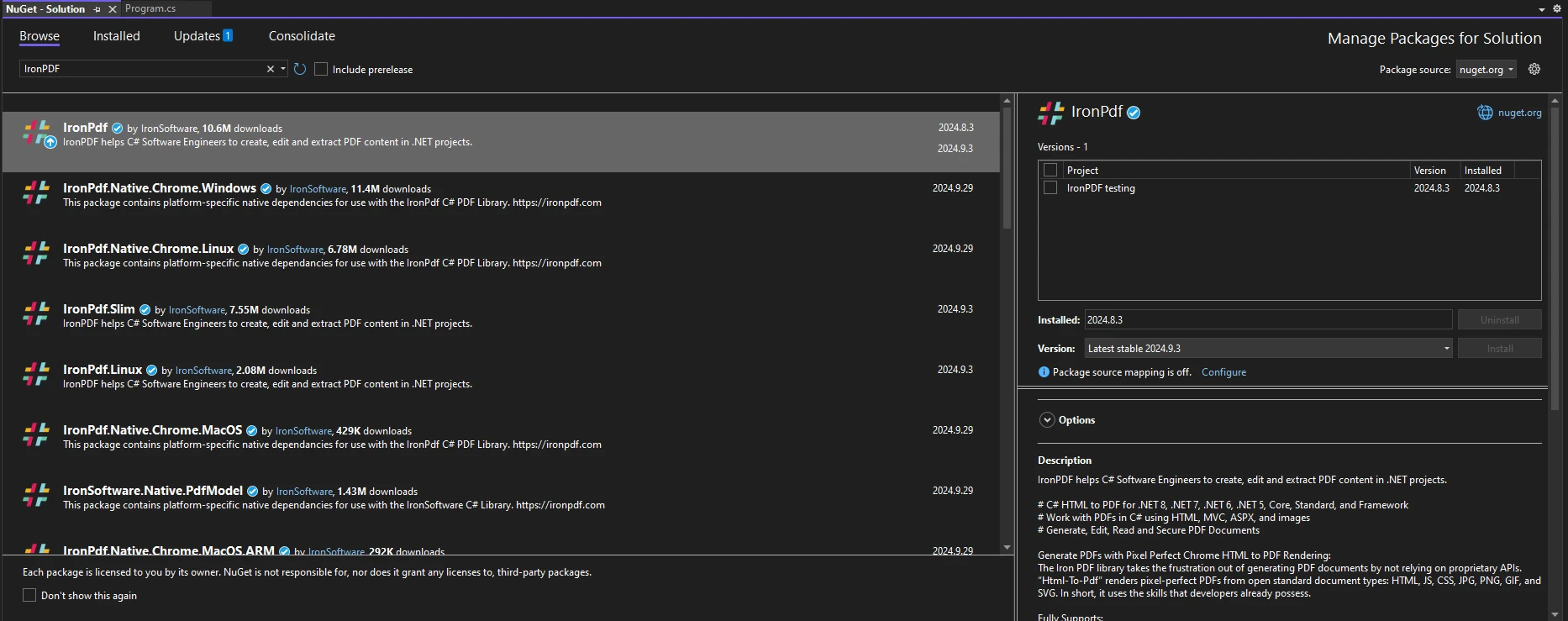
Una vez que haya instalado IronPDF, todo lo que necesita agregar para comenzar a usar IronPDF es la declaración correcta de using en la parte superior de su código:
```csharp
using IronPdf;
```
### Ejemplo: Generación de PDFs con diferentes estilos usando IronPDF
#### Estudio de caso: Generación de informes frente a facturas
Echemos un vistazo más de cerca a un caso de uso del mundo real. Supón que estás desarrollando un sistema para una empresa que necesita generar tanto informes como facturas para sus clientes. Dependiendo de lo que el usuario seleccione, se puede renderizar un contenido diferente en un PDF.
1. **Generación de informes:**
Cuando el usuario selecciona "Informe", el sistema genera un PDF con contenido específico para informes. Usando plantillas HTML, puedes personalizar fácilmente la estructura del contenido.
```csharp
case "Report":
string reportHtml = "<h1>Monthly Report</h1><p>This report provides a detailed overview of activities.</p>";
PdfDocument reportPdf = pdfRenderer.RenderHtmlAsPdf(reportHtml);
reportPdf.SaveAs("Monthly_Report.pdf");
break;
```
2. **Generación de facturas:**
Para las facturas, puedes incluir información de facturación y listas detalladas dentro del HTML, que IronPDF convertirá en un PDF de alta calidad.
```csharp
case "Invoice":
string invoiceHtml = "<h1>Invoice #12345</h1><p>Billing details and itemized list here.</p>";
PdfDocument invoicePdf = pdfRenderer.RenderHtmlAsPdf(invoiceHtml);
invoicePdf.SaveAs("Invoice_12345.pdf");
break;
```
Este enfoque asegura que mantengas la flexibilidad y reutilización en tu base de código, ya que puedes extender fácilmente la instrucción switch para manejar tipos de documentos adicionales.
### Ejemplo de código: Creación de informes y facturas con IronPDF y Switch Statements
En el siguiente ejemplo de código, tomaremos la entrada del usuario para pasar a la instrucción Switch para determinar qué PDF se generará.
```csharp
using IronPdf;
using System;
public class Program
{
public static void Main(string[] args)
{
Console.WriteLine("What do you want to create?");
Console.WriteLine("a. Report");
Console.WriteLine("b. Invoice");
var input = Console.ReadLine();
string docType;
if (input == "a")
{
GeneratePdf("Report");
}
else if (input == "b")
{
GeneratePdf("Invoice");
}
else
{
GeneratePdf(null);
}
}
public static void GeneratePdf(string docType)
{
ChromePdfRenderer renderer = new ChromePdfRenderer();
switch (docType)
{
case "Report":
string reportHtml = "<h1>Report</h1><p>This is a dynamically generated report.</p>";
PdfDocument reportPdf = renderer.RenderHtmlAsPdf(reportHtml);
reportPdf.SaveAs("Report.pdf");
break;
case "Invoice":
string invoiceHtml = "<h1>Invoice</h1><p>This is a dynamically generated invoice.</p>";
PdfDocument invoicePdf = renderer.RenderHtmlAsPdf(invoiceHtml);
invoicePdf.SaveAs("Invoice.pdf");
break;
default:
string defaultHtml = "<h1>Document</h1><p>This is a default PDF document.</p>";
PdfDocument defaultPdf = renderer.RenderHtmlAsPdf(defaultHtml);
defaultPdf.SaveAs("Default.pdf");
break;
}
}
}
```
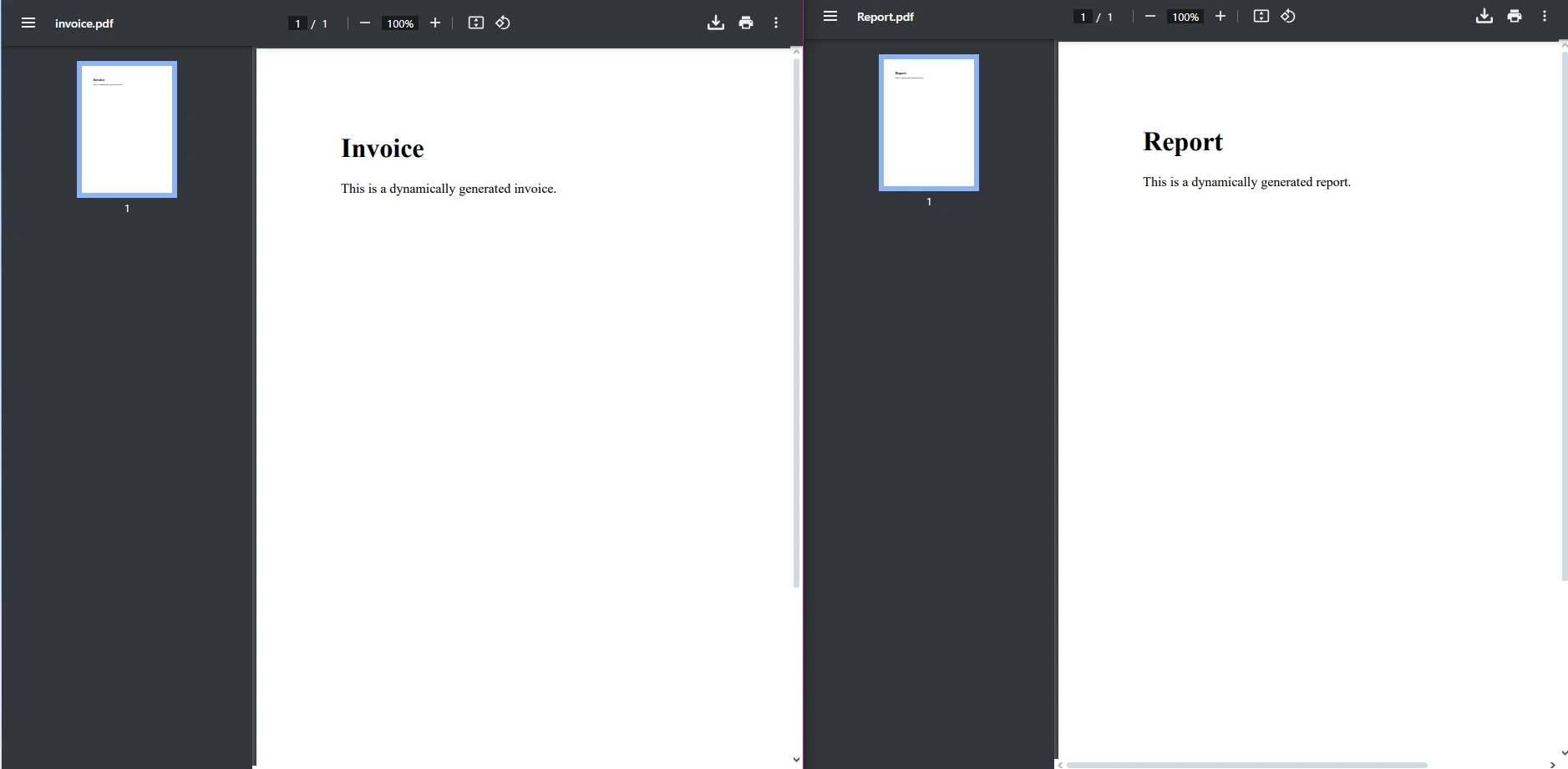
En este ejemplo, la instrucción switch controla qué tipo de documento se genera. Si el docType es "Informe", se creará un PDF de informe. Si es "Factura", se generará una factura. Si no se encuentra coincidencia, se crea un PDF predeterminado en su lugar.
## ¿Por qué elegir IronPDF para sus proyectos .NET?
IronPDF se destaca por su capacidad de renderizar HTML, CSS, JavaScript e incluso contenido C# dinámico directamente en PDFs. Al integrarlo con la instrucción switch de C#, puedes simplificar tu proceso de generación de documentos, haciéndolo más eficiente y mantenible.
Algunos beneficios clave de IronPDF incluyen:
* **Integración sencilla:** Convierte fácilmente [HTML](/examples/using-html-to-create-a-pdf/), [imágenes](/examples/image-to-pdf/) y más en PDFs con mínima configuración.
* **Conjunto completo de características:** IronPDF soporta características como encabezados, pies de página, marcas de agua y más.
* **Soporte multiplataforma:** Funciona en entornos .NET Core, .NET Framework y Azure.
Para saber más sobre el conjunto robusto de características que IronPDF tiene para ofrecer, asegúrate de revisar su útil [guía de cómo hacerlo](trial-license) disponible, puedes explorar todas sus características sin riesgo antes de comprometerte.
### Conclusión
Al aprovechar la instrucción switch case de C# y [IronPDF](/docs/), puedes crear documentos PDF dinámicos y personalizables con un esfuerzo mínimo. Ya sea que necesites generar informes, facturas u otros tipos de documentos, esta combinación ofrece flexibilidad y eficiencia. Usar instrucciones como la instrucción if funciona bien si estás procesando solo uno o dos resultados potenciales, pero las instrucciones switch pueden mejorar en gran medida la claridad de tu código cuando trabajas con múltiples resultados.
Usar el bloque switch para generar diferentes tipos de PDF es una gran manera de llevar IronPDF a un nuevo nivel. Con un gran conjunto de características ricas, gran rendimiento y compatibilidad multiplataforma, IronPDF es una poderosa herramienta de generación de PDF para tener a tu alcance. No te limites a creer en nuestra palabra: descarga la [prueba gratuita](trial-license) hoy mismo y comprueba por ti mismo cómo puede agilizar tus flujos de trabajo de PDF!
En las aplicaciones modernas de .NET, la generación dinámica de PDFs es un requisito común. Ya sea que estés creando informes, facturas u otros documentos, tener una forma simplificada de generar condicionalmente diferentes formatos de PDF es esencial. La instrucción switch (también conocida como Select Case en algunos lenguajes) en C# es una herramienta poderosa para implementar tal lógica eficientemente. El switch case tomará alguna forma de tipo de dato (char, int, string, etc.) y lo comparará con los valores de los casos para ver si alguno coincide. Si coinciden, el código dentro de ese bloque de caso se ejecutará; de lo contrario, lo hará el caso predeterminado si los otros patrones de caso no coinciden.
IronPDF es una biblioteca robusta para la generación y manipulación de PDFs para desarrolladores .NET, permitiéndote convertir HTML, imágenes y varios otros contenidos en PDFs. Aprovechando la instrucción switch de C#, puedes personalizar tus PDFs en base a diferentes condiciones, como la entrada del usuario o el estado de los datos.
Este artículo te guiará a través del uso de la instrucción switch case de C# con IronPDF para crear contenido PDF dinámico y condicional con un buen nivel de control de flujo dentro del programa, elevando en última instancia la eficiencia y legibilidad de tus programas.
¿Qué es Select Case (Switch) en C#?
Descripción general de Select Case en C#
En C#, la instrucción switch (que no debe confundirse con la expresión switch) proporciona una forma limpia y estructurada de manejar la lógica condicional basada en el valor de una variable. En lugar de usar múltiples instrucciones, como las instrucciones if-else, las instrucciones switch case permiten un código más fácil de leer y mantener. La instrucción switch buscará un patrón que coincida con la expresión de coincidencia pasada a la instrucción, antes de ejecutar el código dentro del caso predeterminado si no se encuentra ninguna coincidencia.
Aquí está la estructura básica de una instrucción switch en C#:
switch (variable){ case value1: // action for value1 break; case value2: // action for value2 break; default: // default action if no case matches break;}
switch (variable)
{
    case value1:
        // action for value1
        break;
    case value2:
        // action for value2
        break;
    default:
        // default action if no case matches
        break;
}
Select Case variable Case value1 ' action for value1 Case value2 ' action for value2 Case Else ' default action if no case matchesEnd Select
Select Case variable
	Case value1
		' action for value1
	Case value2
		' action for value2
	Case Else
		' default action if no case matches
End Select
Cada caso representa un valor posible para la variable, y cuando se encuentra una coincidencia, se ejecuta el código dentro de ese bloque. Esto es particularmente útil cuando tienes múltiples resultados basados en una sola variable, como determinar qué tipo de documento generar en un PDF.
Integración de Select Case con IronPDF para la generación dinámica de PDF
Uso de Select Case para la personalización del contenido PDF
Imagina que estás desarrollando un sistema donde se necesitan generar diferentes tipos de documentos dependiendo de la entrada del usuario. Por ejemplo, podrías necesitar crear un informe para un usuario y una factura para otro. Con la instrucción switch de C#, puedes fácilmente determinar qué tipo de PDF generar usando IronPDF.
Aquí hay un escenario de ejemplo: Basado en la selección de un usuario, puedes usar una instrucción switch para decidir qué contenido HTML renderizar en un documento PDF al coincidir la elección del usuario con el mismo tipo de valor de caso.
switch (userChoice){ case "report": // Code to generate a report PDF using IronPDF break; case "invoice": // Code to generate an invoice PDF using IronPDF break; default: // Code to generate a default PDF document using IronPDF break;}
switch (userChoice)
{
    case "report":
        // Code to generate a report PDF using IronPDF
        break;
    case "invoice":
        // Code to generate an invoice PDF using IronPDF
        break;
    default:
        // Code to generate a default PDF document using IronPDF
        break;
}
Select Case userChoice Case "report" ' Code to generate a report PDF using IronPDF Case "invoice" ' Code to generate an invoice PDF using IronPDF Case Else ' Code to generate a default PDF document using IronPDFEnd Select
Select Case userChoice
	Case "report"
		' Code to generate a report PDF using IronPDF
	Case "invoice"
		' Code to generate an invoice PDF using IronPDF
	Case Else
		' Code to generate a default PDF document using IronPDF
End Select
En este ejemplo, el sistema puede generar múltiples tipos de documentos reutilizando las poderosas capacidades de renderización de PDFs de IronPDF mientras simplifica la toma de decisiones usando la instrucción switch.
Ejecución paso a paso
Vamos a recorrer cómo integrar el switch de C# con IronPDF para generar PDFs. Para este ejemplo, manejaremos dos tipos de documentos: Informes y Facturas.
Instalar IronPDF: Primero, necesitarás instalar IronPDF para comenzar a usarlo en tus proyectos.
Configurar contenido HTML para diferentes tipos de documentos:
Crea plantillas HTML para tu informe y factura. Esto permite que IronPDF renderice estas plantillas en un PDF.
Utilizar la instrucción switch para selección dinámica:
Basado en la entrada del usuario (o cualquier otra variable), usa la instrucción switch para determinar qué plantilla HTML usar y pásala a IronPDF para la renderización del PDF.
Instalación de IronPDF
Para comenzar a usar IronPDF, primero deberá instalarlo. Si ya está instalado, puede pasar a la siguiente sección. De lo contrario, los siguientes pasos cubren cómo instalar la biblioteca IronPDF.
A través de la consola del gestor de paquetes NuGet
Para instalar IronPDF utilizando la Consola del Administrador de Paquetes NuGet, abra Visual Studio y navegue a la Consola del Administrador de Paquetes. Luego ejecute el siguiente comando:
PM > Install-Package IronPdf
Install-Package IronPdf
Mediante el gestor de paquetes NuGet para la solución
Abriendo Visual Studio, ve a "Herramientas -> Administrador de Paquetes NuGet -> Administrar Paquetes NuGet para Solución" y busca IronPDF. Desde aquí, todo lo que necesitas hacer es seleccionar tu proyecto, hacer clic en "Instalar" y IronPDF se agregará a tu proyecto.
Una vez que haya instalado IronPDF, todo lo que necesita agregar para comenzar a usar IronPDF es la declaración correcta de using en la parte superior de su código:
using IronPdf;
using IronPdf;
ImportsIronPdf
Imports IronPdf
Ejemplo: Generación de PDFs con diferentes estilos usando IronPDF
Estudio de caso: Generación de informes frente a facturas
Echemos un vistazo más de cerca a un caso de uso del mundo real. Supón que estás desarrollando un sistema para una empresa que necesita generar tanto informes como facturas para sus clientes. Dependiendo de lo que el usuario seleccione, se puede renderizar un contenido diferente en un PDF.
Generación de informes:
Cuando el usuario selecciona "Informe", el sistema genera un PDF con contenido específico para informes. Usando plantillas HTML, puedes personalizar fácilmente la estructura del contenido.
case "Report":
    string reportHtml = "<h1>Monthly Report</h1><p>This report provides a detailed overview of activities.</p>";
    PdfDocument reportPdf = pdfRenderer.RenderHtmlAsPdf(reportHtml);
    reportPdf.SaveAs("Monthly_Report.pdf");
    break;
case "Report":
    string reportHtml = "<h1>Monthly Report</h1><p>This report provides a detailed overview of activities.</p>";
    PdfDocument reportPdf = pdfRenderer.RenderHtmlAsPdf(reportHtml);
    reportPdf.SaveAs("Monthly_Report.pdf");
    break;
Case "Report" Dim reportHtml AsString = "<h1>Monthly Report</h1><p>This report provides a detailed overview of activities.</p>" Dim reportPdf AsPdfDocument = pdfRenderer.RenderHtmlAsPdf(reportHtml) reportPdf.SaveAs("Monthly_Report.pdf") break
Case "Report"
	Dim reportHtml As String = "<h1>Monthly Report</h1><p>This report provides a detailed overview of activities.</p>"
	Dim reportPdf As PdfDocument = pdfRenderer.RenderHtmlAsPdf(reportHtml)
	reportPdf.SaveAs("Monthly_Report.pdf")
	break
Generación de facturas:
Para las facturas, puedes incluir información de facturación y listas detalladas dentro del HTML, que IronPDF convertirá en un PDF de alta calidad.
case "Invoice":
    string invoiceHtml = "<h1>Invoice #12345</h1><p>Billing details and itemized list here.</p>";
    PdfDocument invoicePdf = pdfRenderer.RenderHtmlAsPdf(invoiceHtml);
    invoicePdf.SaveAs("Invoice_12345.pdf");
    break;
case "Invoice":
    string invoiceHtml = "<h1>Invoice #12345</h1><p>Billing details and itemized list here.</p>";
    PdfDocument invoicePdf = pdfRenderer.RenderHtmlAsPdf(invoiceHtml);
    invoicePdf.SaveAs("Invoice_12345.pdf");
    break;
Case "Invoice" Dim invoiceHtml AsString = "<h1>Invoice #12345</h1><p>Billing details and itemized list here.</p>" Dim invoicePdf AsPdfDocument = pdfRenderer.RenderHtmlAsPdf(invoiceHtml) invoicePdf.SaveAs("Invoice_12345.pdf") break
Case "Invoice"
	Dim invoiceHtml As String = "<h1>Invoice #12345</h1><p>Billing details and itemized list here.</p>"
	Dim invoicePdf As PdfDocument = pdfRenderer.RenderHtmlAsPdf(invoiceHtml)
	invoicePdf.SaveAs("Invoice_12345.pdf")
	break
Este enfoque asegura que mantengas la flexibilidad y reutilización en tu base de código, ya que puedes extender fácilmente la instrucción switch para manejar tipos de documentos adicionales.
Ejemplo de código: Creación de informes y facturas con IronPDF y Switch Statements
En el siguiente ejemplo de código, tomaremos la entrada del usuario para pasar a la instrucción Switch para determinar qué PDF se generará.
using IronPdf;using System;public class Program{ public static voidMain(string[] args) {Console.WriteLine("What do you want to create?");Console.WriteLine("a. Report");Console.WriteLine("b. Invoice"); var input = Console.ReadLine(); string docType; if (input == "a") {GeneratePdf("Report"); } else if (input == "b") {GeneratePdf("Invoice"); } else {GeneratePdf(null); } } public static voidGeneratePdf(string docType) { ChromePdfRenderer renderer = new ChromePdfRenderer(); switch (docType) { case "Report": string reportHtml = "<h1>Report</h1><p>This is a dynamically generated report.</p>"; PdfDocument reportPdf = renderer.RenderHtmlAsPdf(reportHtml); reportPdf.SaveAs("Report.pdf"); break; case "Invoice": string invoiceHtml = "<h1>Invoice</h1><p>This is a dynamically generated invoice.</p>"; PdfDocument invoicePdf = renderer.RenderHtmlAsPdf(invoiceHtml); invoicePdf.SaveAs("Invoice.pdf"); break; default: string defaultHtml = "<h1>Document</h1><p>This is a default PDF document.</p>"; PdfDocument defaultPdf = renderer.RenderHtmlAsPdf(defaultHtml); defaultPdf.SaveAs("Default.pdf"); break; } }}
using IronPdf;
using System;

public class Program
{
    public static void Main(string[] args)
    {
        Console.WriteLine("What do you want to create?");
        Console.WriteLine("a. Report");
        Console.WriteLine("b. Invoice");
        var input = Console.ReadLine();
        string docType;

        if (input == "a")
        {
            GeneratePdf("Report");
        }
        else if (input == "b")
        {
            GeneratePdf("Invoice");
        }
        else
        {
            GeneratePdf(null);
        }
    }

    public static void GeneratePdf(string docType)
    {
        ChromePdfRenderer renderer = new ChromePdfRenderer();
        switch (docType)
        {
            case "Report":
                string reportHtml = "<h1>Report</h1><p>This is a dynamically generated report.</p>";
                PdfDocument reportPdf = renderer.RenderHtmlAsPdf(reportHtml);
                reportPdf.SaveAs("Report.pdf");
                break;
            case "Invoice":
                string invoiceHtml = "<h1>Invoice</h1><p>This is a dynamically generated invoice.</p>";
                PdfDocument invoicePdf = renderer.RenderHtmlAsPdf(invoiceHtml);
                invoicePdf.SaveAs("Invoice.pdf");
                break;
            default:
                string defaultHtml = "<h1>Document</h1><p>This is a default PDF document.</p>";
                PdfDocument defaultPdf = renderer.RenderHtmlAsPdf(defaultHtml);
                defaultPdf.SaveAs("Default.pdf");
                break;
        }
    }
}
ImportsIronPdfImportsSystemPublic Class Program PublicShared Sub Main(ByVal args() AsString)Console.WriteLine("What do you want to create?")Console.WriteLine("a. Report")Console.WriteLine("b. Invoice") Dim input = Console.ReadLine() Dim docType AsString If input = "a" ThenGeneratePdf("Report") ElseIf input = "b" ThenGeneratePdf("Invoice") ElseGeneratePdf(Nothing) End If End Sub PublicShared Sub GeneratePdf(ByVal docType AsString) Dim renderer As New ChromePdfRenderer() Select Case docType Case "Report" Dim reportHtml AsString = "<h1>Report</h1><p>This is a dynamically generated report.</p>" Dim reportPdf AsPdfDocument = renderer.RenderHtmlAsPdf(reportHtml) reportPdf.SaveAs("Report.pdf") Case "Invoice" Dim invoiceHtml AsString = "<h1>Invoice</h1><p>This is a dynamically generated invoice.</p>" Dim invoicePdf AsPdfDocument = renderer.RenderHtmlAsPdf(invoiceHtml) invoicePdf.SaveAs("Invoice.pdf") Case Else Dim defaultHtml AsString = "<h1>Document</h1><p>This is a default PDF document.</p>" Dim defaultPdf AsPdfDocument = renderer.RenderHtmlAsPdf(defaultHtml) defaultPdf.SaveAs("Default.pdf") End Select End SubEnd Class
Imports IronPdf
Imports System

Public Class Program
	Public Shared Sub Main(ByVal args() As String)
		Console.WriteLine("What do you want to create?")
		Console.WriteLine("a. Report")
		Console.WriteLine("b. Invoice")
		Dim input = Console.ReadLine()
		Dim docType As String

		If input = "a" Then
			GeneratePdf("Report")
		ElseIf input = "b" Then
			GeneratePdf("Invoice")
		Else
			GeneratePdf(Nothing)
		End If
	End Sub

	Public Shared Sub GeneratePdf(ByVal docType As String)
		Dim renderer As New ChromePdfRenderer()
		Select Case docType
			Case "Report"
				Dim reportHtml As String = "<h1>Report</h1><p>This is a dynamically generated report.</p>"
				Dim reportPdf As PdfDocument = renderer.RenderHtmlAsPdf(reportHtml)
				reportPdf.SaveAs("Report.pdf")
			Case "Invoice"
				Dim invoiceHtml As String = "<h1>Invoice</h1><p>This is a dynamically generated invoice.</p>"
				Dim invoicePdf As PdfDocument = renderer.RenderHtmlAsPdf(invoiceHtml)
				invoicePdf.SaveAs("Invoice.pdf")
			Case Else
				Dim defaultHtml As String = "<h1>Document</h1><p>This is a default PDF document.</p>"
				Dim defaultPdf As PdfDocument = renderer.RenderHtmlAsPdf(defaultHtml)
				defaultPdf.SaveAs("Default.pdf")
		End Select
	End Sub
End Class
En este ejemplo, la instrucción switch controla qué tipo de documento se genera. Si el docType es "Informe", se creará un PDF de informe. Si es "Factura", se generará una factura. Si no se encuentra coincidencia, se crea un PDF predeterminado en su lugar.
¿Por qué elegir IronPDF para sus proyectos .NET?
IronPDF se destaca por su capacidad de renderizar HTML, CSS, JavaScript e incluso contenido C# dinámico directamente en PDFs. Al integrarlo con la instrucción switch de C#, puedes simplificar tu proceso de generación de documentos, haciéndolo más eficiente y mantenible.
Algunos beneficios clave de IronPDF incluyen:
Integración sencilla: Convierte fácilmente HTML, imágenes y más en PDFs con mínima configuración.
Conjunto completo de características: IronPDF soporta características como encabezados, pies de página, marcas de agua y más.
Soporte multiplataforma: Funciona en entornos .NET Core, .NET Framework y Azure.
Para saber más sobre el conjunto robusto de características que IronPDF tiene para ofrecer, asegúrate de revisar su útil guía de cómo hacerlo disponible, puedes explorar todas sus características sin riesgo antes de comprometerte.
Conclusión
Al aprovechar la instrucción switch case de C# y IronPDF, puedes crear documentos PDF dinámicos y personalizables con un esfuerzo mínimo. Ya sea que necesites generar informes, facturas u otros tipos de documentos, esta combinación ofrece flexibilidad y eficiencia. Usar instrucciones como la instrucción if funciona bien si estás procesando solo uno o dos resultados potenciales, pero las instrucciones switch pueden mejorar en gran medida la claridad de tu código cuando trabajas con múltiples resultados.
Usar el bloque switch para generar diferentes tipos de PDF es una gran manera de llevar IronPDF a un nuevo nivel. Con un gran conjunto de características ricas, gran rendimiento y compatibilidad multiplataforma, IronPDF es una poderosa herramienta de generación de PDF para tener a tu alcance. No te limites a creer en nuestra palabra: descarga la prueba gratuita hoy mismo y comprueba por ti mismo cómo puede agilizar tus flujos de trabajo de PDF!
Jacob Mellor es Director de Tecnología de Iron Software y un ingeniero visionario pionero en la tecnología C# PDF. Como desarrollador original de la base de código principal de Iron Software, ha dado forma a la arquitectura de productos de la empresa desde su creación, transformándola, junto con el director ejecutivo Cameron Rimington, en una empresa de más de 50 personas que presta servicios a la NASA, Tesla y organismos gubernamentales de todo el mundo.