using IronPdf;

// Disable local disk access or cross-origin requests
Installation.EnableWebSecurity = true;

// Instantiate Renderer
var renderer = new ChromePdfRenderer();

// Create a PDF from a HTML string using C#
var pdf = renderer.RenderHtmlAsPdf("<h1>Hello World</h1>");

// Export to a file or Stream
pdf.SaveAs("output.pdf");

// Advanced Example with HTML Assets
// Load external html assets: Images, CSS and JavaScript.
// An optional BasePath 'C:\site\assets\' is set as the file location to load assets from
var myAdvancedPdf = renderer.RenderHtmlAsPdf("<img src='icons/iron.png'>", @"C:\site\assets\");
myAdvancedPdf.SaveAs("html-with-assets.pdf");
using IronPdf;// Disable local disk access or cross-origin requestsInstallation.EnableWebSecurity = true;// Instantiate Renderervar renderer = new ChromePdfRenderer();// Create a PDF from a HTML string using C#var pdf = renderer.RenderHtmlAsPdf("<h1>Hello World</h1>");// Export to a file or Streampdf.SaveAs("output.pdf");// Advanced Example with HTML Assets// Load external html assets: Images, CSS and JavaScript.// An optional BasePath 'C:\site\assets\' is set as the file location to load assets fromvar myAdvancedPdf = renderer.RenderHtmlAsPdf("<img src='icons/iron.png'>", @"C:\site\assets\");myAdvancedPdf.SaveAs("html-with-assets.pdf");
PM >Install-Package IronPdf
Install-Package IronPdf
ACTUALIZACIONES PARA DESARROLLADORES
Mudblazor .NET 8 (Cómo Funciona para Desarrolladores)
Este tutorial introduce [MudBlazor](https://mudblazor.com/) e [IronPDF](/) en el contexto de .NET 8 para construir aplicaciones web. MudBlazor es una biblioteca de componentes para proyectos Blazor. Proporciona una gama de componentes de interfaz de usuario para construir aplicaciones Blazor del lado del cliente y servidor. IronPDF es una biblioteca que permite la creación, manipulación y lectura de documentos PDF en aplicaciones .NET.
Cubriremos cómo instalar MudBlazor, usar sus componentes para el desarrollo web e integrar IronPDF para la funcionalidad de PDF. Esta guía está dirigida a principiantes en Blazor y .NET, pero también será útil para desarrolladores intermedios que buscan aprender sobre MudBlazor y IronPDF.
Al final de este tutorial, sabrás cómo configurar una aplicación de servidor Blazor, integrar componentes MudBlazor y usar IronPDF para trabajar con archivos PDF. El enfoque está en el conocimiento práctico para construir aplicaciones web modernas con Visual Studio. Comencemos configurando nuestro entorno y creando un nuevo proyecto en .NET 8.
## Cómo empezar con MudBlazor
### Instalación de MudBlazor en proyectos .NET
Para usar MudBlazor en tu proyecto cliente o de servidor, primero asegúrate de tener instalado el .NET Framework. Luego, crea un nuevo proyecto Blazor en la carpeta de diseño del cliente o diseño del servidor, dependiendo de tus modelos de alojamiento. Usa la línea de comandos o Visual Studio para esto. En Visual Studio, elige la plantilla de aplicación Blazor.
A continuación, añade MudBlazor a tu proyecto. Abre el terminal o la Consola del Administrador de Paquetes y ejecuta el comando:
```shell
:InstallCmd Install-Package MudBlazor
```
Este comando añade MudBlazor a tu proyecto.
Después de instalar MudBlazor, ve a `_Imports.razor`. Añade lo siguiente:
```razor
@using MudBlazor
```
Esto hace que los componentes de MudBlazor estén disponibles en tu proyecto.
En `wwwroot/index.html` (o `Host.cshtml` para proyectos de servidor), agrega el CSS y JS de MudBlazor al mismo archivo, asegurando que el modo de renderización interactiva con la configuración de plantilla predeterminada sea compatible. Incluye la siguiente línea:
```html
<link href="_content/MudBlazor/MudBlazor.min.css" rel="stylesheet" />
```
También, añade:
```html
<script src="_content/MudBlazor/MudBlazor.min.js"></script>
```
Este paso garantiza que los estilos y funcionalidades de MudBlazor funcionen en tu aplicación.
### Un ejemplo de código básico: Construyendo un simple botón MudBlazor
Para demostrar MudBlazor en acción, añadamos un botón simple a un componente. Abre un archivo de componente Razor, como `Index.razor`. Añade el siguiente código para el botón MudBlazor:
```razor
<MudButton Variant="Variant.Filled" Color="Color.Primary" OnClick="@ButtonClick">
    Click Me
</MudButton>
@code {
    private void ButtonClick()
    {
        Console.WriteLine("Button clicked!");
    }
}
```
Este código inicia la creación de un botón que dice "Haz Clic". Cuando se hace clic, registra un mensaje en la consola, demostrando el renderizado del lado del servidor. Las propiedades `Variant` y `Color` personalizan la apariencia del botón.
## Características de MudBlazor
### Diálogos en MudBlazor
El componente de diálogo de MudBlazor simplifica la creación y gestión de diálogos. Primero, inyecta el `IDialogService` en tu componente:
```razor
@inject IDialogService DialogService
```
Luego, utiliza el siguiente método para abrir un diálogo:
```razor
private void OpenDialog()
{
    DialogService.Show<MyDialog>("My Dialog", new DialogParameters { ["Parameter1"] = "Value1" });
}
```
`MyDialog` es un componente Razor que representa el contenido del diálogo. Puedes pasar parámetros con `DialogParameters`.
### Red de datos
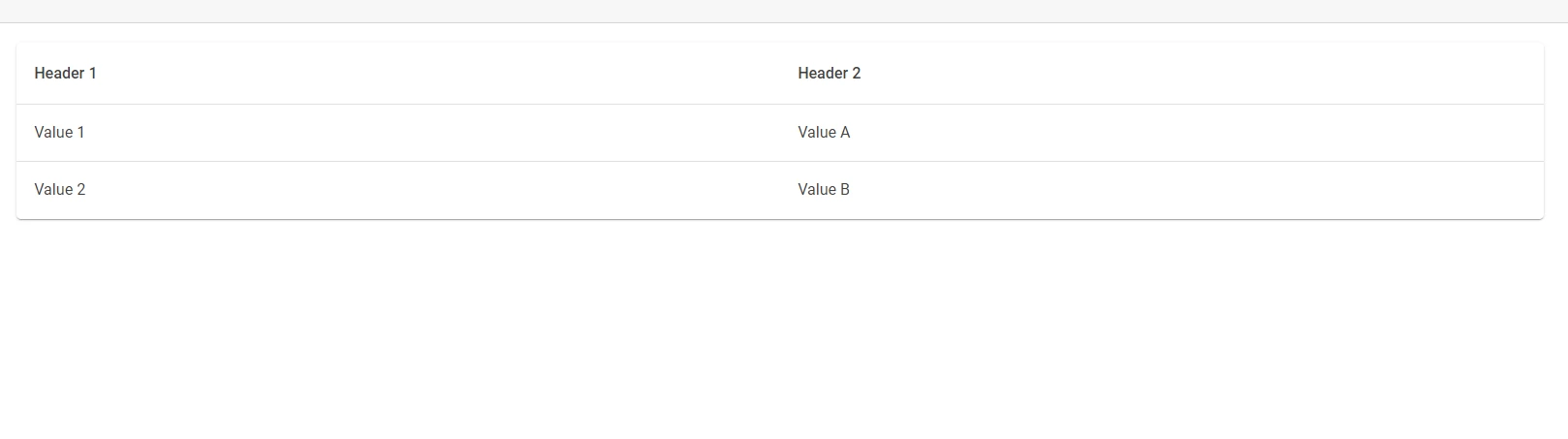
MudBlazor ofrece un componente de cuadrícula de datos para mostrar colecciones. Soporta ordenamiento, paginación y filtrado. Para usarlo, enlaza una colección a la propiedad `Items`:
```razor
<MudTable Items="@myItems">
    <HeaderContent>
        <MudTh>Header 1</MudTh>
        <MudTh>Header 2</MudTh>
    </HeaderContent>
    <RowTemplate>
        <MudTd DataLabel="Header 1">@context.Item1</MudTd>
        <MudTd DataLabel="Header 2">@context.Item2</MudTd>
    </RowTemplate>
</MudTable>
@code {
    private List<MyItemType> myItems = /* Fetch or define your items here */;
}
```
### Formularios de entrada
Para entradas de formulario, MudBlazor proporciona varios componentes. Aquí hay un ejemplo usando `MudTextField`:
```razor
<MudForm Model="@myModel">
    <MudTextField Label="Enter text" For="@(() => myModel.Text)"></MudTextField>
</MudForm>
@code {
    public class MyModel
    {
        public string Text { get; set; }
    }
    private MyModel myModel = new MyModel();
}
```
### Tablas
Para organizar contenido con pestañas, usa `MudTabs`. Define cada pestaña con `MudTabPanel`:
```razor
<MudTabs>
<MudTabPanel Text="Tab 1">
Content for Tab 1
</MudTabPanel>
<MudTabPanel Text="Tab 2">
Content for Tab 2
</MudTabPanel>
</MudTabs>
```

### Iconos
MudBlazor se integra con Material Icons. Para usar un ícono, agrega un componente `MudIcon`:
```razor
<MudIcon Icon="@Icons.Material.Filled.Alarm" />
```
Este código muestra un icono de alarma. Los iconos mejoran las interfaces de usuario proporcionando señales visuales.
## Integración de IronPDF y MudBlazor
[IronPDF](/) es una biblioteca para C# que simplifica el proceso de crear, editar y leer archivos PDF dentro de aplicaciones .NET. Destaca porque requiere una configuración mínima y es bastante directo en términos de convertir [HTML a PDFs](/examples/using-html-to-create-a-pdf/). Esto puede ser especialmente útil cuando buscas generar reportes o facturas dinámicamente.
La mejor característica de IronPDF es su capacidad para convertir [HTML a PDF](/tutorials/html-to-pdf/), preservando el diseño y el estilo original. Es genial para generar PDFs a partir de contenido web como reportes, facturas y documentación. Se admiten archivos HTML, URLs y cadenas HTML para la conversión en PDFs.
```csharp
using IronPdf;
class Program
{
static void Main(string[] args)
{
var renderer = new ChromePdfRenderer();
// Convert HTML String to PDF
var htmlContent = "<h1>Hello, IronPDF!</h1><p>This is a PDF from an HTML string.</p>";
var pdfFromHtmlString = renderer.RenderHtmlAsPdf(htmlContent);
pdfFromHtmlString.SaveAs("HTMLStringToPDF.pdf");
// Convert HTML File to PDF
var htmlFilePath = "path_to_your_html_file.html"; // Specify the path to your HTML file
var pdfFromHtmlFile = renderer.RenderHtmlFileAsPdf(htmlFilePath);
pdfFromHtmlFile.SaveAs("HTMLFileToPDF.pdf");
// Convert URL to PDF
var url = "http://ironpdf.com"; // Specify the URL
var pdfFromUrl = renderer.RenderUrlAsPdf(url);
pdfFromUrl.SaveAs("URLToPDF.pdf");
}
}
```
### Caso de uso de la fusión de IronPDF con C# MudBlazor
MudBlazor es una biblioteca de componentes para Blazor, llena de widgets y herramientas útiles para construir interfaces de usuario receptivas e interactivas. Cuando combinas las capacidades de interfaz de usuario de MudBlazor con la generación de PDF de IronPDF, obtienes un poderoso conjunto de herramientas. Un caso de uso común podría ser una aplicación web que permita a los usuarios diseñar documentos o informes usando componentes MudBlazor y luego, con el clic de un botón, convertir esos diseños en PDFs descargables utilizando IronPDF.
### Ejemplo de código del caso de uso
Repasemos un ejemplo básico donde construimos una interfaz de usuario con MudBlazor y luego usamos IronPDF para convertir esta interfaz en un documento PDF.
Primero, asegúrate de tener MudBlazor y IronPDF instalados en tu proyecto. Puedes hacerlo a través del Administrador de Paquetes NuGet o la Consola del Administrador de Paquetes:
```shell
Install-Package MudBlazor
Install-Package IronPdf
```
#### Paso 1: Construir la interfaz de usuario con MudBlazor
En tu página Blazor, puedes añadir componentes MudBlazor para crear la interfaz de usuario. Aquí hay un formulario simple creado con MudBlazor:
```razor
@page "/report"
<MudText Typo="Typo.h5">Generate PDF Report</MudText>
<MudPaper Class="p-4">
<MudTextField Label="Enter Report Title" @bind-Value="@reportTitle" />
<!-- Add more components as needed -->
<MudButton Variant="Variant.Filled" Color="Color.Primary" OnClick="@GeneratePDF">Generate PDF</MudButton>
</MudPaper>
@code {
private string reportTitle = "";
}
```
#### Paso 2: Implementación de la generación de PDF con IronPDF
Ahora, para integrar la funcionalidad de generación de PDF, manejaremos el método `GeneratePDF`. Esta función convertirá nuestro contenido HTML a un archivo PDF:
```csharp
private void GeneratePDF()
{
var renderer = new ChromePdfRenderer();
var PDF = renderer.RenderHtmlAsPdf($"<h1>{reportTitle}</h1><p>More content here...</p>");
PDF.SaveAs("Report.pdf");
}
```
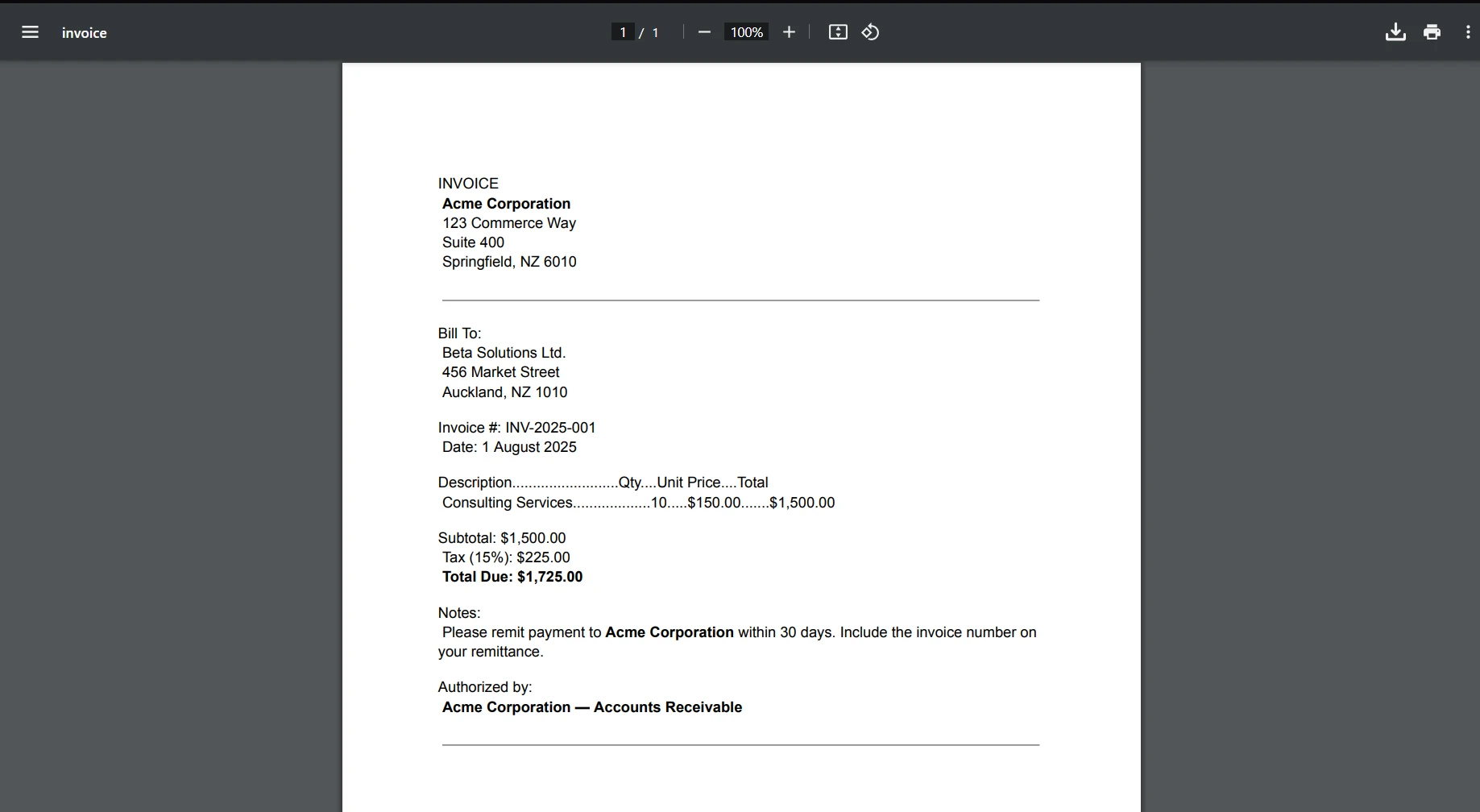
En este ejemplo simplificado, `RenderHtmlAsPdf` toma una cadena de contenido HTML y lo convierte en un PDF. En una aplicación completa, podrías generar dinámicamente esta cadena HTML basada en la entrada del usuario u otras fuentes de datos.

Aquí está la salida del código:

## Conclusión
Esta guía te guía a través del uso de MudBlazor e IronPDF con .NET 8 para el desarrollo web. MudBlazor ofrece componentes de interfaz de usuario para aplicaciones Blazor, mejorando las interfaces de usuario con código mínimo. IronPDF permite la creación y manipulación de PDFs, demostrando ser invaluable para la gestión de documentos dentro de aplicaciones .NET.
A través de instrucciones paso a paso, aprendes a integrar MudBlazor en tus proyectos, utilizar sus componentes y aprovechar IronPDF para generar PDFs a partir de contenido web. Ideal para tanto principiantes como desarrolladores intermedios, este tutorial garantiza que estés bien equipado para construir aplicaciones web modernas usando estas bibliotecas. Para aquellos interesados en explorar más IronPDF, una [prueba gratuita](trial-license) comienza desde `$liteLicense`.
Este tutorial introduce MudBlazor e IronPDF en el contexto de .NET 8 para construir aplicaciones web. MudBlazor es una biblioteca de componentes para proyectos Blazor. Proporciona una gama de componentes de interfaz de usuario para construir aplicaciones Blazor del lado del cliente y servidor. IronPDF es una biblioteca que permite la creación, manipulación y lectura de documentos PDF en aplicaciones .NET.
Cubriremos cómo instalar MudBlazor, usar sus componentes para el desarrollo web e integrar IronPDF para la funcionalidad de PDF. Esta guía está dirigida a principiantes en Blazor y .NET, pero también será útil para desarrolladores intermedios que buscan aprender sobre MudBlazor y IronPDF.
Al final de este tutorial, sabrás cómo configurar una aplicación de servidor Blazor, integrar componentes MudBlazor y usar IronPDF para trabajar con archivos PDF. El enfoque está en el conocimiento práctico para construir aplicaciones web modernas con Visual Studio. Comencemos configurando nuestro entorno y creando un nuevo proyecto en .NET 8.
Cómo empezar con MudBlazor
Instalación de MudBlazor en proyectos .NET
Para usar MudBlazor en tu proyecto cliente o de servidor, primero asegúrate de tener instalado el .NET Framework. Luego, crea un nuevo proyecto Blazor en la carpeta de diseño del cliente o diseño del servidor, dependiendo de tus modelos de alojamiento. Usa la línea de comandos o Visual Studio para esto. En Visual Studio, elige la plantilla de aplicación Blazor.
A continuación, añade MudBlazor a tu proyecto. Abre el terminal o la Consola del Administrador de Paquetes y ejecuta el comando:
PM > Install-Package MudBlazor
Install-Package MudBlazor
Este comando añade MudBlazor a tu proyecto.
Después de instalar MudBlazor, ve a _Imports.razor. Añade lo siguiente:
@using MudBlazor
@using MudBlazor
Text
Esto hace que los componentes de MudBlazor estén disponibles en tu proyecto.
En wwwroot/index.html (o Host.cshtml para proyectos de servidor), agrega el CSS y JS de MudBlazor al mismo archivo, asegurando que el modo de renderización interactiva con la configuración de plantilla predeterminada sea compatible. Incluye la siguiente línea:
Este paso garantiza que los estilos y funcionalidades de MudBlazor funcionen en tu aplicación.
Un ejemplo de código básico: Construyendo un simple botón MudBlazor
Para demostrar MudBlazor en acción, añadamos un botón simple a un componente. Abre un archivo de componente Razor, como Index.razor. Añade el siguiente código para el botón MudBlazor:
Este código inicia la creación de un botón que dice "Haz Clic". Cuando se hace clic, registra un mensaje en la consola, demostrando el renderizado del lado del servidor. Las propiedades Variant y Color personalizan la apariencia del botón.
Características de MudBlazor
Diálogos en MudBlazor
El componente de diálogo de MudBlazor simplifica la creación y gestión de diálogos. Primero, inyecta el IDialogService en tu componente:
@inject IDialogService DialogService
@inject IDialogService DialogService
Text
Luego, utiliza el siguiente método para abrir un diálogo:
MyDialog es un componente Razor que representa el contenido del diálogo. Puedes pasar parámetros con DialogParameters.
Red de datos
MudBlazor ofrece un componente de cuadrícula de datos para mostrar colecciones. Soporta ordenamiento, paginación y filtrado. Para usarlo, enlaza una colección a la propiedad Items:
<MudTable Items="@myItems"> <HeaderContent> <MudTh>Header 1</MudTh> <MudTh>Header 2</MudTh> </HeaderContent> <RowTemplate> <MudTd DataLabel="Header 1">@context.Item1</MudTd> <MudTd DataLabel="Header 2">@context.Item2</MudTd> </RowTemplate></MudTable>@code { private List<MyItemType> myItems = /* Fetch or define your items here */;}
Para entradas de formulario, MudBlazor proporciona varios componentes. Aquí hay un ejemplo usando MudTextField:
<MudForm Model="@myModel"> <MudTextField Label="Enter text" For="@(() => myModel.Text)"></MudTextField></MudForm>@code { public class MyModel { public string Text { get; set; } } private MyModel myModel = new MyModel();}
<MudForm Model="@myModel">
    <MudTextField Label="Enter text" For="@(() => myModel.Text)"></MudTextField>
</MudForm>
@code {
    public class MyModel
    {
        public string Text { get; set; }
    }
    private MyModel myModel = new MyModel();
}
Text
Tablas
Para organizar contenido con pestañas, usa MudTabs. Define cada pestaña con MudTabPanel:
<MudTabs> <MudTabPanel Text="Tab 1"> Content for Tab 1 </MudTabPanel> <MudTabPanel Text="Tab 2"> Content for Tab 2 </MudTabPanel></MudTabs>
<MudTabs>
    <MudTabPanel Text="Tab 1">
        Content for Tab 1
    </MudTabPanel>
    <MudTabPanel Text="Tab 2">
        Content for Tab 2
    </MudTabPanel>
</MudTabs>
Text
Iconos
MudBlazor se integra con Material Icons. Para usar un ícono, agrega un componente MudIcon:
<MudIcon Icon="@Icons.Material.Filled.Alarm" />
<MudIcon Icon="@Icons.Material.Filled.Alarm" />
Text
Este código muestra un icono de alarma. Los iconos mejoran las interfaces de usuario proporcionando señales visuales.
Integración de IronPDF y MudBlazor
IronPDF es una biblioteca para C# que simplifica el proceso de crear, editar y leer archivos PDF dentro de aplicaciones .NET. Destaca porque requiere una configuración mínima y es bastante directo en términos de convertir HTML a PDFs. Esto puede ser especialmente útil cuando buscas generar reportes o facturas dinámicamente.
La mejor característica de IronPDF es su capacidad para convertir HTML a PDF, preservando el diseño y el estilo original. Es genial para generar PDFs a partir de contenido web como reportes, facturas y documentación. Se admiten archivos HTML, URLs y cadenas HTML para la conversión en PDFs.
using IronPdf;class Program{ static voidMain(string[] args) { var renderer = new ChromePdfRenderer(); // Convert HTML String to PDF var htmlContent = "<h1>Hello, IronPDF!</h1><p>This is a PDF from an HTML string.</p>"; var pdfFromHtmlString = renderer.RenderHtmlAsPdf(htmlContent); pdfFromHtmlString.SaveAs("HTMLStringToPDF.pdf"); // Convert HTML File to PDF var htmlFilePath = "path_to_your_html_file.html"; // Specify the path to your HTML file var pdfFromHtmlFile = renderer.RenderHtmlFileAsPdf(htmlFilePath); pdfFromHtmlFile.SaveAs("HTMLFileToPDF.pdf"); // Convert URL to PDF var url = "http://ironpdf.com"; // Specify the URL var pdfFromUrl = renderer.RenderUrlAsPdf(url); pdfFromUrl.SaveAs("URLToPDF.pdf"); }}
using IronPdf;

class Program
{
    static void Main(string[] args)
    {
        var renderer = new ChromePdfRenderer();

        // Convert HTML String to PDF
        var htmlContent = "<h1>Hello, IronPDF!</h1><p>This is a PDF from an HTML string.</p>";
        var pdfFromHtmlString = renderer.RenderHtmlAsPdf(htmlContent);
        pdfFromHtmlString.SaveAs("HTMLStringToPDF.pdf");

        // Convert HTML File to PDF
        var htmlFilePath = "path_to_your_html_file.html"; // Specify the path to your HTML file
        var pdfFromHtmlFile = renderer.RenderHtmlFileAsPdf(htmlFilePath);
        pdfFromHtmlFile.SaveAs("HTMLFileToPDF.pdf");

        // Convert URL to PDF
        var url = "http://ironpdf.com"; // Specify the URL
        var pdfFromUrl = renderer.RenderUrlAsPdf(url);
        pdfFromUrl.SaveAs("URLToPDF.pdf");
    }
}
ImportsIronPdfModuleProgram Sub Main(args AsString()) Dim renderer = New ChromePdfRenderer() ' Convert HTML String to PDF Dim htmlContent = "<h1>Hello, IronPDF!</h1><p>This is a PDF from an HTML string.</p>" Dim pdfFromHtmlString = renderer.RenderHtmlAsPdf(htmlContent) pdfFromHtmlString.SaveAs("HTMLStringToPDF.pdf") ' Convert HTML File to PDF Dim htmlFilePath = "path_to_your_html_file.html" ' Specify the path to your HTML file Dim pdfFromHtmlFile = renderer.RenderHtmlFileAsPdf(htmlFilePath) pdfFromHtmlFile.SaveAs("HTMLFileToPDF.pdf") ' Convert URL to PDF Dim url = "http://ironpdf.com" ' Specify the URL Dim pdfFromUrl = renderer.RenderUrlAsPdf(url) pdfFromUrl.SaveAs("URLToPDF.pdf") End SubEndModule
Imports IronPdf

Module Program
    Sub Main(args As String())
        Dim renderer = New ChromePdfRenderer()

        ' Convert HTML String to PDF
        Dim htmlContent = "<h1>Hello, IronPDF!</h1><p>This is a PDF from an HTML string.</p>"
        Dim pdfFromHtmlString = renderer.RenderHtmlAsPdf(htmlContent)
        pdfFromHtmlString.SaveAs("HTMLStringToPDF.pdf")

        ' Convert HTML File to PDF
        Dim htmlFilePath = "path_to_your_html_file.html" ' Specify the path to your HTML file
        Dim pdfFromHtmlFile = renderer.RenderHtmlFileAsPdf(htmlFilePath)
        pdfFromHtmlFile.SaveAs("HTMLFileToPDF.pdf")

        ' Convert URL to PDF
        Dim url = "http://ironpdf.com" ' Specify the URL
        Dim pdfFromUrl = renderer.RenderUrlAsPdf(url)
        pdfFromUrl.SaveAs("URLToPDF.pdf")
    End Sub
End Module
Caso de uso de la fusión de IronPDF con C# MudBlazor
MudBlazor es una biblioteca de componentes para Blazor, llena de widgets y herramientas útiles para construir interfaces de usuario receptivas e interactivas. Cuando combinas las capacidades de interfaz de usuario de MudBlazor con la generación de PDF de IronPDF, obtienes un poderoso conjunto de herramientas. Un caso de uso común podría ser una aplicación web que permita a los usuarios diseñar documentos o informes usando componentes MudBlazor y luego, con el clic de un botón, convertir esos diseños en PDFs descargables utilizando IronPDF.
Ejemplo de código del caso de uso
Repasemos un ejemplo básico donde construimos una interfaz de usuario con MudBlazor y luego usamos IronPDF para convertir esta interfaz en un documento PDF.
Primero, asegúrate de tener MudBlazor y IronPDF instalados en tu proyecto. Puedes hacerlo a través del Administrador de Paquetes NuGet o la Consola del Administrador de Paquetes:
Install-Package MudBlazorInstall-Package IronPdf
Install-Package MudBlazor
Install-Package IronPdf
SHELL
Paso 1: Construir la interfaz de usuario con MudBlazor
En tu página Blazor, puedes añadir componentes MudBlazor para crear la interfaz de usuario. Aquí hay un formulario simple creado con MudBlazor:
@page "/report"<MudText Typo="Typo.h5">Generate PDF Report</MudText><MudPaper Class="p-4"> <MudTextField Label="Enter Report Title" @bind-Value="@reportTitle" /> <!-- Add more components as needed --> <MudButton Variant="Variant.Filled" Color="Color.Primary" OnClick="@GeneratePDF">Generate PDF</MudButton></MudPaper>@code { private string reportTitle = "";}
Paso 2: Implementación de la generación de PDF con IronPDF
Ahora, para integrar la funcionalidad de generación de PDF, manejaremos el método GeneratePDF. Esta función convertirá nuestro contenido HTML a un archivo PDF:
private voidGeneratePDF(){ var renderer = new ChromePdfRenderer(); varPDF = renderer.RenderHtmlAsPdf($"<h1>{reportTitle}</h1><p>More content here...</p>");PDF.SaveAs("Report.pdf");}
private void GeneratePDF()
{
    var renderer = new ChromePdfRenderer();
    var PDF = renderer.RenderHtmlAsPdf($"<h1>{reportTitle}</h1><p>More content here...</p>");
    PDF.SaveAs("Report.pdf");
}
Private Sub GeneratePDF() Dim renderer = New ChromePdfRenderer() DimPDF = renderer.RenderHtmlAsPdf($"<h1>{reportTitle}</h1><p>More content here...</p>")PDF.SaveAs("Report.pdf")End Sub
Private Sub GeneratePDF()
	Dim renderer = New ChromePdfRenderer()
	Dim PDF = renderer.RenderHtmlAsPdf($"<h1>{reportTitle}</h1><p>More content here...</p>")
	PDF.SaveAs("Report.pdf")
End Sub
En este ejemplo simplificado, RenderHtmlAsPdf toma una cadena de contenido HTML y lo convierte en un PDF. En una aplicación completa, podrías generar dinámicamente esta cadena HTML basada en la entrada del usuario u otras fuentes de datos.
Aquí está la salida del código:
Conclusión
Esta guía te guía a través del uso de MudBlazor e IronPDF con .NET 8 para el desarrollo web. MudBlazor ofrece componentes de interfaz de usuario para aplicaciones Blazor, mejorando las interfaces de usuario con código mínimo. IronPDF permite la creación y manipulación de PDFs, demostrando ser invaluable para la gestión de documentos dentro de aplicaciones .NET.
A través de instrucciones paso a paso, aprendes a integrar MudBlazor en tus proyectos, utilizar sus componentes y aprovechar IronPDF para generar PDFs a partir de contenido web. Ideal para tanto principiantes como desarrolladores intermedios, este tutorial garantiza que estés bien equipado para construir aplicaciones web modernas usando estas bibliotecas. Para aquellos interesados en explorar más IronPDF, una prueba gratuita comienza desde $999.
Jacob Mellor es Director de Tecnología de Iron Software y un ingeniero visionario pionero en la tecnología C# PDF. Como desarrollador original de la base de código principal de Iron Software, ha dado forma a la arquitectura de productos de la empresa desde su creación, transformándola, junto con el director ejecutivo Cameron Rimington, en una empresa de más de 50 personas que presta servicios a la NASA, Tesla y organismos gubernamentales de todo el mundo.