using IronPdf;

// Disable local disk access or cross-origin requests
Installation.EnableWebSecurity = true;

// Instantiate Renderer
var renderer = new ChromePdfRenderer();

// Create a PDF from a HTML string using C#
var pdf = renderer.RenderHtmlAsPdf("<h1>Hello World</h1>");

// Export to a file or Stream
pdf.SaveAs("output.pdf");

// Advanced Example with HTML Assets
// Load external html assets: Images, CSS and JavaScript.
// An optional BasePath 'C:\site\assets\' is set as the file location to load assets from
var myAdvancedPdf = renderer.RenderHtmlAsPdf("<img src='icons/iron.png'>", @"C:\site\assets\");
myAdvancedPdf.SaveAs("html-with-assets.pdf");
using IronPdf;// Disable local disk access or cross-origin requestsInstallation.EnableWebSecurity = true;// Instantiate Renderervar renderer = new ChromePdfRenderer();// Create a PDF from a HTML string using C#var pdf = renderer.RenderHtmlAsPdf("<h1>Hello World</h1>");// Export to a file or Streampdf.SaveAs("output.pdf");// Advanced Example with HTML Assets// Load external html assets: Images, CSS and JavaScript.// An optional BasePath 'C:\site\assets\' is set as the file location to load assets fromvar myAdvancedPdf = renderer.RenderHtmlAsPdf("<img src='icons/iron.png'>", @"C:\site\assets\");myAdvancedPdf.SaveAs("html-with-assets.pdf");
Este tutorial está diseñado para principiantes que están interesados en explorar la integración de dos potentes bibliotecas: [NPlot](https://www.nuget.org/packages/NPlot/) e IronPDF. Juntas, forman un conjunto de herramientas robusto para crear y exportar gráficos en aplicaciones C#.
NPlot es una biblioteca de gráficos versátil en el framework .NET, ideal para generar una amplia variedad de gráficos y diagramas. Desde gráficos de líneas simples hasta gráficos de dispersión complejos, NPlot se destaca por mostrar datos basados en muestras y generar gráficos dinámicos, ya sea que esté trabajando con conjuntos de datos pequeños o muy grandes.
IronPDF complementa NPlot al permitir la conversión de estos gráficos en documentos PDF. Ya sea que esté tratando con contenido de correo electrónico en HTML o clases de gráficos específicas, IronPDF puede renderizarlos en PDFs de alta calidad.
Esta funcionalidad es particularmente útil para aplicaciones que requieren la generación de informes o documentación de datos analizados.
## Cómo empezar con NPlot
### Introducción a NPlot en .NET Framework
NPlot es una biblioteca de gráficos dinámica diseñada para el Marco de Trabajo .NET, atendiendo a una amplia gama de necesidades de visualización de datos. Ya sea que esté trabajando en aplicaciones de escritorio o en soluciones basadas en la web, NPlot ofrece la funcionalidad para representar gráficamente los datos de manera clara y efectiva.
### Instalando NPlot en su proyecto C#
Para comenzar a usar NPlot en su proyecto de C#, necesita instalarlo. Aquí le mostramos cómo puede agregar fácilmente NPlot a su aplicación:
**Usando el Gestor de Paquetes NuGet:**
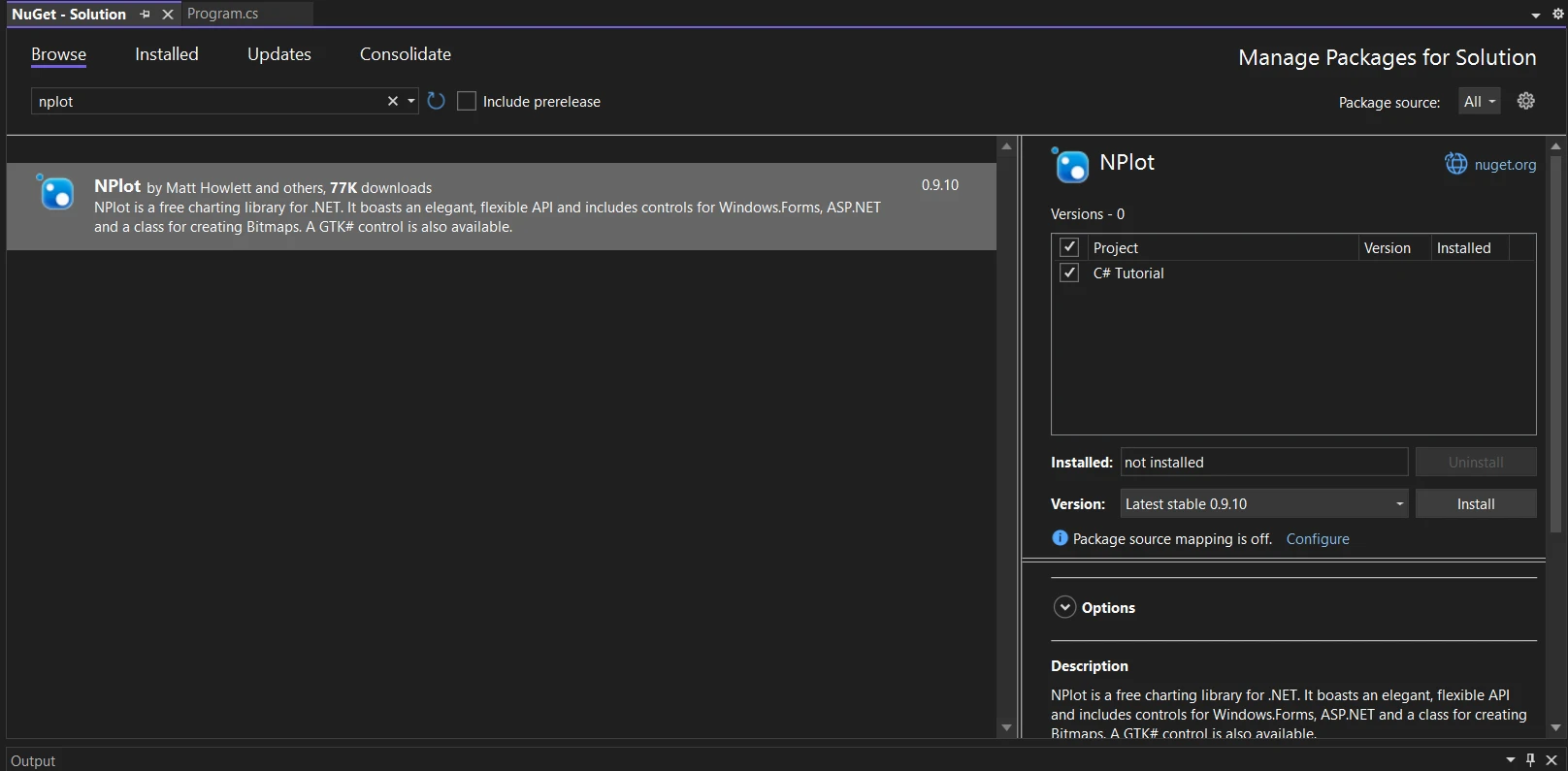
1. En Visual Studio, vaya a 'Herramientas' > 'Gestor de Paquetes NuGet' > 'Administrar Paquetes NuGet para la Solución...'.
2. Busque 'NPlot' e instálelo en su proyecto.
### Primeros pasos con NPlot
Una vez que NPlot está instalado, puede comenzar a crear gráficos. La facilidad de uso de NPlot lo hace ideal para principiantes, permitiendo la creación de gráficos con solo unas pocas líneas de código.
### Creación de un gráfico básico
Vamos a crear un gráfico de líneas simple como nuestro primer gráfico:
**Configurando la Superficie del Gráfico:** Cree un objeto `PlotSurface2D`. Esto actúa como el lienzo para su gráfico. Establezca algunas propiedades de visualización para personalizar su apariencia, como el color de fondo y el título.
**Agregando Datos al Gráfico:** Use la clase `LinePlot` de NPlot para crear un gráfico de líneas. Agregue valores de datos pertenecientes a una o más categorías. Estos puntos de datos se trazarán en el gráfico.
**Visualización del gráfico:** agregue el gráfico lineal a la superficie del gráfico. Renderice la superficie del gráfico en un formulario o control de usuario para visualización.
```csharp
using System;
using NPlot;

class Program
{
    static void Main()
    {
        // Create a new bitmap plot surface
        var plotSurface = new NPlot.Bitmap.PlotSurface2D(800, 600);

        // Create a line plot
        var linePlot = new LinePlot
        {
            AbscissaData = new double[] { 1, 2, 3, 4, 5 },
            OrdinateData = new double[] { 1, 4, 9, 16, 25 }
        };

        // Add the line plot to the plot surface
        plotSurface.Add(linePlot);

        // Customize the plot (e.g., titles, labels)
        plotSurface.Title = "Sample Plot";
        plotSurface.XAxis1.Label = "X-Axis";
        plotSurface.YAxis1.Label = "Y-Axis";

        // Refresh the plot to render it
        plotSurface.Refresh();

        // Save the plot as a PNG image
        plotSurface.Bitmap.Save("c://plot.png", System.Drawing.Imaging.ImageFormat.Png);

        Console.WriteLine("Plot saved as plot.png");
    }
}
```
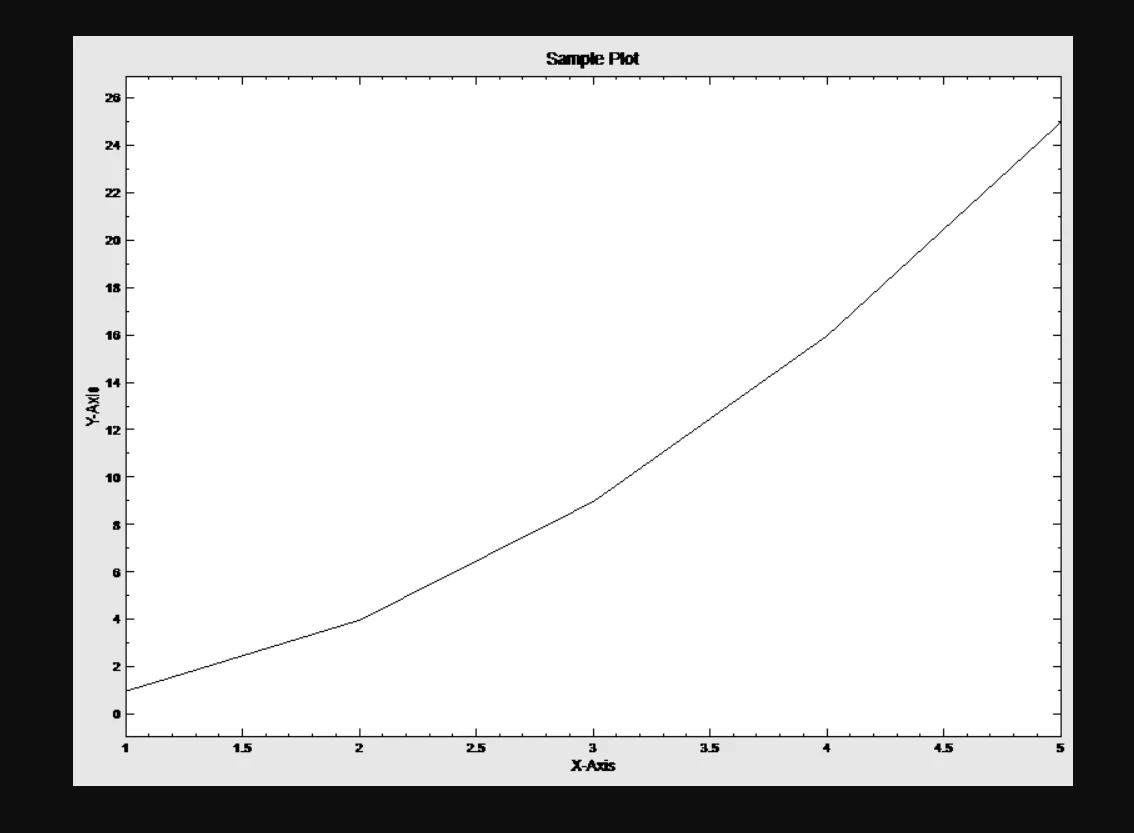
Aquí está la imagen del gráfico de salida:
## Técnicas avanzadas de creación de gráficos con NPlot
Después de dominar los gráficos básicos, NPlot ofrece una gama de tipos de gráficos más complejos para mejorar sus capacidades de visualización de datos. Estos incluyen gráficos de barras, gráficos de dispersión y gráficos de escalones, cada uno adecuado para diferentes tipos de representación de datos.
### Utilización de gráficos de barras y de dispersión
**Gráfico de barras:** ideal para mostrar valores de datos en una o más categorías. Cada barra representa un valor de datos, con su altura indicando la magnitud del valor.
**Diagrama de dispersión:** perfecto para visualizar conjuntos de datos donde cada punto de datos es independiente. Traza puntos de datos en un gráfico bidimensional, permitiendo el análisis de patrones o tendencias.
### Implementación de un Step Plot
**Gráfico escalonado:** se utiliza para datos que involucran valores de abscisas sucesivos, como datos de series de tiempo. Crea una representación similar a una escalera, mostrando claramente los cambios entre puntos de datos sucesivos.
## Integración de NPlot con IronPDF
La integración de NPlot con IronPDF permite la conversión sin problemas de gráficos en documentos PDF. IronPDF es una biblioteca potente que permite renderizar contenido HTML y clases de gráficos en archivos PDF de alta calidad. Esta integración es particularmente útil para aplicaciones que requieren generar informes o documentar datos analizados.
### Cómo empezar con IronPDF
-------------------------------
## Instalar la biblioteca IronPDF
### Instalación mediante el gestor de paquetes NuGet
Para integrar IronPDF en su proyecto de NPlot C# utilizando el gestor de paquetes NuGet, siga estos pasos:
1. Abre Visual Studio y en el explorador de soluciones, haz clic derecho en tu proyecto.
2. Elige "Administrar paquetes NuGet…" del menú contextual.
3. Ve a la pestaña de explorar y busca IronPDF.
4. Seleccione la biblioteca IronPDF de los resultados de búsqueda y haga clic en el botón instalar.
5. Acepta cualquier mensaje de acuerdo de licencia.
Si desea incluir IronPDF en su proyecto a través de la consola del gestor de paquetes, ejecute el siguiente comando en la Consola del Gestor de Paquetes:
```shell
:ProductInstall
```
Se descargará e instalará IronPDF en tu proyecto.
### Instalación mediante el sitio web de NuGet
Para una descripción detallada de IronPDF, incluyendo sus características, compatibilidad y opciones de descarga adicionales, visita la página de IronPDF en el sitio web de NuGet en [https://www.nuget.org/packages/IronPdf](https://www.nuget.org/packages/IronPdf).
### Instalación mediante DLL
Alternativamente, puedes incorporar IronPDF directamente en tu proyecto utilizando su archivo dll. Descarga el archivo ZIP que contiene el DLL desde la [Página de Descarga de IronPDF](https://ironpdf.com/packages/IronPdf.zip). Descomprímelo e incluye la DLL en tu proyecto.
### Generación de gráficos dinámicos con NPlot
NPlot se destaca en la creación de gráficos dinámicos y visualmente atractivos dentro de aplicaciones C#. Esta sección le guiará a través de la generación de un gráfico de dispersión, un caso típico para mostrar datos con dos variables.
Los gráficos de dispersión son particularmente efectivos para visualizar la relación entre las variables. Siga estos pasos para crear un gráfico de dispersión:
1. **Iniciar Superficie del Gráfico:** Comience creando una instancia `PlotSurface2D`.
2. **Preparar los datos:** Reúna los valores de los datos que desea graficar. Los gráficos de dispersión trazan puntos individuales, así que necesitará dos matrices de valores: una para las coordenadas x y otra para las coordenadas y. Puede agregar tantos gráficos como desee al `PlotSurface2D`.
3. **Instanciar un Gráfico de Dispersión:** Use la clase `PointPlot` o `ScatterPlot` de NPlot para crear su gráfico con sus objetos de gráfico.
4. **Personalice el gráfico:** aplique varias personalizaciones, como configurar los estilos de puntos, colores y propiedades de los ejes, para que el gráfico sea informativo y atractivo.
```csharp
using NPlot;
class Program
{
static void Main()
{
var plotSurface = new NPlot.Windows.PlotSurface2D();
// Prepare data for the scatter plot
var scatterPlot = new PointPlot
{
AbscissaData = new double[] { /* x-coordinates */ },
OrdinateData = new double[] { /* y-coordinates */ }
};
// Add the scatter plot to the plot surface
plotSurface.Add(scatterPlot);
// Customize the chart and render the plotSurface
plotSurface.Refresh();
}
}
```
### Convertir gráficos a PDF con IronPDF
Una vez que haya creado un gráfico con NPlot, puede usar IronPDF para convertir este gráfico en un documento PDF. Este proceso implica renderizar el gráfico como una imagen y luego usar IronPDF para incrustar esta imagen en un PDF. Puede seguir estos pasos para convertir gráficos a PDF:
1. **Representar el gráfico como imagen:** primero, convierta su gráfico NPlot en un formato de imagen. Esto se puede hacer dibujando el `PlotSurface2D` en un bitmap.
2. **Cree un PDF con IronPDF:** utilice la API de IronPDF para crear un nuevo documento PDF e insertar la imagen del gráfico.
```csharp
using IronPdf;
class Program
{
static void Main()
{
// Assuming 'chartImagePath' is the path to the Bitmap image of your NPlot chart
var imageFiles = new string[] { "chartImagePath" };
// Convert image files to PDF and save the output
ImageToPdfConverter.ImageToPdf(imageFiles).SaveAs("Chart.pdf");
}
}
```
## Conclusión
A lo largo de este tutorial, hemos explorado la integración de dos potentes bibliotecas en C#: NPlot para crear gráficos dinámicos impulsados por datos a partir de elementos dependientes de datos, e IronPDF para convertir estos gráficos en documentos PDF.
Esta combinación proporciona un conjunto de herramientas integral para desarrolladores de C#, permitiéndoles visualizar datos de manera efectiva y luego transicionar esos datos sin problemas a un formato compartible y de archivo.
Comience con la [Licencia de Prueba Gratuita](trial-license) de IronPDF, disponible desde `$liteLicense`.
Este tutorial está diseñado para principiantes que están interesados en explorar la integración de dos potentes bibliotecas: NPlot e IronPDF. Juntas, forman un conjunto de herramientas robusto para crear y exportar gráficos en aplicaciones C#.
NPlot es una biblioteca de gráficos versátil en el framework .NET, ideal para generar una amplia variedad de gráficos y diagramas. Desde gráficos de líneas simples hasta gráficos de dispersión complejos, NPlot se destaca por mostrar datos basados en muestras y generar gráficos dinámicos, ya sea que esté trabajando con conjuntos de datos pequeños o muy grandes.
IronPDF complementa NPlot al permitir la conversión de estos gráficos en documentos PDF. Ya sea que esté tratando con contenido de correo electrónico en HTML o clases de gráficos específicas, IronPDF puede renderizarlos en PDFs de alta calidad.
Esta funcionalidad es particularmente útil para aplicaciones que requieren la generación de informes o documentación de datos analizados.
Cómo empezar con NPlot
Introducción a NPlot en .NET Framework
NPlot es una biblioteca de gráficos dinámica diseñada para el Marco de Trabajo .NET, atendiendo a una amplia gama de necesidades de visualización de datos. Ya sea que esté trabajando en aplicaciones de escritorio o en soluciones basadas en la web, NPlot ofrece la funcionalidad para representar gráficamente los datos de manera clara y efectiva.
Instalando NPlot en su proyecto C#
Para comenzar a usar NPlot en su proyecto de C#, necesita instalarlo. Aquí le mostramos cómo puede agregar fácilmente NPlot a su aplicación:
Usando el Gestor de Paquetes NuGet:
En Visual Studio, vaya a 'Herramientas' > 'Gestor de Paquetes NuGet' > 'Administrar Paquetes NuGet para la Solución...'.
Busque 'NPlot' e instálelo en su proyecto.
Primeros pasos con NPlot
Una vez que NPlot está instalado, puede comenzar a crear gráficos. La facilidad de uso de NPlot lo hace ideal para principiantes, permitiendo la creación de gráficos con solo unas pocas líneas de código.
Creación de un gráfico básico
Vamos a crear un gráfico de líneas simple como nuestro primer gráfico:
Configurando la Superficie del Gráfico: Cree un objeto PlotSurface2D. Esto actúa como el lienzo para su gráfico. Establezca algunas propiedades de visualización para personalizar su apariencia, como el color de fondo y el título.
Agregando Datos al Gráfico: Use la clase LinePlot de NPlot para crear un gráfico de líneas. Agregue valores de datos pertenecientes a una o más categorías. Estos puntos de datos se trazarán en el gráfico.
Visualización del gráfico: agregue el gráfico lineal a la superficie del gráfico. Renderice la superficie del gráfico en un formulario o control de usuario para visualización.
using System;using NPlot;class Program{ static voidMain() { // Create a new bitmap plot surface var plotSurface = new NPlot.Bitmap.PlotSurface2D(800, 600); // Create a line plot var linePlot = new LinePlot {AbscissaData = new double[] { 1, 2, 3, 4, 5 },OrdinateData = new double[] { 1, 4, 9, 16, 25 } }; // Add the line plot to the plot surface plotSurface.Add(linePlot); // Customize the plot (e.g., titles, labels) plotSurface.Title = "Sample Plot"; plotSurface.XAxis1.Label = "X-Axis"; plotSurface.YAxis1.Label = "Y-Axis"; // Refresh the plot to render it plotSurface.Refresh(); // Save the plot as a PNG image plotSurface.Bitmap.Save("c://plot.png", System.Drawing.Imaging.ImageFormat.Png);Console.WriteLine("Plot saved as plot.png"); }}
using System;
using NPlot;

class Program
{
    static void Main()
    {
        // Create a new bitmap plot surface
        var plotSurface = new NPlot.Bitmap.PlotSurface2D(800, 600);

        // Create a line plot
        var linePlot = new LinePlot
        {
            AbscissaData = new double[] { 1, 2, 3, 4, 5 },
            OrdinateData = new double[] { 1, 4, 9, 16, 25 }
        };

        // Add the line plot to the plot surface
        plotSurface.Add(linePlot);

        // Customize the plot (e.g., titles, labels)
        plotSurface.Title = "Sample Plot";
        plotSurface.XAxis1.Label = "X-Axis";
        plotSurface.YAxis1.Label = "Y-Axis";

        // Refresh the plot to render it
        plotSurface.Refresh();

        // Save the plot as a PNG image
        plotSurface.Bitmap.Save("c://plot.png", System.Drawing.Imaging.ImageFormat.Png);

        Console.WriteLine("Plot saved as plot.png");
    }
}
ImportsSystemImportsNPlotFriend Class ProgramShared Sub Main() ' Create a new bitmap plot surface Dim plotSurface = New NPlot.Bitmap.PlotSurface2D(800, 600) ' Create a line plot Dim linePlot As New LinePlotWith { .AbscissaData = New Double() { 1, 2, 3, 4, 5 }, .OrdinateData = New Double() { 1, 4, 9, 16, 25 } } ' Add the line plot to the plot surface plotSurface.Add(linePlot) ' Customize the plot (e.g., titles, labels) plotSurface.Title = "Sample Plot" plotSurface.XAxis1.Label = "X-Axis" plotSurface.YAxis1.Label = "Y-Axis" ' Refresh the plot to render it plotSurface.Refresh() ' Save the plot as a PNG image plotSurface.Bitmap.Save("c://plot.png", System.Drawing.Imaging.ImageFormat.Png)Console.WriteLine("Plot saved as plot.png") End SubEnd Class
Imports System
Imports NPlot

Friend Class Program
	Shared Sub Main()
		' Create a new bitmap plot surface
		Dim plotSurface = New NPlot.Bitmap.PlotSurface2D(800, 600)

		' Create a line plot
		Dim linePlot As New LinePlot With {
			.AbscissaData = New Double() { 1, 2, 3, 4, 5 },
			.OrdinateData = New Double() { 1, 4, 9, 16, 25 }
		}

		' Add the line plot to the plot surface
		plotSurface.Add(linePlot)

		' Customize the plot (e.g., titles, labels)
		plotSurface.Title = "Sample Plot"
		plotSurface.XAxis1.Label = "X-Axis"
		plotSurface.YAxis1.Label = "Y-Axis"

		' Refresh the plot to render it
		plotSurface.Refresh()

		' Save the plot as a PNG image
		plotSurface.Bitmap.Save("c://plot.png", System.Drawing.Imaging.ImageFormat.Png)

		Console.WriteLine("Plot saved as plot.png")
	End Sub
End Class
Aquí está la imagen del gráfico de salida:
Técnicas avanzadas de creación de gráficos con NPlot
Después de dominar los gráficos básicos, NPlot ofrece una gama de tipos de gráficos más complejos para mejorar sus capacidades de visualización de datos. Estos incluyen gráficos de barras, gráficos de dispersión y gráficos de escalones, cada uno adecuado para diferentes tipos de representación de datos.
Utilización de gráficos de barras y de dispersión
Gráfico de barras: ideal para mostrar valores de datos en una o más categorías. Cada barra representa un valor de datos, con su altura indicando la magnitud del valor.
Diagrama de dispersión: perfecto para visualizar conjuntos de datos donde cada punto de datos es independiente. Traza puntos de datos en un gráfico bidimensional, permitiendo el análisis de patrones o tendencias.
Implementación de un Step Plot
Gráfico escalonado: se utiliza para datos que involucran valores de abscisas sucesivos, como datos de series de tiempo. Crea una representación similar a una escalera, mostrando claramente los cambios entre puntos de datos sucesivos.
Integración de NPlot con IronPDF
La integración de NPlot con IronPDF permite la conversión sin problemas de gráficos en documentos PDF. IronPDF es una biblioteca potente que permite renderizar contenido HTML y clases de gráficos en archivos PDF de alta calidad. Esta integración es particularmente útil para aplicaciones que requieren generar informes o documentar datos analizados.
Cómo empezar con IronPDF
Instalar la biblioteca IronPDF
Instalación mediante el gestor de paquetes NuGet
Para integrar IronPDF en su proyecto de NPlot C# utilizando el gestor de paquetes NuGet, siga estos pasos:
Abre Visual Studio y en el explorador de soluciones, haz clic derecho en tu proyecto.
Elige "Administrar paquetes NuGet…" del menú contextual.
Ve a la pestaña de explorar y busca IronPDF.
Seleccione la biblioteca IronPDF de los resultados de búsqueda y haga clic en el botón instalar.
Acepta cualquier mensaje de acuerdo de licencia.
Si desea incluir IronPDF en su proyecto a través de la consola del gestor de paquetes, ejecute el siguiente comando en la Consola del Gestor de Paquetes:
PM > Install-Package IronPdf
Install-Package IronPdf
Se descargará e instalará IronPDF en tu proyecto.
Instalación mediante el sitio web de NuGet
Para una descripción detallada de IronPDF, incluyendo sus características, compatibilidad y opciones de descarga adicionales, visita la página de IronPDF en el sitio web de NuGet en https://www.nuget.org/packages/IronPdf.
Instalación mediante DLL
Alternativamente, puedes incorporar IronPDF directamente en tu proyecto utilizando su archivo dll. Descarga el archivo ZIP que contiene el DLL desde la Página de Descarga de IronPDF. Descomprímelo e incluye la DLL en tu proyecto.
Generación de gráficos dinámicos con NPlot
NPlot se destaca en la creación de gráficos dinámicos y visualmente atractivos dentro de aplicaciones C#. Esta sección le guiará a través de la generación de un gráfico de dispersión, un caso típico para mostrar datos con dos variables.
Los gráficos de dispersión son particularmente efectivos para visualizar la relación entre las variables. Siga estos pasos para crear un gráfico de dispersión:
Iniciar Superficie del Gráfico: Comience creando una instancia PlotSurface2D.
Preparar los datos: Reúna los valores de los datos que desea graficar. Los gráficos de dispersión trazan puntos individuales, así que necesitará dos matrices de valores: una para las coordenadas x y otra para las coordenadas y. Puede agregar tantos gráficos como desee al PlotSurface2D.
Instanciar un Gráfico de Dispersión: Use la clase PointPlot o ScatterPlot de NPlot para crear su gráfico con sus objetos de gráfico.
Personalice el gráfico: aplique varias personalizaciones, como configurar los estilos de puntos, colores y propiedades de los ejes, para que el gráfico sea informativo y atractivo.
using NPlot;class Program{ static voidMain() { var plotSurface = new NPlot.Windows.PlotSurface2D(); // Prepare data for the scatter plot var scatterPlot = new PointPlot {AbscissaData = new double[] { /* x-coordinates */ },OrdinateData = new double[] { /* y-coordinates */ } }; // Add the scatter plot to the plot surface plotSurface.Add(scatterPlot); // Customize the chart and render the plotSurface plotSurface.Refresh(); }}
using NPlot;

class Program
{
    static void Main()
    {
        var plotSurface = new NPlot.Windows.PlotSurface2D();

        // Prepare data for the scatter plot
        var scatterPlot = new PointPlot
        {
            AbscissaData = new double[] { /* x-coordinates */ },
            OrdinateData = new double[] { /* y-coordinates */ }
        };

        // Add the scatter plot to the plot surface
        plotSurface.Add(scatterPlot);

        // Customize the chart and render the plotSurface
        plotSurface.Refresh();
    }
}
ImportsNPlotFriend Class ProgramShared Sub Main() Dim plotSurface = New NPlot.Windows.PlotSurface2D() ' Prepare data for the scatter plot Dim scatterPlot = New PointPlotWith { .AbscissaData = New Double() { }, .OrdinateData = New Double() { } } ' Add the scatter plot to the plot surface plotSurface.Add(scatterPlot) ' Customize the chart and render the plotSurface plotSurface.Refresh() End SubEnd Class
Imports NPlot

Friend Class Program
	Shared Sub Main()
		Dim plotSurface = New NPlot.Windows.PlotSurface2D()

		' Prepare data for the scatter plot
		Dim scatterPlot = New PointPlot With {
			.AbscissaData = New Double() { },
			.OrdinateData = New Double() { }
		}

		' Add the scatter plot to the plot surface
		plotSurface.Add(scatterPlot)

		' Customize the chart and render the plotSurface
		plotSurface.Refresh()
	End Sub
End Class
Convertir gráficos a PDF con IronPDF
Una vez que haya creado un gráfico con NPlot, puede usar IronPDF para convertir este gráfico en un documento PDF. Este proceso implica renderizar el gráfico como una imagen y luego usar IronPDF para incrustar esta imagen en un PDF. Puede seguir estos pasos para convertir gráficos a PDF:
Representar el gráfico como imagen: primero, convierta su gráfico NPlot en un formato de imagen. Esto se puede hacer dibujando el PlotSurface2D en un bitmap.
Cree un PDF con IronPDF: utilice la API de IronPDF para crear un nuevo documento PDF e insertar la imagen del gráfico.
using IronPdf;class Program{ static voidMain() { // Assuming 'chartImagePath' is the path to the Bitmap image of your NPlot chart var imageFiles = new string[] { "chartImagePath" }; // Convert image files to PDF and save the outputImageToPdfConverter.ImageToPdf(imageFiles).SaveAs("Chart.pdf"); }}
using IronPdf;

class Program
{
    static void Main()
    {
        // Assuming 'chartImagePath' is the path to the Bitmap image of your NPlot chart
        var imageFiles = new string[] { "chartImagePath" };

        // Convert image files to PDF and save the output
        ImageToPdfConverter.ImageToPdf(imageFiles).SaveAs("Chart.pdf");
    }
}
ImportsIronPdfFriend Class ProgramShared Sub Main() ' Assuming 'chartImagePath' is the path to the Bitmap image of your NPlot chart Dim imageFiles = New String() { "chartImagePath" } ' Convert image files to PDF and save the outputImageToPdfConverter.ImageToPdf(imageFiles).SaveAs("Chart.pdf") End SubEnd Class
Imports IronPdf

Friend Class Program
	Shared Sub Main()
		' Assuming 'chartImagePath' is the path to the Bitmap image of your NPlot chart
		Dim imageFiles = New String() { "chartImagePath" }

		' Convert image files to PDF and save the output
		ImageToPdfConverter.ImageToPdf(imageFiles).SaveAs("Chart.pdf")
	End Sub
End Class
Conclusión
A lo largo de este tutorial, hemos explorado la integración de dos potentes bibliotecas en C#: NPlot para crear gráficos dinámicos impulsados por datos a partir de elementos dependientes de datos, e IronPDF para convertir estos gráficos en documentos PDF.
Esta combinación proporciona un conjunto de herramientas integral para desarrolladores de C#, permitiéndoles visualizar datos de manera efectiva y luego transicionar esos datos sin problemas a un formato compartible y de archivo.
Jacob Mellor es Director de Tecnología de Iron Software y un ingeniero visionario pionero en la tecnología C# PDF. Como desarrollador original de la base de código principal de Iron Software, ha dado forma a la arquitectura de productos de la empresa desde su creación, transformándola, junto con el director ejecutivo Cameron Rimington, en una empresa de más de 50 personas que presta servicios a la NASA, Tesla y organismos gubernamentales de todo el mundo.