using IronPdf;

// Disable local disk access or cross-origin requests
Installation.EnableWebSecurity = true;

// Instantiate Renderer
var renderer = new ChromePdfRenderer();

// Create a PDF from a HTML string using C#
var pdf = renderer.RenderHtmlAsPdf("<h1>Hello World</h1>");

// Export to a file or Stream
pdf.SaveAs("output.pdf");

// Advanced Example with HTML Assets
// Load external html assets: Images, CSS and JavaScript.
// An optional BasePath 'C:\site\assets\' is set as the file location to load assets from
var myAdvancedPdf = renderer.RenderHtmlAsPdf("<img src='icons/iron.png'>", @"C:\site\assets\");
myAdvancedPdf.SaveAs("html-with-assets.pdf");
using IronPdf;// Disable local disk access or cross-origin requestsInstallation.EnableWebSecurity = true;// Instantiate Renderervar renderer = new ChromePdfRenderer();// Create a PDF from a HTML string using C#var pdf = renderer.RenderHtmlAsPdf("<h1>Hello World</h1>");// Export to a file or Streampdf.SaveAs("output.pdf");// Advanced Example with HTML Assets// Load external html assets: Images, CSS and JavaScript.// An optional BasePath 'C:\site\assets\' is set as the file location to load assets fromvar myAdvancedPdf = renderer.RenderHtmlAsPdf("<img src='icons/iron.png'>", @"C:\site\assets\");myAdvancedPdf.SaveAs("html-with-assets.pdf");
**Cree archivos PDF en C# con solo una línea de código utilizando la biblioteca .NET de IronPDF, que simplifica la generación de PDF a partir de cadenas HTML, URL o formularios con funciones de representación integradas y fácil integración con Visual Studio.**
Crear un PDF en una biblioteca C# .NET es fácil y eficiente con las guías adecuadas. Con IronPDF, puede crear y editar funciones PDF de manera sencilla según los requisitos de su aplicación. Este [ejemplo de tutorial](/docs/#pdf-generator-tutorial) muestra cómo usar el software eficientemente en tu proyecto y crear un PDF con solo un clic de botón.
<div class="learnn-how-section">
<div class="row">
<div class="col-sm-6">
<h2>PDF Biblioteca .NET</h2>
<ul class="list-unstyled">
<li>Instalación de la biblioteca IronPDF C# .NET</li>
<li>Código de una línea para crear PDF en C#</li>
<li>Convierte un formulario a PDF en 1 clic</li>
</ul>
</div>
<div class="col-sm-6">
<div class="download-card">
<a href="/csharp-pdf.pdf" target="_blank"><img style="box-shadow: none; width: 308px; height: 320px;" src="/img/faq/pdf-in-csharp-no-button.svg" alt="" class="img-responsive learn-how-to-img" /></a>
</div>
</div>
</div>
</div>
<hr class="separator" />
<h4 class="tutorial-segment-title">Paso 1</h4>
## ¿Cómo instalo la biblioteca PDF de C# .NET?
Las dos principales formas de acceder a la biblioteca son:
<ol>
<li>Download and unpack the [IronPDF Package](https://ironpdf.com/packages/IronPdf.zip) DLL file</li>
<li>Navigate to [NuGet](https://www.nuget.org/packages/IronPdf) and install the package via Visual Studio.</li>
</ol>
Para los principiantes que aprenden [a generar PDF .NET](https://ironpdf.com/docs/) , el administrador de paquetes NuGet proporciona el método de instalación más simple. Maneja automáticamente las dependencias y garantiza que esté utilizando la última versión estable. La [descripción general de la instalación](https://ironpdf.com/get-started/installation-overview/) proporciona orientación detallada para varios entornos de desarrollo.
<br />
### ¿Qué método de instalación debo elegir?
```shell
:ProductInstall
```
NuGet es el enfoque recomendado para la mayoría de los desarrolladores, especialmente aquellos nuevos en el desarrollo .NET . Se integra perfectamente con Visual Studio y otros IDE, lo que lo hace perfecto para [crear archivos PDF en C#](https://ironpdf.com/how-to/create-new-pdfs/) . El administrador de paquetes maneja automáticamente toda la configuración compleja, incluyendo:
- Resolución de dependencias y compatibilidad de versiones
- Binarios específicos de la plataforma para [Windows](https://ironpdf.com/get-started/windows/) , [Linux](https://ironpdf.com/get-started/linux/) o [Mac](https://ironpdf.com/get-started/macos/)
- Actualizaciones automáticas a través del administrador de paquetes de Visual Studio
- Integración con el proceso de construcción de su proyecto
### ¿Cuáles son los problemas de instalación más comunes?
Al instalar IronPDF, los desarrolladores a veces encuentran algunos desafíos comunes. La [guía de solución de problemas](https://ironpdf.com/troubleshooting/quick-ironpdf-troubleshooting/) cubre la mayoría de los escenarios, pero estos son los más frecuentes:
1. **Falta el entorno de ejecución de Visual C++** : IronPDF requiere redistribuibles de Visual C++. Si ve errores sobre archivos DLL faltantes, instale el último entorno de ejecución de Visual C++ de Microsoft.
2. **Bloqueo de firewall de NuGet** : los entornos corporativos pueden bloquear NuGet.org. En este caso, puede descargar el [paquete sin conexión](https://ironpdf.com/get-started/advanced-installation-nuget/) e instalarlo manualmente.
3. **Desajustes de plataforma** : asegúrese de que su proyecto esté orientado a la plataforma correcta (x86, x64 o AnyCPU). IronPDF funciona mejor con plataformas específicas en lugar de con AnyCPU.
### ¿Por qué utilizar NuGet en lugar de la instalación manual?
Para los desarrolladores que están aprendiendo [a convertir HTML a PDF](https://ironpdf.com/tutorials/html-to-pdf/) , NuGet ofrece varias ventajas:
- **Actualizaciones automáticas** : obtenga parches de seguridad y nuevas funciones automáticamente
- **Control de versiones** : fácil reversión a versiones anteriores si es necesario
- **Colaboración en equipo** : todos los desarrolladores obtienen la misma versión del paquete
- **Compatibilidad con servidores de compilación** : funciona a la perfección con las canalizaciones CI/CD
- **Restauración de paquetes** : los paquetes faltantes se descargan automáticamente durante la compilación
La [documentación de los paquetes NuGet](https://ironpdf.com/get-started/advanced-installation-nuget/) proporciona opciones de configuración avanzadas para escenarios específicos, como [la implementación de Azure](https://ironpdf.com/get-started/azure/) o [los contenedores Docker](https://ironpdf.com/get-started/ironpdf-docker/) .
<hr class="separator" />
<h4 class="tutorial-segment-title">Tutorial de cómo hacerlo</h4>
## ¿Cómo uso la biblioteca PDF .NET ?
<div style="display: flex; align-items: center; justify-content: space-between;">
<div class="center-image-wrapper" style="max-width: 200px">
<img src="/static-assets/pdf/blog/pdf-library-for-net/pdf-library-for-net-1.webp" alt="Logotipo del lenguaje de programación C#: insignia hexagonal morada con texto "C#" blanco que representa el desarrollo .NET" class="img-responsive add-shadow" />
</div>
<div class="center-image-wrapper" style="max-width: 265px">
<img src="/static-assets/pdf/blog/pdf-library-for-net/pdf-library-for-net-2.webp" alt="Flechas de chevron coloridas en degradado de morado a verde azulado que muestran la dirección del flujo de trabajo de conversión de PDF" class="img-responsive add-shadow" />
</div>
<div class="center-image-wrapper" style="max-width: 200px">
<img src="/static-assets/pdf/blog/pdf-library-for-net/pdf-library-for-net-3.webp" alt="Icono de herramientas de diseño y medición: bolígrafo negro cruzado con regla azul para funciones de anotación en PDF" class="img-responsive add-shadow" />
</div>
<div class="center-image-wrapper" style="max-width: 200px">
<img src="/static-assets/pdf/blog/pdf-library-for-net/pdf-library-for-net-2.webp" alt="Flechas de chevron multicolores que representan el proceso de transformación de documentos en IronPDF" class="img-responsive add-shadow" />
</div>
<div class="center-image-wrapper" style="max-width: 200px">
<img src="/static-assets/pdf/blog/pdf-library-for-net/adobe-pdf.webp" alt="Icono de documento Adobe PDF que muestra el formato de archivo PDF estándar utilizado en aplicaciones .NET" class="img-responsive add-shadow" />
</div>
</div>
Ahora que tenemos el software, podemos [generar archivos PDF](/how-to/create-new-pdfs/) , [ajustar configuraciones](/examples/pdf-generation-settings/) , agregar [texto e imágenes personalizados](/blog/using-ironpdf/how-to-add-images-in-pdf-using-csharp/) y [manipular los archivos PDF](/blog/pdf-tools/how-to-edit-text-in-pdf-guide/) para cumplir con los requisitos de nuestro proyecto. IronPDF ofrece funciones integrales para [crear nuevos PDF](https://ironpdf.com/how-to/create-new-pdfs/) , [editar los existentes](https://ironpdf.com/tutorials/csharp-edit-pdf-complete-tutorial/) e incluso [convertir varios formatos,](https://ironpdf.com/features/convert/) como [imágenes a PDF](https://ironpdf.com/how-to/image-to-pdf/) o [XML a PDF](https://ironpdf.com/how-to/xml-to-pdf/) .
### ¿Qué hace `ChromePdfRenderer`?
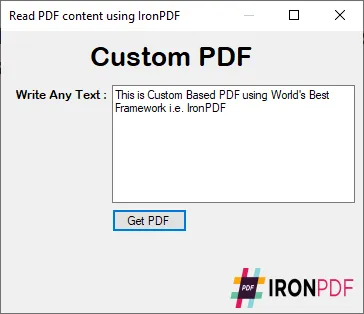
En el código siguiente, utilizamos un formulario C# para demostrar cómo crear un PDF con la biblioteca C# .NET . En este ejemplo, tenemos un `TextBox` para escribir nuestro propio texto y luego simplemente hacer clic en un botón para crear un PDF. La clase `ChromePdfRenderer` ofrece la forma más sencilla de generar archivos PDF desde diferentes fuentes, incluida una [cadena HTML](/examples/viewport/) , [URL web](/examples/converting-a-url-to-a-pdf/) o [archivos doc bajo otro renderizador](/object-reference/api/IronPdf.DocxToPdfRenderer.html) .
[ChromePdfRenderer](https://ironpdf.com/how-to/ironpdf-2021-chrome-rendering-engine-eap/) es el núcleo del motor de renderizado de IronPDF. Utiliza la misma tecnología que Google Chrome para garantizar que sus archivos PDF se vean exactamente igual que en un navegador web moderno. Esto significa soporte total para:
- [Estilo CSS3 y diseños responsivos](https://ironpdf.com/how-to/html-to-pdf-responsive-css/)
- [Ejecución de JavaScript](https://ironpdf.com/how-to/javascript-to-pdf/) para contenido dinámico
- [Fuentes e iconos web](https://ironpdf.com/how-to/webfonts-webicons/)
- [Gráficos SVG](https://ironpdf.com/how-to/SVGs/)
- [UTF-8 e idiomas internacionales](https://ironpdf.com/how-to/utf-8/)
### ¿Cómo manejo los errores en la generación de PDF?
El manejo de errores es crucial para la generación confiable de PDF. IronPDF proporciona excepciones detalladas que ayudan a identificar problemas rápidamente. A continuación se muestra un enfoque sólido para [la generación de PDF con manejo de errores](https://ironpdf.com/how-to/custom-logging/) :
```csharp
using IronPdf;
using System;
using System.IO;

public class PdfGenerator
{
    public static bool CreatePdfSafely(string htmlContent, string outputPath)
    {
        try
        {
            var renderer = new ChromePdfRenderer();

            // Configure rendering options for better results
            renderer.RenderingOptions.PaperOrientation = PdfPaperOrientation.Portrait;
            renderer.RenderingOptions.MarginTop = 20;
            renderer.RenderingOptions.MarginBottom = 20;
            renderer.RenderingOptions.PrintHtmlBackgrounds = true;

            // Generate the PDF
            var pdf = renderer.RenderHtmlAsPdf(htmlContent);

            // Ensure directory exists
            string directory = Path.GetDirectoryName(outputPath);
            if (!Directory.Exists(directory))
            {
                Directory.CreateDirectory(directory);
            }

            // Save the PDF
            pdf.SaveAs(outputPath);

            return true;
        }
        catch (Exception ex)
        {
            // Log the error (you can use your preferred logging framework)
            Console.WriteLine($"PDF generation failed: {ex.Message}");
            return false;
        }
    }
}
```
Para escenarios de error más avanzados, consulte las [guías de solución de problemas](https://ironpdf.com/troubleshooting/quick-ironpdf-troubleshooting/) que cubren problemas comunes como [administración de memoria](https://ironpdf.com/troubleshooting/memory-leak-in-ironpdf/) y [retrasos en la representación](https://ironpdf.com/troubleshooting/render-delay-timeout/) .
### ¿Cuándo debería utilizar la representación HTML en lugar de la creación directa de PDF?
Comprender cuándo utilizar la representación HTML frente a la creación directa de PDF le ayudará a elegir el enfoque correcto. IronPDF se destaca en la representación HTML porque proporciona:
**Beneficios de la representación HTML:**
- Aprovechar las habilidades de desarrollo web existentes
- Utilice CSS familiar para el estilo
- Diseño adaptable y fácil de usar con [configuraciones de ventana gráfica](https://ironpdf.com/how-to/viewport-zoom/)
- Contenido dinámico con [soporte JavaScript](https://ironpdf.com/how-to/javascript-to-pdf/)
- Prototipado rápido e iteración
**Utilice la representación HTML cuando:**
- Convertir páginas web existentes o [páginas ASPX](https://ironpdf.com/how-to/aspx-to-pdf/)
- Creación de informes con diseños complejos
- Trabajar con [diseños responsivos](https://ironpdf.com/how-to/html-to-pdf-responsive-css/)
- Generar facturas o recibos a partir de plantillas
- Creación [de formularios PDF](https://ironpdf.com/how-to/create-forms/) con formularios HTML
**La manipulación directa de PDF es mejor para:**
- [Agregar anotaciones](https://ironpdf.com/how-to/annotations/) a archivos PDF existentes
- [Fusionar o dividir archivos PDF](https://ironpdf.com/how-to/merge-or-split-pdfs/)
- [Aplicación de firmas digitales](https://ironpdf.com/how-to/signing/)
- [Agregar marcas de agua](https://ironpdf.com/how-to/custom-watermark/)
- [Extracción de texto e imágenes](https://ironpdf.com/how-to/extract-text-and-images/)
```csharp
// C# Program to create PDF from TextBox input using IronPDF
using IronPdf;
using System.Windows.Forms;
namespace readpdf
{
public partial class Form1 : Form
{
public Form1()
{
InitializeComponent();
}
// Event handler for the button click
private void button1_Click(object sender, System.EventArgs e)
{
// Create a ChromePdfRenderer object to convert HTML to PDF
var HtmlLine = new ChromePdfRenderer();
// Retrieve the text from the TextBox
string text = textBox1.Text;
// Render the HTML as a PDF, wrapping the text in an <h1> tag
using var pdf = HtmlLine.RenderHtmlAsPdf("<h1>" + text + "</h1>");
// Save the PDF to a file called "custom.pdf"
pdf.SaveAs("custom.pdf");
// Show a confirmation message to the user
MessageBox.Show("Done!");
}
}
}
```
<hr class="separator" />
## ¿Cómo convierto un formulario C# a PDF?
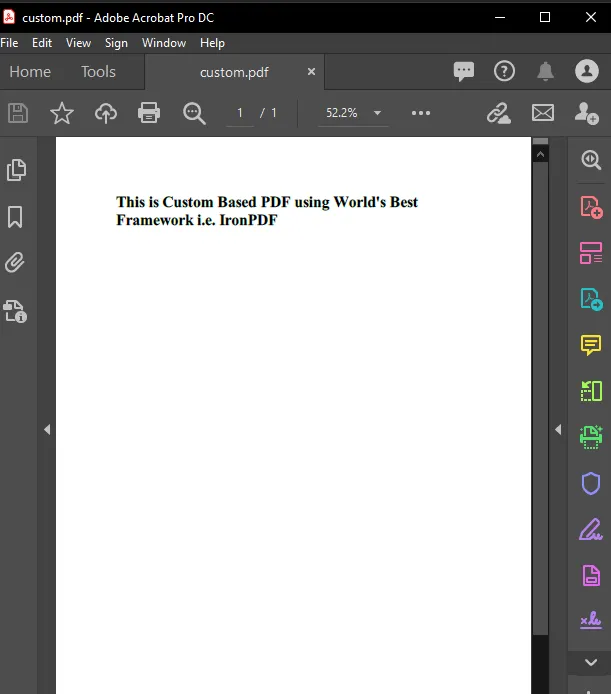
Hemos utilizado una aplicación de Windows Forms en C# para mostrarle la salida perfecta con texto personalizado. Con solo un clic, el texto en `TextBox` se convierte en un PDF personalizado. Esto requiere sólo una línea de código y es fácil de entender. Para escenarios más complejos, es posible que desee explorar [la conversión de CSHTML a PDF](https://ironpdf.com/how-to/cshtml-to-pdf-mvc-core/) para aplicaciones MVC o [la generación de PDF con Blazor](https://ironpdf.com/how-to/blazor-tutorial/) para aplicaciones web modernas.
### ¿Por qué funciona este método de un solo clic?
El método de un solo clic funciona eficazmente porque IronPDF maneja toda la representación compleja internamente. Cuando llamas a `RenderHtmlAsPdf()`, IronPDF:
1. **Inicializa el motor Chrome** : utiliza el mismo motor de renderizado que el navegador Chrome
2. **Procesa el HTML** : analiza su cadena HTML y aplica cualquier estilo en línea
3. **Renders a PDF** : Convierte el contenido renderizado a formato PDF
4. **Optimiza la salida** : aplica [compresión](https://ironpdf.com/how-to/pdf-compression/) y optimización.
Esta simplicidad hace que IronPDF sea perfecto para escenarios [de desarrollo rápido](https://ironpdf.com/get-started/quickstart/) donde se necesitan resultados rápidos. La biblioteca maneja [la gestión de fuentes](https://ironpdf.com/how-to/manage-fonts/) , [la incrustación de imágenes](https://ironpdf.com/how-to/datauris/) e incluso [la ejecución de JavaScript](https://ironpdf.com/examples/execute-custom-javascript/) automáticamente.
### ¿A qué formatos de archivos puedo exportar?
Si bien PDF es el formato de salida principal, IronPDF admite varias opciones de exportación y conversión:
- **PDF a imágenes** : [convierte archivos PDF a PNG, JPEG o TIFF](https://ironpdf.com/how-to/rasterize-pdf-to-images/)
- **PDF a HTML** : [Exporta archivos PDF nuevamente a formato HTML](https://ironpdf.com/how-to/pdf-to-html/)
- **Cumplimiento de PDF/A** : [Cree archivos PDF](https://ironpdf.com/how-to/pdfa/) para almacenamiento a largo plazo
- **PDF/UA** : [Generar archivos PDF accesibles](https://ironpdf.com/how-to/pdfua/) para usuarios con discapacidades
- **Flujos de memoria** : [Exportación a memoria](https://ironpdf.com/how-to/pdf-to-memory-stream/) para aplicaciones web
Además, IronPDF puede importar desde varias fuentes:
- [Archivos HTML y cadenas](https://ironpdf.com/how-to/html-file-to-pdf/)
- [URL y páginas web](https://ironpdf.com/how-to/url-to-pdf/)
- [Documentos DOCX](https://ironpdf.com/how-to/docx-to-pdf/)
- [Imágenes](https://ironpdf.com/how-to/image-to-pdf/)
- [Archivos Markdown](https://ironpdf.com/how-to/md-to-pdf/)
- [Documentos RTF](https://ironpdf.com/how-to/rtf-to-pdf/)
### ¿Cómo personalizo la salida PDF?
IronPDF ofrece amplias opciones de personalización a través de la clase [RenderingOptions](https://ironpdf.com/how-to/rendering-options/) . A continuación se muestra un ejemplo que muestra personalizaciones comunes:
```csharp
using IronPdf;
// Create renderer with custom settings
var renderer = new ChromePdfRenderer();
// Page setup options
renderer.RenderingOptions.PaperSize = PdfPaperSize.A4;
renderer.RenderingOptions.PaperOrientation = PdfPaperOrientation.Portrait;
// Margins (in millimeters)
renderer.RenderingOptions.MarginTop = 25;
renderer.RenderingOptions.MarginBottom = 25;
renderer.RenderingOptions.MarginLeft = 20;
renderer.RenderingOptions.MarginRight = 20;
// Header and footer configuration
renderer.RenderingOptions.HtmlHeader = new HtmlHeaderFooter()
{
Height = 15,
HtmlFragment = "<div style='text-align: center;'>{page} of {total-pages}</div>",
DrawDividerLine = true
};
// Additional options
renderer.RenderingOptions.PrintHtmlBackgrounds = true;
renderer.RenderingOptions.GrayScale = false;
renderer.RenderingOptions.Zoom = 100;
renderer.RenderingOptions.CreatePdfFormsFromHtml = true;
// Apply custom CSS for print
renderer.RenderingOptions.CssMediaType = PdfCssMediaType.Print;
// Generate PDF with all customizations
var pdf = renderer.RenderHtmlAsPdf("<h1>Customized PDF Output</h1>");
pdf.SaveAs("customized.pdf");
```
Para personalizaciones más avanzadas, explora:
- [Tamaños de papel personalizados](https://ironpdf.com/how-to/custom-paper-size/)
- [Encabezados y pies de página](https://ironpdf.com/how-to/headers-and-footers/)
- [Fondos y primeros planos](https://ironpdf.com/how-to/background-foreground/)
- [Números de página](https://ironpdf.com/how-to/page-numbers/)
- [Marcas de agua](https://ironpdf.com/how-to/custom-watermark/)
<div class="row">
<div class="col-md-6">
<h3>~ Formulario C# ~</h3>
<div class="center-image-wrapper">
<a rel="nofollow" href="/static-assets/pdf/blog/pdf-library-for-net/pdf-library-for-net-4.webp" target="_blank"><img src="/static-assets/pdf/blog/pdf-library-for-net/pdf-library-for-net-4.webp" alt="Aplicación de Windows Forms que muestra la integración de IronPDF : campo de entrada de texto con el botón "Obtener PDF" para convertir el texto del usuario en documentos PDF" class="img-responsive add-shadow" /></a>
</div>
</div>
<div class="col-md-6">
<h3>~ PDF</h3>
<div class="center-image-wrapper">
<a rel="nofollow" href="/static-assets/pdf/blog/pdf-library-for-net/pdf-library-for-net-5.webp" target="_blank"><img src="/static-assets/pdf/blog/pdf-library-for-net/pdf-library-for-net-5.webp" alt="Salida PDF generada que se muestra en Adobe Acrobat Pro DC y que muestra texto personalizado creado con la biblioteca IronPDF" class="img-responsive add-shadow" /></a>
</div>
</div>
</div>
<hr class="separator" />
<h4 class="tutorial-segment-title">Acceso rápido a la biblioteca</h4>
<div class="tutorial-section">
<div class="row">
<div class="col-sm-4">
<div class="tutorial-image">
<img style="max-width: 110px; width: 100px; height: 140px;" alt="" class="img-responsive add-shadow" src="/img/svgs/documentation.svg" width="100" height="140" />
</div>
</div>
<div class="col-sm-8">
<h3>Compartir referencia API</h3>
<p>Read through and share the API Reference for all the functionality you need to work with PDFs in your .NET project. The comprehensive documentation covers everything from basic [PDF creation](https://ironpdf.com/how-to/create-new-pdfs/) to advanced features like [digital signatures](https://ironpdf.com/tutorials/csharp-pdf-security-complete-tutorial/) and [form handling](https://ironpdf.com/how-to/edit-forms/).</p>
<a class="doc-link" href="https://ironpdf.com/object-reference/api/IronPdf.html" target="_blank"> Referencia API para IronPDF <i class="fa fa-chevron-right"></i></a>
</div>
</div>
</div>
Cree archivos PDF en C# con solo una línea de código utilizando la biblioteca .NET de IronPDF, que simplifica la generación de PDF a partir de cadenas HTML, URL o formularios con funciones de representación integradas y fácil integración con Visual Studio.
Crear un PDF en una biblioteca C# .NET es fácil y eficiente con las guías adecuadas. Con IronPDF, puede crear y editar funciones PDF de manera sencilla según los requisitos de su aplicación. Este ejemplo de tutorial muestra cómo usar el software eficientemente en tu proyecto y crear un PDF con solo un clic de botón.
PDF Biblioteca .NET
Instalación de la biblioteca IronPDF C# .NET
Código de una línea para crear PDF en C#
Convierte un formulario a PDF en 1 clic
Paso 1
¿Cómo instalo la biblioteca PDF de C# .NET?
Las dos principales formas de acceder a la biblioteca son:
Navigate to NuGet and install the package via Visual Studio.
Para los principiantes que aprenden a generar PDF .NET , el administrador de paquetes NuGet proporciona el método de instalación más simple. Maneja automáticamente las dependencias y garantiza que esté utilizando la última versión estable. La descripción general de la instalación proporciona orientación detallada para varios entornos de desarrollo.
¿Qué método de instalación debo elegir?
PM > Install-Package IronPdf
Install-Package IronPdf
NuGet es el enfoque recomendado para la mayoría de los desarrolladores, especialmente aquellos nuevos en el desarrollo .NET . Se integra perfectamente con Visual Studio y otros IDE, lo que lo hace perfecto para crear archivos PDF en C# . El administrador de paquetes maneja automáticamente toda la configuración compleja, incluyendo:
Resolución de dependencias y compatibilidad de versiones
Binarios específicos de la plataforma para Windows , Linux o Mac
Actualizaciones automáticas a través del administrador de paquetes de Visual Studio
Integración con el proceso de construcción de su proyecto
¿Cuáles son los problemas de instalación más comunes?
Al instalar IronPDF, los desarrolladores a veces encuentran algunos desafíos comunes. La guía de solución de problemas cubre la mayoría de los escenarios, pero estos son los más frecuentes:
Falta el entorno de ejecución de Visual C++ : IronPDF requiere redistribuibles de Visual C++. Si ve errores sobre archivos DLL faltantes, instale el último entorno de ejecución de Visual C++ de Microsoft.
Bloqueo de firewall de NuGet : los entornos corporativos pueden bloquear NuGet.org. En este caso, puede descargar el paquete sin conexión e instalarlo manualmente.
Desajustes de plataforma : asegúrese de que su proyecto esté orientado a la plataforma correcta (x86, x64 o AnyCPU). IronPDF funciona mejor con plataformas específicas en lugar de con AnyCPU.
¿Por qué utilizar NuGet en lugar de la instalación manual?
Para los desarrolladores que están aprendiendo a convertir HTML a PDF , NuGet ofrece varias ventajas:
Actualizaciones automáticas : obtenga parches de seguridad y nuevas funciones automáticamente
Control de versiones : fácil reversión a versiones anteriores si es necesario
Colaboración en equipo : todos los desarrolladores obtienen la misma versión del paquete
Compatibilidad con servidores de compilación : funciona a la perfección con las canalizaciones CI/CD
Restauración de paquetes : los paquetes faltantes se descargan automáticamente durante la compilación
En el código siguiente, utilizamos un formulario C# para demostrar cómo crear un PDF con la biblioteca C# .NET . En este ejemplo, tenemos un TextBox para escribir nuestro propio texto y luego simplemente hacer clic en un botón para crear un PDF. La clase ChromePdfRenderer ofrece la forma más sencilla de generar archivos PDF desde diferentes fuentes, incluida una cadena HTML , URL web o archivos doc bajo otro renderizador .
ChromePdfRenderer es el núcleo del motor de renderizado de IronPDF. Utiliza la misma tecnología que Google Chrome para garantizar que sus archivos PDF se vean exactamente igual que en un navegador web moderno. Esto significa soporte total para:
El manejo de errores es crucial para la generación confiable de PDF. IronPDF proporciona excepciones detalladas que ayudan a identificar problemas rápidamente. A continuación se muestra un enfoque sólido para la generación de PDF con manejo de errores :
using IronPdf;using System;using System.IO;public class PdfGenerator{ public static boolCreatePdfSafely(string htmlContent, string outputPath) { try { var renderer = new ChromePdfRenderer(); // Configure rendering options for better results renderer.RenderingOptions.PaperOrientation = PdfPaperOrientation.Portrait; renderer.RenderingOptions.MarginTop = 20; renderer.RenderingOptions.MarginBottom = 20; renderer.RenderingOptions.PrintHtmlBackgrounds = true; // Generate the PDF var pdf = renderer.RenderHtmlAsPdf(htmlContent); // Ensure directory exists string directory = Path.GetDirectoryName(outputPath); if (!Directory.Exists(directory)) {Directory.CreateDirectory(directory); } // Save the PDF pdf.SaveAs(outputPath); return true; } catch (Exception ex) { // Log the error (you can use your preferred logging framework)Console.WriteLine($"PDF generation failed: {ex.Message}"); return false; } }}
using IronPdf;
using System;
using System.IO;

public class PdfGenerator
{
    public static bool CreatePdfSafely(string htmlContent, string outputPath)
    {
        try
        {
            var renderer = new ChromePdfRenderer();

            // Configure rendering options for better results
            renderer.RenderingOptions.PaperOrientation = PdfPaperOrientation.Portrait;
            renderer.RenderingOptions.MarginTop = 20;
            renderer.RenderingOptions.MarginBottom = 20;
            renderer.RenderingOptions.PrintHtmlBackgrounds = true;

            // Generate the PDF
            var pdf = renderer.RenderHtmlAsPdf(htmlContent);

            // Ensure directory exists
            string directory = Path.GetDirectoryName(outputPath);
            if (!Directory.Exists(directory))
            {
                Directory.CreateDirectory(directory);
            }

            // Save the PDF
            pdf.SaveAs(outputPath);

            return true;
        }
        catch (Exception ex)
        {
            // Log the error (you can use your preferred logging framework)
            Console.WriteLine($"PDF generation failed: {ex.Message}");
            return false;
        }
    }
}
ImportsIronPdfImportsSystemImportsSystem.IOPublic Class PdfGenerator PublicShared Function CreatePdfSafely(htmlContent AsString, outputPath AsString) AsBooleanTry Dim renderer = New ChromePdfRenderer() ' Configure rendering options for better results renderer.RenderingOptions.PaperOrientation = PdfPaperOrientation.Portrait renderer.RenderingOptions.MarginTop = 20 renderer.RenderingOptions.MarginBottom = 20 renderer.RenderingOptions.PrintHtmlBackgrounds = True ' Generate the PDF Dim pdf = renderer.RenderHtmlAsPdf(htmlContent) ' Ensure directory exists Dim directory AsString = Path.GetDirectoryName(outputPath) IfNotDirectory.Exists(directory) ThenDirectory.CreateDirectory(directory) End If ' Save the PDF pdf.SaveAs(outputPath) Return TrueCatch ex AsException ' Log the error (you can use your preferred logging framework)Console.WriteLine($"PDF generation failed: {ex.Message}") Return FalseEndTry End FunctionEnd Class
Imports IronPdf
Imports System
Imports System.IO

Public Class PdfGenerator
    Public Shared Function CreatePdfSafely(htmlContent As String, outputPath As String) As Boolean
        Try
            Dim renderer = New ChromePdfRenderer()

            ' Configure rendering options for better results
            renderer.RenderingOptions.PaperOrientation = PdfPaperOrientation.Portrait
            renderer.RenderingOptions.MarginTop = 20
            renderer.RenderingOptions.MarginBottom = 20
            renderer.RenderingOptions.PrintHtmlBackgrounds = True

            ' Generate the PDF
            Dim pdf = renderer.RenderHtmlAsPdf(htmlContent)

            ' Ensure directory exists
            Dim directory As String = Path.GetDirectoryName(outputPath)
            If Not Directory.Exists(directory) Then
                Directory.CreateDirectory(directory)
            End If

            ' Save the PDF
            pdf.SaveAs(outputPath)

            Return True
        Catch ex As Exception
            ' Log the error (you can use your preferred logging framework)
            Console.WriteLine($"PDF generation failed: {ex.Message}")
            Return False
        End Try
    End Function
End Class
¿Cuándo debería utilizar la representación HTML en lugar de la creación directa de PDF?
Comprender cuándo utilizar la representación HTML frente a la creación directa de PDF le ayudará a elegir el enfoque correcto. IronPDF se destaca en la representación HTML porque proporciona:
Beneficios de la representación HTML:
Aprovechar las habilidades de desarrollo web existentes
// C# Program to create PDF from TextBox input using IronPDFusing IronPdf;using System.Windows.Forms;namespace readpdf{ public partial class Form1 : Form { publicForm1() {InitializeComponent(); } // Event handler for the button click private void button1_Click(object sender, System.EventArgs e) { // Create a ChromePdfRenderer object to convert HTML to PDF varHtmlLine = new ChromePdfRenderer(); // Retrieve the text from the TextBox string text = textBox1.Text; // Render the HTML as a PDF, wrapping the text in an <h1> tag using var pdf = HtmlLine.RenderHtmlAsPdf("<h1>" + text + "</h1>"); // Save the PDF to a file called "custom.pdf" pdf.SaveAs("custom.pdf"); // Show a confirmation message to the userMessageBox.Show("Done!"); } }}
// C# Program to create PDF from TextBox input using IronPDF
using IronPdf;
using System.Windows.Forms;

namespace readpdf
{
    public partial class Form1 : Form
    {
        public Form1()
        {
            InitializeComponent();
        }

        // Event handler for the button click
        private void button1_Click(object sender, System.EventArgs e)
        {
            // Create a ChromePdfRenderer object to convert HTML to PDF
            var HtmlLine = new ChromePdfRenderer();

            // Retrieve the text from the TextBox
            string text = textBox1.Text;

            // Render the HTML as a PDF, wrapping the text in an <h1> tag
            using var pdf = HtmlLine.RenderHtmlAsPdf("<h1>" + text + "</h1>");

            // Save the PDF to a file called "custom.pdf"
            pdf.SaveAs("custom.pdf");

            // Show a confirmation message to the user
            MessageBox.Show("Done!");
        }
    }
}
' VB.NET Program to create PDF from TextBox input using IronPDFImportsIronPdfImportsSystem.Windows.FormsNamespace readpdf PublicPartial Class Form1InheritsForm Public Sub New()InitializeComponent() End Sub ' Event handler for the button click Private Sub button1_Click(sender AsObject, e AsEventArgs) Handles button1.Click ' Create a ChromePdfRenderer object to convert HTML to PDF DimHtmlLine = New ChromePdfRenderer() ' Retrieve the text from the TextBox Dim text AsString = textBox1.Text ' Render the HTML as a PDF, wrapping the text in an <h1> tagUsing pdf = HtmlLine.RenderHtmlAsPdf("<h1>" & text & "</h1>") ' Save the PDF to a file called "custom.pdf" pdf.SaveAs("custom.pdf")EndUsing ' Show a confirmation message to the userMessageBox.Show("Done!") End Sub End ClassEndNamespace
' VB.NET Program to create PDF from TextBox input using IronPDF
Imports IronPdf
Imports System.Windows.Forms

Namespace readpdf
    Public Partial Class Form1
        Inherits Form

        Public Sub New()
            InitializeComponent()
        End Sub

        ' Event handler for the button click
        Private Sub button1_Click(sender As Object, e As EventArgs) Handles button1.Click
            ' Create a ChromePdfRenderer object to convert HTML to PDF
            Dim HtmlLine = New ChromePdfRenderer()

            ' Retrieve the text from the TextBox
            Dim text As String = textBox1.Text

            ' Render the HTML as a PDF, wrapping the text in an <h1> tag
            Using pdf = HtmlLine.RenderHtmlAsPdf("<h1>" & text & "</h1>")
                ' Save the PDF to a file called "custom.pdf"
                pdf.SaveAs("custom.pdf")
            End Using

            ' Show a confirmation message to the user
            MessageBox.Show("Done!")
        End Sub
    End Class
End Namespace
¿Cómo convierto un formulario C# a PDF?
Hemos utilizado una aplicación de Windows Forms en C# para mostrarle la salida perfecta con texto personalizado. Con solo un clic, el texto en TextBox se convierte en un PDF personalizado. Esto requiere sólo una línea de código y es fácil de entender. Para escenarios más complejos, es posible que desee explorar la conversión de CSHTML a PDF para aplicaciones MVC o la generación de PDF con Blazor para aplicaciones web modernas.
¿Por qué funciona este método de un solo clic?
El método de un solo clic funciona eficazmente porque IronPDF maneja toda la representación compleja internamente. Cuando llamas a RenderHtmlAsPdf(), IronPDF:
Inicializa el motor Chrome : utiliza el mismo motor de renderizado que el navegador Chrome
Procesa el HTML : analiza su cadena HTML y aplica cualquier estilo en línea
Renders a PDF : Convierte el contenido renderizado a formato PDF
Optimiza la salida : aplica compresión y optimización.
IronPDF ofrece amplias opciones de personalización a través de la clase RenderingOptions . A continuación se muestra un ejemplo que muestra personalizaciones comunes:
using IronPdf;// Create renderer with custom settingsvar renderer = new ChromePdfRenderer();// Page setup optionsrenderer.RenderingOptions.PaperSize = PdfPaperSize.A4;renderer.RenderingOptions.PaperOrientation = PdfPaperOrientation.Portrait;// Margins (in millimeters)renderer.RenderingOptions.MarginTop = 25;renderer.RenderingOptions.MarginBottom = 25;renderer.RenderingOptions.MarginLeft = 20;renderer.RenderingOptions.MarginRight = 20;// Header and footer configurationrenderer.RenderingOptions.HtmlHeader = new HtmlHeaderFooter(){Height = 15,HtmlFragment = "<div style='text-align: center;'>{page} of {total-pages}</div>",DrawDividerLine = true};// Additional optionsrenderer.RenderingOptions.PrintHtmlBackgrounds = true;renderer.RenderingOptions.GrayScale = false;renderer.RenderingOptions.Zoom = 100;renderer.RenderingOptions.CreatePdfFormsFromHtml = true;// Apply custom CSS for printrenderer.RenderingOptions.CssMediaType = PdfCssMediaType.Print;// Generate PDF with all customizationsvar pdf = renderer.RenderHtmlAsPdf("<h1>Customized PDF Output</h1>");pdf.SaveAs("customized.pdf");
using IronPdf;

// Create renderer with custom settings
var renderer = new ChromePdfRenderer();

// Page setup options
renderer.RenderingOptions.PaperSize = PdfPaperSize.A4;
renderer.RenderingOptions.PaperOrientation = PdfPaperOrientation.Portrait;

// Margins (in millimeters)
renderer.RenderingOptions.MarginTop = 25;
renderer.RenderingOptions.MarginBottom = 25;
renderer.RenderingOptions.MarginLeft = 20;
renderer.RenderingOptions.MarginRight = 20;

// Header and footer configuration
renderer.RenderingOptions.HtmlHeader = new HtmlHeaderFooter()
{
    Height = 15,
    HtmlFragment = "<div style='text-align: center;'>{page} of {total-pages}</div>",
    DrawDividerLine = true
};

// Additional options
renderer.RenderingOptions.PrintHtmlBackgrounds = true;
renderer.RenderingOptions.GrayScale = false;
renderer.RenderingOptions.Zoom = 100;
renderer.RenderingOptions.CreatePdfFormsFromHtml = true;

// Apply custom CSS for print
renderer.RenderingOptions.CssMediaType = PdfCssMediaType.Print;

// Generate PDF with all customizations
var pdf = renderer.RenderHtmlAsPdf("<h1>Customized PDF Output</h1>");
pdf.SaveAs("customized.pdf");
ImportsIronPdf' Create renderer with custom settingsDim renderer = New ChromePdfRenderer()' Page setup optionsrenderer.RenderingOptions.PaperSize = PdfPaperSize.A4renderer.RenderingOptions.PaperOrientation = PdfPaperOrientation.Portrait' Margins (in millimeters)renderer.RenderingOptions.MarginTop = 25renderer.RenderingOptions.MarginBottom = 25renderer.RenderingOptions.MarginLeft = 20renderer.RenderingOptions.MarginRight = 20' Header and footer configurationrenderer.RenderingOptions.HtmlHeader = New HtmlHeaderFooter() With { .Height = 15, .HtmlFragment = "<div style='text-align: center;'>{page} of {total-pages}</div>", .DrawDividerLine = True}' Additional optionsrenderer.RenderingOptions.PrintHtmlBackgrounds = Truerenderer.RenderingOptions.GrayScale = Falserenderer.RenderingOptions.Zoom = 100renderer.RenderingOptions.CreatePdfFormsFromHtml = True' Apply custom CSS for printrenderer.RenderingOptions.CssMediaType = PdfCssMediaType.Print' Generate PDF with all customizationsDim pdf = renderer.RenderHtmlAsPdf("<h1>Customized PDF Output</h1>")pdf.SaveAs("customized.pdf")
Imports IronPdf

' Create renderer with custom settings
Dim renderer = New ChromePdfRenderer()

' Page setup options
renderer.RenderingOptions.PaperSize = PdfPaperSize.A4
renderer.RenderingOptions.PaperOrientation = PdfPaperOrientation.Portrait

' Margins (in millimeters)
renderer.RenderingOptions.MarginTop = 25
renderer.RenderingOptions.MarginBottom = 25
renderer.RenderingOptions.MarginLeft = 20
renderer.RenderingOptions.MarginRight = 20

' Header and footer configuration
renderer.RenderingOptions.HtmlHeader = New HtmlHeaderFooter() With {
    .Height = 15,
    .HtmlFragment = "<div style='text-align: center;'>{page} of {total-pages}</div>",
    .DrawDividerLine = True
}

' Additional options
renderer.RenderingOptions.PrintHtmlBackgrounds = True
renderer.RenderingOptions.GrayScale = False
renderer.RenderingOptions.Zoom = 100
renderer.RenderingOptions.CreatePdfFormsFromHtml = True

' Apply custom CSS for print
renderer.RenderingOptions.CssMediaType = PdfCssMediaType.Print

' Generate PDF with all customizations
Dim pdf = renderer.RenderHtmlAsPdf("<h1>Customized PDF Output</h1>")
pdf.SaveAs("customized.pdf")
Read through and share the API Reference for all the functionality you need to work with PDFs in your .NET project. The comprehensive documentation covers everything from basic PDF creation to advanced features like digital signatures and form handling.
Curtis Chau tiene una licenciatura en Ciencias de la Computación (Carleton University) y se especializa en el desarrollo front-end con experiencia en Node.js, TypeScript, JavaScript y React. Apasionado por crear interfaces de usuario intuitivas y estéticamente agradables, disfruta trabajando con frameworks modernos y creando manuales bien estructurados y visualmente atractivos.