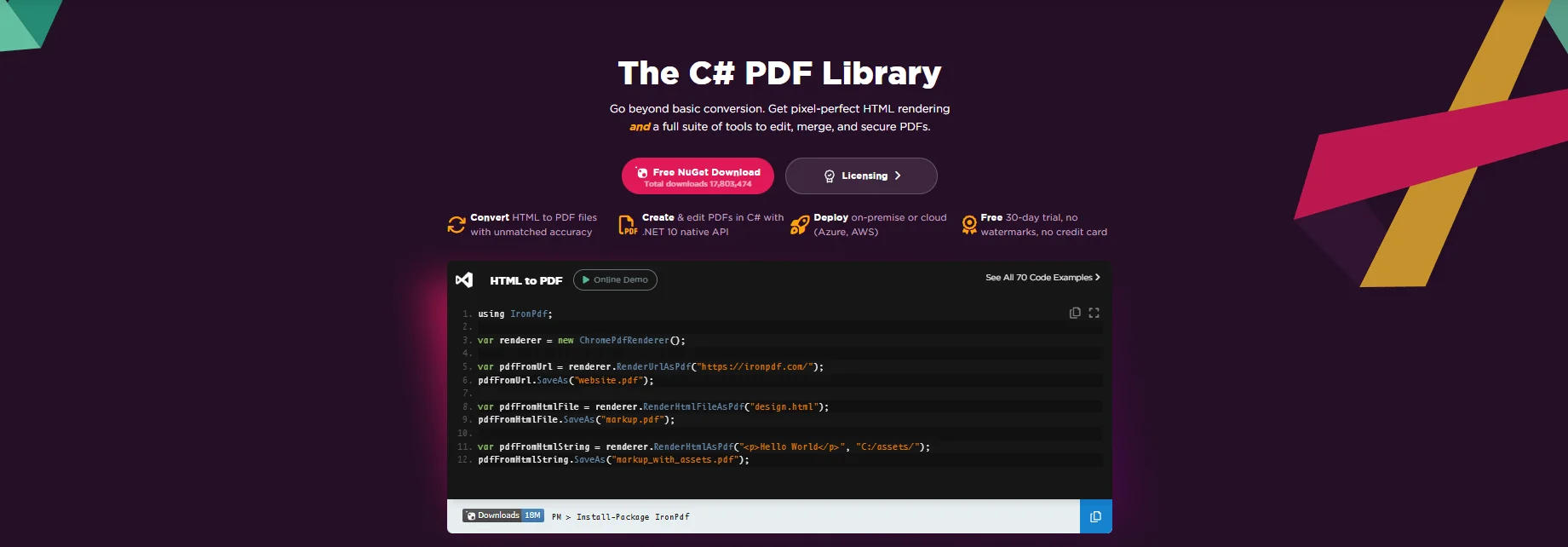
using IronPdf;

// Disable local disk access or cross-origin requests
Installation.EnableWebSecurity = true;

// Instantiate Renderer
var renderer = new ChromePdfRenderer();

// Create a PDF from a HTML string using C#
var pdf = renderer.RenderHtmlAsPdf("<h1>Hello World</h1>");

// Export to a file or Stream
pdf.SaveAs("output.pdf");

// Advanced Example with HTML Assets
// Load external html assets: Images, CSS and JavaScript.
// An optional BasePath 'C:\site\assets\' is set as the file location to load assets from
var myAdvancedPdf = renderer.RenderHtmlAsPdf("<img src='icons/iron.png'>", @"C:\site\assets\");
myAdvancedPdf.SaveAs("html-with-assets.pdf");
using IronPdf;// Disable local disk access or cross-origin requestsInstallation.EnableWebSecurity = true;// Instantiate Renderervar renderer = new ChromePdfRenderer();// Create a PDF from a HTML string using C#var pdf = renderer.RenderHtmlAsPdf("<h1>Hello World</h1>");// Export to a file or Streampdf.SaveAs("output.pdf");// Advanced Example with HTML Assets// Load external html assets: Images, CSS and JavaScript.// An optional BasePath 'C:\site\assets\' is set as the file location to load assets fromvar myAdvancedPdf = renderer.RenderHtmlAsPdf("<img src='icons/iron.png'>", @"C:\site\assets\");myAdvancedPdf.SaveAs("html-with-assets.pdf");
# Working with PDF Files in C#
Al trabajar con archivos PDF en proyectos de C#, no se puede pasar por alto el aspecto crucial de la preservación a largo plazo de los archivos. La aparición del PDF/A ha sido un cambio de juego, especialmente para los desarrolladores que trabajan con documentos electrónicos. Nos adentraremos en el proceso de convertir archivos PDF a PDF/A usando la biblioteca IronPDF, un paso significativo para asegurar la longevidad de tus documentos digitales.
## Cómo convertir PDF a PDF/A
1. Instala la biblioteca PDF usando el Administrador de Paquetes NuGet.
2. Carga el documento PDF en el programa.
3. Convierte el PDF a PDF/A y guárdalo.
## Entendiendo PDF/A
PDF/A no es solo una ligera variación del Formato de Documento Portátil que conocemos. Es una versión especializada diseñada con un propósito principal: la preservación a largo plazo de documentos electrónicos. A medida que aprendas más al respecto, descubrirás que PDF/A aborda algunos desafíos clave en el almacenamiento digital.
El estándar PDF/A garantiza que los documentos permanezcan legibles y accesibles por un largo tiempo, independientemente del software o hardware utilizado para crearlos. Esto es particularmente importante para industrias como la ley, las finanzas y el gobierno, donde la integridad del documento a lo largo del tiempo es innegociable.
Existen diferentes niveles de conformidad en PDF/A, cada uno con su propio conjunto de requisitos. PDF/A-1 es el nivel base, mientras que PDF/A-2 y PDF/A-3 añaden soporte para características adicionales, como la compresión JPEG2000 y la incrustación de otros formatos de archivo. PDF/A-3 se utiliza con más frecuencia, ya que ofrece mayor flexibilidad sin dejar de mantener estrictos estándares de archivo.
## ¿Por qué convertir a PDF/A?
Mientras que convertir PDFs regulares al formato PDF/A puede requerir algún esfuerzo adicional, los beneficios que ofrece son significativos. Aquí están las principales ventajas:
- **Autocontención:** todos los componentes necesarios para mostrar el documento correctamente, incluidas las fuentes, la información de color y los detalles del documento, se almacenan dentro del propio archivo. Esto significa que no tienes que preocuparte por fuentes faltantes o cambios de diseño cuando abras el documento en diferentes tipos de máquinas, como Windows, Mac, iPhone o Android.
- **Cumplimiento y automatización de facturas sin inconvenientes:** cuando se trata de un gran volumen de facturas, la capacidad de escalar y extraer datos rápidamente es crucial para las operaciones a nivel empresarial. Esto es especialmente cierto para tareas que involucran facturas. Convertir a PDF/A, en combinación con el formato ZUGFeRD, permite a los desarrolladores incrustar otros tipos de archivos, como datos XML. Esta funcionalidad permite a los sistemas extraer datos de facturas directamente de archivos XML, optimizando significativamente los procesos de automatización y eliminando pasos innecesarios de análisis. Además, cumple con las regulaciones legales para el archivo de facturas, asegurando el cumplimiento de los mandatos de facturación en países de la UE.
- **Capacidad de búsqueda mejorada:** las reglas de archivos PDF/A indican que debe poder copiar texto del documento. Esto facilita la búsqueda de palabras o frases en el documento. Al trabajar con una extensa colección de documentos, esto ahorra una cantidad significativa de tiempo. Seguir los estándares ISO es a menudo necesario para muchos tipos de trabajo.
## Librería IronPDF C#
Después de extensas pruebas con varias bibliotecas PDF, encontramos que la biblioteca IronPDF es la solución más completa para cualquier tarea relacionada con PDF. IronPDF, una biblioteca .NET, hace que trabajar con PDFs en C# sea increíblemente sencillo, incluyendo el proceso de convertir un documento PDF a PDF/A, así como sus otras variaciones, y asegurar el cumplimiento con ZUGFeRD. Puedes realizar multitud de tareas PDF usando IronPDF, con su característica principal siendo la creación de archivos PDF desde HTML, todo dentro de un producto confiable y confiado por muchos.
### Introducción a IronPDF
Para comenzar a usar IronPDF en tu proyecto C#, primero necesitarás instalarlo. Puedes hacer esto fácilmente a través del Administrador de Paquetes NuGet. Así es como:
1. Abra su proyecto en Visual Studio.
2. Haz clic derecho en tu proyecto en el Explorador de Soluciones y selecciona "Administrar paquetes NuGet".
3. Busca "IronPDF" e instala la última versión.
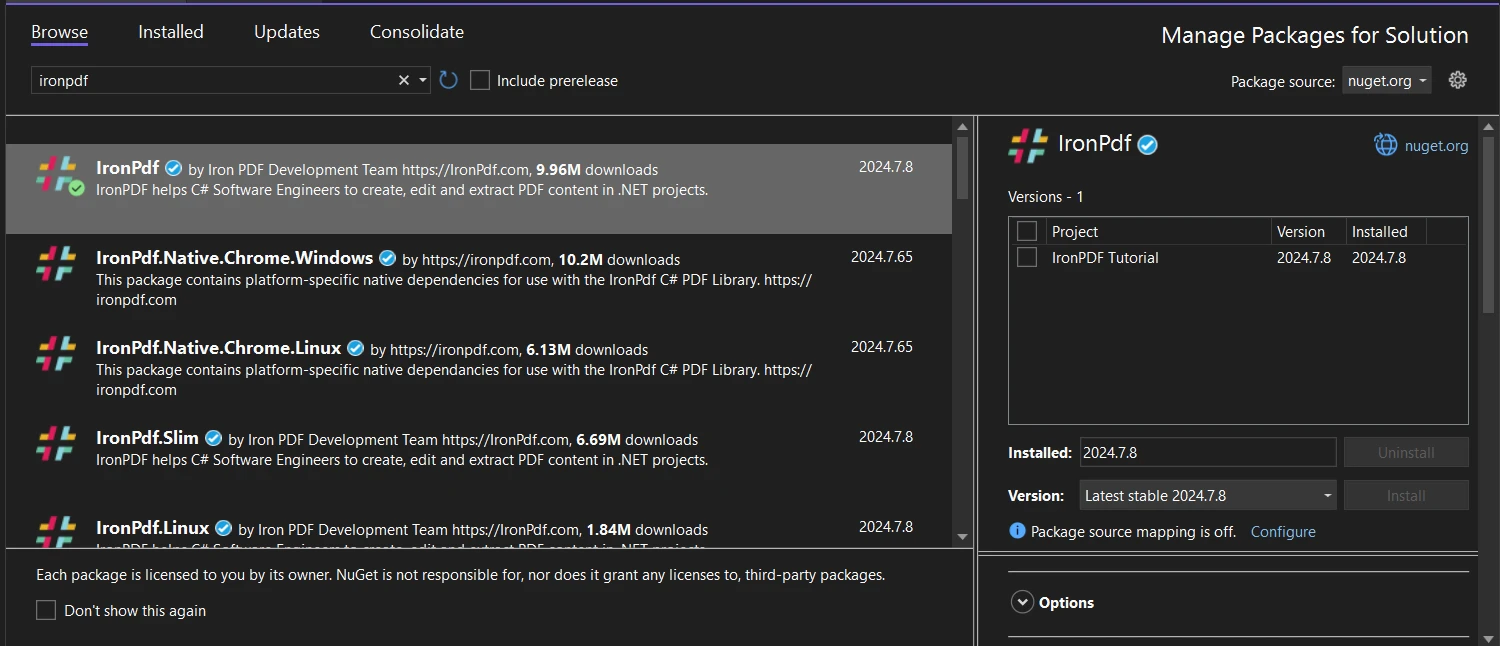
Alternativamente, puedes usar la Consola del Administrador de Paquetes y ejecutar:
```shell
:ProductInstall
```
Una vez instalado, estás listo para comenzar a trabajar con PDFs en tu código C#.
## Convertir PDF a PDF/A: Guía paso a paso
Ahora, analicemos el proceso de convertir tu PDF a PDF/A usando IronPDF. Lo desglosaremos en pasos manejables y explicaremos cada parte del código.
### Paso 1: Configuración del proyecto
Primero, asegúrate de tener configurado un proyecto C# y de haber instalado IronPDF. En la parte superior de tu archivo C#, necesitarás incluir el espacio de nombres de IronPDF:
```csharp
using IronPdf;
```
### Paso 2: Cargar el PDF
El siguiente paso es cargar tu archivo PDF existente. IronPDF hace que esto sea increíblemente sencillo:
```csharp
PdfDocument pdf = PdfDocument.FromFile("path/to/your/file.pdf");
```
Esta línea crea un objeto `PdfDocument` a partir de su archivo PDF existente. Reemplace `"path/to/your/file.pdf"` con la ruta real de su archivo PDF.
### Paso 3: Conversión a PDF/A
Ahora viene la parte mágica: convertir tu PDF al formato PDF/A. IronPDF proporciona un método sencillo para esto:
```csharp
pdf.SaveAsPdfA("output-pdf-a3.pdf", PdfAVersions.PdfA3);
```
Esta línea hace dos cosas cruciales:
1. Especifica el nombre del archivo de salida (`"output-pdf-a3.pdf"` en este caso).
2. Establece la versión PDF/A a PDF/A-3.
### Poniéndolo todo junto
Aquí está el fragmento de código completo que reúne todos estos pasos:
```csharp
using IronPdf;

class Program
{
    static void Main()
    {
        // Load the PDF document
        PdfDocument pdf = PdfDocument.FromFile("input.pdf");

        // Convert the PDF to PDF/A and save it
        pdf.SaveAsPdfA("output-pdf-a3.pdf", PdfAVersions.PdfA3);

        // Output success message
        Console.WriteLine("PDF converted to PDF/A-3 successfully.");
    }
}
```
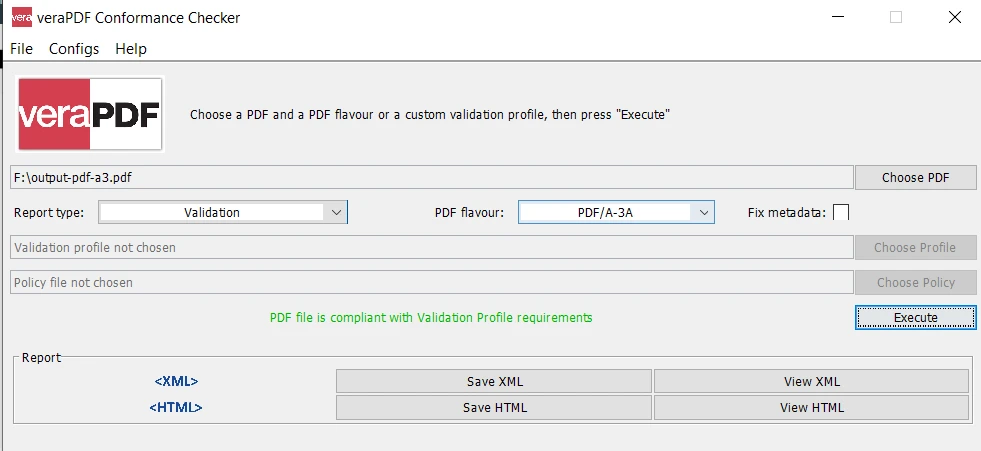
¡Es así de sencillo! Con solo unas pocas líneas de código, has convertido un PDF regular a un archivo PDF/A-3. Para la validación del archivo PDF convertido, se puede usar una herramienta como veraPDF. Es sencillo: elige un archivo, especifica el sabor PDF y ejecuta la validación.
## Técnicas avanzadas y consideraciones
### Manejo de errores de conversión
No todos los PDFs pueden ser convertidos a PDF/A sin problemas. Algunos problemas comunes incluyen fuentes no compatibles, archivos incrustados que no cumplen con los estándares PDF/A y el uso de efectos de transparencia en versiones anteriores de PDF/A. Es una buena práctica implementar manejo de errores:
```csharp
try
{
// Convert the PDF to PDF/A
pdf.SaveAsPdfA("output-pdf-a3.pdf", PdfAVersions.PdfA3);
Console.WriteLine("Conversion successful!");
}
catch (Exception ex)
{
Console.WriteLine($"Conversion failed: {ex.Message}");
}
```
### Elección de la versión PDF/A adecuada
Dependiendo de tus requisitos, podrías necesitar usar una versión específica de PDF/A. IronPDF soporta múltiples versiones:
```csharp
pdf.SaveAsPdfA("output-pdf-a1b.pdf", PdfAVersions.PdfA1b);
pdf.SaveAsPdfA("output-pdf-a2b.pdf", PdfAVersions.PdfA2b);
pdf.SaveAsPdfA("output-pdf-a3.pdf", PdfAVersions.PdfA3);
```
Elige la versión que mejor se adapte a tus necesidades. PDF/A-3 es la más flexible, pero algunos sistemas requieren versiones anteriores para compatibilidad. IronPDF no solo convierte tus archivos PDF a PDF/A y funciona como un convertidor de PDF/A, sino que también te ayuda a integrar firmas electrónicas avanzadas, marcas de agua, encriptación PDF y muchas otras herramientas PDF.
Para más información sobre ejemplos en la vida real y una consideración más profunda sobre qué formato elegir, puedes referirte a esta extensa [guía práctica](https://ironpdf.com/how-to/pdfa/).
## Prácticas recomendadas para la conversión a PDF/A
A través de mi experiencia trabajando con conversiones PDF/A, he desarrollado algunas mejores prácticas que pueden ayudarte:
1. Siempre valida tus archivos PDF/A después de convertirlos. Aunque IronPDF hace un gran trabajo, es bueno verificar dos veces.
2. Conserva tus PDFs originales. El proceso de conversión generalmente no tiene pérdidas, pero siempre es seguro conservar los originales.
3. Ten en cuenta el tamaño del archivo. Los archivos PDF/A pueden ser más grandes debido a las fuentes incrustadas y otros recursos. Si el tamaño del archivo es un problema, considera usar técnicas de compresión donde sea apropiado.
4. Actualiza regularmente tu biblioteca IronPDF. Los desarrolladores lanzan frecuentemente actualizaciones que mejoran la calidad de la conversión y añaden soporte para nuevas características.
5. Para conversiones en lote, considera implementar un indicador de progreso para rastrear el proceso de conversión. Esto puede ser especialmente útil cuando se maneja un gran número de archivos.
## Conclusión
En conclusión, este artículo ha examinado varios escenarios y consideraciones para convertir documentos a PDF/A, guiándonos en la selección de los formatos más apropiados para diferentes situaciones. Aunque el proceso de conversión puede ser complejo, IronPDF surge como una solución destacada, simplificando la tarea con solo una línea de código. Al cerrar efectivamente la brecha entre las necesidades inmediatas de documentación y los estrictos requisitos de preservación a largo plazo, IronPDF no solo simplifica el proceso sino que también asegura que tus documentos permanezcan accesibles y confiables a lo largo del tiempo por sí solos.
A medida que continúes trabajando con PDF/A, probablemente descubrirás aún más beneficios y casos de uso. El mundo de la preservación digital de documentos es vasto y está evolviendo, y herramientas como IronPDF están a la vanguardia, haciéndolo accesible para desarrolladores como nosotros. IronPDF también ofrece una [prueba gratuita](trial-license) y su licencia comienza con opciones de precios asequibles.
Así que, la próxima vez que trabajes en un proyecto relacionado con la gestión de documentos, considera el impacto a largo plazo de tus elecciones. Con PDF/A e IronPDF en tu kit de herramientas, estás bien equipado para crear soluciones que resistan la prueba del tiempo.
Al trabajar con archivos PDF en proyectos de C#, no se puede pasar por alto el aspecto crucial de la preservación a largo plazo de los archivos. La aparición del PDF/A ha sido un cambio de juego, especialmente para los desarrolladores que trabajan con documentos electrónicos. Nos adentraremos en el proceso de convertir archivos PDF a PDF/A usando la biblioteca IronPDF, un paso significativo para asegurar la longevidad de tus documentos digitales.
Cómo convertir PDF a PDF/A
Instala la biblioteca PDF usando el Administrador de Paquetes NuGet.
Carga el documento PDF en el programa.
Convierte el PDF a PDF/A y guárdalo.
Entendiendo PDF/A
PDF/A no es solo una ligera variación del Formato de Documento Portátil que conocemos. Es una versión especializada diseñada con un propósito principal: la preservación a largo plazo de documentos electrónicos. A medida que aprendas más al respecto, descubrirás que PDF/A aborda algunos desafíos clave en el almacenamiento digital.
El estándar PDF/A garantiza que los documentos permanezcan legibles y accesibles por un largo tiempo, independientemente del software o hardware utilizado para crearlos. Esto es particularmente importante para industrias como la ley, las finanzas y el gobierno, donde la integridad del documento a lo largo del tiempo es innegociable.
Existen diferentes niveles de conformidad en PDF/A, cada uno con su propio conjunto de requisitos. PDF/A-1 es el nivel base, mientras que PDF/A-2 y PDF/A-3 añaden soporte para características adicionales, como la compresión JPEG2000 y la incrustación de otros formatos de archivo. PDF/A-3 se utiliza con más frecuencia, ya que ofrece mayor flexibilidad sin dejar de mantener estrictos estándares de archivo.
¿Por qué convertir a PDF/A?
Mientras que convertir PDFs regulares al formato PDF/A puede requerir algún esfuerzo adicional, los beneficios que ofrece son significativos. Aquí están las principales ventajas:
Autocontención: todos los componentes necesarios para mostrar el documento correctamente, incluidas las fuentes, la información de color y los detalles del documento, se almacenan dentro del propio archivo. Esto significa que no tienes que preocuparte por fuentes faltantes o cambios de diseño cuando abras el documento en diferentes tipos de máquinas, como Windows, Mac, iPhone o Android.
Cumplimiento y automatización de facturas sin inconvenientes: cuando se trata de un gran volumen de facturas, la capacidad de escalar y extraer datos rápidamente es crucial para las operaciones a nivel empresarial. Esto es especialmente cierto para tareas que involucran facturas. Convertir a PDF/A, en combinación con el formato ZUGFeRD, permite a los desarrolladores incrustar otros tipos de archivos, como datos XML. Esta funcionalidad permite a los sistemas extraer datos de facturas directamente de archivos XML, optimizando significativamente los procesos de automatización y eliminando pasos innecesarios de análisis. Además, cumple con las regulaciones legales para el archivo de facturas, asegurando el cumplimiento de los mandatos de facturación en países de la UE.
Capacidad de búsqueda mejorada: las reglas de archivos PDF/A indican que debe poder copiar texto del documento. Esto facilita la búsqueda de palabras o frases en el documento. Al trabajar con una extensa colección de documentos, esto ahorra una cantidad significativa de tiempo. Seguir los estándares ISO es a menudo necesario para muchos tipos de trabajo.
Librería IronPDF C#
Después de extensas pruebas con varias bibliotecas PDF, encontramos que la biblioteca IronPDF es la solución más completa para cualquier tarea relacionada con PDF. IronPDF, una biblioteca .NET, hace que trabajar con PDFs en C# sea increíblemente sencillo, incluyendo el proceso de convertir un documento PDF a PDF/A, así como sus otras variaciones, y asegurar el cumplimiento con ZUGFeRD. Puedes realizar multitud de tareas PDF usando IronPDF, con su característica principal siendo la creación de archivos PDF desde HTML, todo dentro de un producto confiable y confiado por muchos.
Introducción a IronPDF
Para comenzar a usar IronPDF en tu proyecto C#, primero necesitarás instalarlo. Puedes hacer esto fácilmente a través del Administrador de Paquetes NuGet. Así es como:
Abra su proyecto en Visual Studio.
Haz clic derecho en tu proyecto en el Explorador de Soluciones y selecciona "Administrar paquetes NuGet".
Busca "IronPDF" e instala la última versión.
Alternativamente, puedes usar la Consola del Administrador de Paquetes y ejecutar:
PM > Install-Package IronPdf
Install-Package IronPdf
Una vez instalado, estás listo para comenzar a trabajar con PDFs en tu código C#.
Convertir PDF a PDF/A: Guía paso a paso
Ahora, analicemos el proceso de convertir tu PDF a PDF/A usando IronPDF. Lo desglosaremos en pasos manejables y explicaremos cada parte del código.
Paso 1: Configuración del proyecto
Primero, asegúrate de tener configurado un proyecto C# y de haber instalado IronPDF. En la parte superior de tu archivo C#, necesitarás incluir el espacio de nombres de IronPDF:
using IronPdf;
using IronPdf;
ImportsIronPdf
Imports IronPdf
Paso 2: Cargar el PDF
El siguiente paso es cargar tu archivo PDF existente. IronPDF hace que esto sea increíblemente sencillo:
PdfDocument pdf = PdfDocument.FromFile("path/to/your/file.pdf");
PdfDocument pdf = PdfDocument.FromFile("path/to/your/file.pdf");
Dim pdf AsPdfDocument = PdfDocument.FromFile("path/to/your/file.pdf")
Dim pdf As PdfDocument = PdfDocument.FromFile("path/to/your/file.pdf")
Esta línea crea un objeto PdfDocument a partir de su archivo PDF existente. Reemplace "path/to/your/file.pdf" con la ruta real de su archivo PDF.
Paso 3: Conversión a PDF/A
Ahora viene la parte mágica: convertir tu PDF al formato PDF/A. IronPDF proporciona un método sencillo para esto:
Especifica el nombre del archivo de salida ("output-pdf-a3.pdf" en este caso).
Establece la versión PDF/A a PDF/A-3.
Poniéndolo todo junto
Aquí está el fragmento de código completo que reúne todos estos pasos:
using IronPdf;class Program{ static voidMain() { // Load the PDF document PdfDocument pdf = PdfDocument.FromFile("input.pdf"); // Convert the PDF to PDF/A and save it pdf.SaveAsPdfA("output-pdf-a3.pdf", PdfAVersions.PdfA3); // Output success messageConsole.WriteLine("PDF converted to PDF/A-3 successfully."); }}
using IronPdf;

class Program
{
    static void Main()
    {
        // Load the PDF document
        PdfDocument pdf = PdfDocument.FromFile("input.pdf");

        // Convert the PDF to PDF/A and save it
        pdf.SaveAsPdfA("output-pdf-a3.pdf", PdfAVersions.PdfA3);

        // Output success message
        Console.WriteLine("PDF converted to PDF/A-3 successfully.");
    }
}
ImportsIronPdfModuleProgram Sub Main() ' Load the PDF document Dim pdf AsPdfDocument = PdfDocument.FromFile("input.pdf") ' Convert the PDF to PDF/A and save it pdf.SaveAsPdfA("output-pdf-a3.pdf", PdfAVersions.PdfA3) ' Output success messageConsole.WriteLine("PDF converted to PDF/A-3 successfully.") End SubEndModule
Imports IronPdf

Module Program
    Sub Main()
        ' Load the PDF document
        Dim pdf As PdfDocument = PdfDocument.FromFile("input.pdf")

        ' Convert the PDF to PDF/A and save it
        pdf.SaveAsPdfA("output-pdf-a3.pdf", PdfAVersions.PdfA3)

        ' Output success message
        Console.WriteLine("PDF converted to PDF/A-3 successfully.")
    End Sub
End Module
¡Es así de sencillo! Con solo unas pocas líneas de código, has convertido un PDF regular a un archivo PDF/A-3. Para la validación del archivo PDF convertido, se puede usar una herramienta como veraPDF. Es sencillo: elige un archivo, especifica el sabor PDF y ejecuta la validación.
Técnicas avanzadas y consideraciones
Manejo de errores de conversión
No todos los PDFs pueden ser convertidos a PDF/A sin problemas. Algunos problemas comunes incluyen fuentes no compatibles, archivos incrustados que no cumplen con los estándares PDF/A y el uso de efectos de transparencia en versiones anteriores de PDF/A. Es una buena práctica implementar manejo de errores:
try{ // Convert the PDF to PDF/A pdf.SaveAsPdfA("output-pdf-a3.pdf", PdfAVersions.PdfA3);Console.WriteLine("Conversion successful!");}catch (Exception ex){Console.WriteLine($"Conversion failed: {ex.Message}");}
try
{
    // Convert the PDF to PDF/A
    pdf.SaveAsPdfA("output-pdf-a3.pdf", PdfAVersions.PdfA3);
    Console.WriteLine("Conversion successful!");
}
catch (Exception ex)
{
    Console.WriteLine($"Conversion failed: {ex.Message}");
}
Try ' Convert the PDF to PDF/A pdf.SaveAsPdfA("output-pdf-a3.pdf", PdfAVersions.PdfA3)Console.WriteLine("Conversion successful!")Catch ex AsExceptionConsole.WriteLine($"Conversion failed: {ex.Message}")EndTry
Try
	' Convert the PDF to PDF/A
	pdf.SaveAsPdfA("output-pdf-a3.pdf", PdfAVersions.PdfA3)
	Console.WriteLine("Conversion successful!")
Catch ex As Exception
	Console.WriteLine($"Conversion failed: {ex.Message}")
End Try
Elección de la versión PDF/A adecuada
Dependiendo de tus requisitos, podrías necesitar usar una versión específica de PDF/A. IronPDF soporta múltiples versiones:
Elige la versión que mejor se adapte a tus necesidades. PDF/A-3 es la más flexible, pero algunos sistemas requieren versiones anteriores para compatibilidad. IronPDF no solo convierte tus archivos PDF a PDF/A y funciona como un convertidor de PDF/A, sino que también te ayuda a integrar firmas electrónicas avanzadas, marcas de agua, encriptación PDF y muchas otras herramientas PDF.
Para más información sobre ejemplos en la vida real y una consideración más profunda sobre qué formato elegir, puedes referirte a esta extensa guía práctica.
Prácticas recomendadas para la conversión a PDF/A
A través de mi experiencia trabajando con conversiones PDF/A, he desarrollado algunas mejores prácticas que pueden ayudarte:
Siempre valida tus archivos PDF/A después de convertirlos. Aunque IronPDF hace un gran trabajo, es bueno verificar dos veces.
Conserva tus PDFs originales. El proceso de conversión generalmente no tiene pérdidas, pero siempre es seguro conservar los originales.
Ten en cuenta el tamaño del archivo. Los archivos PDF/A pueden ser más grandes debido a las fuentes incrustadas y otros recursos. Si el tamaño del archivo es un problema, considera usar técnicas de compresión donde sea apropiado.
Actualiza regularmente tu biblioteca IronPDF. Los desarrolladores lanzan frecuentemente actualizaciones que mejoran la calidad de la conversión y añaden soporte para nuevas características.
Para conversiones en lote, considera implementar un indicador de progreso para rastrear el proceso de conversión. Esto puede ser especialmente útil cuando se maneja un gran número de archivos.
Conclusión
En conclusión, este artículo ha examinado varios escenarios y consideraciones para convertir documentos a PDF/A, guiándonos en la selección de los formatos más apropiados para diferentes situaciones. Aunque el proceso de conversión puede ser complejo, IronPDF surge como una solución destacada, simplificando la tarea con solo una línea de código. Al cerrar efectivamente la brecha entre las necesidades inmediatas de documentación y los estrictos requisitos de preservación a largo plazo, IronPDF no solo simplifica el proceso sino que también asegura que tus documentos permanezcan accesibles y confiables a lo largo del tiempo por sí solos.
A medida que continúes trabajando con PDF/A, probablemente descubrirás aún más beneficios y casos de uso. El mundo de la preservación digital de documentos es vasto y está evolviendo, y herramientas como IronPDF están a la vanguardia, haciéndolo accesible para desarrolladores como nosotros. IronPDF también ofrece una prueba gratuita y su licencia comienza con opciones de precios asequibles.
Así que, la próxima vez que trabajes en un proyecto relacionado con la gestión de documentos, considera el impacto a largo plazo de tus elecciones. Con PDF/A e IronPDF en tu kit de herramientas, estás bien equipado para crear soluciones que resistan la prueba del tiempo.
Curtis Chau tiene una licenciatura en Ciencias de la Computación (Carleton University) y se especializa en el desarrollo front-end con experiencia en Node.js, TypeScript, JavaScript y React. Apasionado por crear interfaces de usuario intuitivas y estéticamente agradables, disfruta trabajando con frameworks modernos y creando manuales bien estructurados y visualmente atractivos.