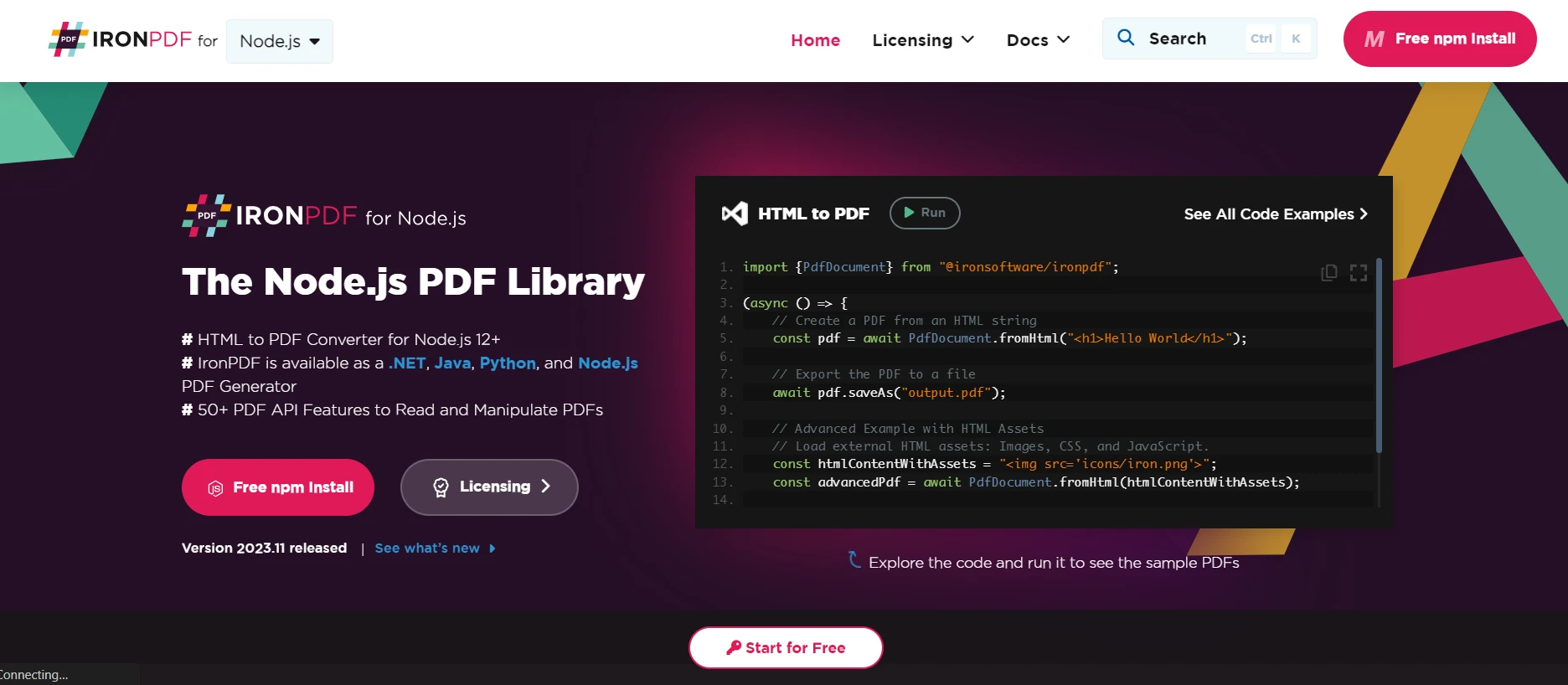
import {PdfDocument} from "@ironsoftware/ironpdf";

(async () => {
    // Create a PDF from an HTML string
    const pdf = await PdfDocument.fromHtml("<h1>Hello World</h1>");

    // Export the PDF to a file
    await pdf.saveAs("output.pdf");

    // Advanced Example with HTML Assets
    // Load external HTML assets: Images, CSS, and JavaScript.
    const htmlContentWithAssets = "<img src='icons/iron.png'>";
    const advancedPdf = await PdfDocument.fromHtml(htmlContentWithAssets);

    // Save the PDF with loaded assets
    await advancedPdf.saveAs("html-with-assets.pdf");
})();
import {PdfDocument} from "@ironsoftware/ironpdf";(async () => { // Create a PDF from an HTML string const pdf = awaitPdfDocument.fromHtml("<h1>Hello World</h1>"); // Export the PDF to a file await pdf.saveAs("output.pdf"); // Advanced Example with HTML Assets // Load external HTML assets: Images, CSS, and JavaScript. const htmlContentWithAssets = "<img src='icons/iron.png'>"; const advancedPdf = awaitPdfDocument.fromHtml(htmlContentWithAssets); // Save the PDF with loaded assets await advancedPdf.saveAs("html-with-assets.pdf");})();
Esta publicación utilizará IronPDF, una herramienta de biblioteca que puede comprimir PDFs en Node.js en diferentes niveles. Unas pocas líneas de código son suficientes para crear, abrir, leer y comprimir archivos PDF con IronPDF, una robusta biblioteca PDF. Para saber más sobre el nivel de compresión de datos, consulte esta [página de Wikipedia](https://es.wikipedia.org/wiki/Compresi%C3%B3n_de_datos).
## ¿Qué es Node.js?
Node.js es un entorno de ejecución de JavaScript multiplataforma y de código abierto que permite que el código JavaScript se ejecute fuera de un navegador web. Permite a los programadores crear aplicaciones de red escalables, rápidas y eficientes al habilitar la ejecución de JavaScript del lado del servidor. Debido a que Node.js es liviano e ideal para desarrollar aplicaciones en tiempo real que gestionan numerosas conexiones concurrentes, emplea un paradigma de E/S no bloqueante y dirigido por eventos.
Los servidores web, APIs, aplicaciones de streaming, aplicaciones de chat en tiempo real, dispositivos de Internet de las cosas (IoT) y más son algunas de las muchas aplicaciones que se construyen con frecuencia con Node.js. En resumen, Node.js se ha vuelto cada vez más popular debido a su efectividad, velocidad y compatibilidad con JavaScript tanto para el desarrollo de frontend como backend, proporcionando un solo lenguaje para el desarrollo de pila completa.
## Cómo comprimir archivos PDF en Node.js
1. Para comprimir PDFs, descargue el paquete de Node.js.
2. Cree un nuevo PDF o importe uno existente.
3. Para minimizar el tamaño de las imágenes en PDF, use el método `compressSize`.
4. Para reducir el tamaño del PDF, aplique la función [`compressSize`](/nodejs/object-reference/api/classes/PdfDocument.html#compressSize).
5. El archivo PDF comprimido debe ser exportado.
## IronPDF for Node.js
El propósito principal de la biblioteca .NET IronPDF es crear, editar y manejar documentos PDF dentro de aplicaciones .NET. IronPDF podría no tener soporte nativo directo para Node.js, y está diseñado principalmente para ser utilizado con el .NET Framework como C# o VB.NET.
## Características de IronPDF
- **Operaciones PDF con numerosas funciones:** IronPDF puede ofrecer una gama completa de funciones para crear, editar y modificar documentos PDF si es compatible con Node.js Es posible que se incluyan características como [convertir archivos HTML a PDFs](/nodejs/tutorials/html-to-pdf/), incorporar texto, imágenes, tablas, formularios, marcas de agua, cifrado y más.
- **Compatibilidad .NET :** la compatibilidad de IronPDF con Node.js puede ser ventajosa para los desarrolladores que tienen experiencia con tecnologías .NET o que tienen una infraestructura establecida basada en .NET, ya que les permite aprovechar su experiencia y hacer uso de una biblioteca PDF preferida en un entorno Node.js
- **Calidad y rendimiento:** IronPDF puede proporcionar capacidades confiables y excelentes de creación y manipulación de PDF al llevar las características de rendimiento y calidad de la generación de PDF basada en .NET a las aplicaciones Node.js
- **Soporte y documentación:** si IronPDF ha agregado soporte Node.js , puede ofrecer documentación completa, código de muestra y otros recursos para ayudar con la integración, el registro y el uso en aplicaciones Node.js
Es crucial recordar que los beneficios dependerían principalmente de las necesidades particulares de su proyecto, así como de la capacidad de IronPDF, su compatibilidad y facilidad de interacción con Node.js. Para obtener la información más reciente y precisa sobre la compatibilidad e integración de Node.js, siempre asegúrese de estudiar la documentación más reciente, fuentes oficiales o actualizaciones de IronPDF. Para saber más sobre IronPDF, consulte estas [páginas de documentación](/nodejs/docs/).
## Requisitos del paquete
- Visual Studio Code - IDE
- Node.js
- Se necesita un gestor de paquetes para instalar paquetes; puede usar npm o Yarn para esto.
### Instalar el paquete IronPDF for Node.js
Acceda al Símbolo del sistema o Terminal: Abra su interfaz de línea de comandos. Dependiendo de su sistema operativo, puede acceder a él:
- Windows: PowerShell o Símbolo del sistema
- macOS: Terminal
- Linux: Terminal
Configure el paquete: Para instalar un paquete, use el comando npm install y el nombre del paquete. Para instalar un paquete llamado `@ironsoftware/ironpdf`, por ejemplo, ingrese el siguiente comando:
```shell
:ProductInstall
```
El nombre del paquete real que desea instalar debe ser sustituido según sus requisitos.
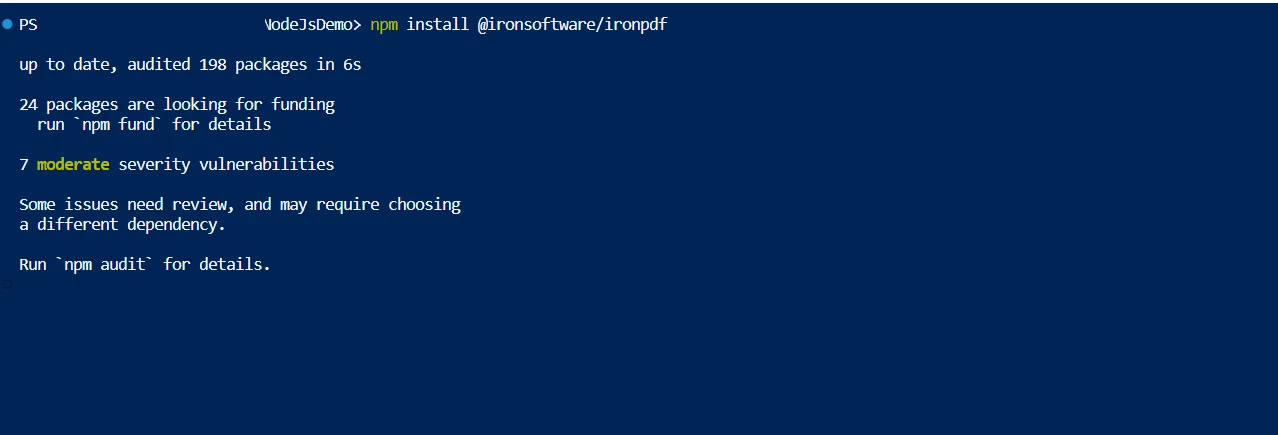
**Instalar IronPDF**
## Comprimir PDF con IronPDF
Los archivos PDF se pueden comprimir eficazmente con IronPDF. Es crucial mantener las imágenes en el archivo PDF lo más pequeñas posible. El proceso de optimización puede iniciarse utilizando el método `compressSize` en el objeto PDF.
```nodejs
const { PdfDocument } = require('@ironsoftware/ironpdf');

// Define an asynchronous function to perform PDF compression
const pdfprocess = async () => {
  console.log('Start compression Process'); // Notify the start of the process
  // Load the existing PDF document from the specified path
  const pdf = await PdfDocument.fromFile("Demo.pdf");
  // Compress images in the PDF with a quality parameter (1-100)
  await pdf.compressSize(60);
  // Save the compressed PDF with the specified name
  await pdf.saveAs("Result_60.pdf");
  // Further compress images, scaling them down based on visible size
  await pdf.compressSize(90, true);
  // Save the further scaled and compressed PDF
  await pdf.saveAs("Result_90.pdf");
  console.log('End compression Process'); // Notify the end of the process
};

// Execute the PDF compression function
pdfprocess();
```
En el código anterior, primero, importe la biblioteca IronPDF. Con la ayuda del método [`fromFile`](/nodejs/object-reference/api/classes/PdfDocument.html#fromFile) disponible en la clase [`PdfDocument`](/nodejs/object-reference/api/classes/PdfDocument.html), cargue el archivo PDF existente. Luego mantenga los datos en una variable de objeto que permite realizar varios tipos de operaciones. Se usa un método `compressSize` y pasa dos parámetros: calidad de imagen y escala de imagen que optimizarán los PDFs. Utilice el método [`saveAs`](/nodejs/object-reference/api/classes/PdfDocument.html#saveAs) para guardar el archivo PDF en la ubicación especificada.
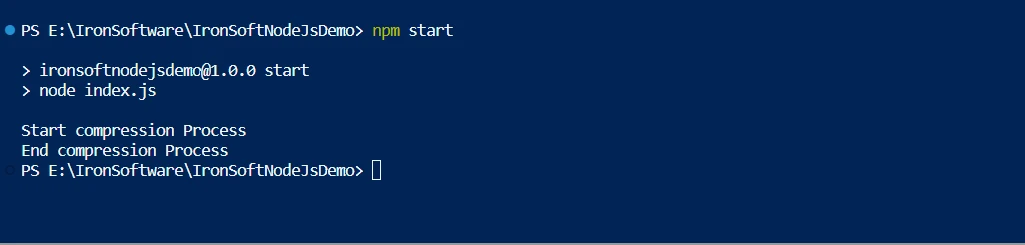
**La salida de la consola**
Resultado:
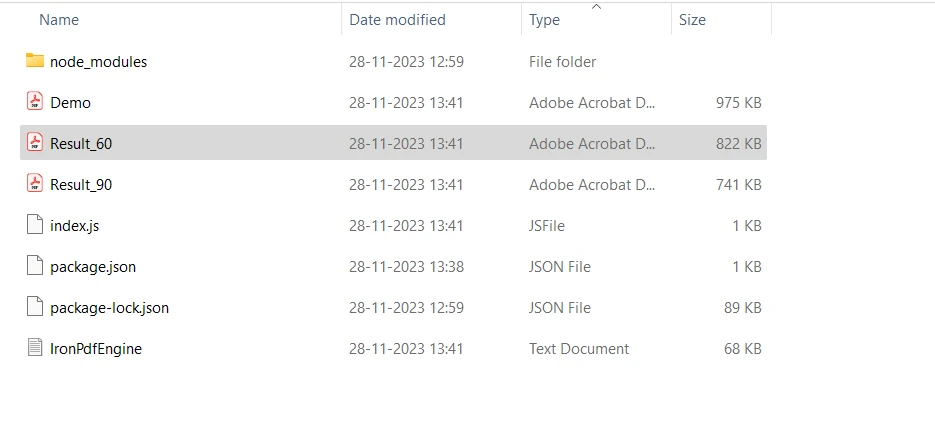
**El resultado de los archivos PDF comprimidos**
El ajuste de calidad es crítico al cambiar el tamaño de las imágenes JPEG. La menor cantidad de pérdida ocurre cuando el nivel de calidad es del 100%, pero el 1% da como resultado una salida de muy baja calidad. Las imágenes con una calificación de calidad del 90% o superior se consideran típicamente de alta calidad, 80%-90% como de calidad media, y 70%-80% como de baja calidad. Reducir la calidad por debajo del 70% podría llevar a fotografías de menor calidad, pero reduce significativamente el tamaño total del archivo de la publicación en PDF.
Para encontrar el tamaño de archivo perfecto para la relación calidad de imagen que se adapte a sus requisitos, es recomendable experimentar con diferentes configuraciones de calidad. El grado de pérdida de calidad dependerá finalmente del tipo de imagen de entrada, con algunas imágenes que probablemente perderán claridad más notablemente que otras. Para aprender más sobre esto, haga clic en esta [página de muestra para configuraciones de compresión más detalladas](/nodejs/examples/pdf-compression/).
## Conclusión
Para minimizar riesgos y garantizar la protección de datos, la biblioteca IronPDF proporciona fuertes características de seguridad. Es compatible con cualquier navegador popular y no está limitado a uno en particular. Para satisfacer las diversas necesidades de los desarrolladores, la biblioteca ofrece múltiples alternativas de licenciamiento, como una licencia de desarrollador gratuita y licencias de desarrollo adicionales que pueden adquirirse.
Una licencia perpetua, opciones de actualización, un año de mantenimiento de software y una garantía de devolución de dinero de 30 días están incluidos en el paquete Lite `$liteLicense`. Los usuarios pueden evaluar el producto en configuraciones de aplicación práctica para un período de prueba con marca de agua. Por favor, visite la [página de licencias](licensing) proporcionada para conocer más sobre los costos, licencias, y versión de prueba de IronPDF. Para conocer otros productos ofrecidos por Iron Software, consulte la [página oficial](https://ironsoftware.com/).
Esta publicación utilizará IronPDF, una herramienta de biblioteca que puede comprimir PDFs en Node.js en diferentes niveles. Unas pocas líneas de código son suficientes para crear, abrir, leer y comprimir archivos PDF con IronPDF, una robusta biblioteca PDF. Para saber más sobre el nivel de compresión de datos, consulte esta página de Wikipedia.
¿Qué es Node.js?
Node.js es un entorno de ejecución de JavaScript multiplataforma y de código abierto que permite que el código JavaScript se ejecute fuera de un navegador web. Permite a los programadores crear aplicaciones de red escalables, rápidas y eficientes al habilitar la ejecución de JavaScript del lado del servidor. Debido a que Node.js es liviano e ideal para desarrollar aplicaciones en tiempo real que gestionan numerosas conexiones concurrentes, emplea un paradigma de E/S no bloqueante y dirigido por eventos.
Los servidores web, APIs, aplicaciones de streaming, aplicaciones de chat en tiempo real, dispositivos de Internet de las cosas (IoT) y más son algunas de las muchas aplicaciones que se construyen con frecuencia con Node.js. En resumen, Node.js se ha vuelto cada vez más popular debido a su efectividad, velocidad y compatibilidad con JavaScript tanto para el desarrollo de frontend como backend, proporcionando un solo lenguaje para el desarrollo de pila completa.
Cómo comprimir archivos PDF en Node.js
Para comprimir PDFs, descargue el paquete de Node.js.
Cree un nuevo PDF o importe uno existente.
Para minimizar el tamaño de las imágenes en PDF, use el método compressSize.
Para reducir el tamaño del PDF, aplique la función compressSize.
El archivo PDF comprimido debe ser exportado.
IronPDF for Node.js
El propósito principal de la biblioteca .NET IronPDF es crear, editar y manejar documentos PDF dentro de aplicaciones .NET. IronPDF podría no tener soporte nativo directo para Node.js, y está diseñado principalmente para ser utilizado con el .NET Framework como C# o VB.NET.
Características de IronPDF
Operaciones PDF con numerosas funciones: IronPDF puede ofrecer una gama completa de funciones para crear, editar y modificar documentos PDF si es compatible con Node.js Es posible que se incluyan características como convertir archivos HTML a PDFs, incorporar texto, imágenes, tablas, formularios, marcas de agua, cifrado y más.
Compatibilidad .NET : la compatibilidad de IronPDF con Node.js puede ser ventajosa para los desarrolladores que tienen experiencia con tecnologías .NET o que tienen una infraestructura establecida basada en .NET, ya que les permite aprovechar su experiencia y hacer uso de una biblioteca PDF preferida en un entorno Node.js
Calidad y rendimiento: IronPDF puede proporcionar capacidades confiables y excelentes de creación y manipulación de PDF al llevar las características de rendimiento y calidad de la generación de PDF basada en .NET a las aplicaciones Node.js
Soporte y documentación: si IronPDF ha agregado soporte Node.js , puede ofrecer documentación completa, código de muestra y otros recursos para ayudar con la integración, el registro y el uso en aplicaciones Node.js
Es crucial recordar que los beneficios dependerían principalmente de las necesidades particulares de su proyecto, así como de la capacidad de IronPDF, su compatibilidad y facilidad de interacción con Node.js. Para obtener la información más reciente y precisa sobre la compatibilidad e integración de Node.js, siempre asegúrese de estudiar la documentación más reciente, fuentes oficiales o actualizaciones de IronPDF. Para saber más sobre IronPDF, consulte estas páginas de documentación.
Requisitos del paquete
Visual Studio Code - IDE
Node.js
Se necesita un gestor de paquetes para instalar paquetes; puede usar npm o Yarn para esto.
Instalar el paquete IronPDF for Node.js
Acceda al Símbolo del sistema o Terminal: Abra su interfaz de línea de comandos. Dependiendo de su sistema operativo, puede acceder a él:
Windows: PowerShell o Símbolo del sistema
macOS: Terminal
Linux: Terminal
Configure el paquete: Para instalar un paquete, use el comando npm install y el nombre del paquete. Para instalar un paquete llamado @ironsoftware/ironpdf, por ejemplo, ingrese el siguiente comando:
> npm i @ironsoftware/ironpdf
npm i @ironsoftware/ironpdf
El nombre del paquete real que desea instalar debe ser sustituido según sus requisitos.
Instalar IronPDF
Comprimir PDF con IronPDF
Los archivos PDF se pueden comprimir eficazmente con IronPDF. Es crucial mantener las imágenes en el archivo PDF lo más pequeñas posible. El proceso de optimización puede iniciarse utilizando el método compressSize en el objeto PDF.
const { PdfDocument } = require('@ironsoftware/ironpdf');// Define an asynchronous function to perform PDF compressionconst pdfprocess = async () => { console.log('Start compression Process'); // Notify the start of the process // Load the existing PDF document from the specified path const pdf = awaitPdfDocument.fromFile("Demo.pdf"); // Compress images in the PDF with a quality parameter (1-100) await pdf.compressSize(60); // Save the compressed PDF with the specified name await pdf.saveAs("Result_60.pdf"); // Further compress images, scaling them down based on visible size await pdf.compressSize(90, true); // Save the further scaled and compressed PDF await pdf.saveAs("Result_90.pdf"); console.log('End compression Process'); // Notify the end of the process};// Execute the PDF compression functionpdfprocess();
const { PdfDocument } = require('@ironsoftware/ironpdf');

// Define an asynchronous function to perform PDF compression
const pdfprocess = async () => {
  console.log('Start compression Process'); // Notify the start of the process
  // Load the existing PDF document from the specified path
  const pdf = await PdfDocument.fromFile("Demo.pdf");
  // Compress images in the PDF with a quality parameter (1-100)
  await pdf.compressSize(60);
  // Save the compressed PDF with the specified name
  await pdf.saveAs("Result_60.pdf");
  // Further compress images, scaling them down based on visible size
  await pdf.compressSize(90, true);
  // Save the further scaled and compressed PDF
  await pdf.saveAs("Result_90.pdf");
  console.log('End compression Process'); // Notify the end of the process
};

// Execute the PDF compression function
pdfprocess();
JavaScript
En el código anterior, primero, importe la biblioteca IronPDF. Con la ayuda del método fromFile disponible en la clase PdfDocument, cargue el archivo PDF existente. Luego mantenga los datos en una variable de objeto que permite realizar varios tipos de operaciones. Se usa un método compressSize y pasa dos parámetros: calidad de imagen y escala de imagen que optimizarán los PDFs. Utilice el método saveAs para guardar el archivo PDF en la ubicación especificada.
La salida de la consola
Resultado:
El resultado de los archivos PDF comprimidos
El ajuste de calidad es crítico al cambiar el tamaño de las imágenes JPEG. La menor cantidad de pérdida ocurre cuando el nivel de calidad es del 100%, pero el 1% da como resultado una salida de muy baja calidad. Las imágenes con una calificación de calidad del 90% o superior se consideran típicamente de alta calidad, 80%-90% como de calidad media, y 70%-80% como de baja calidad. Reducir la calidad por debajo del 70% podría llevar a fotografías de menor calidad, pero reduce significativamente el tamaño total del archivo de la publicación en PDF.
Para encontrar el tamaño de archivo perfecto para la relación calidad de imagen que se adapte a sus requisitos, es recomendable experimentar con diferentes configuraciones de calidad. El grado de pérdida de calidad dependerá finalmente del tipo de imagen de entrada, con algunas imágenes que probablemente perderán claridad más notablemente que otras. Para aprender más sobre esto, haga clic en esta página de muestra para configuraciones de compresión más detalladas.
Conclusión
Para minimizar riesgos y garantizar la protección de datos, la biblioteca IronPDF proporciona fuertes características de seguridad. Es compatible con cualquier navegador popular y no está limitado a uno en particular. Para satisfacer las diversas necesidades de los desarrolladores, la biblioteca ofrece múltiples alternativas de licenciamiento, como una licencia de desarrollador gratuita y licencias de desarrollo adicionales que pueden adquirirse.
Una licencia perpetua, opciones de actualización, un año de mantenimiento de software y una garantía de devolución de dinero de 30 días están incluidos en el paquete Lite $999. Los usuarios pueden evaluar el producto en configuraciones de aplicación práctica para un período de prueba con marca de agua. Por favor, visite la página de licencias proporcionada para conocer más sobre los costos, licencias, y versión de prueba de IronPDF. Para conocer otros productos ofrecidos por Iron Software, consulte la página oficial.
Curtis Chau tiene una licenciatura en Ciencias de la Computación (Carleton University) y se especializa en el desarrollo front-end con experiencia en Node.js, TypeScript, JavaScript y React. Apasionado por crear interfaces de usuario intuitivas y estéticamente agradables, disfruta trabajando con frameworks modernos y creando manuales bien estructurados y visualmente atractivos.




 Instalar IronPDF
 La salida de la consola
 El resultado de los archivos PDF comprimidos