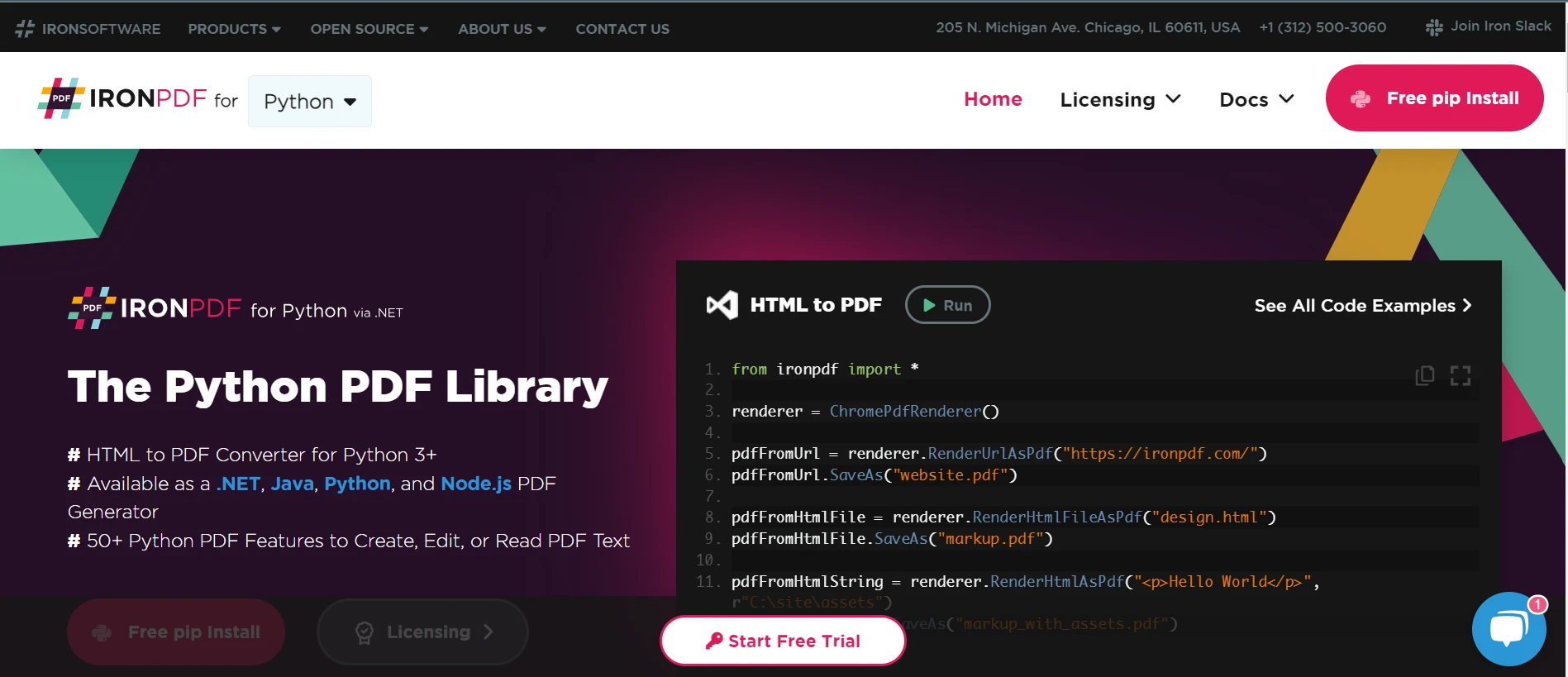
from ironpdf import *

# Instantiate Renderer
renderer = ChromePdfRenderer()

# Create a PDF from a HTML string using Python
pdf = renderer.RenderHtmlAsPdf("<h1>Hello World</h1>")

# Export to a file or Stream
pdf.SaveAs("output.pdf")

# Advanced Example with HTML Assets
# Load external html assets: Images, CSS and JavaScript.
# An optional BasePath 'C:\site\assets\' is set as the file location to load assets from
myAdvancedPdf = renderer.RenderHtmlAsPdf("<img src='icons/iron.png'>", r"C:\site\assets")
myAdvancedPdf.SaveAs("html-with-assets.pdf")
from ironpdf import *# Instantiate Rendererrenderer = ChromePdfRenderer()# Create a PDF from a HTML string using Pythonpdf = renderer.RenderHtmlAsPdf("<h1>Hello World</h1>")# Export to a file or Streampdf.SaveAs("output.pdf")# Advanced Example with HTML Assets# Load external html assets: Images, CSS and JavaScript.# An optional BasePath 'C:\site\assets\' is set as the file location to load assets frommyAdvancedPdf = renderer.RenderHtmlAsPdf("<img src='icons/iron.png'>", r"C:\site\assets")myAdvancedPdf.SaveAs("html-with-assets.pdf")
USANDO IRONPDF FOR PYTHON
PyWriter de PDF en Python (Tutorial de Ejemplo de Código)
[IronPDF](/python/) es una biblioteca de objetos de archivos PDF pura de Python para desarrolladores de Python que buscan [escribir archivos PDF](https://pypdf.readthedocs.io/en/stable/modules/PdfWriter.html) o manipular archivos PDF dentro de sus aplicaciones. IronPDF se destaca por su simplicidad y versatilidad, lo que lo convierte en una elección ideal para tareas que requieren creación automática de PDF o integración de generación de PDF en sistemas de software.
Esta guía explorará cómo IronPDF, una biblioteca de PDF pura de Python, puede ser usada para crear archivos PDF o atributos de página PDF y leer archivos PDF. Incluirá ejemplos y fragmentos de código práctico, proporcionándole una comprensión práctica de cómo usar IronPDF for Python's PdfWriter en sus proyectos de Python para escribir archivos PDF y crear una nueva página PDF.
## Configuración de IronPDF
### Instalación
Para comenzar a usar IronPDF, necesitarás instalarlo a través del Índice de Paquetes de Python. Ejecute el siguiente comando en la terminal:
```shell
:ProductInstall
```
## Escribir archivos PDF y manipular archivos PDF
### Crear un nuevo PDF
IronPDF simplifica el proceso de [crear nuevos archivos PDF](/python/examples/using-html-to-create-a-pdf/) y trabajar en PDFs existentes. Proporciona una interfaz directa para generar documentos, ya sea un PDF simple de una página o un documento más complejo con varios elementos como contraseñas de usuario. Esta funcionalidad es vital para tareas como la generación de informes, la creación de facturas, y mucho más.
```python
from ironpdf import ChromePdfRenderer, License, Logger

# Set the IronPDF license key
License.LicenseKey = "Your-License-Key"
# Enable logging for debugging purposes
Logger.EnableDebugging = True
Logger.LogFilePath = "Custom.log"
Logger.LoggingMode = Logger.LoggingModes.All

# Basic HTML content for the PDF
html = """
<html>
   <head>
      <title>IronPDF for Python!</title>
      <link rel='stylesheet' href='assets/style.css'>
   </head>
   <body>
      <h1>It's IronPDF World!!</h1>
      <a href="https://ironpdf.com/python/"><img src='assets/logo.png' /></a>
   </body>
</html>
"""

# Create a PDF renderer
renderer = ChromePdfRenderer()
# Render the HTML content as a PDF
pdf = renderer.RenderHtmlAsPdf(html)
# Save the rendered PDF to a file
pdf.SaveAs("New PDF File.pdf")
```
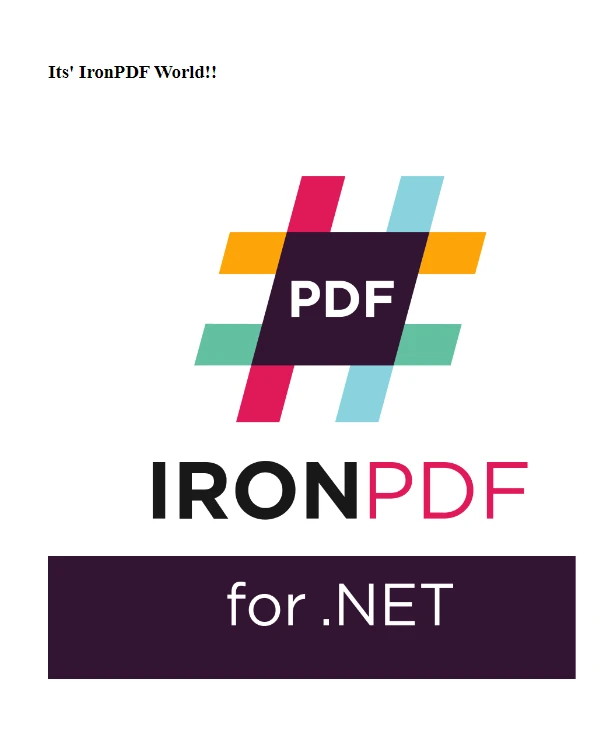
**Archivo de Salida**
### Fusión de archivos PDF
IronPDF simplifica la tarea de combinar varios archivos PDF en uno solo. Esta característica es beneficiosa para agregar varios informes, ensamblar documentos escaneados u organizar información que pertenece junta. Por ejemplo, puede necesitar fusionar archivos PDF al crear un informe integral de múltiples fuentes o cuando tiene una serie de documentos que deben presentarse como un solo archivo.
```python
from ironpdf import PdfDocument, License, Logger
# Set the IronPDF license key
License.LicenseKey = "Your-License-Key"
# Enable logging for debugging purposes
Logger.EnableDebugging = True
Logger.LogFilePath = "Custom.log"
Logger.LoggingMode = Logger.LoggingModes.All
# Load existing PDF documents
pdfOne = PdfDocument("Report First.pdf")
pdfTwo = PdfDocument("Report Second.pdf")
# Merge the PDFs into a single document
merged = PdfDocument.Merge(pdfOne, pdfTwo)
# Save the merged PDF
merged.SaveAs("Merged.pdf")
```
La capacidad de fusionar archivos PDF existentes en un nuevo archivo PDF también puede ser útil en campos como la ciencia de datos, donde un documento PDF consolidado podría servir como un conjunto de datos para entrenar un módulo de IA. IronPDF maneja esta tarea sin esfuerzo, manteniendo la integridad y el formato de cada página de los documentos originales, resultando en un archivo de salida PDF fluido y coherente.
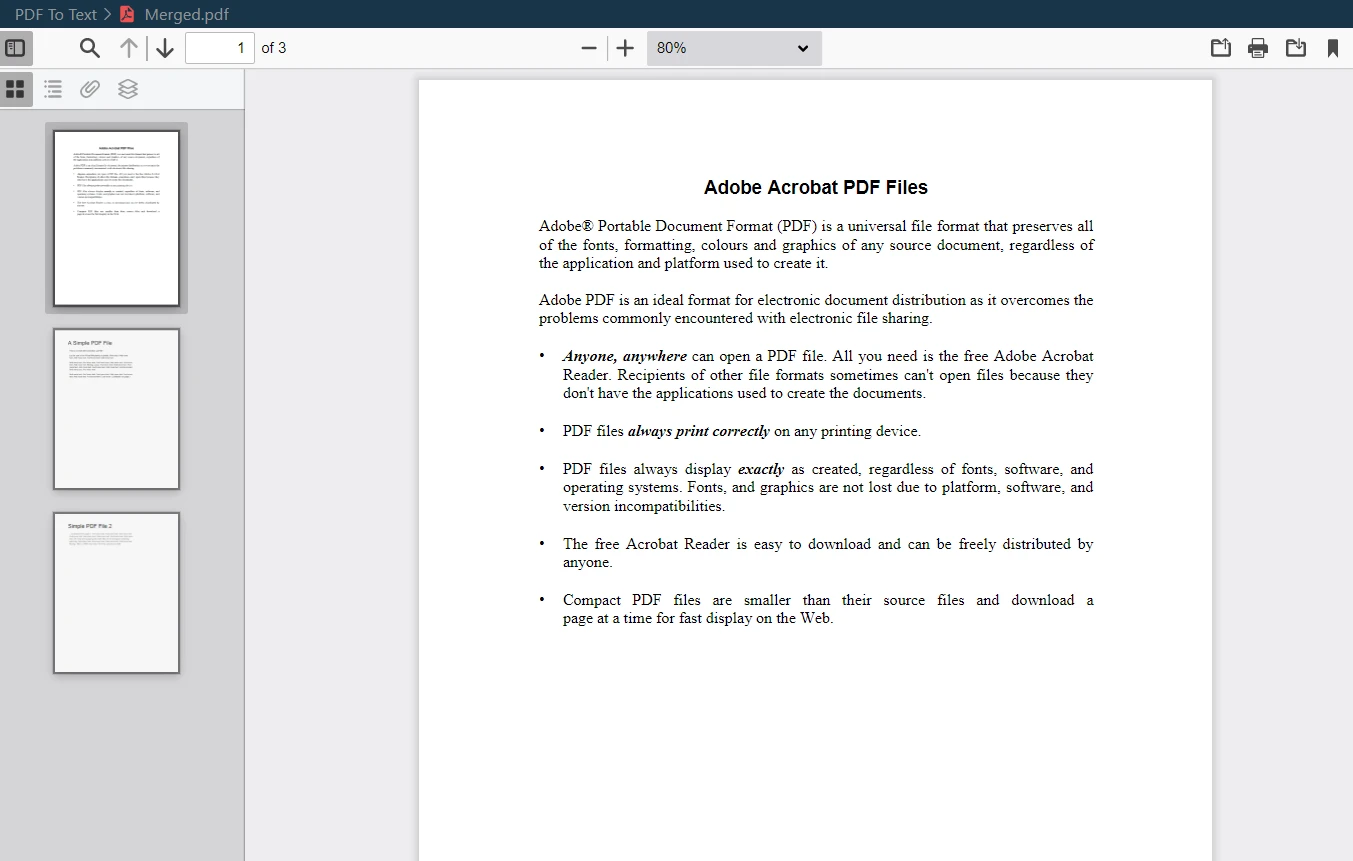
**Salida de PDF Combinado**
### Dividir un solo PDF
Por otro lado, IronPDF también sobresale al dividir un archivo PDF existente en múltiples archivos nuevos. Esta función es útil cuando necesita extraer secciones específicas de un documento PDF sustancial o cuando divide un documento en partes más pequeñas y manejables.
```python
from ironpdf import PdfDocument, License, Logger
# Set the IronPDF license key
License.LicenseKey = "Your-License-Key"
# Enable logging for debugging purposes
Logger.EnableDebugging = True
Logger.LogFilePath = "Custom.log"
Logger.LoggingMode = Logger.LoggingModes.All
# Load the PDF document
pdf = PdfDocument("Report.pdf")
# Extract the first page
page1doc = pdf.CopyPage(0)
# Save the extracted page as a new PDF
page1doc.SaveAs("Split1.pdf")
```
Por ejemplo, puede querer aislar ciertas páginas PDF de un informe grande o crear documentos individuales de diferentes capítulos de un libro. IronPDF le permite seleccionar las múltiples páginas deseadas para convertirlas en un nuevo archivo PDF, asegurando que pueda manipular y gestionar su contenido PDF según sea necesario.
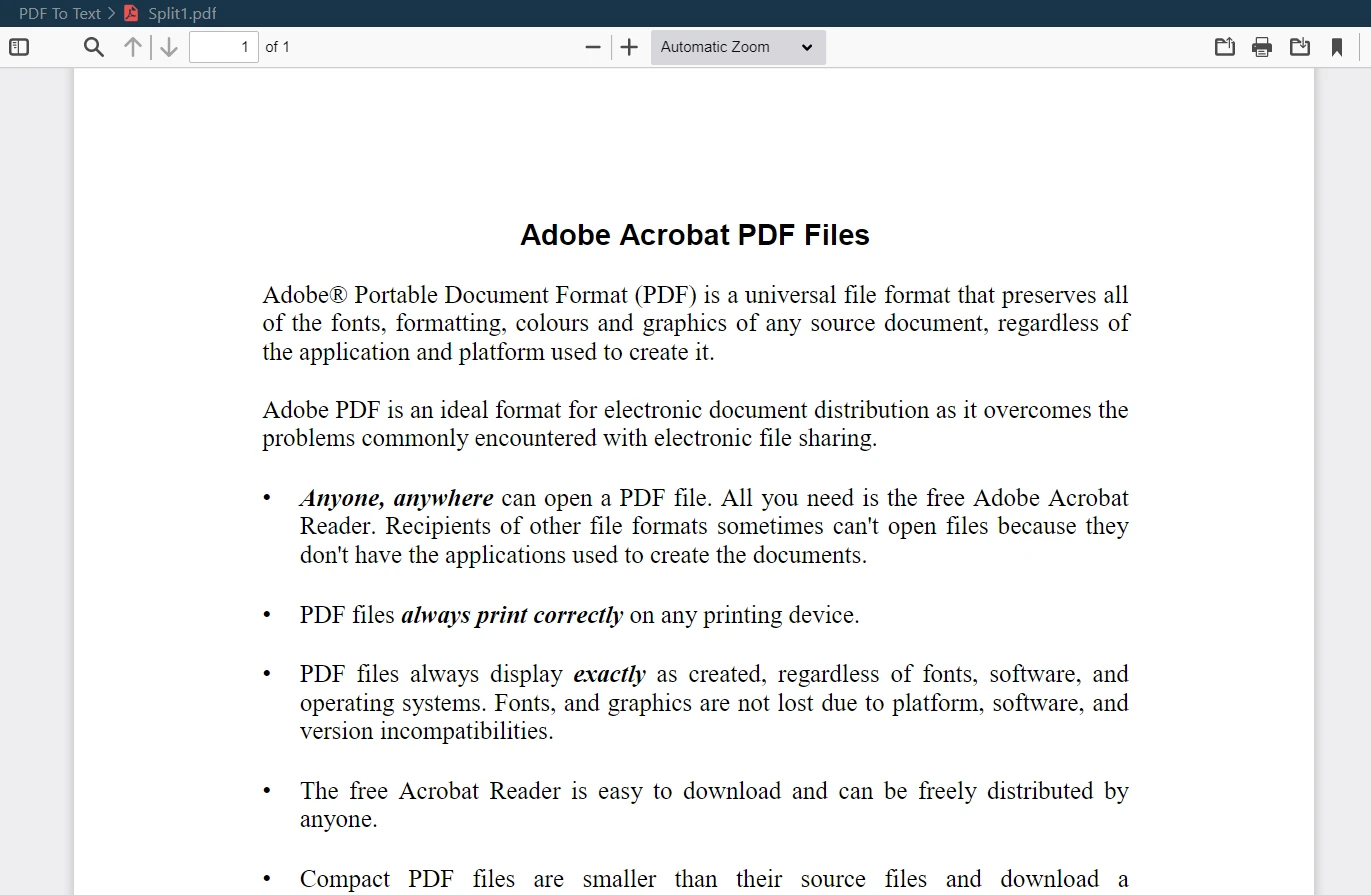
**Salida de PDF Dividido**
### Implementación de funciones de seguridad
Asegurar sus documentos PDF se convierte en una prioridad principal cuando se trata de información sensible o confidencial. IronPDF aborda esta necesidad ofreciendo características de seguridad robustas, incluyendo protección por contraseña de usuario y encriptación. Esto asegura que sus archivos PDF permanezcan seguros y accesibles solo para usuarios autorizados.
```python
from ironpdf import PdfDocument, License, Logger
# Set the IronPDF license key
License.LicenseKey = "Your-License-Key"
# Enable logging for debugging purposes
Logger.EnableDebugging = True
Logger.LogFilePath = "Custom.log"
Logger.LoggingMode = Logger.LoggingModes.All
# Load the PDF document
pdf = PdfDocument("Report.pdf")
# Adjust security settings to make the PDF read-only and set permissions
pdf.SecuritySettings.RemovePasswordsAndEncryption()
pdf.SecuritySettings.MakePdfDocumentReadOnly("secret-key")
pdf.SecuritySettings.AllowUserAnnotations = False
pdf.SecuritySettings.AllowUserCopyPasteContent = False
pdf.SecuritySettings.AllowUserFormData = False
pdf.SecuritySettings.AllowUserPrinting = PdfPrintSecurity.FullPrintRights
# Set the document encryption passwords
pdf.SecuritySettings.OwnerPassword = "top-secret" # password to edit the PDF
pdf.SecuritySettings.UserPassword = "sharable" # password to open the PDF
# Save the secured PDF
pdf.SaveAs("secured.pdf")
```
Al implementar contraseñas de usuario, puede controlar quién puede ver o editar sus documentos PDF. Las opciones de encriptación añaden una capa adicional de seguridad, protegiendo sus datos contra accesos no autorizados y haciendo de IronPDF una opción confiable para gestionar información sensible en formato PDF.
### Extracción de texto de PDF
Otra característica crítica de IronPDF es su capacidad para extraer texto de documentos PDF. Esta funcionalidad es particularmente útil para la recuperación de datos, análisis de contenido, o incluso para reutilizar el contenido de texto de PDFs existentes en nuevos documentos.
```python
from ironpdf import PdfDocument, License, Logger
# Set the IronPDF license key
License.LicenseKey = "Your-License-Key"
# Enable logging for debugging purposes
Logger.EnableDebugging = True
Logger.LogFilePath = "Custom.log"
Logger.LoggingMode = Logger.LoggingModes.All
# Load the PDF document
pdf = PdfDocument("Report.pdf")
# Extract all text from the PDF document
allText = pdf.ExtractAllText()
# Extract text from a specific page in the document
specificPage = pdf.ExtractTextFromPage(3)
```
Ya sea que esté extrayendo datos para análisis, buscando información específica dentro de un documento grande, o transfiriendo contenido de PDF a archivos de texto para un procesamiento posterior, IronPDF lo hace sencillo y eficiente. La biblioteca asegura que el texto extraído mantenga su formato y estructura original, haciéndolo inmediatamente utilizable para sus necesidades específicas.
### Gestión de la información del documento
La gestión eficiente de PDFs se extiende más allá de su contenido. IronPDF permite la gestión efectiva de metadatos y propiedades de documentos como el nombre del autor, el título del documento, la fecha de creación, y más. Esta capacidad es vital para organizar y catalogar sus documentos PDF, particularmente en entornos donde la procedencia del documento y los metadatos son importantes.
```python
from ironpdf import PdfDocument, License, Logger
from datetime import datetime
# Set the IronPDF license key
License.LicenseKey = "Your-License-Key"
# Enable logging for debugging purposes
Logger.EnableDebugging = True
Logger.LogFilePath = "Custom.log"
Logger.LoggingMode = Logger.LoggingModes.All
# Load an existing PDF or create a new one
pdf = PdfDocument("Report.pdf")
# Edit file metadata
pdf.MetaData.Author = "Satoshi Nakamoto"
pdf.MetaData.Keywords = "SEO, Friendly"
pdf.MetaData.ModifiedDate = datetime.now()
# Save the PDF with updated metadata
pdf.SaveAs("MetaData Updated.pdf")
```
Por ejemplo, en un entorno académico o corporativo, poder rastrear la fecha de creación y la autoría de los documentos puede ser esencial para los propósitos de mantenimiento de registros y recuperación de documentos. IronPDF facilita la gestión de esta información, proporcionando una manera simplificada de manejar y actualizar la información del documento dentro de sus aplicaciones de Python.
## Conclusión
**Licencia**
Este tutorial ha cubierto los conceptos básicos del uso de IronPDF en Python para la manipulación de PDFs. Desde crear nuevos archivos PDF hasta fusionar los existentes y añadir características de seguridad, IronPDF es una herramienta versátil para cualquier desarrollador de Python.
IronPDF for Python también ofrece las siguientes características:
* [Crear un nuevo archivo PDF](/python/tutorials/html-to-pdf/) desde cero usando HTML o URL
* [Editar](/python/examples/editing-pdfs/) archivos PDF existentes
* [Rotar](/python/examples/pdf-page-orientation/) páginas PDF
* [Extraer texto](/python/blog/using-ironpdf-for-python/extract-data-from-pdf-python-tutorial/), metadatos e imágenes de archivos PDF
* [Asegurar archivos PDF](/python/examples/security-and-metadata/) con contraseñas y restricciones
* [Dividir](/python/blog/using-ironpdf-for-python/split-pdf-python-tutorial/) y [combinar](/python/how-to/python-merge-pdf/) PDFs
IronPDF for Python ofrece una [prueba gratuita](trial-license) para que los usuarios exploren sus características. Para seguir utilizándolo tras el periodo de prueba, las licencias tienen un precio a partir de `$liteLicense`. Este precio permite a los desarrolladores utilizar todo el rango de capacidades de IronPDF en sus proyectos.
IronPDF es una biblioteca de objetos de archivos PDF pura de Python para desarrolladores de Python que buscan escribir archivos PDF o manipular archivos PDF dentro de sus aplicaciones. IronPDF se destaca por su simplicidad y versatilidad, lo que lo convierte en una elección ideal para tareas que requieren creación automática de PDF o integración de generación de PDF en sistemas de software.
Esta guía explorará cómo IronPDF, una biblioteca de PDF pura de Python, puede ser usada para crear archivos PDF o atributos de página PDF y leer archivos PDF. Incluirá ejemplos y fragmentos de código práctico, proporcionándole una comprensión práctica de cómo usar IronPDF for Python's PdfWriter en sus proyectos de Python para escribir archivos PDF y crear una nueva página PDF.
Configuración de IronPDF
Instalación
Para comenzar a usar IronPDF, necesitarás instalarlo a través del Índice de Paquetes de Python. Ejecute el siguiente comando en la terminal:
> pip install ironpdf
pip install ironpdf
Escribir archivos PDF y manipular archivos PDF
Crear un nuevo PDF
IronPDF simplifica el proceso de crear nuevos archivos PDF y trabajar en PDFs existentes. Proporciona una interfaz directa para generar documentos, ya sea un PDF simple de una página o un documento más complejo con varios elementos como contraseñas de usuario. Esta funcionalidad es vital para tareas como la generación de informes, la creación de facturas, y mucho más.
from ironpdf importChromePdfRenderer, License, Logger# Set the IronPDF license keyLicense.LicenseKey = "Your-License-Key"# Enable logging for debugging purposesLogger.EnableDebugging = TrueLogger.LogFilePath = "Custom.log"Logger.LoggingMode = Logger.LoggingModes.All# Basic HTML content for the PDFhtml = """<html> <head> <title>IronPDF for Python!</title> <link rel='stylesheet' href='assets/style.css'> </head> <body> <h1>It's IronPDF World!!</h1> <a href="https://ironpdf.com/python/"><img src='assets/logo.png' /></a> </body></html>"""# Create a PDF rendererrenderer = ChromePdfRenderer()# Render the HTML content as a PDFpdf = renderer.RenderHtmlAsPdf(html)# Save the rendered PDF to a filepdf.SaveAs("New PDF File.pdf")
from ironpdf import ChromePdfRenderer, License, Logger

# Set the IronPDF license key
License.LicenseKey = "Your-License-Key"
# Enable logging for debugging purposes
Logger.EnableDebugging = True
Logger.LogFilePath = "Custom.log"
Logger.LoggingMode = Logger.LoggingModes.All

# Basic HTML content for the PDF
html = """
<html>
   <head>
      <title>IronPDF for Python!</title>
      <link rel='stylesheet' href='assets/style.css'>
   </head>
   <body>
      <h1>It's IronPDF World!!</h1>
      <a href="https://ironpdf.com/python/"><img src='assets/logo.png' /></a>
   </body>
</html>
"""

# Create a PDF renderer
renderer = ChromePdfRenderer()
# Render the HTML content as a PDF
pdf = renderer.RenderHtmlAsPdf(html)
# Save the rendered PDF to a file
pdf.SaveAs("New PDF File.pdf")
Python
Archivo de Salida
Fusión de archivos PDF
IronPDF simplifica la tarea de combinar varios archivos PDF en uno solo. Esta característica es beneficiosa para agregar varios informes, ensamblar documentos escaneados u organizar información que pertenece junta. Por ejemplo, puede necesitar fusionar archivos PDF al crear un informe integral de múltiples fuentes o cuando tiene una serie de documentos que deben presentarse como un solo archivo.
from ironpdf importPdfDocument, License, Logger# Set the IronPDF license keyLicense.LicenseKey = "Your-License-Key"# Enable logging for debugging purposesLogger.EnableDebugging = TrueLogger.LogFilePath = "Custom.log"Logger.LoggingMode = Logger.LoggingModes.All# Load existing PDF documentspdfOne = PdfDocument("Report First.pdf")pdfTwo = PdfDocument("Report Second.pdf")# Merge the PDFs into a single documentmerged = PdfDocument.Merge(pdfOne, pdfTwo)# Save the merged PDFmerged.SaveAs("Merged.pdf")
from ironpdf import PdfDocument, License, Logger

# Set the IronPDF license key
License.LicenseKey = "Your-License-Key"
# Enable logging for debugging purposes
Logger.EnableDebugging = True
Logger.LogFilePath = "Custom.log"
Logger.LoggingMode = Logger.LoggingModes.All

# Load existing PDF documents
pdfOne = PdfDocument("Report First.pdf")
pdfTwo = PdfDocument("Report Second.pdf")
# Merge the PDFs into a single document
merged = PdfDocument.Merge(pdfOne, pdfTwo)
# Save the merged PDF
merged.SaveAs("Merged.pdf")
Python
La capacidad de fusionar archivos PDF existentes en un nuevo archivo PDF también puede ser útil en campos como la ciencia de datos, donde un documento PDF consolidado podría servir como un conjunto de datos para entrenar un módulo de IA. IronPDF maneja esta tarea sin esfuerzo, manteniendo la integridad y el formato de cada página de los documentos originales, resultando en un archivo de salida PDF fluido y coherente.
Salida de PDF Combinado
Dividir un solo PDF
Por otro lado, IronPDF también sobresale al dividir un archivo PDF existente en múltiples archivos nuevos. Esta función es útil cuando necesita extraer secciones específicas de un documento PDF sustancial o cuando divide un documento en partes más pequeñas y manejables.
from ironpdf importPdfDocument, License, Logger# Set the IronPDF license keyLicense.LicenseKey = "Your-License-Key"# Enable logging for debugging purposesLogger.EnableDebugging = TrueLogger.LogFilePath = "Custom.log"Logger.LoggingMode = Logger.LoggingModes.All# Load the PDF documentpdf = PdfDocument("Report.pdf")# Extract the first pagepage1doc = pdf.CopyPage(0)# Save the extracted page as a new PDFpage1doc.SaveAs("Split1.pdf")
from ironpdf import PdfDocument, License, Logger

# Set the IronPDF license key
License.LicenseKey = "Your-License-Key"
# Enable logging for debugging purposes
Logger.EnableDebugging = True
Logger.LogFilePath = "Custom.log"
Logger.LoggingMode = Logger.LoggingModes.All

# Load the PDF document
pdf = PdfDocument("Report.pdf")
# Extract the first page
page1doc = pdf.CopyPage(0)
# Save the extracted page as a new PDF
page1doc.SaveAs("Split1.pdf")
Python
Por ejemplo, puede querer aislar ciertas páginas PDF de un informe grande o crear documentos individuales de diferentes capítulos de un libro. IronPDF le permite seleccionar las múltiples páginas deseadas para convertirlas en un nuevo archivo PDF, asegurando que pueda manipular y gestionar su contenido PDF según sea necesario.
Salida de PDF Dividido
Implementación de funciones de seguridad
Asegurar sus documentos PDF se convierte en una prioridad principal cuando se trata de información sensible o confidencial. IronPDF aborda esta necesidad ofreciendo características de seguridad robustas, incluyendo protección por contraseña de usuario y encriptación. Esto asegura que sus archivos PDF permanezcan seguros y accesibles solo para usuarios autorizados.
from ironpdf importPdfDocument, License, Logger# Set the IronPDF license keyLicense.LicenseKey = "Your-License-Key"# Enable logging for debugging purposesLogger.EnableDebugging = TrueLogger.LogFilePath = "Custom.log"Logger.LoggingMode = Logger.LoggingModes.All# Load the PDF documentpdf = PdfDocument("Report.pdf")# Adjust security settings to make the PDF read-only and set permissionspdf.SecuritySettings.RemovePasswordsAndEncryption()pdf.SecuritySettings.MakePdfDocumentReadOnly("secret-key")pdf.SecuritySettings.AllowUserAnnotations = Falsepdf.SecuritySettings.AllowUserCopyPasteContent = Falsepdf.SecuritySettings.AllowUserFormData = Falsepdf.SecuritySettings.AllowUserPrinting = PdfPrintSecurity.FullPrintRights# Set the document encryption passwordspdf.SecuritySettings.OwnerPassword = "top-secret" # password to edit the PDFpdf.SecuritySettings.UserPassword = "sharable" # password to open the PDF# Save the secured PDFpdf.SaveAs("secured.pdf")
from ironpdf import PdfDocument, License, Logger

# Set the IronPDF license key
License.LicenseKey = "Your-License-Key"
# Enable logging for debugging purposes
Logger.EnableDebugging = True
Logger.LogFilePath = "Custom.log"
Logger.LoggingMode = Logger.LoggingModes.All

# Load the PDF document
pdf = PdfDocument("Report.pdf")
# Adjust security settings to make the PDF read-only and set permissions
pdf.SecuritySettings.RemovePasswordsAndEncryption()
pdf.SecuritySettings.MakePdfDocumentReadOnly("secret-key")
pdf.SecuritySettings.AllowUserAnnotations = False
pdf.SecuritySettings.AllowUserCopyPasteContent = False
pdf.SecuritySettings.AllowUserFormData = False
pdf.SecuritySettings.AllowUserPrinting = PdfPrintSecurity.FullPrintRights
# Set the document encryption passwords
pdf.SecuritySettings.OwnerPassword = "top-secret"  # password to edit the PDF
pdf.SecuritySettings.UserPassword = "sharable"  # password to open the PDF
# Save the secured PDF
pdf.SaveAs("secured.pdf")
Python
Al implementar contraseñas de usuario, puede controlar quién puede ver o editar sus documentos PDF. Las opciones de encriptación añaden una capa adicional de seguridad, protegiendo sus datos contra accesos no autorizados y haciendo de IronPDF una opción confiable para gestionar información sensible en formato PDF.
Extracción de texto de PDF
Otra característica crítica de IronPDF es su capacidad para extraer texto de documentos PDF. Esta funcionalidad es particularmente útil para la recuperación de datos, análisis de contenido, o incluso para reutilizar el contenido de texto de PDFs existentes en nuevos documentos.
from ironpdf importPdfDocument, License, Logger# Set the IronPDF license keyLicense.LicenseKey = "Your-License-Key"# Enable logging for debugging purposesLogger.EnableDebugging = TrueLogger.LogFilePath = "Custom.log"Logger.LoggingMode = Logger.LoggingModes.All# Load the PDF documentpdf = PdfDocument("Report.pdf")# Extract all text from the PDF documentallText = pdf.ExtractAllText()# Extract text from a specific page in the documentspecificPage = pdf.ExtractTextFromPage(3)
from ironpdf import PdfDocument, License, Logger

# Set the IronPDF license key
License.LicenseKey = "Your-License-Key"
# Enable logging for debugging purposes
Logger.EnableDebugging = True
Logger.LogFilePath = "Custom.log"
Logger.LoggingMode = Logger.LoggingModes.All

# Load the PDF document
pdf = PdfDocument("Report.pdf")
# Extract all text from the PDF document
allText = pdf.ExtractAllText()
# Extract text from a specific page in the document
specificPage = pdf.ExtractTextFromPage(3)
Python
Ya sea que esté extrayendo datos para análisis, buscando información específica dentro de un documento grande, o transfiriendo contenido de PDF a archivos de texto para un procesamiento posterior, IronPDF lo hace sencillo y eficiente. La biblioteca asegura que el texto extraído mantenga su formato y estructura original, haciéndolo inmediatamente utilizable para sus necesidades específicas.
Gestión de la información del documento
La gestión eficiente de PDFs se extiende más allá de su contenido. IronPDF permite la gestión efectiva de metadatos y propiedades de documentos como el nombre del autor, el título del documento, la fecha de creación, y más. Esta capacidad es vital para organizar y catalogar sus documentos PDF, particularmente en entornos donde la procedencia del documento y los metadatos son importantes.
from ironpdf importPdfDocument, License, Loggerfrom datetime import datetime# Set the IronPDF license keyLicense.LicenseKey = "Your-License-Key"# Enable logging for debugging purposesLogger.EnableDebugging = TrueLogger.LogFilePath = "Custom.log"Logger.LoggingMode = Logger.LoggingModes.All# Load an existing PDF or create a new onepdf = PdfDocument("Report.pdf")# Edit file metadatapdf.MetaData.Author = "Satoshi Nakamoto"pdf.MetaData.Keywords = "SEO, Friendly"pdf.MetaData.ModifiedDate = datetime.now()# Save the PDF with updated metadatapdf.SaveAs("MetaData Updated.pdf")
from ironpdf import PdfDocument, License, Logger
from datetime import datetime

# Set the IronPDF license key
License.LicenseKey = "Your-License-Key"
# Enable logging for debugging purposes
Logger.EnableDebugging = True
Logger.LogFilePath = "Custom.log"
Logger.LoggingMode = Logger.LoggingModes.All

# Load an existing PDF or create a new one
pdf = PdfDocument("Report.pdf")
# Edit file metadata
pdf.MetaData.Author = "Satoshi Nakamoto"
pdf.MetaData.Keywords = "SEO, Friendly"
pdf.MetaData.ModifiedDate = datetime.now()
# Save the PDF with updated metadata
pdf.SaveAs("MetaData Updated.pdf")
Python
Por ejemplo, en un entorno académico o corporativo, poder rastrear la fecha de creación y la autoría de los documentos puede ser esencial para los propósitos de mantenimiento de registros y recuperación de documentos. IronPDF facilita la gestión de esta información, proporcionando una manera simplificada de manejar y actualizar la información del documento dentro de sus aplicaciones de Python.
Conclusión
Licencia
Este tutorial ha cubierto los conceptos básicos del uso de IronPDF en Python para la manipulación de PDFs. Desde crear nuevos archivos PDF hasta fusionar los existentes y añadir características de seguridad, IronPDF es una herramienta versátil para cualquier desarrollador de Python.
IronPDF for Python también ofrece las siguientes características:
IronPDF for Python ofrece una prueba gratuita para que los usuarios exploren sus características. Para seguir utilizándolo tras el periodo de prueba, las licencias tienen un precio a partir de $999. Este precio permite a los desarrolladores utilizar todo el rango de capacidades de IronPDF en sus proyectos.
Curtis Chau tiene una licenciatura en Ciencias de la Computación (Carleton University) y se especializa en el desarrollo front-end con experiencia en Node.js, TypeScript, JavaScript y React. Apasionado por crear interfaces de usuario intuitivas y estéticamente agradables, disfruta trabajando con frameworks modernos y creando manuales bien estructurados y visualmente atractivos.




 Archivo de Salida
 Salida de PDF Combinado
 Salida de PDF Dividido