



更新日 2026年4月23日
Microsoft.Extensions.AIを使用した .NET での LLM 統合の簡素化
AI はソフトウェア開発を変革していますが、.NET への大規模言語モデル (LLM) の統合はこれまで複雑でした。IronPdf.AI を使用して AI 統合をさらに進め、OpenAI を活用した PDF 解析、データ抽出、およびコンテンツの要約を .NET アプリケーションにもたらします。
詳しく読む

マルチスレッドは現代のソフトウェア開発において重要な側面であり、開発者が複数のタスクを同時に実行することで、パフォーマンスと応答性を向上させることができます。 しかし、スレッドを効果的に管理するためには、同期や連携に注意を払う必要があります。 C# 開発者のツールの一つで、スレッドのタイミングと調整を管理するために重要なのが Thread.Sleep() メソッドです。
この記事では、Thread.Sleep() メソッドの細部に入り込み、その目的、使用法、潜在的な落とし穴、および代替方法について探求します。 加えて、この記事では、PDFドキュメントのプログラムによる生成を容易にするIronPDF C# PDFライブラリを紹介します。
Thread.Sleep() の理解Thread.Sleep() メソッドは、C# の System.Threading 名前空間の一部で、指定された時間だけ現在のスレッドの実行を停止するために使用されます。待機しているスレッドまたはブロックされているスレッドは、指定された時間が経過するまで実行を停止します。Sleep メソッドは、スレッドが非アクティブになるべき時間間隔を表す単一の引数をとります。引数はミリ秒単位で指定するか、TimeSpan オブジェクトとして指定できます。
using System;
using System.Threading;

class Program
{
    static void Main()
    {
        // Using Thread.Sleep() with a specified number of milliseconds
        Thread.Sleep(1000); // Block for 1 second

        // Using Thread.Sleep() with TimeSpan
        TimeSpan sleepDuration = TimeSpan.FromSeconds(2);
        Thread.Sleep(sleepDuration); // Block for 2 seconds
    }
}Imports System
Imports System.Threading
Friend Class Program
Shared Sub Main()
' Using Thread.Sleep() with a specified number of milliseconds
Thread.Sleep(1000) ' Block for 1 second
' Using Thread.Sleep() with TimeSpan
Dim sleepDuration As TimeSpan = TimeSpan.FromSeconds(2)
Thread.Sleep(sleepDuration) ' Block for 2 seconds
End Sub
End ClassThread.Sleep の目的Thread.Sleep を使用する主な目的は、スレッドの実行に遅延または一時停止を導入することです。 これは、次のようなさまざまなシナリオで役立つことがあります。
Thread.Sleep() メソッドを使用して交通信号制御システムをシミュレートする現実の例を考えてみましょう。 このシナリオでは、赤、黄、緑の信号を持つ交通信号の動作をモデル化したシンプルなコンソールアプリケーションを作成します。
using System;
using System.Threading;

public class TrafficLightSimulator
{
    static void Main()
    {
        Console.WriteLine("Traffic Light Simulator");
        while (true)
        {
            // Display the red light
            Console.ForegroundColor = ConsoleColor.Red;
            Console.WriteLine($"Stop! Red light - {DateTime.Now:u}");
            Thread.Sleep(5000); // Pause for 5 seconds

            // Display the yellow light
            Console.ForegroundColor = ConsoleColor.Yellow;
            Console.WriteLine($"Get ready! Yellow light - {DateTime.Now:u}");
            Thread.Sleep(2000); // Pause for 2 seconds

            // Display the green light
            Console.ForegroundColor = ConsoleColor.Green;
            Console.WriteLine($"Go! Green light - {DateTime.Now:u}");
            Thread.Sleep(5000); // Pause for 5 seconds

            // Reset console color and clear screen
            Console.ResetColor();
            Console.Clear();
        }
    }
}Imports System
Imports System.Threading
Public Class TrafficLightSimulator
Shared Sub Main()
Console.WriteLine("Traffic Light Simulator")
Do
' Display the red light
Console.ForegroundColor = ConsoleColor.Red
Console.WriteLine($"Stop! Red light - {DateTime.Now:u}")
Thread.Sleep(5000) ' Pause for 5 seconds
' Display the yellow light
Console.ForegroundColor = ConsoleColor.Yellow
Console.WriteLine($"Get ready! Yellow light - {DateTime.Now:u}")
Thread.Sleep(2000) ' Pause for 2 seconds
' Display the green light
Console.ForegroundColor = ConsoleColor.Green
Console.WriteLine($"Go! Green light - {DateTime.Now:u}")
Thread.Sleep(5000) ' Pause for 5 seconds
' Reset console color and clear screen
Console.ResetColor()
Console.Clear()
Loop
End Sub
End Class上記のプログラム例では、簡単な交通信号シミュレーションが while ループ内にあります。Thread.Sleep() メソッドは、交通信号の遷移間に遅延を導入するために使用されています。 例は次のように機能します。
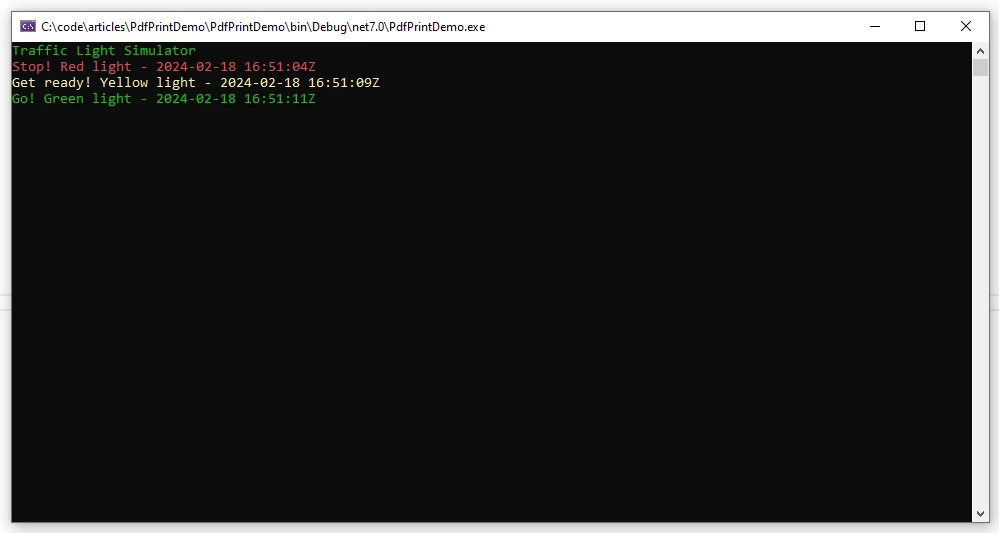
この例は、Thread.Sleep() を使用して交通信号シミュレーションのタイミングを制御し、実世界のシステムの動作をモデル化する簡単な方法を示しています。 これが基本的な例であり、複雑なアプリケーションでは、ユーザー入力の処理、複数の交通信号の管理、正確なタイミングの保証のために、より高度なスレッド化や同期技術を探索することが望ましいかもしれません。
TimeSpan タイムアウトの使用Thread.Sleep() メソッドと共に TimeSpan を使用して、スリープの時間を指定できます。 以前の例から拡張された交通信号シミュレーションの例を、TimeSpan を使用して示します。
using System;
using System.Threading;

class TrafficLightSimulator
{
    public static void Main()
    {
        Console.WriteLine("Traffic Light Simulator");
        while (true)
        {
            // Display the red light
            Console.ForegroundColor = ConsoleColor.Red;
            Console.WriteLine($"Stop! Red light - {DateTime.Now:u}");
            Thread.Sleep(TimeSpan.FromSeconds(5)); // Pause for 5 seconds

            // Display the yellow light
            Console.ForegroundColor = ConsoleColor.Yellow;
            Console.WriteLine($"Get ready! Yellow light - {DateTime.Now:u}");
            Thread.Sleep(TimeSpan.FromSeconds(2)); // Pause for 2 seconds

            // Display the green light
            Console.ForegroundColor = ConsoleColor.Green;
            Console.WriteLine($"Go! Green light - {DateTime.Now:u}");
            Thread.Sleep(TimeSpan.FromSeconds(5)); // Pause for 5 seconds

            // Reset console color and clear screen
            Console.ResetColor();
            Console.Clear();
        }
    }
}Imports System
Imports System.Threading
Friend Class TrafficLightSimulator
Public Shared Sub Main()
Console.WriteLine("Traffic Light Simulator")
Do
' Display the red light
Console.ForegroundColor = ConsoleColor.Red
Console.WriteLine($"Stop! Red light - {DateTime.Now:u}")
Thread.Sleep(TimeSpan.FromSeconds(5)) ' Pause for 5 seconds
' Display the yellow light
Console.ForegroundColor = ConsoleColor.Yellow
Console.WriteLine($"Get ready! Yellow light - {DateTime.Now:u}")
Thread.Sleep(TimeSpan.FromSeconds(2)) ' Pause for 2 seconds
' Display the green light
Console.ForegroundColor = ConsoleColor.Green
Console.WriteLine($"Go! Green light - {DateTime.Now:u}")
Thread.Sleep(TimeSpan.FromSeconds(5)) ' Pause for 5 seconds
' Reset console color and clear screen
Console.ResetColor()
Console.Clear()
Loop
End Sub
End Classこの修正版の例では、TimeSpan.FromSeconds() はスリープの期間を表す TimeSpan オブジェクトを作成するために使用されています。 これによりコードがより読みやすく表現力豊かになります。
TimeSpan プロパティを Thread.Sleep() メソッドで使用することにより、秒単位(または TimeSpan のサポートする他の単位)で期間を直接指定でき、時間間隔の扱いがより直感的になります。 これは、アプリケーションでのより長いまたは複雑なスリープ期間を処理する際に特に便利です。
Thread.Sleep() を戦略的に配置することで、実際のシステムで発生する時間遅延を模倣し、シミュレーションの精度を向上させることができます。void SimulateRealTimeEvent()
{
// Simulate some event
}
void SimulateNextEvent()
{
// Simulate another event
}
// Simulating real-time behavior with Thread.Sleep()
SimulateRealTimeEvent();
Thread.Sleep(1000); // Pause for 1 second
SimulateNextEvent();Private Sub SimulateRealTimeEvent()
' Simulate some event
End Sub
Private Sub SimulateNextEvent()
' Simulate another event
End Sub
' Simulating real-time behavior with Thread.Sleep()
SimulateRealTimeEvent()
Thread.Sleep(1000) ' Pause for 1 second
SimulateNextEvent()Thread.Sleep() はフレームレートを制御し、更新が視覚的に心地よい速度で行われるようにするために使用できます。void UpdateUIElement()
{
// Code to update a UI element
}
void UpdateNextUIElement()
{
// Code to update the next UI element
}
// Updating UI with controlled delays
UpdateUIElement();
Thread.Sleep(50); // Pause for 50 milliseconds
UpdateNextUIElement();Private Sub UpdateUIElement()
' Code to update a UI element
End Sub
Private Sub UpdateNextUIElement()
' Code to update the next UI element
End Sub
' Updating UI with controlled delays
UpdateUIElement()
Thread.Sleep(50) ' Pause for 50 milliseconds
UpdateNextUIElement()Thread.Sleep() は連続するサービスコール間に遅延を導入し、レート制限内にとどまるために利用できます。void CallExternalService()
{
// Call to external service
}
void CallNextService()
{
// Call to another external service
}
// Throttling service calls with Thread.Sleep()
CallExternalService();
Thread.Sleep(2000); // Pause for 2 seconds before the next call
CallNextService();Private Sub CallExternalService()
' Call to external service
End Sub
Private Sub CallNextService()
' Call to another external service
End Sub
' Throttling service calls with Thread.Sleep()
CallExternalService()
Thread.Sleep(2000) ' Pause for 2 seconds before the next call
CallNextService()Thread.Sleep() の利点Thread.Sleep() は、スレッドの実行を同期し、レースコンディションを防ぎ、複数スレッドを扱う際の秩序だった処理を保証します。Thread.Sleep() は遅延を導入するための簡単な解決策ですが、開発者が注意すべき潜在的な落とし穴と考慮事項があります。
Thread.Sleep() を使用して一時停止されると、実質的にブロックされ、その時間中に他の作業は実行できません。応答性が重要なシナリオでは、メインスレッドを長時間ブロックすると、ユーザーエクスペリエンスが悪化する可能性があります。Thread.Sleep() を正確なタイミング要件に依存するときは、開発者は注意する必要があります。Task.Delay() メソッドや async/await を用いた非同期プログラミングなどの代替手法が、Thread.Sleep() より好まれることがよくあります。 これらのアプローチはスレッドをブロックすることなくより良い応答性を提供します。using System;
using System.Threading.Tasks;
class Program
{
static async Task Main()
{
// Using Task.Delay() instead of Thread.Sleep()
await Task.Delay(1000); // Pause for 1 second asynchronously
}
}Imports System
Imports System.Threading.Tasks
Friend Class Program
Shared Async Function Main() As Task
' Using Task.Delay() instead of Thread.Sleep()
Await Task.Delay(1000) ' Pause for 1 second asynchronously
End Function
End ClassIronPDF by Iron Softwareは、PDFジェネレータ兼リーダーとして機能するC# PDFライブラリです。 このセクションでは基本機能を紹介します。 詳細についてはIronPDFのドキュメントをご覧ください。
IronPDFのハイライトは、すべてのレイアウトとスタイルを保持するHTMLからPDFへの変換機能です。 これはレポート、請求書、ドキュメンテーションに便利なウェブコンテンツをPDFに変換します。 HTMLファイル、URL、およびHTML文字列を簡単にPDFに変換できます。
using IronPdf;

class Program
{
    static void Main(string[] args)
    {
        var renderer = new ChromePdfRenderer();

        // 1. Convert HTML String to PDF
        var htmlContent = "<h1>Hello, IronPDF!</h1><p>This is a PDF from an HTML string.</p>";
        var pdfFromHtmlString = renderer.RenderHtmlAsPdf(htmlContent);
        pdfFromHtmlString.SaveAs("HTMLStringToPDF.pdf");

        // 2. Convert HTML File to PDF
        var htmlFilePath = "path_to_your_html_file.html"; // Specify the path to your HTML file
        var pdfFromHtmlFile = renderer.RenderHtmlFileAsPdf(htmlFilePath);
        pdfFromHtmlFile.SaveAs("HTMLFileToPDF.pdf");

        // 3. Convert URL to PDF
        var url = "http://ironpdf.com"; // Specify the URL
        var pdfFromUrl = renderer.RenderUrlAsPdf(url);
        pdfFromUrl.SaveAs("URLToPDF.pdf");
    }
}Imports IronPdf
Friend Class Program
Shared Sub Main(ByVal args() As String)
Dim renderer = New ChromePdfRenderer()
' 1. Convert HTML String to PDF
Dim htmlContent = "<h1>Hello, IronPDF!</h1><p>This is a PDF from an HTML string.</p>"
Dim pdfFromHtmlString = renderer.RenderHtmlAsPdf(htmlContent)
pdfFromHtmlString.SaveAs("HTMLStringToPDF.pdf")
' 2. Convert HTML File to PDF
Dim htmlFilePath = "path_to_your_html_file.html" ' Specify the path to your HTML file
Dim pdfFromHtmlFile = renderer.RenderHtmlFileAsPdf(htmlFilePath)
pdfFromHtmlFile.SaveAs("HTMLFileToPDF.pdf")
' 3. Convert URL to PDF
Dim url = "http://ironpdf.com" ' Specify the URL
Dim pdfFromUrl = renderer.RenderUrlAsPdf(url)
pdfFromUrl.SaveAs("URLToPDF.pdf")
End Sub
End ClassNuGetパッケージマネージャを使用してIronPDFをインストールするには、NuGetパッケージマネージャコンソールまたはVisual Studioパッケージマネージャのいずれかを使用します。
NuGetパッケージマネージャコンソールを使用してIronPDFライブラリをインストールするには、次のコマンドのいずれかを使用します。
Visual Studioのパッケージマネージャを使用してIronPDFライブラリをインストールします。

using System;
using IronPdf;

class Person
{
    public string FirstName { get; set; }
    public string LastName { get; set; }

    public void DisplayFullName()
    {
        if (string.IsNullOrEmpty(FirstName) || string.IsNullOrEmpty(LastName))
        {
            LogError($"Invalid name: {nameof(FirstName)} or {nameof(LastName)} is missing.");
        }
        else
        {
            Console.WriteLine($"Full Name: {FirstName} {LastName}");
        }
    }

    public void PrintPdf()
    {
        Console.WriteLine("Generating PDF using IronPDF.");

        // Content to print to PDF
        string content = $@"<!DOCTYPE html>
<html>
<body>
<h1>Hello, {FirstName}!</h1>
<p>First Name: {FirstName}</p>
<p>Last Name: {LastName}</p>
</body>
</html>";

        // Create a new PDF document
        var pdfDocument = new ChromePdfRenderer();
        pdfDocument.RenderHtmlAsPdf(content).SaveAs("person.pdf");
    }

    private void LogError(string errorMessage)
    {
        Console.ForegroundColor = ConsoleColor.Red;
        Console.WriteLine($"Error: {errorMessage}");
        Console.ResetColor();
    }
}

class Program
{
    public static void Main()
    {
        // Create an instance of the Person class
        Person person = new Person();

        // Attempt to display the full name
        person.DisplayFullName();

        // Set the properties
        person.FirstName = "John"; // Set First Name
        person.LastName = "Doe"; // Set Last Name

        // Display the full name again
        person.DisplayFullName();

        Console.WriteLine("Pause for 2 seconds and Print PDF");
        Thread.Sleep(2000); // Pause for 2 seconds

        // Print the full name to PDF
        person.PrintPdf();
    }
}Imports System
Imports IronPdf
Friend Class Person
Public Property FirstName() As String
Public Property LastName() As String
Public Sub DisplayFullName()
If String.IsNullOrEmpty(FirstName) OrElse String.IsNullOrEmpty(LastName) Then
LogError($"Invalid name: {NameOf(FirstName)} or {NameOf(LastName)} is missing.")
Else
Console.WriteLine($"Full Name: {FirstName} {LastName}")
End If
End Sub
Public Sub PrintPdf()
Console.WriteLine("Generating PDF using IronPDF.")
' Content to print to PDF
Dim content As String = $"<!DOCTYPE html>
<html>
<body>
<h1>Hello, {FirstName}!</h1>
<p>First Name: {FirstName}</p>
<p>Last Name: {LastName}</p>
</body>
</html>"
' Create a new PDF document
Dim pdfDocument = New ChromePdfRenderer()
pdfDocument.RenderHtmlAsPdf(content).SaveAs("person.pdf")
End Sub
Private Sub LogError(ByVal errorMessage As String)
Console.ForegroundColor = ConsoleColor.Red
Console.WriteLine($"Error: {errorMessage}")
Console.ResetColor()
End Sub
End Class
Friend Class Program
Public Shared Sub Main()
' Create an instance of the Person class
Dim person As New Person()
' Attempt to display the full name
person.DisplayFullName()
' Set the properties
person.FirstName = "John" ' Set First Name
person.LastName = "Doe" ' Set Last Name
' Display the full name again
person.DisplayFullName()
Console.WriteLine("Pause for 2 seconds and Print PDF")
Thread.Sleep(2000) ' Pause for 2 seconds
' Print the full name to PDF
person.PrintPdf()
End Sub
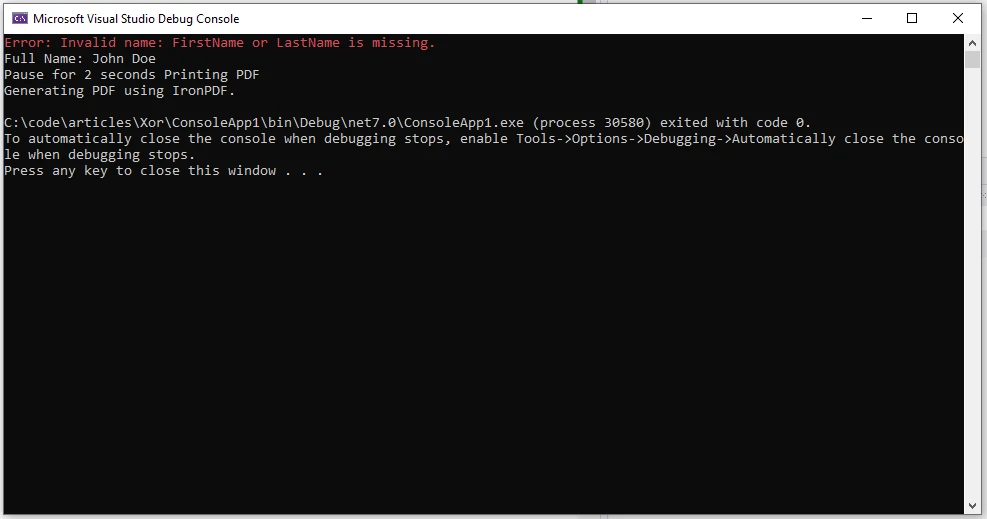
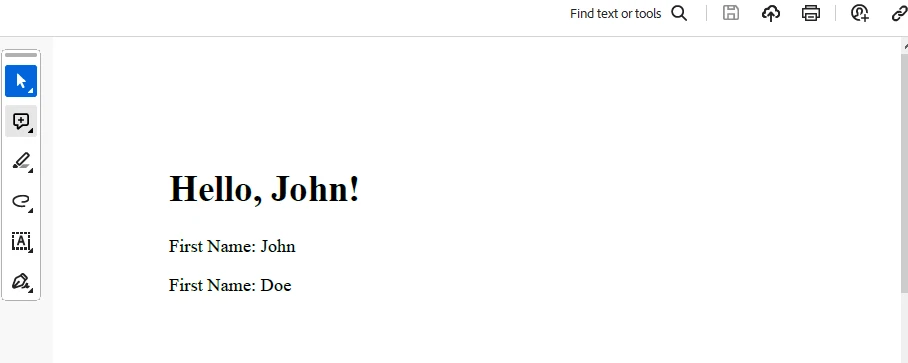
End Classこのプログラムでは、Thread.Sleep と IronPDF の使用法を紹介します。 コードは最初に個人の FirstName と LastName プロパティを検証します。 その後、コンソールにその人のフルネームを印刷します。 その後 Thread.Sleep を使用して 2 秒待機し、PrintPdf() メソッドと IronPDFライブラリを使用して FullName を PDF に印刷します。
IronPDF を使用するには、このキーを appsettings.json ファイルに挿入してください。
"IronPdf.LicenseKey": "your license key"試用ライセンスを受け取るには、メールアドレスを提供してください。 IronPDFのライセンスに関する詳細は、このIronPDFライセンスページをご覧ください.
C# での Thread.Sleep() メソッドは、スレッドのタイミングと同期を管理するための基本的なツールとして機能します。 遅延を導入するためのシンプルで効果的な解決策である一方で、開発者はその制限とアプリケーションパフォーマンスに対する潜在的な影響に注意する必要があります。 現代の C# 開発が進化するにつれ、Task.Delay() や非同期プログラミングのような代替アプローチを探求することは、応答性と効率的なマルチスレッドアプリケーションを記述するために重要です。 スレッドの同期の微妙な点を理解し、適切なツールを選択することで、開発者は動的な環境で同時処理の要求に応える堅固で効率的なソフトウェアを作成することができます。
さらに、IronPDF の機能の多様性を PDF ドキュメント生成で検証し、Thread.Sleep メソッドとどのように使用できるかを観察しました。 IronPDFの使用方法に関する他の例についてはIronPDF例ページを訪問してください。

ジェイコブ・メラーはIron Softwareの最高技術責任者(CTO)であり、C# PDFテクノロジーを開拓する先見的なエンジニアです。Iron Softwareのコアコードベースを支えるオリジナル開発者として、彼は創業以来、会社の製品アーキテクチャを形成し、CEOのCameron Rimingtonとともに、会社をNASA、Tesla、および世界的な政府機関にサービスを提供する50人以上の会社に変えました。1999年にロンドンで最初のソフトウェアビジネスを開業し、2005年に最初 for .NETコンポーネントを作成した後、Microsoftのエコシステム全体で複雑な問題を解決することを専門としました。

IronPDF はIRONSUITEの一部です
オフィス文書向けの.NET API製品10個

PDFがHTMLのように見える必要があるとき、迅速に。


