



업데이트됨 2026년 4월 23일
.NET에서 Microsoft.Extensions.AI로 LLM 통합 간소화
AI는 소프트웨어 개발을 변혁하고 있으나, 대규모 언어 모델(LLM)을 .NET에 통합하는 것은 지금까지 복잡했습니다. 현대에는 OpenAI 기반 PDF 파싱, 데이터 추출 및 콘텐츠 요약을 .NET 애플리케이션에 가져오는 IronPdf.AI로 AI 통합을 더욱 확장하세요.
더 읽어보기

IronPDF를 사용하여 동적 PDF 생성을 하는 .NET 개발자로서, 다양한 종류의 문서 데이터, 로그 메시지, 사용자 역할 또는 내보내기 옵션과 같은 특정 유형을 나타내고 관리해야 할 때가 많습니다. 이때 C# 차별화된 합집합의 개념이 도입됩니다.
C#은 F#이나 Rust와 같이 차별화된 합집합에 대한 기본 지원이 없지만, 이를 효과적으로 시뮬레이트할 수 있습니다. 이 블로그 포스트에서는 C#에서 차별화된 합집합 타입을 정의하고 사용하는 방법, IronPDF와 함께 실제 PDF 처리에 적용하는 방법, 특히 패턴 매칭과 함께 사용할 때 이 패턴이 제공하는 이점을 살펴보겠습니다.
차별화된 합집합, 태그가 붙은 합집합 또는 합집합 타입으로도 알려져 있으며, 변수에 제한된 옵션 집합에서 하나의 값을 보유하게 하고 각 옵션은 고유한 케이스 식별자와 연관됩니다.
F#과 같은 다른 언어에서는 union 키워드를 사용하여 이를 정의할 수 있습니다. C#은 이 기능을 기본적으로 제공하지 않지만, 개발자는 기록, 클래스 및 switch 표현식의 똑똑한 조합을 사용하여 이를 모방할 수 있습니다.
예를 들어:
public abstract record PdfAction;
public record GenerateReport(string ReportName) : PdfAction;
public record LogError(string Message) : PdfAction;
public record ExportToExcel(string FilePath) : PdfAction;Public MustOverride ReadOnly Property PdfAction() As record
public record GenerateReport(String ReportName) : PdfAction
public record LogError(String Message) : PdfAction
public record ExportToExcel(String FilePath) : PdfAction위의 각 기록은 합집합의 단일 케이스를 나타냅니다. 기본 PdfAction 타입이 구분자입니다.
IronPDF를 사용하여 PDF 보고서 생성기를 구축하고 있으며, 사용자의 입력에 따라 다른 작업을 수행해야 하는 상황을 상상해 보십시오—PDF 생성, 오류 로그 기록, 데이터 내보내기 등이 있을 수 있습니다.
C#에서 판별된 유니온을 사용하면 이러한 옵션 유형을 깔끔하게 표현할 수 있어 컴파일 타임 안전성, 버그 감소, 명확한 논리를 얻을 수 있습니다.
IronPDF와 함께 사용할 수 있는 방법은 다음과 같습니다.
void HandlePdfAction(PdfAction action)
{
    switch (action)
    {
        case GenerateReport r:
            var pdf = new IronPdf.HtmlToPdf().RenderHtmlAsPdf("<h1>" + r.ReportName + "</h1>");
            pdf.SaveAs(r.ReportName + ".pdf");
            break;
        case LogError e:
            Console.WriteLine("Logging Error: " + e.Message);
            break;
        case ExportToExcel x:
            Console.WriteLine("Exporting to Excel at " + x.FilePath);
            break;
        default:
            throw new NotSupportedException("Unknown action");
    }
}Private Sub HandlePdfAction(ByVal action As PdfAction)
Select Case action
'INSTANT VB TODO TASK: The following 'case' pattern variable is not converted by Instant VB:
'ORIGINAL LINE: case GenerateReport r:
Case GenerateReport r
Dim pdf = (New IronPdf.HtmlToPdf()).RenderHtmlAsPdf("<h1>" & r.ReportName & "</h1>")
pdf.SaveAs(r.ReportName & ".pdf")
'INSTANT VB TODO TASK: The following 'case' pattern variable is not converted by Instant VB:
'ORIGINAL LINE: case LogError e:
Case LogError e
Console.WriteLine("Logging Error: " & e.Message)
'INSTANT VB TODO TASK: The following 'case' pattern variable is not converted by Instant VB:
'ORIGINAL LINE: case ExportToExcel x:
Case ExportToExcel x
Console.WriteLine("Exporting to Excel at " & x.FilePath)
Case Else
Throw New NotSupportedException("Unknown action")
End Select
End Sub이 접근 방식은 코드의 정리 및 강화를 유지하고, 모든 가능한 옵션을 한 곳에서 이해하기 쉽게 만들어 줍니다.
C#에는 union 키워드가 없지만, 차별화된 합집합을 다음과 같이 시뮬레이션할 수 있습니다:
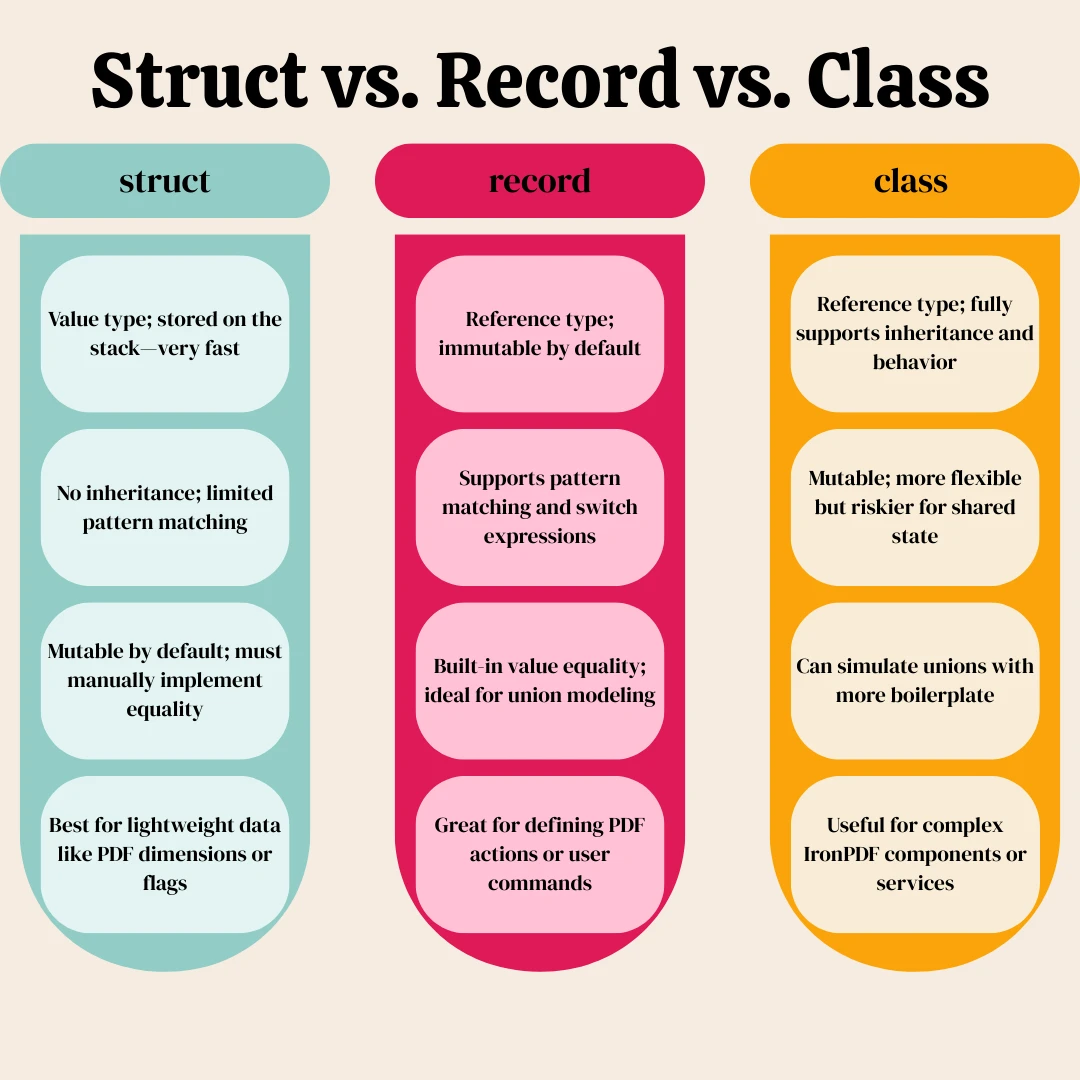
성능 및 메모리 레이아웃이 중요한 경우—예를 들어, 높은 처리량의 PDF 로그에—구조체 차별화된 합집합을 신중하게 사용하는 것을 고려할 수 있습니다:
public interface IAction { }
public readonly struct SaveAction : IAction
{
    public string FileName { get; }
    public SaveAction(string fileName) => FileName = fileName;
}Public Interface IAction
End Interface
'INSTANT VB WARNING: VB has no equivalent to the C# readonly struct:
'ORIGINAL LINE: public readonly struct SaveAction : IAction
Public Structure SaveAction
Implements IAction
Public ReadOnly Property FileName() As String
Public Sub New(ByVal fileName As String)
Me.FileName = fileName
End Sub
End Structure참고: 특히 switch 표현식에 의존할 때, 구조체로 인해 패턴 매칭의 일부 이점을 잃을 수 있습니다.
이 소프트웨어 엔지니어링 패턴을 채택하는 데에는 몇 가지 중요한 장점이 있습니다:
IronPDF와 함께 사용할 때, 이는 사용자 입력 관리, 렌더링 로직 또는 다양한 값 파이프라인을 통해 동적 템플릿을 작성하는 것을 더 쉽게 만들어 줍니다.
이 패턴이 우수한 성과를 거두는 몇 가지 실용적인 시나리오가 있습니다:
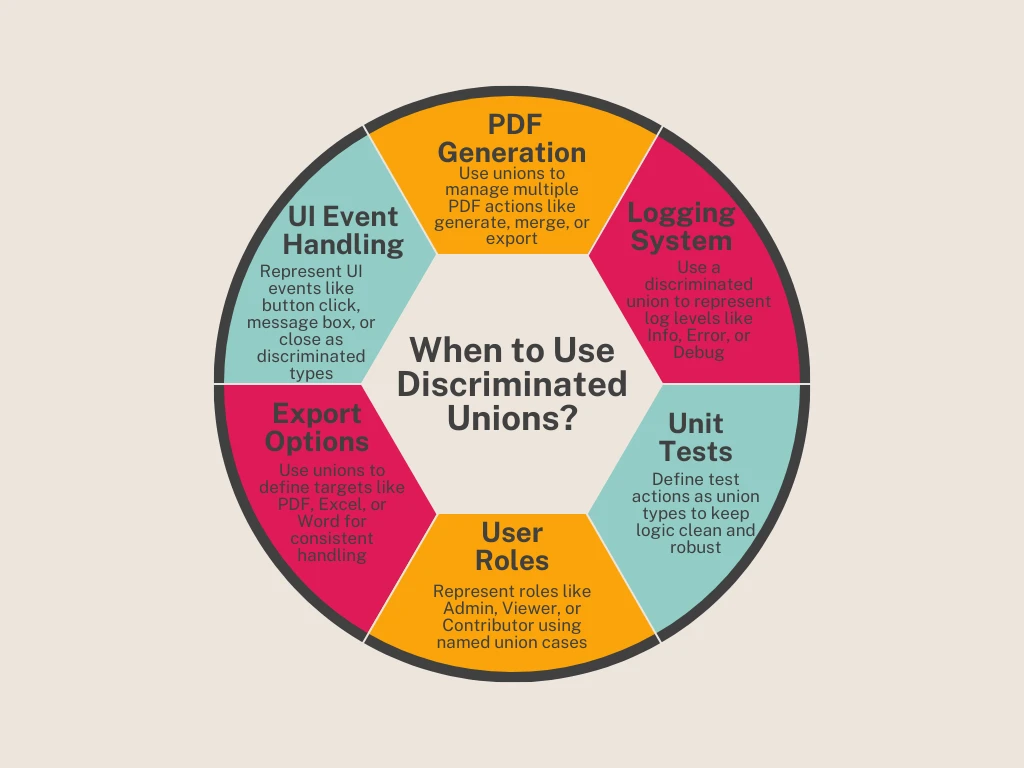
UI 이벤트를 캡처하고 이를 구별된 유니언을 사용하여 IronPDF 작업으로 라우팅하고자 한다고 가정해 봅시다:
public abstract record UserAction;
public record GeneratePdf(string HtmlContent, string FileName) : UserAction;
public record ShowMessage(string Text) : UserAction;
public record ExitApplication() : UserAction;
void OnUserEvent(UserAction action)
{
    switch (action)
    {
        case GeneratePdf pdf:
            var renderer = new IronPdf.HtmlToPdf();
            var document = renderer.RenderHtmlAsPdf(pdf.HtmlContent);
            document.SaveAs(pdf.FileName);
            break;
        case ShowMessage msg:
            MessageBox.Show(msg.Text);
            break;
        case ExitApplication:
            Application.Exit();
            break;
    }
}Public MustOverride ReadOnly Property UserAction() As record
public record GeneratePdf(String HtmlContent, String FileName) : UserAction
public record ShowMessage(String Text) : UserAction
public record ExitApplication() : UserAction
'INSTANT VB TODO TASK: Local functions are not converted by Instant VB:
'void OnUserEvent(UserAction action)
'{
' switch (action)
' {
' case GeneratePdf pdf:
' var renderer = New IronPdf.HtmlToPdf();
' var document = renderer.RenderHtmlAsPdf(pdf.HtmlContent);
' document.SaveAs(pdf.FileName);
' break;
' case ShowMessage msg:
' MessageBox.Show(msg.Text);
' break;
' case ExitApplication:
' Application.@Exit();
' break;
' }
'}이렇게 하면 이벤트를 명확한 논리로 표현할 수 있으며, 공개 오브젝트 타입이나 과도한 동적 처리에 대한 의존도를 줄일 수 있습니다.
더 많은 표현력 있는 타입 시스템에 대한 수요가 증가함에 따라 C#에서 구별된 유니언에 대한 네이티브 지원을 추가하자는 제안이 이미 나왔습니다. 언어는 아직 진정한 유니언 키워드를 도입하지 않았지만, C#은 점점 발전하고 있으며 레코드, 패턴 매칭, 스위치 식과 같은 기능이 구별된 유니언 기능에 더 가까워지고 있습니다.
최신 기능 친화적인 언어 구성에 관심이 있는 .NET 개발자는 이 공간을 주목해야 합니다.
네이티브 지원이 없더라도 C#에서 구별된 유니언을 사용하면 IronPDF 애플리케이션에서 논리 구조와 표현 방식을 크게 향상시킬 수 있습니다. 레코드, 스위치 식 및 기본 클래스를 활용함으로써 코드베이스를 더 읽기 쉽고 유지 관리하며, 오류에 강한 상태로 만들 수 있으며, 더 선언적이고 표현적인 방식으로 PDF 관련 작업을 처리할 수 있습니다.
현대적이고 유연한 .NET 애플리케이션을 구축하는 소프트웨어 엔지니어라면, 이 패턴은 도구 키트의 필수품입니다.
C# PDF 생성을 다음 단계로 발전시키시겠습니까? IronPDF를 다운로드하고 무료 체험판으로 시작하세요. HTML에서 문서를 생성하거나, 내보내기를 기록하거나, 구별된 유니언을 사용하여 보고서를 자동화하든 관계없이—IronPDF는 앱에 필요한 성능과 성능을 제공합니다.

제이콥 멜러는 Iron Software의 최고 기술 책임자(CTO)이자 C# PDF 기술을 개척한 선구적인 엔지니어입니다. Iron Software의 핵심 코드베이스를 최초로 개발한 그는 창립 초기부터 회사의 제품 아키텍처를 설계해 왔으며, CEO인 캐머런 리밍턴과 함께 회사를 NASA, 테슬라, 그리고 전 세계 정부 기관에 서비스를 제공하는 50명 이상의 직원을 보유한 기업으로 성장시켰습니다.

IronPDF는 IRON SUITE 의 일부입니다.
10개의 .NET API 제품, 당신의 사무 문서를 위해











PDF 파일을 HTML처럼 빠르게 변환해야 할 때.


