



Updated September 2, 2026
HTML to PDF in C#: Benchmarking 7 .NET Libraries (2026)
Compare 7 C# HTML to PDF libraries on .NET 10 for cold start, throughput, memory and rendering accuracy. Only 3 rendered the test invoice correctly.
Read More

PDF files are widely used across various sectors for tasks like invoicing and creating different document types. They effectively meet client needs. When developing .NET applications that require PDF generation, selecting the right library can greatly affect your development speed, output quality, and long-term maintenance costs. Two libraries often considered by developers are IronPDF and ABCpdf - but which one truly delivers better results for your specific needs?
This thorough comparison examines both libraries' capabilities, from HTML-to-PDF conversion accuracy to licensing models, helping you make an informed decision. We'll look at real-world performance metrics, API design philosophy, and practical code examples that demonstrate each library's strengths and limitations. Whether you're building a SaaS platform that generates thousands of invoices daily or an enterprise application requiring precise document rendering, understanding these differences is crucial for project success.
IronPDF is a commercial-grade PDF generation library that helps C# software engineers to edit, extract, and generate PDF documents in .NET projects. Built with a Chrome-based rendering engine at its core, IronPDF transforms HTML, CSS, and JavaScript into PDFs with the same fidelity you'd expect from printing a web page in Google Chrome.
IronPDF uses a .NET Chromium engine to render HTML pages to PDF files. With HTML-to-PDF there is no need to use complex APIs to position or design PDFs. IronPDF supports standard web documents: HTML, ASPX, JS, CSS, and images. The library's architecture prioritizes developer experience while maintaining professional-grade output quality.
@font-face declarationsIronPDF maintains consistent behavior across different environments:
The ABCpdf .NET C# PDF library is a .NET component for the dynamic reading, writing, conversion, and manipulation of Adobe PDF documents. Developed by WebSupergoo, ABCpdf has been serving the .NET community for over two decades, offering multiple HTML rendering engines and comprehensive PDF manipulation features.
ABCpdf fully supports HTML/CSS and related technologies like JavaScript, SVG, AJAX, and Font Awesome. The library provides developers with both high-level convenience methods and low-level PDF object access.
ABCpdf's unique approach offers several rendering engines:
This multi-engine approach allows developers to choose the best renderer for their specific content, though it adds complexity to deployment and testing.
ABCpdf can read a variety of document formats when helper applications like OpenOffice.org are installed. Supported formats include:
ABCpdf is fully multithreaded, allowing it to be used flexibly in various .NET environments, including C#, ASPX, and VB, and it's tested in high-performance multithreaded settings. The library includes:
When working with contemporary web applications, the ability to convert Bootstrap-based layouts and other modern CSS frameworks to PDF is increasingly critical. Many enterprise applications and SaaS platforms now rely on Bootstrap for their UI consistency, and PDF generation needs to preserve these layouts perfectly.
IronPDF's Chromium rendering engine provides comprehensive support for modern CSS frameworks:
Real-world examples: Bootstrap homepage and Bootstrap templates convert to PDF with pixel-perfect accuracy.
Code Example: E-Commerce Product Grid
using IronPdf;

var renderer = new ChromePdfRenderer();

string bootstrapProductGrid = @"
<!DOCTYPE html>
<html>
<head>
    <link href='https://cdn.jsdelivr.net/npm/bootstrap@5.3.0/dist/css/bootstrap.min.css' rel='stylesheet'>
</head>
<body>
    <div class='container my-5'>
        <h1 class='mb-4'>Product Catalog</h1>
        <div class='row row-cols-1 row-cols-md-3 g-4'>
            <div class='col'>
                <div class='card h-100'>
                    <img src='https://via.placeholder.com/300x200' class='card-img-top' alt='Product 1'>
                    <div class='card-body d-flex flex-column'>
                        <h5 class='card-title'>Premium Widget</h5>
                        <p class='card-text flex-grow-1'>High-quality widget with advanced features and excellent durability.</p>
                        <div class='d-flex justify-content-between align-items-center mt-auto'>
                            <span class='h4 mb-0 text-primary'>$99.99</span>
                            <button class='btn btn-primary'>Add to Cart</button>
                        </div>
                    </div>
                </div>
            </div>
            <div class='col'>
                <div class='card h-100'>
                    <img src='https://via.placeholder.com/300x200' class='card-img-top' alt='Product 2'>
                    <div class='card-body d-flex flex-column'>
                        <h5 class='card-title'>Standard Widget</h5>
                        <p class='card-text flex-grow-1'>Reliable widget perfect for everyday use with great value.</p>
                        <div class='d-flex justify-content-between align-items-center mt-auto'>
                            <span class='h4 mb-0 text-primary'>$49.99</span>
                            <button class='btn btn-primary'>Add to Cart</button>
                        </div>
                    </div>
                </div>
            </div>
            <div class='col'>
                <div class='card h-100'>
                    <img src='https://via.placeholder.com/300x200' class='card-img-top' alt='Product 3'>
                    <div class='card-body d-flex flex-column'>
                        <h5 class='card-title'>Basic Widget</h5>
                        <p class='card-text flex-grow-1'>Entry-level widget with essential features at an affordable price.</p>
                        <div class='d-flex justify-content-between align-items-center mt-auto'>
                            <span class='h4 mb-0 text-primary'>$29.99</span>
                            <button class='btn btn-primary'>Add to Cart</button>
                        </div>
                    </div>
                </div>
            </div>
        </div>
    </div>
</body>
</html>";

var pdf = renderer.RenderHtmlAsPdf(bootstrapProductGrid);
pdf.SaveAs("product-catalog.pdf");Imports IronPdf
Dim renderer As New ChromePdfRenderer()
Dim bootstrapProductGrid As String = "
<!DOCTYPE html>
<html>
<head>
<link href='https://cdn.jsdelivr.net/npm/bootstrap@5.3.0/dist/css/bootstrap.min.css' rel='stylesheet'>
</head>
<body>
<div class='container my-5'>
<h1 class='mb-4'>Product Catalog</h1>
<div class='row row-cols-1 row-cols-md-3 g-4'>
<div class='col'>
<div class='card h-100'>
<img src='https://via.placeholder.com/300x200' class='card-img-top' alt='Product 1'>
<div class='card-body d-flex flex-column'>
<h5 class='card-title'>Premium Widget</h5>
<p class='card-text flex-grow-1'>High-quality widget with advanced features and excellent durability.</p>
<div class='d-flex justify-content-between align-items-center mt-auto'>
<span class='h4 mb-0 text-primary'>$99.99</span>
<button class='btn btn-primary'>Add to Cart</button>
</div>
</div>
</div>
</div>
<div class='col'>
<div class='card h-100'>
<img src='https://via.placeholder.com/300x200' class='card-img-top' alt='Product 2'>
<div class='card-body d-flex flex-column'>
<h5 class='card-title'>Standard Widget</h5>
<p class='card-text flex-grow-1'>Reliable widget perfect for everyday use with great value.</p>
<div class='d-flex justify-content-between align-items-center mt-auto'>
<span class='h4 mb-0 text-primary'>$49.99</span>
<button class='btn btn-primary'>Add to Cart</button>
</div>
</div>
</div>
</div>
<div class='col'>
<div class='card h-100'>
<img src='https://via.placeholder.com/300x200' class='card-img-top' alt='Product 3'>
<div class='card-body d-flex flex-column'>
<h5 class='card-title'>Basic Widget</h5>
<p class='card-text flex-grow-1'>Entry-level widget with essential features at an affordable price.</p>
<div class='d-flex justify-content-between align-items-center mt-auto'>
<span class='h4 mb-0 text-primary'>$29.99</span>
<button class='btn btn-primary'>Add to Cart</button>
</div>
</div>
</div>
</div>
</div>
</div>
</body>
</html>"
Dim pdf = renderer.RenderHtmlAsPdf(bootstrapProductGrid)
pdf.SaveAs("product-catalog.pdf")Output: A perfectly formatted product catalog with Bootstrap 5's card grid system, flexbox alignment, and responsive spacing - all preserved in the PDF.
ABCpdf's support for modern CSS frameworks varies significantly depending on which rendering engine you select:
Key considerations:
ABCpdf's multi-engine architecture provides flexibility but requires careful engine selection and testing to ensure Bootstrap layouts render correctly. For applications heavily invested in Bootstrap or modern CSS frameworks, the ABCChrome engine provides the best results but comes with x64-only deployment constraints.
For more details on Bootstrap framework compatibility, see the Bootstrap & Flexbox CSS Guide.
| Category | Feature/Aspect | IronPDF | ABCpdf | Key Advantage |
|---|---|---|---|---|
| Core Architecture | Design Philosophy | Simplicity-first, intuitive APIs | Flexibility-first, multiple engines | IronPDF: Faster development |
| API Complexity | Simple methods like RenderHtmlAsPdf() | Object-oriented with Doc class | IronPDF: Simpler API | |
| Learning Curve | Lower, single-engine design | Higher, multi-engine configuration required | IronPDF: Quicker adoption | |
| Platform Support | Cross-Platform | Native support, single package | Windows primary, Linux limited | IronPDF: True cross-platform |
| .NET Versions | .NET 10, 9, 8, 7, 6, 5, Core 3.1+, Framework 4.6.2+ | .NET 10, 9, 8, 7, 6, 5, Core 3.0+, Framework 4.0+ | Both: Modern framework support | |
| Operating Systems | Windows, Linux, macOS, Docker native | Windows, limited Linux support | IronPDF: Broader OS support | |
| HTML to PDF | Rendering Engine | Chrome V127+ engine | Multiple engines (versioned ABCChrome, Gecko, WebKit, MSHTML) | ABCpdf: Engine flexibility |
| CSS3/HTML5 Support | Chrome-compatible (V8 engine) | Varies by engine | IronPDF: Consistent rendering | |
| JavaScript Execution | Full V8 JavaScript support | Engine-dependent | IronPDF: Modern JS features | |
| Web Fonts | Google Fonts, @font-face, system fonts | Supported with ABCChrome | Both: Web font support | |
| Performance | Single Page Rendering | Varies by document complexity | Varies by engine and document complexity | Both: engine-dependent |
| Batch Processing | Optimized parallel processing | Multi-threaded capable | IronPDF: Better async support | |
| Memory Usage | Higher (full Chrome engine) | Lower (lighter engines available) | ABCpdf: Lower memory footprint with non-Chrome engines | |
| Developer Experience | Documentation | Extensive tutorials, videos, examples | Comprehensive API docs | IronPDF: More learning resources |
| Code Examples | 100+ ready-to-run samples | Extensive examples | Both: Rich examples | |
| IntelliSense Support | Full XML documentation | Comprehensive IntelliSense | Both: IDE integration | |
| Licensing & Pricing | Entry Level | Lite: $999 (1 dev, 1 project) | Standard: $329 (1 dev, 32-bit only) | ABCpdf: Lower entry cost |
| Professional | Professional: $2,399 (10 devs, 10 projects) | Professional: $495 (1 dev, 64-bit) | IronPDF: Better team licensing | |
| Redistribution | +$2,399 royalty-free | $4,950 Enterprise license | IronPDF: More affordable | |
| Support | Support Included | Yes, 24/5 engineering support | Yes, email support | IronPDF: Live chat support |
| Response Time | < 1 minute (live chat) | 24-48 hours typical | IronPDF: Faster response | |
| Best For | Use Cases | Modern web apps, SaaS, cloud-native | Windows desktop, legacy systems | Context-dependent |
Note. ABCpdf offers multiple rendering engines for flexibility and runs on Windows and Linux, with some features remaining Windows-only. IronPDF provides consistent cross-platform performance with the latest Chrome engine. Pricing structures differ significantly between single-developer and team licenses.
Before diving into code examples, let's set up a proper development environment. Open Visual Studio and create a new project:
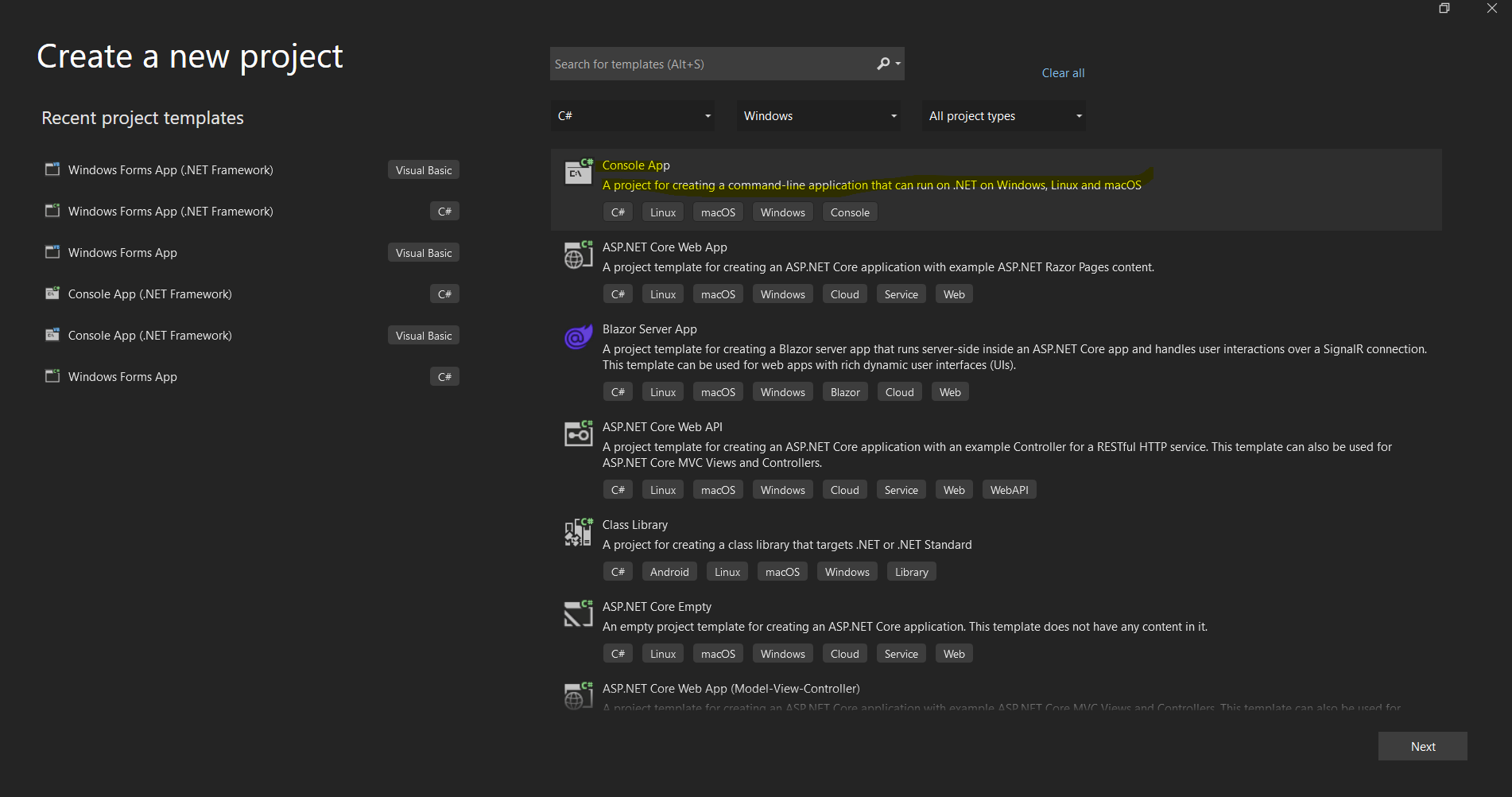 Visual Studio's project creation dialog for setting up a new .NET application
IronPDF offers multiple installation approaches to accommodate different development workflows:
The simplest approach is through Visual Studio's integrated NuGet Package Manager:
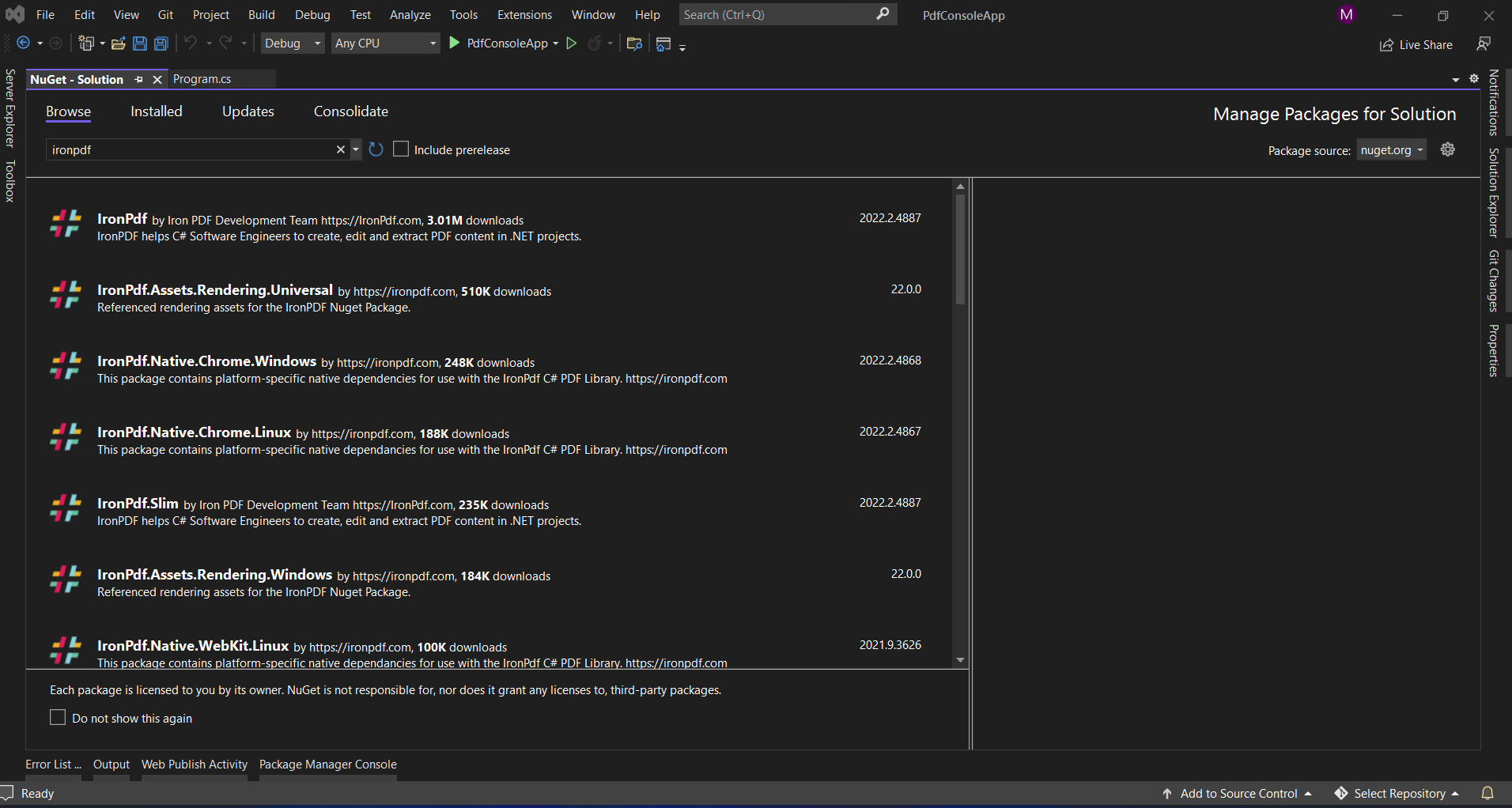 Installing IronPDF through Visual Studio's NuGet Package Manager interface
For developers who prefer command-line tools:
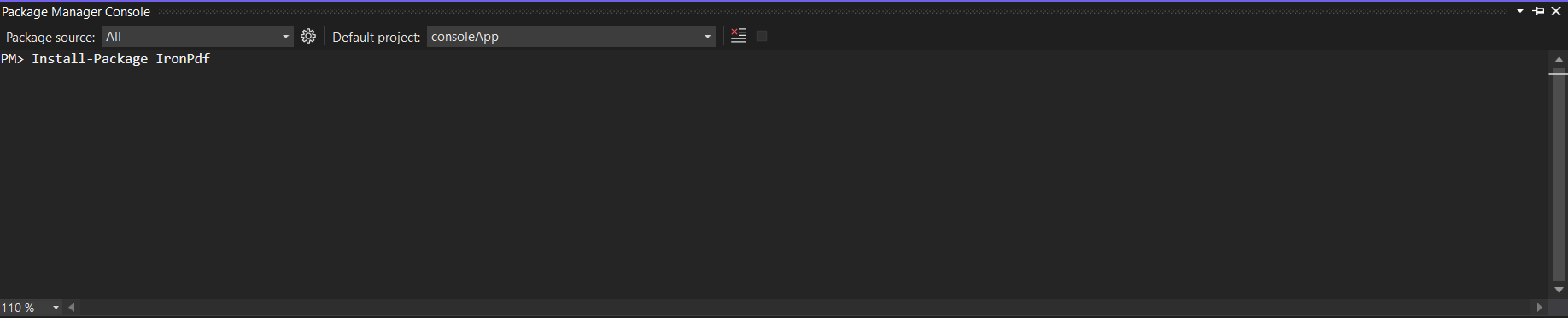 Using the Package Manager Console to install IronPDF with a single command
For environments with restricted internet access:
For .NET Core/5+ projects:
ABCpdf provides similar installation options with some additional considerations:
Note that ABCpdf ships the core library in one package and the older or alternative rendering engines in their own packages:
ABCpdf - the main library, including the current ABCChrome build for WindowsABCpdf.ABCChrome123, ABCpdf.ABCChrome117, ABCpdf.ABCChrome86, ABCpdf.ABCChrome65 - earlier ABCChrome buildsABCpdf.ABCGecko - For Gecko rendering engineABCpdf.ABCWebKit - For WebKit rendering engineABCpdf requires additional setup for non-Windows platforms:
<!-- For Linux deployment: reference the ABCChrome Linux runtime that matches your engine -->
<PackageReference Include="ABCpdf.ABCChrome146.Linux" />Understanding the fundamental differences in how each library approaches HTML to PDF conversion helps explain their varying capabilities and performance characteristics.
IronPDF uses a full Chrome browser engine, providing several advantages:
using IronPdf;

// IronPDF's approach - Chrome rendering with full browser capabilities
var renderer = new ChromePdfRenderer();

// Configure rendering to match Chrome's print preview exactly
renderer.RenderingOptions = ChromePdfRenderOptions.DefaultChrome;

// Or customize for specific needs
renderer.RenderingOptions.CssMediaType = PdfCssMediaType.Screen;
renderer.RenderingOptions.EnableJavaScript = true;
renderer.RenderingOptions.WaitFor.RenderDelay(500); // Wait for JS execution

// Convert complex HTML with modern CSS and JavaScript
string complexHtml = @"
<!DOCTYPE html>
<html>
<head>
    <style>
        @import url('https://fonts.googleapis.com/css2?family=Roboto:wght@300;700&display=swap');

        .container {
            display: grid;
            grid-template-columns: repeat(auto-fit, minmax(250px, 1fr));
            gap: 20px;
            font-family: 'Roboto', sans-serif;
        }

        .card {
            background: linear-gradient(135deg, #667eea 0%, #764ba2 100%);
            border-radius: 10px;
            padding: 20px;
            color: white;
            box-shadow: 0 10px 20px rgba(0,0,0,0.19);
            transform: translateY(0);
            transition: transform 0.3s;
        }

        @media print {
            .card { break-inside: avoid; }
        }
    </style>
</head>
<body>
    <div class='container'>
        <div class='card'>
            <h2>Modern CSS Support</h2>
            <p>Grid, Flexbox, Gradients, Shadows - all rendered perfectly</p>
        </div>
        <div class='card'>
            <h2>Web Fonts</h2>
            <p>Google Fonts and custom fonts work seamlessly</p>
        </div>
    </div>
    <script>
        // Dynamic content generation
        document.addEventListener('DOMContentLoaded', function() {
            const container = document.querySelector('.container');
            const dynamicCard = document.createElement('div');
            dynamicCard.className = 'card';
            dynamicCard.innerHTML = '<h2>JavaScript Generated</h2><p>This card was added by JavaScript</p>';
            container.appendChild(dynamicCard);
        });
    </script>
</body>
</html>";

var pdf = renderer.RenderHtmlAsPdf(complexHtml);
pdf.SaveAs("modern-web-features.pdf");Imports IronPdf
' IronPDF's approach - Chrome rendering with full browser capabilities
Dim renderer As New ChromePdfRenderer()
' Configure rendering to match Chrome's print preview exactly
renderer.RenderingOptions = ChromePdfRenderOptions.DefaultChrome
' Or customize for specific needs
renderer.RenderingOptions.CssMediaType = PdfCssMediaType.Screen
renderer.RenderingOptions.EnableJavaScript = True
renderer.RenderingOptions.WaitFor.RenderDelay(500) ' Wait for JS execution
' Convert complex HTML with modern CSS and JavaScript
Dim complexHtml As String = "
<!DOCTYPE html>
<html>
<head>
<style>
@import url('https://fonts.googleapis.com/css2?family=Roboto:wght@300;700&display=swap');
.container {
display: grid;
grid-template-columns: repeat(auto-fit, minmax(250px, 1fr));
gap: 20px;
font-family: 'Roboto', sans-serif;
}
.card {
background: linear-gradient(135deg, #667eea 0%, #764ba2 100%);
border-radius: 10px;
padding: 20px;
color: white;
box-shadow: 0 10px 20px rgba(0,0,0,0.19);
transform: translateY(0);
transition: transform 0.3s;
}
@media print {
.card { break-inside: avoid; }
}
</style>
</head>
<body>
<div class='container'>
<div class='card'>
<h2>Modern CSS Support</h2>
<p>Grid, Flexbox, Gradients, Shadows - all rendered perfectly</p>
</div>
<div class='card'>
<h2>Web Fonts</h2>
<p>Google Fonts and custom fonts work seamlessly</p>
</div>
</div>
<script>
// Dynamic content generation
document.addEventListener('DOMContentLoaded', function() {
const container = document.querySelector('.container');
const dynamicCard = document.createElement('div');
dynamicCard.className = 'card';
dynamicCard.innerHTML = '<h2>JavaScript Generated</h2><p>This card was added by JavaScript</p>';
container.appendChild(dynamicCard);
});
</script>
</body>
</html>"
Dim pdf = renderer.RenderHtmlAsPdf(complexHtml)
pdf.SaveAs("modern-web-features.pdf")This code demonstrates several key advantages of IronPDF's Chrome-based approach:
ABCpdf offers multiple rendering engines, each with different capabilities:
using WebSupergoo.ABCpdf14;

// Method 1: Using ABCChrome engine (most modern)
Doc chromeDoc = new Doc();
chromeDoc.HtmlOptions.Engine = EngineType.Chrome146;
chromeDoc.HtmlOptions.ForChrome.AddLinks = true; // ForChrome filters to options this engine supports

// ABCChrome follows current browser standards
int chromeId = chromeDoc.AddImageUrl("https://example.com");

// Chain pages if content overflows
while (chromeDoc.Chainable(chromeId))
{
    chromeDoc.Page = chromeDoc.AddPage();
    chromeId = chromeDoc.AddImageToChain(chromeId);
}

chromeDoc.Save("chrome-engine-output.pdf");

// Method 2: Using Gecko engine (Firefox-based)
Doc geckoDoc = new Doc();
geckoDoc.HtmlOptions.Engine = EngineType.Gecko;
geckoDoc.HtmlOptions.UseScript = true; // Enable JavaScript

// Gecko provides Firefox-style rendering
string html = "<html><body><h1>Gecko Rendered Content</h1></body></html>";
geckoDoc.AddImageHtml(html);
geckoDoc.Save("gecko-engine-output.pdf");

// Method 3: Using MSHTML engine (IE-based, legacy support)
Doc ieDoc = new Doc();
ieDoc.HtmlOptions.Engine = EngineType.MSHtml;

// MSHTML is retained for legacy content
ieDoc.AddImageUrl("https://legacy-app.example.com");
ieDoc.Save("ie-engine-output.pdf");Imports WebSupergoo.ABCpdf14
' Method 1: Using ABCChrome engine (most modern)
Dim chromeDoc As New Doc()
chromeDoc.HtmlOptions.Engine = EngineType.Chrome146
chromeDoc.HtmlOptions.ForChrome.AddLinks = True ' ForChrome filters to options this engine supports
' ABCChrome follows current browser standards
Dim chromeId As Integer = chromeDoc.AddImageUrl("https://example.com")
' Chain pages if content overflows
While chromeDoc.Chainable(chromeId)
chromeDoc.Page = chromeDoc.AddPage()
chromeId = chromeDoc.AddImageToChain(chromeId)
End While
chromeDoc.Save("chrome-engine-output.pdf")
' Method 2: Using Gecko engine (Firefox-based)
Dim geckoDoc As New Doc()
geckoDoc.HtmlOptions.Engine = EngineType.Gecko
geckoDoc.HtmlOptions.UseScript = True ' Enable JavaScript
' Gecko provides Firefox-style rendering
Dim html As String = "<html><body><h1>Gecko Rendered Content</h1></body></html>"
geckoDoc.AddImageHtml(html)
geckoDoc.Save("gecko-engine-output.pdf")
' Method 3: Using MSHTML engine (IE-based, legacy support)
Dim ieDoc As New Doc()
ieDoc.HtmlOptions.Engine = EngineType.MSHtml
' MSHTML is retained for legacy content
ieDoc.AddImageUrl("https://legacy-app.example.com")
ieDoc.Save("ie-engine-output.pdf")The multi-engine approach provides flexibility but requires careful consideration:
One of the most common use cases for PDF libraries is converting live web pages to PDF documents. Let's examine how each library handles this task.
IronPDF's URL to PDF conversion leverages the full Chrome browser engine:
using IronPdf;
using System;
using System.Threading.Tasks;

public class UrlToPdfConverter
{
    public static async Task ConvertUrlToPdfAsync()
    {
        var renderer = new ChromePdfRenderer();

        // Configure for optimal web page capture
        renderer.RenderingOptions = new ChromePdfRenderOptions
        {
            // Viewport and scaling
            ViewPortWidth = 1920,
            ViewPortHeight = 1080,
            ZoomLevel = 100,

            // Paper and margins
            PaperSize = PdfPaperSize.A4,
            MarginTop = 10,
            MarginBottom = 10,
            MarginLeft = 10,
            MarginRight = 10,

            // Rendering behavior
            CssMediaType = PdfCssMediaType.Screen,
            PrintHtmlBackgrounds = true,
            CreatePdfFormsFromHtml = true,

            // JavaScript and timing
            EnableJavaScript = true,
            WaitFor = new WaitFor
            {
                // Wait strategies for dynamic content
                RenderDelay = 500, // milliseconds
                JavaScriptFinishDelay = 100,
                AllowedExecutionTime = 30000 // 30 seconds max
            }
        };

        // Handle authentication if needed
        renderer.RenderingOptions.HttpOptions.HttpHeaders.Add("Authorization", "Bearer your-token");

        // Convert with error handling
        try
        {
            // Async conversion for better performance
            var pdf = await renderer.RenderUrlAsPdfAsync("https://github.com/trending");

            // Add metadata
            pdf.MetaData.Author = "IronPDF Example";
            pdf.MetaData.Title = "GitHub Trending Projects";
            pdf.MetaData.CreationDate = DateTime.Now;

            // Add watermark
            pdf.ApplyWatermark("<h2 style='color:red;opacity:0.5'>CONFIDENTIAL</h2>",
                30, VerticalAlignment.Middle, HorizontalAlignment.Center);

            pdf.SaveAs("github-trending.pdf");
            Console.WriteLine("PDF created successfully!");
        }
        catch (Exception ex)
        {
            Console.WriteLine($"Error creating PDF: {ex.Message}");
        }
    }
}Imports IronPdf
Imports System
Imports System.Threading.Tasks
Public Class UrlToPdfConverter
Public Shared Async Function ConvertUrlToPdfAsync() As Task
Dim renderer = New ChromePdfRenderer()
' Configure for optimal web page capture
renderer.RenderingOptions = New ChromePdfRenderOptions With {
' Viewport and scaling
.ViewPortWidth = 1920,
.ViewPortHeight = 1080,
.ZoomLevel = 100,
' Paper and margins
.PaperSize = PdfPaperSize.A4,
.MarginTop = 10,
.MarginBottom = 10,
.MarginLeft = 10,
.MarginRight = 10,
' Rendering behavior
.CssMediaType = PdfCssMediaType.Screen,
.PrintHtmlBackgrounds = True,
.CreatePdfFormsFromHtml = True,
' JavaScript and timing
.EnableJavaScript = True,
.WaitFor = New WaitFor With {
' Wait strategies for dynamic content
.RenderDelay = 500, ' milliseconds
.JavaScriptFinishDelay = 100,
.AllowedExecutionTime = 30000 ' 30 seconds max
}
}
' Handle authentication if needed
renderer.RenderingOptions.HttpOptions.HttpHeaders.Add("Authorization", "Bearer your-token")
' Convert with error handling
Try
' Async conversion for better performance
Dim pdf = Await renderer.RenderUrlAsPdfAsync("https://github.com/trending")
' Add metadata
pdf.MetaData.Author = "IronPDF Example"
pdf.MetaData.Title = "GitHub Trending Projects"
pdf.MetaData.CreationDate = DateTime.Now
' Add watermark
pdf.ApplyWatermark("<h2 style='color:red;opacity:0.5'>CONFIDENTIAL</h2>", 30, VerticalAlignment.Middle, HorizontalAlignment.Center)
pdf.SaveAs("github-trending.pdf")
Console.WriteLine("PDF created successfully!")
Catch ex As Exception
Console.WriteLine($"Error creating PDF: {ex.Message}")
End Try
End Function
End ClassKey features demonstrated:
ABCpdf's URL conversion with page chaining:
using WebSupergoo.ABCpdf14;
using System;

public class ABCpdfUrlConverter
{
    public static void ConvertUrlWithABCpdf()
    {
        using (Doc theDoc = new Doc())
        {
            // Configure the HTML engine
            theDoc.HtmlOptions.Engine = EngineType.Chrome146;
            theDoc.HtmlOptions.RepaintDelay = 1000; // Wait 1 second before capture

            // Set viewport size
            theDoc.HtmlOptions.BrowserWidth = 1200;

            // Page setup
            theDoc.Rect.Inset(20, 20);
            theDoc.Page = theDoc.AddPage();

            // Add the URL
            int theID = theDoc.AddImageUrl("https://github.com/trending");

            // Chain pages for overflow content
            while (true)
            {
                if (!theDoc.Chainable(theID))
                    break;
                theDoc.Page = theDoc.AddPage();
                theID = theDoc.AddImageToChain(theID);
            }

            // Reduce file size
            for (int i = 1; i <= theDoc.PageCount; i++)
            {
                theDoc.PageNumber = i;
                theDoc.Flatten();
            }

            // Save
            theDoc.Save("abcpdf-github.pdf");
        }
    }
}Imports WebSupergoo.ABCpdf14
Imports System
Public Class ABCpdfUrlConverter
Public Shared Sub ConvertUrlWithABCpdf()
Using theDoc As New Doc()
' Configure the HTML engine
theDoc.HtmlOptions.Engine = EngineType.Chrome146
theDoc.HtmlOptions.RepaintDelay = 1000 ' Wait 1 second before capture
' Set viewport size
theDoc.HtmlOptions.BrowserWidth = 1200
' Page setup
theDoc.Rect.Inset(20, 20)
theDoc.Page = theDoc.AddPage()
' Add the URL
Dim theID As Integer = theDoc.AddImageUrl("https://github.com/trending")
' Chain pages for overflow content
Do
If Not theDoc.Chainable(theID) Then Exit Do
theDoc.Page = theDoc.AddPage()
theID = theDoc.AddImageToChain(theID)
Loop
' Reduce file size
For i As Integer = 1 To theDoc.PageCount
theDoc.PageNumber = i
theDoc.Flatten()
Next
' Save
theDoc.Save("abcpdf-github.pdf")
End Using
End Sub
End ClassNotable differences:
using statementBoth libraries excel at converting HTML strings to PDF, but their approaches differ significantly.
IronPDF's HTML string conversion with advanced features:
using IronPdf;
using System.IO;

public class HtmlStringToPdf
{
    public static void GenerateInvoicePdf()
    {
        var renderer = new ChromePdfRenderer();

        // Configure for print-quality output
        renderer.RenderingOptions = new ChromePdfRenderOptions
        {
            PaperSize = PdfPaperSize.A4,
            DPI = 300, // High quality print
            CssMediaType = PdfCssMediaType.Print,
            PaperFit = new PaperFit
            {
                UseFitToPageRendering = true,
                RenderScale = 100
            }
        };

        // Professional invoice HTML
        string invoiceHtml = @"
<!DOCTYPE html>
<html>
<head>
    <meta charset='UTF-8'>
    <style>
        @page {
            size: A4;
            margin: 0;
        }

        body {
            font-family: 'Segoe UI', Arial, sans-serif;
            margin: 0;
            padding: 20mm;
            color: #333;
        }

        .invoice-header {
            display: flex;
            justify-content: space-between;
            align-items: start;
            margin-bottom: 30px;
            border-bottom: 2px solid #0066cc;
            padding-bottom: 20px;
        }

        .company-info h1 {
            color: #0066cc;
            margin: 0;
            font-size: 28px;
        }

        .invoice-details {
            text-align: right;
        }

        .invoice-details h2 {
            color: #666;
            margin: 0 0 10px 0;
            font-size: 24px;
        }

        .invoice-table {
            width: 100%;
            border-collapse: collapse;
            margin-top: 30px;
        }

        .invoice-table th {
            background-color: #0066cc;
            color: white;
            padding: 12px;
            text-align: left;
        }

        .invoice-table td {
            padding: 12px;
            border-bottom: 1px solid #ddd;
        }

        .invoice-table tr:hover {
            background-color: #f5f5f5;
        }

        .total-section {
            margin-top: 30px;
            text-align: right;
        }

        .total-section .total-row {
            display: flex;
            justify-content: flex-end;
            margin: 5px 0;
        }

        .total-section .label {
            font-weight: bold;
            margin-right: 20px;
            min-width: 100px;
        }

        .total-section .grand-total {
            font-size: 20px;
            color: #0066cc;
            border-top: 2px solid #0066cc;
            padding-top: 10px;
            margin-top: 10px;
        }

        @media print {
            .no-print { display: none; }
        }
    </style>
</head>
<body>
    <div class='invoice-header'>
        <div class='company-info'>
            <h1>ACME Corporation</h1>
            <p>123 Business Street<br>
            New York, NY 10001<br>
            Phone: (555) 123-4567<br>
            Email: billing@acme.com</p>
        </div>
        <div class='invoice-details'>
            <h2>INVOICE</h2>
            <p><strong>Invoice #:</strong> INV-2025-001<br>
            <strong>Date:</strong> " + DateTime.Now.ToString("MMMM dd, yyyy") + @"<br>
            <strong>Due Date:</strong> " + DateTime.Now.AddDays(30).ToString("MMMM dd, yyyy") + @"</p>
        </div>
    </div>

    <div class='billing-info'>
        <h3>Bill To:</h3>
        <p>John Doe<br>
        456 Client Avenue<br>
        Los Angeles, CA 90001</p>
    </div>

    <table class='invoice-table'>
        <thead>
            <tr>
                <th>Description</th>
                <th>Quantity</th>
                <th>Unit Price</th>
                <th>Total</th>
            </tr>
        </thead>
        <tbody>
            <tr>
                <td>Professional Services - Web Development</td>
                <td>40 hours</td>
                <td>$150.00</td>
                <td>$6,000.00</td>
            </tr>
            <tr>
                <td>Hosting Services (Annual)</td>
                <td>1</td>
                <td>$1,200.00</td>
                <td>$1,200.00</td>
            </tr>
            <tr>
                <td>Domain Registration</td>
                <td>2</td>
                <td>$15.00</td>
                <td>$30.00</td>
            </tr>
        </tbody>
    </table>

    <div class='total-section'>
        <div class='total-row'>
            <span class='label'>Subtotal:</span>
            <span>$7,230.00</span>
        </div>
        <div class='total-row'>
            <span class='label'>Tax (8%):</span>
            <span>$578.40</span>
        </div>
        <div class='total-row grand-total'>
            <span class='label'>Total Due:</span>
            <span>$7,808.40</span>
        </div>
    </div>

    <div class='footer' style='margin-top: 50px; padding-top: 20px; border-top: 1px solid #ddd; text-align: center; color: #666;'>
        <p>Thank you for your business!<br>
        Payment is due within 30 days. Please include invoice number with payment.</p>
    </div>
</body>
</html>";

        // Generate PDF with base path for local assets
        var pdf = renderer.RenderHtmlAsPdf(invoiceHtml, @"C:\Assets\");

        // Add security
        pdf.SecuritySettings.AllowUserEdits = IronPdf.Security.PdfEditSecurity.NoEdit;
        pdf.SecuritySettings.AllowUserPrinting = IronPdf.Security.PdfPrintSecurity.FullPrintRights;
        pdf.SecuritySettings.OwnerPassword = "admin123";

        // Save with optimization
        pdf.CompressImages(60); // 60% quality for smaller file size
        pdf.SaveAs("professional-invoice.pdf");
    }
}Imports IronPdf
Imports System.IO
Public Class HtmlStringToPdf
Public Shared Sub GenerateInvoicePdf()
Dim renderer = New ChromePdfRenderer()
' Configure for print-quality output
renderer.RenderingOptions = New ChromePdfRenderOptions With {
.PaperSize = PdfPaperSize.A4,
.DPI = 300, ' High quality print
.CssMediaType = PdfCssMediaType.Print,
.PaperFit = New PaperFit With {
.UseFitToPageRendering = True,
.RenderScale = 100
}
}
' Professional invoice HTML
Dim invoiceHtml As String = "
<!DOCTYPE html>
<html>
<head>
<meta charset='UTF-8'>
<style>
@page {
size: A4;
margin: 0;
}
body {
font-family: 'Segoe UI', Arial, sans-serif;
margin: 0;
padding: 20mm;
color: #333;
}
.invoice-header {
display: flex;
justify-content: space-between;
align-items: start;
margin-bottom: 30px;
border-bottom: 2px solid #0066cc;
padding-bottom: 20px;
}
.company-info h1 {
color: #0066cc;
margin: 0;
font-size: 28px;
}
.invoice-details {
text-align: right;
}
.invoice-details h2 {
color: #666;
margin: 0 0 10px 0;
font-size: 24px;
}
.invoice-table {
width: 100%;
border-collapse: collapse;
margin-top: 30px;
}
.invoice-table th {
background-color: #0066cc;
color: white;
padding: 12px;
text-align: left;
}
.invoice-table td {
padding: 12px;
border-bottom: 1px solid #ddd;
}
.invoice-table tr:hover {
background-color: #f5f5f5;
}
.total-section {
margin-top: 30px;
text-align: right;
}
.total-section .total-row {
display: flex;
justify-content: flex-end;
margin: 5px 0;
}
.total-section .label {
font-weight: bold;
margin-right: 20px;
min-width: 100px;
}
.total-section .grand-total {
font-size: 20px;
color: #0066cc;
border-top: 2px solid #0066cc;
padding-top: 10px;
margin-top: 10px;
}
@media print {
.no-print { display: none; }
}
</style>
</head>
<body>
<div class='invoice-header'>
<div class='company-info'>
<h1>ACME Corporation</h1>
<p>123 Business Street<br>
New York, NY 10001<br>
Phone: (555) 123-4567<br>
Email: billing@acme.com</p>
</div>
<div class='invoice-details'>
<h2>INVOICE</h2>
<p><strong>Invoice #:</strong> INV-2025-001<br>
<strong>Date:</strong> " & DateTime.Now.ToString("MMMM dd, yyyy") & "<br>
<strong>Due Date:</strong> " & DateTime.Now.AddDays(30).ToString("MMMM dd, yyyy") & "</p>
</div>
</div>
<div class='billing-info'>
<h3>Bill To:</h3>
<p>John Doe<br>
456 Client Avenue<br>
Los Angeles, CA 90001</p>
</div>
<table class='invoice-table'>
<thead>
<tr>
<th>Description</th>
<th>Quantity</th>
<th>Unit Price</th>
<th>Total</th>
</tr>
</thead>
<tbody>
<tr>
<td>Professional Services - Web Development</td>
<td>40 hours</td>
<td>$150.00</td>
<td>$6,000.00</td>
</tr>
<tr>
<td>Hosting Services (Annual)</td>
<td>1</td>
<td>$1,200.00</td>
<td>$1,200.00</td>
</tr>
<tr>
<td>Domain Registration</td>
<td>2</td>
<td>$15.00</td>
<td>$30.00</td>
</tr>
</tbody>
</table>
<div class='total-section'>
<div class='total-row'>
<span class='label'>Subtotal:</span>
<span>$7,230.00</span>
</div>
<div class='total-row'>
<span class='label'>Tax (8%):</span>
<span>$578.40</span>
</div>
<div class='total-row grand-total'>
<span class='label'>Total Due:</span>
<span>$7,808.40</span>
</div>
</div>
<div class='footer' style='margin-top: 50px; padding-top: 20px; border-top: 1px solid #ddd; text-align: center; color: #666;'>
<p>Thank you for your business!<br>
Payment is due within 30 days. Please include invoice number with payment.</p>
</div>
</body>
</html>"
' Generate PDF with base path for local assets
Dim pdf = renderer.RenderHtmlAsPdf(invoiceHtml, "C:\Assets\")
' Add security
pdf.SecuritySettings.AllowUserEdits = IronPdf.Security.PdfEditSecurity.NoEdit
pdf.SecuritySettings.AllowUserPrinting = IronPdf.Security.PdfPrintSecurity.FullPrintRights
pdf.SecuritySettings.OwnerPassword = "admin123"
' Save with optimization
pdf.CompressImages(60) ' 60% quality for smaller file size
pdf.SaveAs("professional-invoice.pdf")
End Sub
End ClassThis example showcases:
ABCpdf's HTML string handling with styled text:
using WebSupergoo.ABCpdf14;

public class ABCpdfHtmlString
{
    public static void CreateStyledDocument()
    {
        using (Doc theDoc = new Doc())
        {
            // Set up the document
            theDoc.Rect.Inset(40, 40);
            theDoc.Color.String = "0 0 0"; // Black text

            // Add styled HTML content
            theDoc.FontSize = 48;
            string styledHtml = @"
                <h1 style='color: #0066cc'>ABCpdf Document</h1>
                <p style='font-size: 14pt; line-height: 1.5'>
                    This demonstrates <b>bold text</b>, <i>italic text</i>,
                    and <span style='color: red'>colored text</span>.
                </p>
                <ul style='margin-left: 20px'>
                    <li>First item</li>
                    <li>Second item</li>
                    <li>Third item</li>
                </ul>";

            // Add HTML with automatic text flow
            int theID = theDoc.AddImageHtml(styledHtml);

            // Continue on new pages if needed
            while (true)
            {
                if (!theDoc.Chainable(theID))
                    break;
                theDoc.Page = theDoc.AddPage();
                theID = theDoc.AddImageToChain(theID);
            }

            // Apply encryption and permissions
            theDoc.Encryption.Type = 2; // 128-bit RC4; Type 5 with AESV3 is the PDF 2.0 recommendation
            theDoc.Encryption.CanPrint = true;
            theDoc.Encryption.CanEdit = false;

            theDoc.Save("styled-abcpdf.pdf");
        }
    }
}Imports WebSupergoo.ABCpdf14
Public Class ABCpdfHtmlString
Public Shared Sub CreateStyledDocument()
Using theDoc As New Doc()
' Set up the document
theDoc.Rect.Inset(40, 40)
theDoc.Color.String = "0 0 0" ' Black text
' Add styled HTML content
theDoc.FontSize = 48
Dim styledHtml As String = "
<h1 style='color: #0066cc'>ABCpdf Document</h1>
<p style='font-size: 14pt; line-height: 1.5'>
This demonstrates <b>bold text</b>, <i>italic text</i>,
and <span style='color: red'>colored text</span>.
</p>
<ul style='margin-left: 20px'>
<li>First item</li>
<li>Second item</li>
<li>Third item</li>
</ul>"
' Add HTML with automatic text flow
Dim theID As Integer = theDoc.AddImageHtml(styledHtml)
' Continue on new pages if needed
Do
If Not theDoc.Chainable(theID) Then Exit Do
theDoc.Page = theDoc.AddPage()
theID = theDoc.AddImageToChain(theID)
Loop
' Apply encryption and permissions
theDoc.Encryption.Type = 2 ' 128-bit RC4; Type 5 with AESV3 is the PDF 2.0 recommendation
theDoc.Encryption.CanPrint = True
theDoc.Encryption.CanEdit = False
theDoc.Save("styled-abcpdf.pdf")
End Using
End Sub
End ClassUnderstanding performance characteristics helps in choosing the right library for your specific use case.
using BenchmarkDotNet.Attributes;
using BenchmarkDotNet.Running;
using System.IO;
using IronPdf;
using WebSupergoo.ABCpdf14;

[MemoryDiagnoser]
[SimpleJob(warmupCount: 3, targetCount: 10)]
public class PdfGenerationBenchmark
{
    private string _simpleHtml;
    private string _complexHtml;
    private ChromePdfRenderer _ironPdfRenderer;
    private Doc _abcPdfDoc;

    [GlobalSetup]
    public void Setup()
    {
        _simpleHtml = "<h1>Simple Document</h1><p>Basic paragraph text.</p>";
        _complexHtml = File.ReadAllText("complex-page.html"); // 50KB HTML with CSS/JS

        _ironPdfRenderer = new ChromePdfRenderer();
        _abcPdfDoc = new Doc();
        _abcPdfDoc.HtmlOptions.Engine = EngineType.Chrome146;
    }

    [Benchmark]
    public void IronPDF_SimpleHtml()
    {
        var pdf = _ironPdfRenderer.RenderHtmlAsPdf(_simpleHtml);
        pdf.SaveAs("temp_iron_simple.pdf");
    }

    [Benchmark]
    public void ABCpdf_SimpleHtml()
    {
        _abcPdfDoc.Clear();
        _abcPdfDoc.AddImageHtml(_simpleHtml);
        _abcPdfDoc.Save("temp_abc_simple.pdf");
    }

    [Benchmark]
    public void IronPDF_ComplexHtml()
    {
        var pdf = _ironPdfRenderer.RenderHtmlAsPdf(_complexHtml);
        pdf.SaveAs("temp_iron_complex.pdf");
    }

    [Benchmark]
    public void ABCpdf_ComplexHtml()
    {
        _abcPdfDoc.Clear();
        int id = _abcPdfDoc.AddImageHtml(_complexHtml);
        while (_abcPdfDoc.Chainable(id))
        {
            _abcPdfDoc.Page = _abcPdfDoc.AddPage();
            id = _abcPdfDoc.AddImageToChain(id);
        }
        _abcPdfDoc.Save("temp_abc_complex.pdf");
    }
}Imports BenchmarkDotNet.Attributes
Imports BenchmarkDotNet.Running
Imports System.IO
Imports IronPdf
Imports WebSupergoo.ABCpdf14
<MemoryDiagnoser>
<SimpleJob(warmupCount:=3, targetCount:=10)>
Public Class PdfGenerationBenchmark
Private _simpleHtml As String
Private _complexHtml As String
Private _ironPdfRenderer As ChromePdfRenderer
Private _abcPdfDoc As Doc
<GlobalSetup>
Public Sub Setup()
_simpleHtml = "<h1>Simple Document</h1><p>Basic paragraph text.</p>"
_complexHtml = File.ReadAllText("complex-page.html") ' 50KB HTML with CSS/JS
_ironPdfRenderer = New ChromePdfRenderer()
_abcPdfDoc = New Doc()
_abcPdfDoc.HtmlOptions.Engine = EngineType.Chrome146
End Sub
<Benchmark>
Public Sub IronPDF_SimpleHtml()
Dim pdf = _ironPdfRenderer.RenderHtmlAsPdf(_simpleHtml)
pdf.SaveAs("temp_iron_simple.pdf")
End Sub
<Benchmark>
Public Sub ABCpdf_SimpleHtml()
_abcPdfDoc.Clear()
_abcPdfDoc.AddImageHtml(_simpleHtml)
_abcPdfDoc.Save("temp_abc_simple.pdf")
End Sub
<Benchmark>
Public Sub IronPDF_ComplexHtml()
Dim pdf = _ironPdfRenderer.RenderHtmlAsPdf(_complexHtml)
pdf.SaveAs("temp_iron_complex.pdf")
End Sub
<Benchmark>
Public Sub ABCpdf_ComplexHtml()
_abcPdfDoc.Clear()
Dim id As Integer = _abcPdfDoc.AddImageHtml(_complexHtml)
While _abcPdfDoc.Chainable(id)
_abcPdfDoc.Page = _abcPdfDoc.AddPage()
id = _abcPdfDoc.AddImageToChain(id)
End While
_abcPdfDoc.Save("temp_abc_complex.pdf")
End Sub
End ClassThe benchmark code above uses BenchmarkDotNet as a starting framework. Actual results vary significantly based on hardware, document complexity, .NET runtime version, and engine configuration. Key general observations from community reports:
Run your own benchmarks against representative documents from your workload for accurate comparisons.
using IronPdf;
using IronPdf.Signing;
using System.Security.Cryptography.X509Certificates;

public class SecurityFeatures
{
    public static void ApplyDigitalSignature()
    {
        // Load existing PDF
        var pdf = PdfDocument.FromFile("unsigned-document.pdf");

        // Load certificate
        var cert = new X509Certificate2("certificate.pfx", "password");

        // Create signature
        var signature = new PdfSignature(cert)
        {
            // Visual signature appearance
            SignatureImage = new PdfSignature.SignatureImage
            {
                ImagePath = "signature.png",
                Width = 200,
                Height = 100
            },

            // Signature position
            PageIndex = 0,
            X = 400,
            Y = 100,

            // Signature details
            Reason = "Document approved",
            Location = "New York, NY",
            ContactInfo = "john.doe@company.com"
        };

        // Apply signature
        pdf.Sign(signature);

        // Additional security
        pdf.SecuritySettings.AllowUserPrinting = IronPdf.Security.PdfPrintSecurity.FullPrintRights;
        pdf.SecuritySettings.AllowUserCopyPasteContent = false;
        pdf.SecuritySettings.AllowUserEdits = IronPdf.Security.PdfEditSecurity.NoEdit;
        pdf.SecuritySettings.AllowUserFormData = true;
        pdf.SecuritySettings.OwnerPassword = "owner123";
        pdf.SecuritySettings.UserPassword = "user123";
        pdf.SecuritySettings.EncryptionType = IronPdf.Security.PdfEncryptionType.Aes_256;

        pdf.SaveAs("signed-secured.pdf");
    }
}Imports IronPdf
Imports IronPdf.Signing
Imports System.Security.Cryptography.X509Certificates
Public Class SecurityFeatures
Public Shared Sub ApplyDigitalSignature()
' Load existing PDF
Dim pdf = PdfDocument.FromFile("unsigned-document.pdf")
' Load certificate
Dim cert = New X509Certificate2("certificate.pfx", "password")
' Create signature
Dim signature = New PdfSignature(cert) With {
' Visual signature appearance
.SignatureImage = New PdfSignature.SignatureImage With {
.ImagePath = "signature.png",
.Width = 200,
.Height = 100
},
' Signature position
.PageIndex = 0,
.X = 400,
.Y = 100,
' Signature details
.Reason = "Document approved",
.Location = "New York, NY",
.ContactInfo = "john.doe@company.com"
}
' Apply signature
pdf.Sign(signature)
' Additional security
pdf.SecuritySettings.AllowUserPrinting = IronPdf.Security.PdfPrintSecurity.FullPrintRights
pdf.SecuritySettings.AllowUserCopyPasteContent = False
pdf.SecuritySettings.AllowUserEdits = IronPdf.Security.PdfEditSecurity.NoEdit
pdf.SecuritySettings.AllowUserFormData = True
pdf.SecuritySettings.OwnerPassword = "owner123"
pdf.SecuritySettings.UserPassword = "user123"
pdf.SecuritySettings.EncryptionType = IronPdf.Security.PdfEncryptionType.Aes_256
pdf.SaveAs("signed-secured.pdf")
End Sub
End Classusing WebSupergoo.ABCpdf14;
using WebSupergoo.ABCpdf14.Objects;
public class ABCpdfSecurity
{
public static void SignDocument()
{
using (Doc theDoc = new Doc())
{
theDoc.Read("unsigned-document.pdf");
theDoc.PageNumber = 1;
// Add an unsigned signature field on the current page
theDoc.Rect.SetRect(400, 100, 200, 100);
Signature theSig = theDoc.Form.AddSignature(theDoc.Rect, "AuthorSignature");
// Describe the signature
theSig.Reason = "Document approved";
theSig.Location = "New York, NY";
// Sign with a PFX certificate, then save
theSig.Sign("certificate.pfx", "password");
theDoc.Save("abcpdf-signed.pdf");
}
}
}Imports WebSupergoo.ABCpdf14
Imports WebSupergoo.ABCpdf14.Objects
Public Class ABCpdfSecurity
Public Shared Sub SignDocument()
Using theDoc As New Doc()
theDoc.Read("unsigned-document.pdf")
theDoc.PageNumber = 1
' Add an unsigned signature field on the current page
theDoc.Rect.SetRect(400, 100, 200, 100)
Dim theSig As Signature = theDoc.Form.AddSignature(theDoc.Rect, "AuthorSignature")
' Describe the signature
theSig.Reason = "Document approved"
theSig.Location = "New York, NY"
' Sign with a PFX certificate, then save
theSig.Sign("certificate.pfx", "password")
theDoc.Save("abcpdf-signed.pdf")
End Using
End Sub
End Classpublic class FormHandling
{
public static void WorkWithForms()
{
// Create PDF with form fields from HTML
var renderer = new ChromePdfRenderer();
renderer.RenderingOptions.CreatePdfFormsFromHtml = true;
string formHtml = @"
<form>
<label>Name: <input type='text' name='fullname' required></label><br>
<label>Email: <input type='email' name='email' required></label><br>
<label>Subscribe: <input type='checkbox' name='subscribe' value='yes'></label><br>
<label>Country:
<select name='country'>
<option>USA</option>
<option>Canada</option>
<option>UK</option>
</select>
</label><br>
<button type='submit'>Submit</button>
</form>";
var pdf = renderer.RenderHtmlAsPdf(formHtml);
// Fill form programmatically
pdf.Form.Fields["fullname"].Value = "John Doe";
pdf.Form.Fields["email"].Value = "john@example.com";
pdf.Form.Fields["subscribe"].Value = "yes";
pdf.Form.Fields["country"].Value = "USA";
// Extract form data
foreach (var field in pdf.Form.Fields)
{
Console.WriteLine($"{field.Name}: {field.Value}");
}
// Flatten form (make non-editable)
pdf.Form.Flatten();
pdf.SaveAs("filled-form.pdf");
}
}Public Class FormHandling
Public Shared Sub WorkWithForms()
' Create PDF with form fields from HTML
Dim renderer = New ChromePdfRenderer()
renderer.RenderingOptions.CreatePdfFormsFromHtml = True
Dim formHtml As String = "
<form>
<label>Name: <input type='text' name='fullname' required></label><br>
<label>Email: <input type='email' name='email' required></label><br>
<label>Subscribe: <input type='checkbox' name='subscribe' value='yes'></label><br>
<label>Country:
<select name='country'>
<option>USA</option>
<option>Canada</option>
<option>UK</option>
</select>
</label><br>
<button type='submit'>Submit</button>
</form>"
Dim pdf = renderer.RenderHtmlAsPdf(formHtml)
' Fill form programmatically
pdf.Form.Fields("fullname").Value = "John Doe"
pdf.Form.Fields("email").Value = "john@example.com"
pdf.Form.Fields("subscribe").Value = "yes"
pdf.Form.Fields("country").Value = "USA"
' Extract form data
For Each field In pdf.Form.Fields
Console.WriteLine($"{field.Name}: {field.Value}")
Next
' Flatten form (make non-editable)
pdf.Form.Flatten()
pdf.SaveAs("filled-form.pdf")
End Sub
End Classusing System.Threading.Tasks;
using System.Collections.Concurrent;
public class BatchProcessing
{
public static async Task ProcessMultipleDocumentsAsync(List<string> htmlFiles)
{
var renderer = new ChromePdfRenderer();
renderer.RenderingOptions.PaperSize = PdfPaperSize.A4;
// Use concurrent processing
var pdfResults = new ConcurrentBag<(string filename, byte[] data)>();
await Parallel.ForEachAsync(htmlFiles, async (htmlFile, ct) =>
{
try
{
var html = await File.ReadAllTextAsync(htmlFile);
var pdf = await renderer.RenderHtmlAsPdfAsync(html);
// Optimize each PDF
pdf.CompressImages(70);
var filename = Path.GetFileNameWithoutExtension(htmlFile) + ".pdf";
var data = pdf.BinaryData;
pdfResults.Add((filename, data));
}
catch (Exception ex)
{
Console.WriteLine($"Error processing {htmlFile}: {ex.Message}");
}
});
// Merge all PDFs into one
var finalPdf = new PdfDocument();
foreach (var (filename, data) in pdfResults.OrderBy(x => x.filename))
{
var pdf = new PdfDocument(data);
finalPdf.AppendPdf(pdf);
}
finalPdf.SaveAs("batch-processed.pdf");
}
}Imports System.Threading.Tasks
Imports System.Collections.Concurrent
Public Class BatchProcessing
Public Shared Async Function ProcessMultipleDocumentsAsync(htmlFiles As List(Of String)) As Task
Dim renderer = New ChromePdfRenderer()
renderer.RenderingOptions.PaperSize = PdfPaperSize.A4
' Use concurrent processing
Dim pdfResults = New ConcurrentBag(Of (filename As String, data As Byte()))()
Await Task.Run(Sub()
Parallel.ForEach(htmlFiles, Sub(htmlFile)
Try
Dim html = Await File.ReadAllTextAsync(htmlFile)
Dim pdf = Await renderer.RenderHtmlAsPdfAsync(html)
' Optimize each PDF
pdf.CompressImages(70)
Dim filename = Path.GetFileNameWithoutExtension(htmlFile) & ".pdf"
Dim data = pdf.BinaryData
pdfResults.Add((filename, data))
Catch ex As Exception
Console.WriteLine($"Error processing {htmlFile}: {ex.Message}")
End Try
End Sub)
End Sub)
' Merge all PDFs into one
Dim finalPdf = New PdfDocument()
For Each result In pdfResults.OrderBy(Function(x) x.filename)
Dim pdf = New PdfDocument(result.data)
finalPdf.AppendPdf(pdf)
Next
finalPdf.SaveAs("batch-processed.pdf")
End Function
End Classpublic class IronPdfTroubleshooting
{
// Issue: Fonts not rendering correctly
public static void FixFontIssues()
{
var renderer = new ChromePdfRenderer();
// Solution 1: Wait for fonts to load
renderer.RenderingOptions.WaitFor.RenderDelay(1000);
// Solution 2: Use system fonts fallback
renderer.RenderingOptions.CssMediaType = PdfCssMediaType.Print;
}
// Issue: JavaScript not executing
public static void FixJavaScriptIssues()
{
var renderer = new ChromePdfRenderer();
// Enable JavaScript and wait for execution
renderer.RenderingOptions.EnableJavaScript = true;
renderer.RenderingOptions.WaitFor.JavaScriptFinishDelay = 2000;
renderer.RenderingOptions.WaitFor.AllowedExecutionTime = 30000;
}
// Issue: Memory usage in Docker
public static void OptimizeForDocker()
{
var renderer = new ChromePdfRenderer();
// Use single-threaded mode for containers
IronPdf.Installation.SingleThreaded = true;
// Reduce memory footprint
renderer.RenderingOptions.ViewPortWidth = 1024;
renderer.RenderingOptions.EnableGrayscale = true;
}
}Public Class IronPdfTroubleshooting
' Issue: Fonts not rendering correctly
Public Shared Sub FixFontIssues()
Dim renderer As New ChromePdfRenderer()
' Solution 1: Wait for fonts to load
renderer.RenderingOptions.WaitFor.RenderDelay(1000)
' Solution 2: Use system fonts fallback
renderer.RenderingOptions.CssMediaType = PdfCssMediaType.Print
End Sub
' Issue: JavaScript not executing
Public Shared Sub FixJavaScriptIssues()
Dim renderer As New ChromePdfRenderer()
' Enable JavaScript and wait for execution
renderer.RenderingOptions.EnableJavaScript = True
renderer.RenderingOptions.WaitFor.JavaScriptFinishDelay = 2000
renderer.RenderingOptions.WaitFor.AllowedExecutionTime = 30000
End Sub
' Issue: Memory usage in Docker
Public Shared Sub OptimizeForDocker()
Dim renderer As New ChromePdfRenderer()
' Use single-threaded mode for containers
IronPdf.Installation.SingleThreaded = True
' Reduce memory footprint
renderer.RenderingOptions.ViewPortWidth = 1024
renderer.RenderingOptions.EnableGrayscale = True
End Sub
End Classpublic class ABCpdfTroubleshooting
{
// Issue: Page breaks in wrong places
public static void FixPageBreaks()
{
using (Doc theDoc = new Doc())
{
// Use HTML page break controls
theDoc.HtmlOptions.UseScript = true;
string html = @"
<style>
.page-break { page-break-after: always; }
.no-break { page-break-inside: avoid; }
</style>
<div class='no-break'>Keep this content together</div>
<div class='page-break'></div>
<div>New page content</div>";
theDoc.AddImageHtml(html);
theDoc.Save("fixed-breaks.pdf");
}
}
// Issue: Images not loading
public static void FixImageLoading()
{
using (Doc theDoc = new Doc())
{
// Set timeout and authentication
theDoc.HtmlOptions.Timeout = 60000; // 60 seconds
theDoc.HtmlOptions.RetryCount = 3;
// For local images, set base directory
theDoc.HtmlOptions.BaseURI = @"file:///C:/Images/";
theDoc.AddImageHtml("<img src='logo.png'>");
theDoc.Save("with-images.pdf");
}
}
}Public Class ABCpdfTroubleshooting
' Issue: Page breaks in wrong places
Public Shared Sub FixPageBreaks()
Using theDoc As New Doc()
' Use HTML page break controls
theDoc.HtmlOptions.UseScript = True
Dim html As String = "
<style>
.page-break { page-break-after: always; }
.no-break { page-break-inside: avoid; }
</style>
<div class='no-break'>Keep this content together</div>
<div class='page-break'></div>
<div>New page content</div>"
theDoc.AddImageHtml(html)
theDoc.Save("fixed-breaks.pdf")
End Using
End Sub
' Issue: Images not loading
Public Shared Sub FixImageLoading()
Using theDoc As New Doc()
' Set timeout and authentication
theDoc.HtmlOptions.Timeout = 60000 ' 60 seconds
theDoc.HtmlOptions.RetryCount = 3
' For local images, set base directory
theDoc.HtmlOptions.BaseURI = "file:///C:/Images/"
theDoc.AddImageHtml("<img src='logo.png'>")
theDoc.Save("with-images.pdf")
End Using
End Sub
End Classpublic class MigrationHelper
{
// ABCpdf code
public void OldABCpdfMethod()
{
Doc theDoc = new Doc();
theDoc.AddImageUrl("https://example.com");
theDoc.Save("output.pdf");
theDoc.Dispose();
}
// Equivalent IronPDF code
public void NewIronPdfMethod()
{
var renderer = new ChromePdfRenderer();
var pdf = renderer.RenderUrlAsPdf("https://example.com");
pdf.SaveAs("output.pdf");
}
// Migration wrapper for gradual transition
public class PdfWrapper
{
private bool _useIronPdf;
public PdfWrapper(bool useIronPdf = true)
{
_useIronPdf = useIronPdf;
}
public void ConvertUrlToPdf(string url, string outputPath)
{
if (_useIronPdf)
{
var renderer = new ChromePdfRenderer();
var pdf = renderer.RenderUrlAsPdf(url);
pdf.SaveAs(outputPath);
}
else
{
using (var doc = new Doc())
{
doc.AddImageUrl(url);
doc.Save(outputPath);
}
}
}
}
}Public Class MigrationHelper
' ABCpdf code
Public Sub OldABCpdfMethod()
Dim theDoc As New Doc()
theDoc.AddImageUrl("https://example.com")
theDoc.Save("output.pdf")
theDoc.Dispose()
End Sub
' Equivalent IronPDF code
Public Sub NewIronPdfMethod()
Dim renderer = New ChromePdfRenderer()
Dim pdf = renderer.RenderUrlAsPdf("https://example.com")
pdf.SaveAs("output.pdf")
End Sub
' Migration wrapper for gradual transition
Public Class PdfWrapper
Private _useIronPdf As Boolean
Public Sub New(Optional useIronPdf As Boolean = True)
_useIronPdf = useIronPdf
End Sub
Public Sub ConvertUrlToPdf(url As String, outputPath As String)
If _useIronPdf Then
Dim renderer = New ChromePdfRenderer()
Dim pdf = renderer.RenderUrlAsPdf(url)
pdf.SaveAs(outputPath)
Else
Using doc As New Doc()
doc.AddImageUrl(url)
doc.Save(outputPath)
End Using
End If
End Sub
End Class
End ClassWhen evaluating PDF libraries, consider the total cost beyond the license price:
public class LicenseCostCalculator
{
    public static void CalculateTotalCost()
    {
        // Scenario: 5-developer team, 3-year project
        // Note: Prices are illustrative. Verify current pricing at vendor websites.

        // IronPDF Professional (see ironpdf.com/licensing/ for current prices)
        var ironPdfCost = new
        {
            License = 2999, // 10 developers, 10 projects (verify current price)
            Support = 0,    // Included in license
            Training = 0,   // Simple API reduces training overhead
        };

        // ABCpdf equivalent setup (see websupergoo.com for current prices)
        var abcPdfCost = new
        {
            ProfessionalLicenses = 495 * 5, // 5 Professional (64-bit) licenses
            RedistributionLicense = 4950,   // Enterprise/Redistribution license
            // Training costs may apply due to multi-engine configuration
        };

        // Perform your own TCO calculation based on your team size, support contracts,
        // and training requirements. Check vendor websites for current pricing.
        Console.WriteLine("Verify current prices before calculating TCO.");
    }
}Public Class LicenseCostCalculator
Public Shared Sub CalculateTotalCost()
' Scenario: 5-developer team, 3-year project
' Note: Prices are illustrative. Verify current pricing at vendor websites.
' IronPDF Professional (see ironpdf.com/licensing/ for current prices)
Dim ironPdfCost = New With {
.License = 2999, ' 10 developers, 10 projects (verify current price)
.Support = 0, ' Included in license
.Training = 0 ' Simple API reduces training overhead
}
' ABCpdf equivalent setup (see websupergoo.com for current prices)
Dim abcPdfCost = New With {
.ProfessionalLicenses = 495 * 5, ' 5 Professional (64-bit) licenses
.RedistributionLicense = 4950 ' Enterprise/Redistribution license
' Training costs may apply due to multi-engine configuration
}
' Perform your own TCO calculation based on your team size, support contracts,
' and training requirements. Check vendor websites for current pricing.
Console.WriteLine("Verify current prices before calculating TCO.")
End Sub
End ClassAfter thorough analysis of both libraries, several key differentiators emerge:
IronPDF excels in:
ABCpdf offers advantages in:
IronPDF provides a single solution to all PDF problems. When you purchase IronPDF, you get all the conversions in one single library, plus tasks related to PDF documents only, requiring no additional dependencies. This consolidated approach, combined with consistent Chrome-based rendering quality and cross-platform support, makes IronPDF a strong choice for most modern .NET applications.
For teams prioritizing rapid development, consistent results across platforms, and long-term maintainability, IronPDF's higher initial cost is offset by reduced development time, better support, and fewer compatibility issues.
Ready to experience the difference? Start your free trial today:
// Get started in minutes
// Install-Package IronPdf

// Your first PDF in 3 lines
var renderer = new ChromePdfRenderer();
var pdf = renderer.RenderHtmlAsPdf("<h1>Hello World</h1>");
pdf.SaveAs("my-first-pdf.pdf");' Get started in minutes
' Install-Package IronPdf
' Your first PDF in 3 lines
Dim renderer As New ChromePdfRenderer()
Dim pdf = renderer.RenderHtmlAsPdf("<h1>Hello World</h1>")
pdf.SaveAs("my-first-pdf.pdf")Visit our comprehensive documentation, explore code examples, or chat with our engineering team for personalized guidance on your PDF generation needs.

Jacob Mellor is Chief Technology Officer at Iron Software and a visionary engineer pioneering C# PDF technology. As the original developer behind Iron Software's core codebase, he has shaped the company's product architecture since its inception, transforming it alongside CEO Cameron Rimington into a 50+ person company serving NASA, Tesla, and global government agencies.

IronPDF is a part of IRONSUITE
10 .NET API products for your office documents

When you need your PDF to look like HTML, fast.


