



Updated April 23, 2026
Bridging CLI Simplicity & .NET : Using Curl DotNet with IronPDF
Jacob Mellor has bridged this gap with CurlDotNet, a library created to bring the familiarity of cURL to the .NET ecosystem.
Read More

MassTransit is a native message broker library designed specifically for .NET applications, encompassing a few fundamental concepts. It simplifies creating distributed applications by handling asynchronous communication between services.
This library provides support for multiple message brokers, including Azure Service Bus and RabbitMQ. It makes it easy to send and consume messages across different services. MassTransit offers a friendly abstraction over complex messaging systems.
The library extends beyond basic messaging, evolving into a class library project where message brokers MassTransit works with are integrated seamlessly into .NET applications. It supports a range of patterns for distributed systems, which includes request/response, publish/subscribe, and send/receive. Developers can leverage these patterns to build complex, scalable applications.
Developers can seek help and share ideas through channels like the MassTransit Discord server. Throughout this article, we'll provide a code sample that illustrates the integration of the MassTransit library with IronPDF.
MassTransit simplifies the process of defining message contracts. This is essential for any message-driven application. A message contract is a simple .NET class or interface. It represents the data structure of the message.
After defining a message contract, developers can proceed to create producer and consumer applications. The producer application creates and sends messages. The consumer application listens for messages and processes them.
Efficient message consumption is critical in distributed applications. MassTransit provides various mechanisms to achieve this. One approach is to use multiple consumers. This allows for parallel processing of messages and improves the throughput of the application.
Routing messages to the right destination is a key aspect of any messaging system. MassTransit handles routing through a combination of queues and exchanges. Developers can specify routing rules to ensure messages reach the intended consumers.
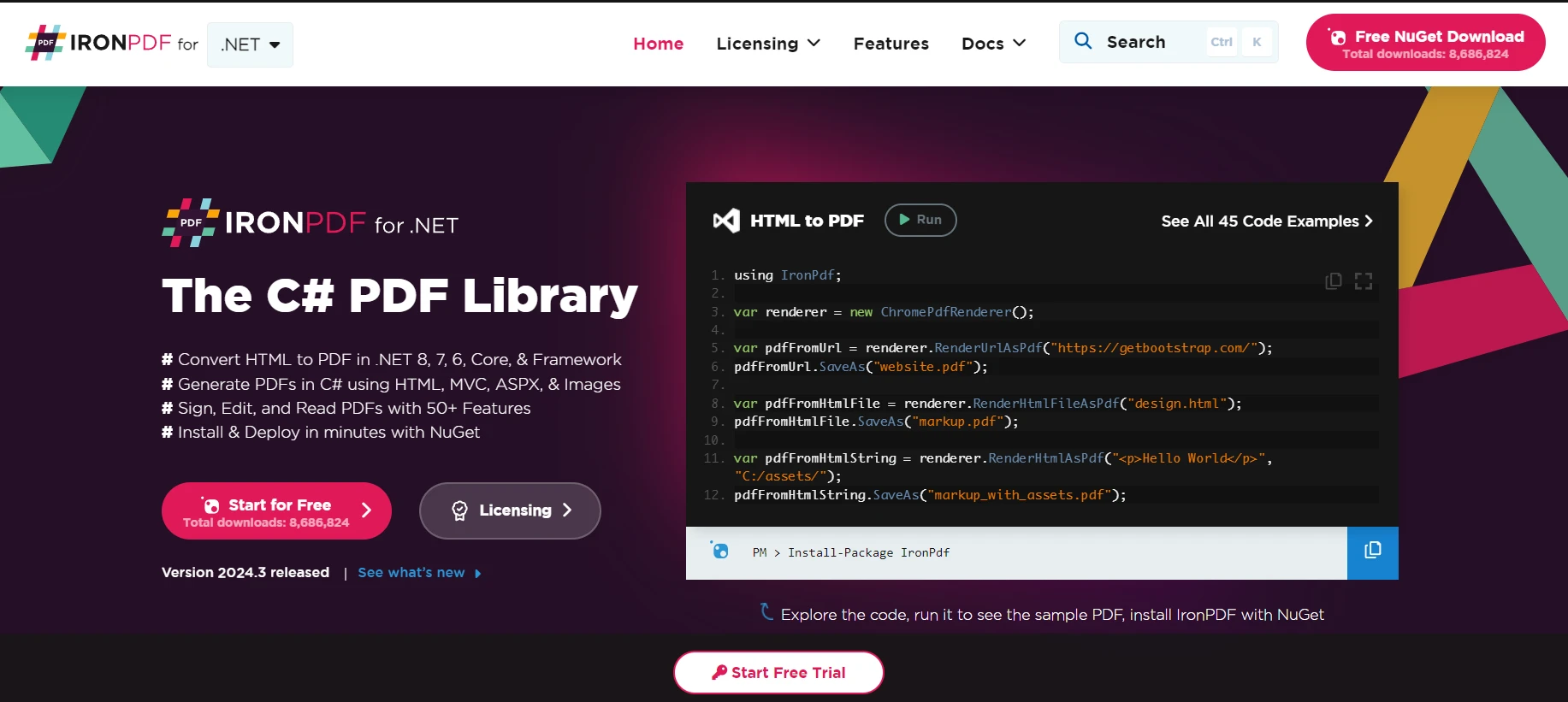
IronPDF's HTML to PDF Conversion is a library for .NET that allows developers to create, read, and manipulate PDF documents in their applications. It works by rendering HTML to PDF, providing a high level of control over the PDF generation process. This capability is especially useful in distributed systems where documents need to be dynamically generated based on message content.
Integrating IronPDF with MassTransit enables the creation of PDF documents as part of the message-processing workflow. For instance, a consumer application can listen for messages that contain data for report generation. Upon receiving a message, the application uses IronPDF to generate a PDF report from the data.
Here is a basic example: a consumer class receives message data and uses IronPDF to convert this data into a PDF document. This process begins with the Consume method of the consumer class. The method uses IronPDF's ChromePdfRenderer functionality to render an HTML string or URL to a PDF.
The resulting PDF can then be stored, emailed, or otherwise processed according to the application's requirements.
First, ensure you have the IronPDF and MassTransit packages added to your consumer application project via NuGet:
# Install IronPDF library
Install-Package IronPdf
# Install MassTransit library
Install-Package MassTransitLet's define a simple message contract. This message contains data that will be converted into a PDF:
// A message contract representing the data needed for a PDF
public class PdfDataMessage
{
    public string HtmlContent { get; set; }
}' A message contract representing the data needed for a PDF
Public Class PdfDataMessage
Public Property HtmlContent() As String
End ClassNext, we'll create the consumer class that processes this message. This class implements IConsumer<PdfDataMessage> and uses IronPDF to generate a PDF from the HtmlContent of the message:
using IronPdf;
using MassTransit;
using System.Threading.Tasks;

// Consumer class for processing PdfDataMessage
public class PdfDataMessageConsumer : IConsumer<PdfDataMessage>
{
    public async Task Consume(ConsumeContext<PdfDataMessage> context)
    {
        var message = context.Message;
        // Use IronPDF to convert HTML content to PDF
        var renderer = new ChromePdfRenderer();
        var pdf = renderer.RenderHtmlAsPdf(message.HtmlContent);

        // Save the PDF document to a file
        var outputPath = $"output_{System.DateTime.Now.Ticks}.pdf";
        pdf.SaveAs(outputPath);

        // Log or handle the PDF file path as needed
        System.Console.WriteLine($"PDF generated and saved to: {outputPath}");

        // Complete the task
        await Task.CompletedTask;
    }
}Imports System
Imports IronPdf
Imports MassTransit
Imports System.Threading.Tasks
' Consumer class for processing PdfDataMessage
Public Class PdfDataMessageConsumer
Implements IConsumer(Of PdfDataMessage)
Public Async Function Consume(ByVal context As ConsumeContext(Of PdfDataMessage)) As Task
Dim message = context.Message
' Use IronPDF to convert HTML content to PDF
Dim renderer = New ChromePdfRenderer()
Dim pdf = renderer.RenderHtmlAsPdf(message.HtmlContent)
' Save the PDF document to a file
Dim outputPath = $"output_{DateTime.Now.Ticks}.pdf"
pdf.SaveAs(outputPath)
' Log or handle the PDF file path as needed
System.Console.WriteLine($"PDF generated and saved to: {outputPath}")
' Complete the task
Await Task.CompletedTask
End Function
End ClassFinally, you'll need to configure MassTransit in your application startup to use this consumer. This setup will vary depending on the message broker you're using (e.g., RabbitMQ, Azure Service Bus). Here is a basic setup example with RabbitMQ:
using MassTransit;

var busControl = Bus.Factory.CreateUsingRabbitMq(cfg =>
{
    cfg.Host("rabbitmq://localhost");
    cfg.ReceiveEndpoint("pdf_generation_queue", e =>
    {
        // Register the consumer
        e.Consumer<PdfDataMessageConsumer>();
    });
});

// Start the bus control to start processing messages
await busControl.StartAsync();
try
{
    Console.WriteLine("Press enter to exit");
    Console.ReadLine();
}
finally
{
    // Stop the bus control to clean up resources
    await busControl.StopAsync();
}Imports MassTransit
Private busControl = Bus.Factory.CreateUsingRabbitMq(Sub(cfg)
cfg.Host("rabbitmq://localhost")
cfg.ReceiveEndpoint("pdf_generation_queue", Sub(e)
' Register the consumer
e.Consumer(Of PdfDataMessageConsumer)()
End Sub)
End Sub)
' Start the bus control to start processing messages
Await busControl.StartAsync()
Try
Console.WriteLine("Press enter to exit")
Console.ReadLine()
Finally
' Stop the bus control to clean up resources
Await busControl.StopAsync()
End TryThis code configures MassTransit with RabbitMQ as the message broker and sets up a receiving endpoint that listens on the pdf_generation_queue. When a PdfDataMessage is received, the PdfDataMessageConsumer processes it.
Please adjust the configuration according to your specific setup, such as the RabbitMQ host or the Azure Service Bus connection string. Also, ensure the message producer application is correctly configured to send messages to the same queue or topic that your consumer is listening to.
This example provides a foundational understanding of integrating MassTransit with IronPDF to generate PDFs from message content. Further customization and error handling may be necessary depending on your application's requirements.
When integrating IronPDF with MassTransit, it's important to consider several best practices:
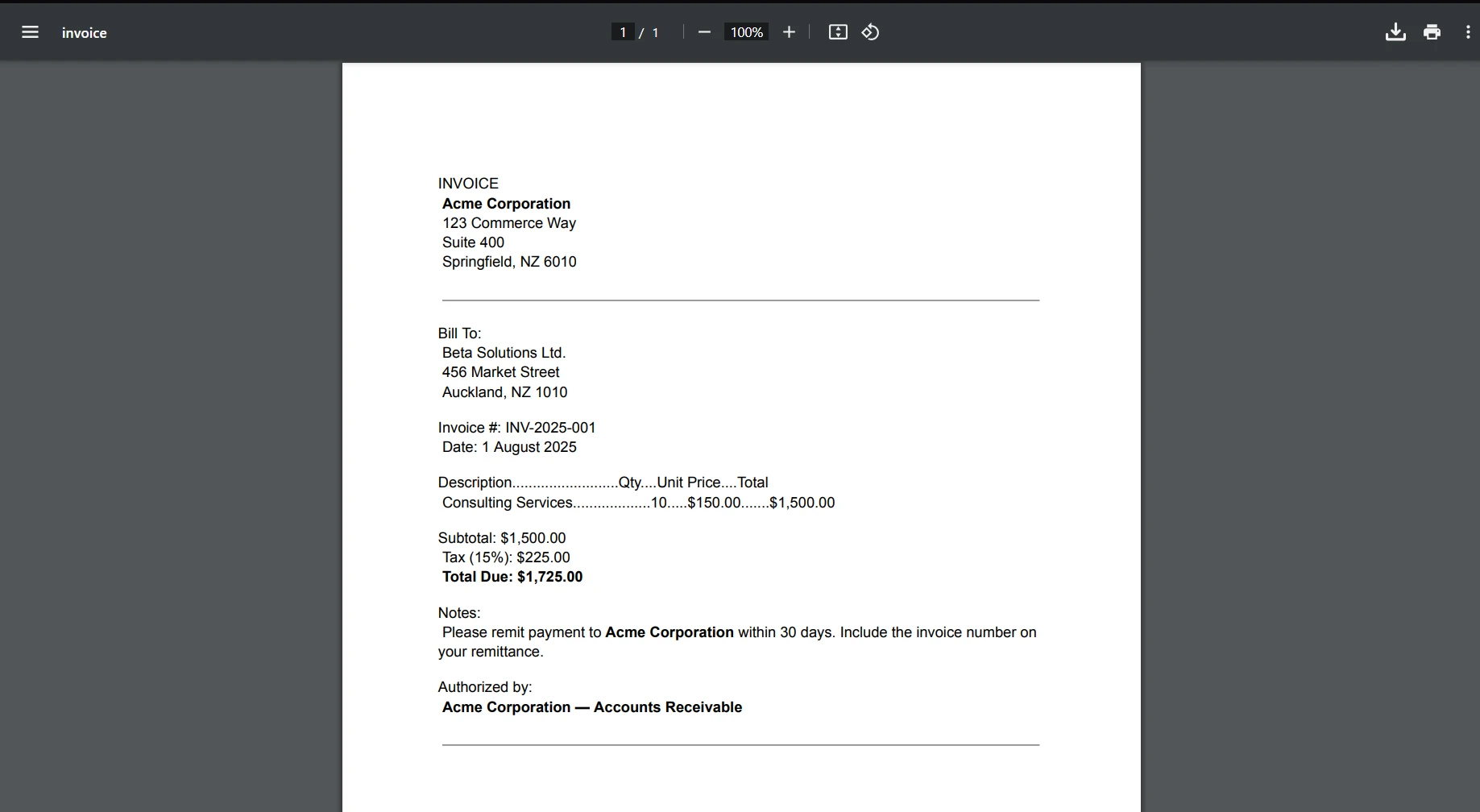
Integrating IronPDF adds a powerful tool to the MassTransit ecosystem. It allows for the generation of complex documents as part of the message-handling process. This integration is particularly useful in scenarios like generating invoices, reports, or any other document based on the message data.
For developers looking to streamline the creation of distributed systems in C#, exploring MassTransit's resources is a practical first step. The library offers a comprehensive suite of features designed to address the specific challenges of message-based architecture, backed by a supportive community and extensive documentation.
Start by visiting the MassTransit GitHub page or official documentation to dive into the specifics and see how it can fit into your project. IronPDF offers a free trial of IronPDF and licenses start from $999.

Jacob Mellor is Chief Technology Officer at Iron Software and a visionary engineer pioneering C# PDF technology. As the original developer behind Iron Software's core codebase, he has shaped the company's product architecture since its inception, transforming it alongside CEO Cameron Rimington into a 50+ person company serving NASA, Tesla, and global government agencies.

IronPDF is a part of IRONSUITE
10 .NET API products for your office documents











When you need your PDF to look like HTML, fast.


