using IronPdf;

// Disable local disk access or cross-origin requests
Installation.EnableWebSecurity = true;

// Instantiate Renderer
var renderer = new ChromePdfRenderer();

// Create a PDF from a HTML string using C#
var pdf = renderer.RenderHtmlAsPdf("<h1>Hello World</h1>");

// Export to a file or Stream
pdf.SaveAs("output.pdf");

// Advanced Example with HTML Assets
// Load external html assets: Images, CSS and JavaScript.
// An optional BasePath 'C:\site\assets\' is set as the file location to load assets from
var myAdvancedPdf = renderer.RenderHtmlAsPdf("<img src='icons/iron.png'>", @"C:\site\assets\");
myAdvancedPdf.SaveAs("html-with-assets.pdf");
using IronPdf;// Disable local disk access or cross-origin requestsInstallation.EnableWebSecurity = true;// Instantiate Renderervar renderer = new ChromePdfRenderer();// Create a PDF from a HTML string using C#var pdf = renderer.RenderHtmlAsPdf("<h1>Hello World</h1>");// Export to a file or Streampdf.SaveAs("output.pdf");// Advanced Example with HTML Assets// Load external html assets: Images, CSS and JavaScript.// An optional BasePath 'C:\site\assets\' is set as the file location to load assets fromvar myAdvancedPdf = renderer.RenderHtmlAsPdf("<img src='icons/iron.png'>", @"C:\site\assets\");myAdvancedPdf.SaveAs("html-with-assets.pdf");
PM >Install-Package IronPdf
Install-Package IronPdf
ENTWICKLER-UPDATES
C# String umkehren (Funktionsweise für Entwickler)
Die Zeichenfolgenmanipulation ist ein grundlegender Aspekt der Programmierung, und eine häufige Aufgabe ist das Umkehren einer Eingabezeichenfolge. In C# gibt es mehrere Möglichkeiten, diese Aufgabe zu erledigen, wie z.B. die Verwendung einer While-Schleife, wobei jede ihre eigenen Vor- und Nachteile und besten Anwendungsfälle hat. In diesem Artikel werden wir verschiedene Methoden zum Umkehren einer Zeichenfolge oder eines Zeichenarrays in C# erkunden, zusammen mit Codebeispielen für verschiedene Szenarien und Randfälle. Außerdem stellen wir eine herausragende PDF-Generierungsbibliothek namens [IronPDF von Iron Software](https://ironpdf.com) vor.
## 1. Eingebaute Funktionen verwenden
C# bietet mehrere eingebaute Funktionen zur Zeichenfolgenmanipulation, und eine davon ist `Array.Reverse()`, die verwendet werden kann, um ein Array von Zeichen oder ein Zeichenarray, das eine Zeichenfolge darstellt, umzukehren. Hier ist ein Codebeispiel der Umkehrmethode:
```csharp
public class Program
{
    // Main method: entry point of the program
    public static void Main()
    {
        string original = "Awesome IronPDF"; // String variable
        char[] charArray = original.ToCharArray(); // Convert string to character array
        Array.Reverse(charArray); // Reverse the character array
        string reversed = new string(charArray); // Create a new reversed string
        Console.WriteLine(reversed); // Output: FDPnorIemosewA
    }
}
```
### Vorteile
* Einfacher und prägnanter Code.
* Nutzt eingebaute Funktionen, was die Notwendigkeit benutzerdefinierter Implementierungen reduziert.
### Nachteile
* Erfordert die Umwandlung der Zeichenfolge in ein Zeichenarray, was zusätzlichen Speicher verbraucht.
* Nicht geeignet für Szenarien, bei denen Leistung kritisch ist.
## 2. Verwenden einer `StringBuilder`
Ein weiterer Ansatz, um eine Zeichenfolge in C# umzukehren, ist die Nutzung der `StringBuilder`-Klasse, die effiziente Operationen zur Zeichenfolgenmanipulation bietet. So können Sie `StringBuilder` verwenden, um eine Zeichenfolge umzukehren:
```csharp
public class Program
{
// Main method: entry point of the program
public static void Main()
{
string someText = "Awesome IronPDF"; // String variable
StringBuilder sb = new StringBuilder(); // Create a StringBuilder instance
for (int i = someText.Length - 1; i >= 0; i--)
{
sb.Append(someText[i]); // Append characters in reverse order
}
string reversed = sb.ToString(); // Convert StringBuilder to string
Console.WriteLine(reversed); // Output: FDPnorIemosewA
}
}
```
### Vorteile
* Effiziente Speichernutzung, insbesondere bei großen Zeichenfolgen.
* Geeignet für Szenarien, bei denen die Leistung entscheidend ist.
### Nachteile
* Erfordert manuelle Iteration über die Zeichen der Originalzeichenfolge.
* Etwas ausführlicher im Vergleich zur Verwendung eingebauter Funktionen.
## 3. rekursiver Ansatz
Ein rekursiver Ansatz kann auch verwendet werden, um eine Zeichenfolge in C# umzukehren. Diese Methode beinhaltet das rekursive Vertauschen der Zeichen von beiden Enden der Zeichenfolge, bis die gesamte Zeichenfolge umgekehrt ist. Hier ist eine Implementierung:
```csharp
public class Program
{
// Main method: entry point of the program
public static void Main()
{
string someText = "Awesome IronPDF"; // Random string
string reversed = ReverseString(someText); // Reverse a string
Console.WriteLine(reversed); // Output: FDPnorIemosewA
}
// Recursive method to reverse a string
public static string ReverseString(string str)
{
if (str.Length <= 1)
return str;
return ReverseString(str.Substring(1)) + str[0]; // Recursive call and string concatenation
}
}
```
### Vorteile
* Eleganter und prägnanter Code.
* Kann nützlich sein in Szenarien, in denen Rekursion bevorzugt oder erforderlich ist.
### Nachteile
* Kann bei extrem langen Zeichenfolgen zu einem Stack-Überlauf aufgrund rekursiver Funktionsaufrufe führen.
* Weniger effizient im Vergleich zu iterativen Ansätzen, insbesondere bei großen Zeichenfolgen.
## Grenzfälle
Beim Umkehren von Zeichenfolgen ist es entscheidend, Randfälle zu berücksichtigen, um Robustheit und Korrektheit sicherzustellen. Einige zu berücksichtigende Randfälle sind:
* **Leerer String:** Behandlung von Fällen, in denen der Eingabestring leer ist.
* **Null-Zeichenkette:** Behandlung von Szenarien, in denen die Eingabezeichenkette null ist.
* **Zeichenketten mit Sonderzeichen:** Sicherstellen, dass Sonderzeichen bei der Umkehrung korrekt behandelt werden.
## PDF-Dokument mit der C# Zeichenketten-Umkehrmethode generieren
IronPDF überzeugt in der [HTML-zu-PDF](/tutorials/html-to-pdf/)-Konvertierung, indem es den originalen Layouts und Stilen präzise erhält. Es ist ideal zur Erstellung von PDFs aus webbasierten Inhalten wie Berichten, Rechnungen und Dokumentationen. Mit Unterstützung für HTML-Dateien, URLs und rohe HTML-Strings erstellt IronPDF problemlos hochwertige PDF-Dokumente.
```csharp
using IronPdf;
class Program
{
// Main method: entry point of the program
static void Main(string[] args)
{
var renderer = new ChromePdfRenderer(); // Create a PDF renderer
// 1. Convert HTML String to PDF
var htmlContent = "<h1>Hello, IronPDF!</h1><p>This is a PDF from an HTML string.</p>";
var pdfFromHtmlString = renderer.RenderHtmlAsPdf(htmlContent); // Render HTML to PDF
pdfFromHtmlString.SaveAs("HTMLStringToPDF.pdf"); // Save the PDF file
// 2. Convert HTML File to PDF
var htmlFilePath = "path_to_your_html_file.html"; // Specify the path to your HTML file
var pdfFromHtmlFile = renderer.RenderHtmlFileAsPdf(htmlFilePath); // Render HTML file to PDF
pdfFromHtmlFile.SaveAs("HTMLFileToPDF.pdf"); // Save the PDF file
// 3. Convert URL to PDF
var url = "http://ironpdf.com"; // Specify the URL
var pdfFromUrl = renderer.RenderUrlAsPdf(url); // Render URL to PDF
pdfFromUrl.SaveAs("URLToPDF.pdf"); // Save the PDF file
}
}
```
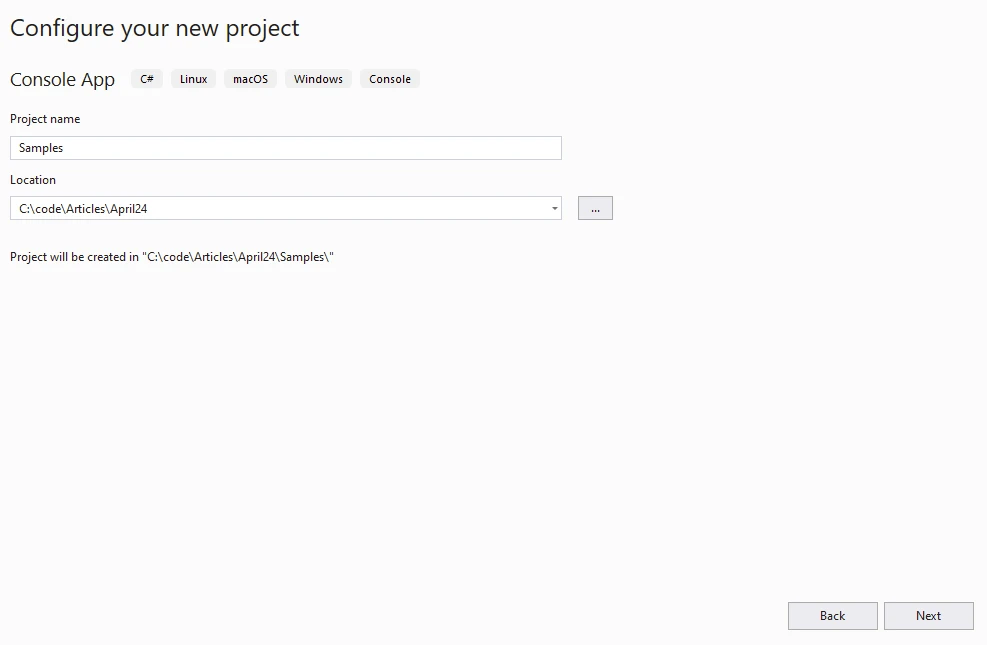
Beginnen Sie mit der Erstellung einer Konsolenanwendung von Visual Studio.
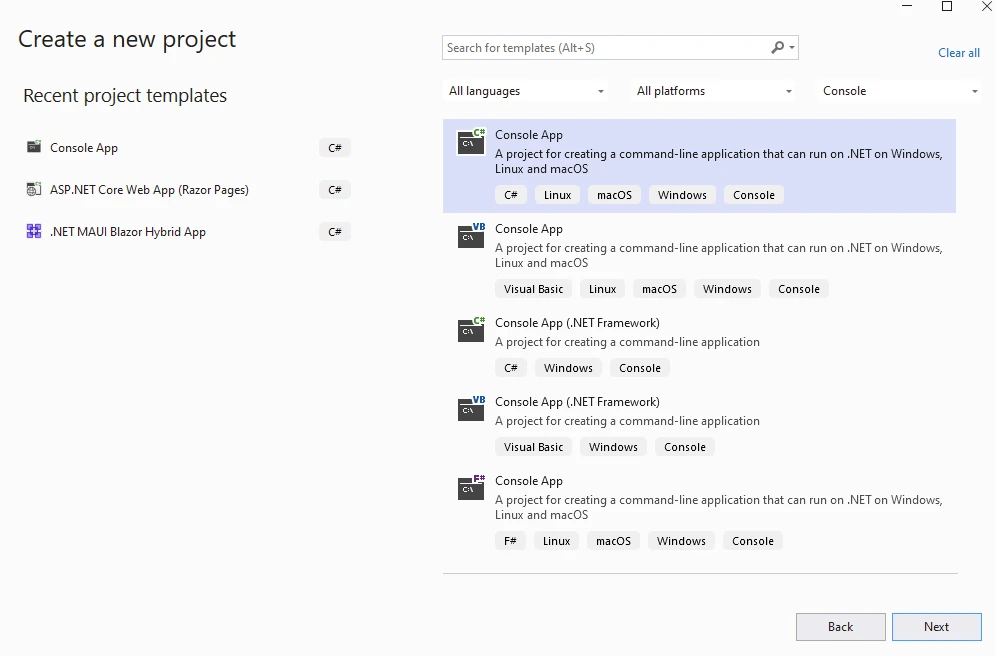
Geben Sie den Projektnamen und den Speicherort an.
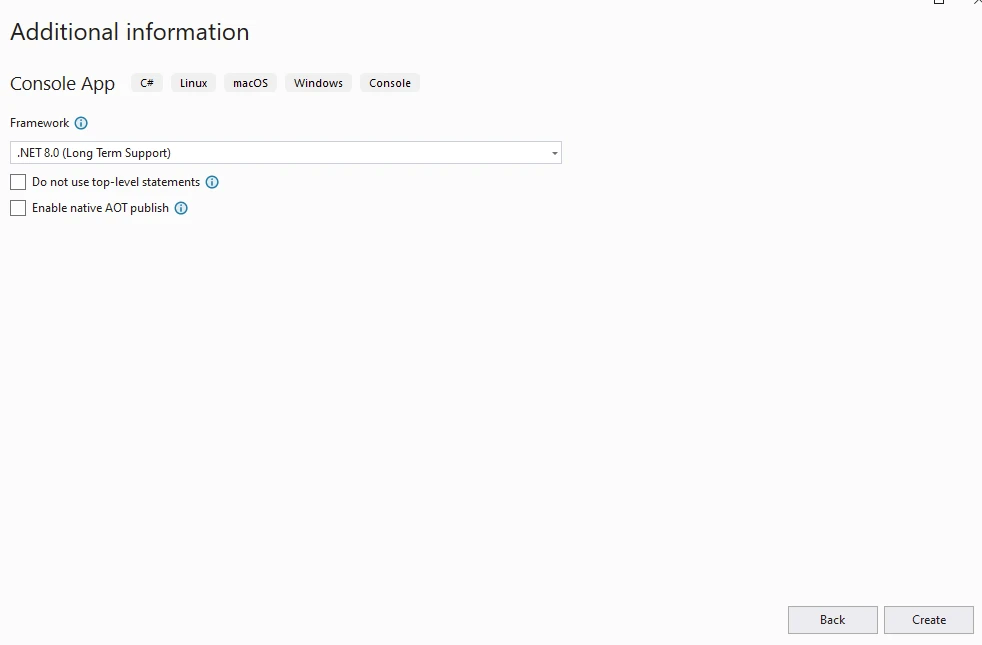
Wählen Sie die .NET-Version aus.
Installieren Sie IronPDF zum erstellten Projekt.
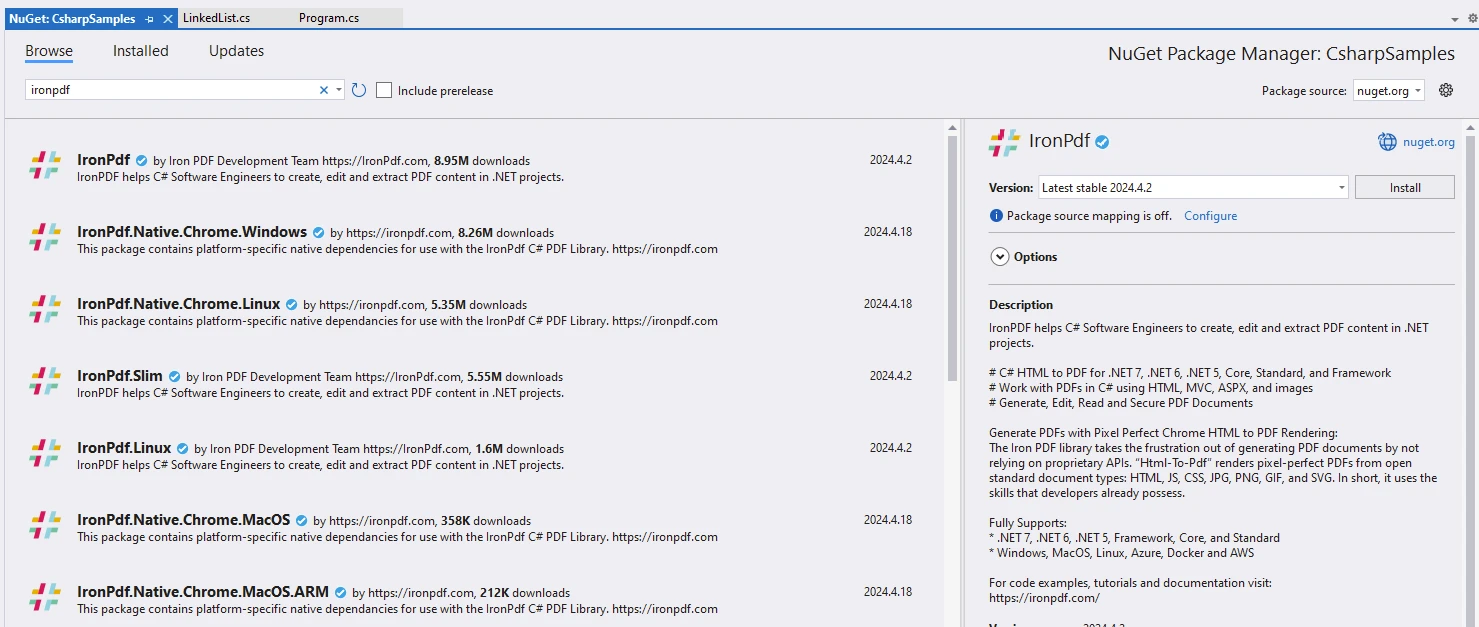
Es kann auch mit dem untenstehenden Befehl in der Befehlszeile erfolgen.
```shell
:InstallCmd dotnet add package IronPdf --version 2024.4.2
```
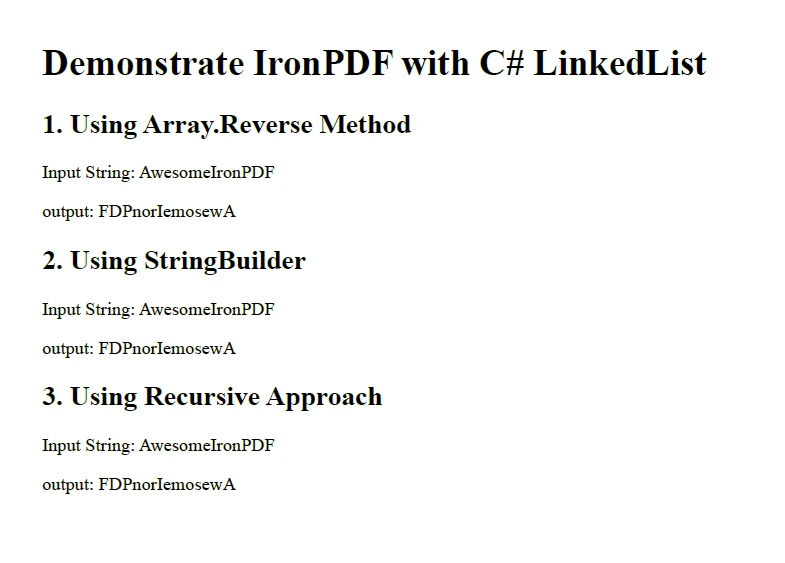
Schreiben Sie den folgenden Code zur Demonstration der Zeichenfolgenumkehr.
```csharp
public class Program
{
// Main method: entry point of the program
public static void Main()
{
var content = "<h1>Demonstrate IronPDF with C# LinkedList</h1>";
content += "<h2>1. Using Array.Reverse Method</h2>";
string someText = "Awesome IronPDF"; // New string variable
content += $"<p>Input String: {someText}</p>";
char[] charArray = someText.ToCharArray(); // Convert string to character array
Array.Reverse(charArray); // Reverse the character array
string reversed1 = new string(charArray); // Create a new reversed string
Console.WriteLine(reversed1); // Output: FDPnorIemosewA
content += $"<p>Output: {reversed1}</p>";
content += "<h2>2. Using StringBuilder</h2>";
StringBuilder sb = new StringBuilder(); // Create a StringBuilder instance
content += $"<p>Input String: {someText}</p>";
for (int i = someText.Length - 1; i >= 0; i--)
{
sb.Append(someText[i]); // Append characters in reverse order
}
string reversed2 = sb.ToString(); // Convert StringBuilder to string
Console.WriteLine(reversed2); // Output: FDPnorIemosewA
content += $"<p>Output: {reversed2}</p>";
content += "<h2>3. Using Recursive Approach</h2>";
content += $"<p>Input String: {someText}</p>";
string reversed3 = ReverseString(someText); // Reverse a string
Console.WriteLine(reversed3); // Output: FDPnorIemosewA
content += $"<p>Output: {reversed3}</p>";
// Create Renderer
var renderer = new ChromePdfRenderer(); // Create a PDF renderer
// Create a PDF from HTML string
var pdf = renderer.RenderHtmlAsPdf(content); // Render HTML to PDF
// Save to a file or Stream
pdf.SaveAs("reverseString.pdf"); // Save the PDF file
}
// Recursive method to reverse a string
public static string ReverseString(string str)
{
if (str.Length <= 1)
return str;
return ReverseString(str.Substring(1)) + str[0]; // Recursive call and string concatenation
}
}
```
### Ausgabe
## Lizenz (Testversion für IronPDF verfügbar)
Für die Ausführung von Anwendungen benötigt die IronPDF-Bibliothek eine Lizenz. Weitere Informationen finden Sie auf der Seite [IronPDF Licensing Information](/licensing/).
Eine Testlizenz kann auf der Seite [IronPDF Trial License](trial-license) erhalten werden.
Fügen Sie den Schlüssel in die unten stehende appSettings.json-Datei ein.
```json
{
"IronPdf.License.LicenseKey": "The Key Goes Here"
}
```
## Abschluss
Das Umkehren einer Zeichenfolge in C# ist eine häufige Programmieraufgabe mit verschiedenen Ansätzen und Überlegungen. Ob Sie eingebaute Funktionen, `StringBuilder` oder rekursive Methoden bevorzugen, jeder Ansatz hat seine Vorteile, Nachteile und beste Anwendungsfälle. Indem Sie diese Methoden verstehen und Randfälle berücksichtigen, können Sie Zeichenfolgen in C# auf eine Weise effektiv umkehren, die Ihren spezifischen Anforderungen entspricht. Wählen Sie die Methode, die am besten zu Ihren Anforderungen passt, basierend auf Leistung, Speicherverbrauch und Handhabung von Sonderzeichen.
Mit der [IronPDF-Bibliothek für C#-PDF-Operationen](https://ironpdf.com) können Entwickler fortgeschrittene Fähigkeiten erwerben, um moderne Anwendungen zu entwickeln.
Die Zeichenfolgenmanipulation ist ein grundlegender Aspekt der Programmierung, und eine häufige Aufgabe ist das Umkehren einer Eingabezeichenfolge. In C# gibt es mehrere Möglichkeiten, diese Aufgabe zu erledigen, wie z.B. die Verwendung einer While-Schleife, wobei jede ihre eigenen Vor- und Nachteile und besten Anwendungsfälle hat. In diesem Artikel werden wir verschiedene Methoden zum Umkehren einer Zeichenfolge oder eines Zeichenarrays in C# erkunden, zusammen mit Codebeispielen für verschiedene Szenarien und Randfälle. Außerdem stellen wir eine herausragende PDF-Generierungsbibliothek namens IronPDF von Iron Software vor.
1. Eingebaute Funktionen verwenden
C# bietet mehrere eingebaute Funktionen zur Zeichenfolgenmanipulation, und eine davon ist Array.Reverse(), die verwendet werden kann, um ein Array von Zeichen oder ein Zeichenarray, das eine Zeichenfolge darstellt, umzukehren. Hier ist ein Codebeispiel der Umkehrmethode:
public class Program{ // Main method: entry point of the program public static voidMain() { string original = "Awesome IronPDF"; // String variable char[] charArray = original.ToCharArray(); // Convert string to character arrayArray.Reverse(charArray); // Reverse the character array string reversed = new string(charArray); // Create a new reversed stringConsole.WriteLine(reversed); // Output: FDPnorIemosewA }}
public class Program
{
    // Main method: entry point of the program
    public static void Main()
    {
        string original = "Awesome IronPDF"; // String variable
        char[] charArray = original.ToCharArray(); // Convert string to character array
        Array.Reverse(charArray); // Reverse the character array
        string reversed = new string(charArray); // Create a new reversed string
        Console.WriteLine(reversed); // Output: FDPnorIemosewA
    }
}
C#
Vorteile
Einfacher und prägnanter Code.
Nutzt eingebaute Funktionen, was die Notwendigkeit benutzerdefinierter Implementierungen reduziert.
Nachteile
Erfordert die Umwandlung der Zeichenfolge in ein Zeichenarray, was zusätzlichen Speicher verbraucht.
Nicht geeignet für Szenarien, bei denen Leistung kritisch ist.
2. Verwenden einer StringBuilder
Ein weiterer Ansatz, um eine Zeichenfolge in C# umzukehren, ist die Nutzung der StringBuilder-Klasse, die effiziente Operationen zur Zeichenfolgenmanipulation bietet. So können Sie StringBuilder verwenden, um eine Zeichenfolge umzukehren:
public class Program{ // Main method: entry point of the program public static voidMain() { string someText = "Awesome IronPDF"; // String variable StringBuilder sb = new StringBuilder(); // Create a StringBuilder instance for (int i = someText.Length - 1; i >= 0; i--) { sb.Append(someText[i]); // Append characters in reverse order } string reversed = sb.ToString(); // Convert StringBuilder to stringConsole.WriteLine(reversed); // Output: FDPnorIemosewA }}
public class Program
{
    // Main method: entry point of the program
    public static void Main()
    {
        string someText = "Awesome IronPDF"; // String variable
        StringBuilder sb = new StringBuilder(); // Create a StringBuilder instance
        for (int i = someText.Length - 1; i >= 0; i--)
        {
            sb.Append(someText[i]); // Append characters in reverse order
        }
        string reversed = sb.ToString(); // Convert StringBuilder to string
        Console.WriteLine(reversed); // Output: FDPnorIemosewA
    }
}
C#
Vorteile
Effiziente Speichernutzung, insbesondere bei großen Zeichenfolgen.
Geeignet für Szenarien, bei denen die Leistung entscheidend ist.
Nachteile
Erfordert manuelle Iteration über die Zeichen der Originalzeichenfolge.
Etwas ausführlicher im Vergleich zur Verwendung eingebauter Funktionen.
3. rekursiver Ansatz
Ein rekursiver Ansatz kann auch verwendet werden, um eine Zeichenfolge in C# umzukehren. Diese Methode beinhaltet das rekursive Vertauschen der Zeichen von beiden Enden der Zeichenfolge, bis die gesamte Zeichenfolge umgekehrt ist. Hier ist eine Implementierung:
public class Program{ // Main method: entry point of the program public static voidMain() { string someText = "Awesome IronPDF"; // Random string string reversed = ReverseString(someText); // Reverse a stringConsole.WriteLine(reversed); // Output: FDPnorIemosewA } // Recursive method to reverse a string public static stringReverseString(string str) { if (str.Length <= 1) return str; returnReverseString(str.Substring(1)) + str[0]; // Recursive call and string concatenation }}
public class Program
{
    // Main method: entry point of the program
    public static void Main()
    {
        string someText = "Awesome IronPDF"; // Random string
        string reversed = ReverseString(someText); // Reverse a string
        Console.WriteLine(reversed); // Output: FDPnorIemosewA
    }

    // Recursive method to reverse a string
    public static string ReverseString(string str)
    {
        if (str.Length <= 1)
            return str;
        return ReverseString(str.Substring(1)) + str[0]; // Recursive call and string concatenation
    }
}
C#
Vorteile
Eleganter und prägnanter Code.
Kann nützlich sein in Szenarien, in denen Rekursion bevorzugt oder erforderlich ist.
Nachteile
Kann bei extrem langen Zeichenfolgen zu einem Stack-Überlauf aufgrund rekursiver Funktionsaufrufe führen.
Weniger effizient im Vergleich zu iterativen Ansätzen, insbesondere bei großen Zeichenfolgen.
Grenzfälle
Beim Umkehren von Zeichenfolgen ist es entscheidend, Randfälle zu berücksichtigen, um Robustheit und Korrektheit sicherzustellen. Einige zu berücksichtigende Randfälle sind:
Leerer String: Behandlung von Fällen, in denen der Eingabestring leer ist.
Null-Zeichenkette: Behandlung von Szenarien, in denen die Eingabezeichenkette null ist.
Zeichenketten mit Sonderzeichen: Sicherstellen, dass Sonderzeichen bei der Umkehrung korrekt behandelt werden.
PDF-Dokument mit der C# Zeichenketten-Umkehrmethode generieren
IronPDF überzeugt in der HTML-zu-PDF-Konvertierung, indem es den originalen Layouts und Stilen präzise erhält. Es ist ideal zur Erstellung von PDFs aus webbasierten Inhalten wie Berichten, Rechnungen und Dokumentationen. Mit Unterstützung für HTML-Dateien, URLs und rohe HTML-Strings erstellt IronPDF problemlos hochwertige PDF-Dokumente.
using IronPdf;class Program{ // Main method: entry point of the program static voidMain(string[] args) { var renderer = new ChromePdfRenderer(); // Create a PDF renderer // 1. Convert HTML String to PDF var htmlContent = "<h1>Hello, IronPDF!</h1><p>This is a PDF from an HTML string.</p>"; var pdfFromHtmlString = renderer.RenderHtmlAsPdf(htmlContent); // Render HTML to PDF pdfFromHtmlString.SaveAs("HTMLStringToPDF.pdf"); // Save the PDF file // 2. Convert HTML File to PDF var htmlFilePath = "path_to_your_html_file.html"; // Specify the path to your HTML file var pdfFromHtmlFile = renderer.RenderHtmlFileAsPdf(htmlFilePath); // Render HTML file to PDF pdfFromHtmlFile.SaveAs("HTMLFileToPDF.pdf"); // Save the PDF file // 3. Convert URL to PDF var url = "http://ironpdf.com"; // Specify the URL var pdfFromUrl = renderer.RenderUrlAsPdf(url); // Render URL to PDF pdfFromUrl.SaveAs("URLToPDF.pdf"); // Save the PDF file }}
using IronPdf;

class Program
{
    // Main method: entry point of the program
    static void Main(string[] args)
    {
        var renderer = new ChromePdfRenderer(); // Create a PDF renderer

        // 1. Convert HTML String to PDF
        var htmlContent = "<h1>Hello, IronPDF!</h1><p>This is a PDF from an HTML string.</p>";
        var pdfFromHtmlString = renderer.RenderHtmlAsPdf(htmlContent); // Render HTML to PDF
        pdfFromHtmlString.SaveAs("HTMLStringToPDF.pdf"); // Save the PDF file

        // 2. Convert HTML File to PDF
        var htmlFilePath = "path_to_your_html_file.html"; // Specify the path to your HTML file
        var pdfFromHtmlFile = renderer.RenderHtmlFileAsPdf(htmlFilePath); // Render HTML file to PDF
        pdfFromHtmlFile.SaveAs("HTMLFileToPDF.pdf"); // Save the PDF file

        // 3. Convert URL to PDF
        var url = "http://ironpdf.com"; // Specify the URL
        var pdfFromUrl = renderer.RenderUrlAsPdf(url); // Render URL to PDF
        pdfFromUrl.SaveAs("URLToPDF.pdf"); // Save the PDF file
    }
}
ImportsIronPdfFriend Class Program ' Main method: entry point of the programShared Sub Main(ByVal args() AsString) Dim renderer = New ChromePdfRenderer() ' Create a PDF renderer ' 1. Convert HTML String to PDF Dim htmlContent = "<h1>Hello, IronPDF!</h1><p>This is a PDF from an HTML string.</p>" Dim pdfFromHtmlString = renderer.RenderHtmlAsPdf(htmlContent) ' Render HTML to PDF pdfFromHtmlString.SaveAs("HTMLStringToPDF.pdf") ' Save the PDF file ' 2. Convert HTML File to PDF Dim htmlFilePath = "path_to_your_html_file.html" ' Specify the path to your HTML file Dim pdfFromHtmlFile = renderer.RenderHtmlFileAsPdf(htmlFilePath) ' Render HTML file to PDF pdfFromHtmlFile.SaveAs("HTMLFileToPDF.pdf") ' Save the PDF file ' 3. Convert URL to PDF Dim url = "http://ironpdf.com" ' Specify the URL Dim pdfFromUrl = renderer.RenderUrlAsPdf(url) ' Render URL to PDF pdfFromUrl.SaveAs("URLToPDF.pdf") ' Save the PDF file End SubEnd Class
Imports IronPdf

Friend Class Program
	' Main method: entry point of the program
	Shared Sub Main(ByVal args() As String)
		Dim renderer = New ChromePdfRenderer() ' Create a PDF renderer

		' 1. Convert HTML String to PDF
		Dim htmlContent = "<h1>Hello, IronPDF!</h1><p>This is a PDF from an HTML string.</p>"
		Dim pdfFromHtmlString = renderer.RenderHtmlAsPdf(htmlContent) ' Render HTML to PDF
		pdfFromHtmlString.SaveAs("HTMLStringToPDF.pdf") ' Save the PDF file

		' 2. Convert HTML File to PDF
		Dim htmlFilePath = "path_to_your_html_file.html" ' Specify the path to your HTML file
		Dim pdfFromHtmlFile = renderer.RenderHtmlFileAsPdf(htmlFilePath) ' Render HTML file to PDF
		pdfFromHtmlFile.SaveAs("HTMLFileToPDF.pdf") ' Save the PDF file

		' 3. Convert URL to PDF
		Dim url = "http://ironpdf.com" ' Specify the URL
		Dim pdfFromUrl = renderer.RenderUrlAsPdf(url) ' Render URL to PDF
		pdfFromUrl.SaveAs("URLToPDF.pdf") ' Save the PDF file
	End Sub
End Class
Beginnen Sie mit der Erstellung einer Konsolenanwendung von Visual Studio.
Geben Sie den Projektnamen und den Speicherort an.
Wählen Sie die .NET-Version aus.
Installieren Sie IronPDF zum erstellten Projekt.
Es kann auch mit dem untenstehenden Befehl in der Befehlszeile erfolgen.
> dotnet add package IronPdf --version 2024.4.2
dotnet add package IronPdf --version 2024.4.2
Schreiben Sie den folgenden Code zur Demonstration der Zeichenfolgenumkehr.
public class Program{ // Main method: entry point of the program public static voidMain() { var content = "<h1>Demonstrate IronPDF with C# LinkedList</h1>"; content += "<h2>1. Using Array.Reverse Method</h2>"; string someText = "Awesome IronPDF"; // New string variable content += $"<p>Input String: {someText}</p>"; char[] charArray = someText.ToCharArray(); // Convert string to character arrayArray.Reverse(charArray); // Reverse the character array string reversed1 = new string(charArray); // Create a new reversed stringConsole.WriteLine(reversed1); // Output: FDPnorIemosewA content += $"<p>Output: {reversed1}</p>"; content += "<h2>2. Using StringBuilder</h2>"; StringBuilder sb = new StringBuilder(); // Create a StringBuilder instance content += $"<p>Input String: {someText}</p>"; for (int i = someText.Length - 1; i >= 0; i--) { sb.Append(someText[i]); // Append characters in reverse order } string reversed2 = sb.ToString(); // Convert StringBuilder to stringConsole.WriteLine(reversed2); // Output: FDPnorIemosewA content += $"<p>Output: {reversed2}</p>"; content += "<h2>3. Using Recursive Approach</h2>"; content += $"<p>Input String: {someText}</p>"; string reversed3 = ReverseString(someText); // Reverse a stringConsole.WriteLine(reversed3); // Output: FDPnorIemosewA content += $"<p>Output: {reversed3}</p>"; // Create Renderer var renderer = new ChromePdfRenderer(); // Create a PDF renderer // Create a PDF from HTML string var pdf = renderer.RenderHtmlAsPdf(content); // Render HTML to PDF // Save to a file or Stream pdf.SaveAs("reverseString.pdf"); // Save the PDF file } // Recursive method to reverse a string public static stringReverseString(string str) { if (str.Length <= 1) return str; returnReverseString(str.Substring(1)) + str[0]; // Recursive call and string concatenation }}
public class Program
{
    // Main method: entry point of the program
    public static void Main()
    {
        var content = "<h1>Demonstrate IronPDF with C# LinkedList</h1>";
        content += "<h2>1. Using Array.Reverse Method</h2>";
        string someText = "Awesome IronPDF"; // New string variable
        content += $"<p>Input String: {someText}</p>";
        char[] charArray = someText.ToCharArray(); // Convert string to character array
        Array.Reverse(charArray); // Reverse the character array
        string reversed1 = new string(charArray); // Create a new reversed string
        Console.WriteLine(reversed1); // Output: FDPnorIemosewA
        content += $"<p>Output: {reversed1}</p>";
        content += "<h2>2. Using StringBuilder</h2>";
        StringBuilder sb = new StringBuilder(); // Create a StringBuilder instance
        content += $"<p>Input String: {someText}</p>";
        for (int i = someText.Length - 1; i >= 0; i--)
        {
            sb.Append(someText[i]); // Append characters in reverse order
        }
        string reversed2 = sb.ToString(); // Convert StringBuilder to string
        Console.WriteLine(reversed2); // Output: FDPnorIemosewA
        content += $"<p>Output: {reversed2}</p>";
        content += "<h2>3. Using Recursive Approach</h2>";
        content += $"<p>Input String: {someText}</p>";
        string reversed3 = ReverseString(someText); // Reverse a string
        Console.WriteLine(reversed3); // Output: FDPnorIemosewA
        content += $"<p>Output: {reversed3}</p>";
        // Create Renderer
        var renderer = new ChromePdfRenderer(); // Create a PDF renderer
        // Create a PDF from HTML string
        var pdf = renderer.RenderHtmlAsPdf(content); // Render HTML to PDF
        // Save to a file or Stream
        pdf.SaveAs("reverseString.pdf"); // Save the PDF file
    }

    // Recursive method to reverse a string
    public static string ReverseString(string str)
    {
        if (str.Length <= 1)
            return str;
        return ReverseString(str.Substring(1)) + str[0]; // Recursive call and string concatenation
    }
}
C#
Ausgabe
Lizenz (Testversion für IronPDF verfügbar)
Für die Ausführung von Anwendungen benötigt die IronPDF-Bibliothek eine Lizenz. Weitere Informationen finden Sie auf der Seite IronPDF Licensing Information.
Fügen Sie den Schlüssel in die unten stehende appSettings.json-Datei ein.
{ "IronPdf.License.LicenseKey": "The Key Goes Here"}
{
  "IronPdf.License.LicenseKey": "The Key Goes Here"
}
JSON
Abschluss
Das Umkehren einer Zeichenfolge in C# ist eine häufige Programmieraufgabe mit verschiedenen Ansätzen und Überlegungen. Ob Sie eingebaute Funktionen, StringBuilder oder rekursive Methoden bevorzugen, jeder Ansatz hat seine Vorteile, Nachteile und beste Anwendungsfälle. Indem Sie diese Methoden verstehen und Randfälle berücksichtigen, können Sie Zeichenfolgen in C# auf eine Weise effektiv umkehren, die Ihren spezifischen Anforderungen entspricht. Wählen Sie die Methode, die am besten zu Ihren Anforderungen passt, basierend auf Leistung, Speicherverbrauch und Handhabung von Sonderzeichen.
Jacob Mellor ist Chief Technology Officer bei Iron Software und ein visionärer Ingenieur, der Pionierarbeit in der C# PDF-Technologie leistet. Als der ursprüngliche Entwickler hinter der Kern-Codebasis von Iron Software hat er die Produktarchitektur des Unternehmens seit seiner Gründung geprägt und es zusammen mit CEO Cameron Rimington in ein Unternehmen mit mehr als 50 Mitarbeitern verwandelt, das die NASA, Tesla und globale Regierungsbehörden beliefert.