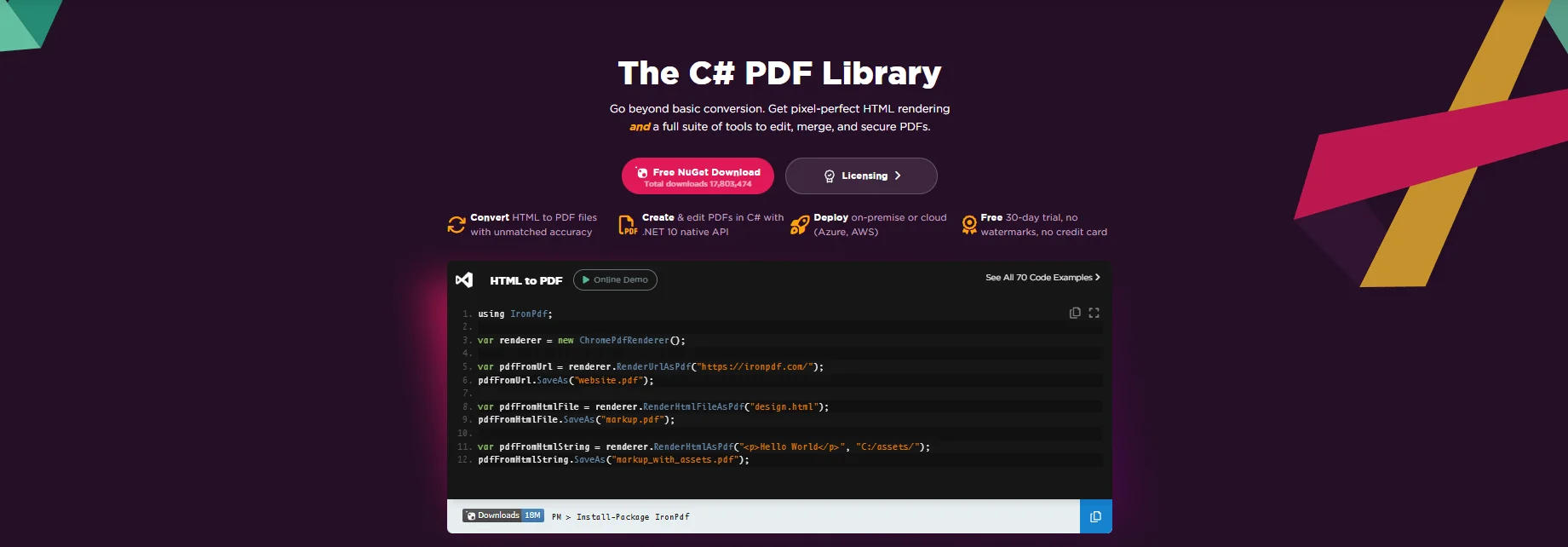
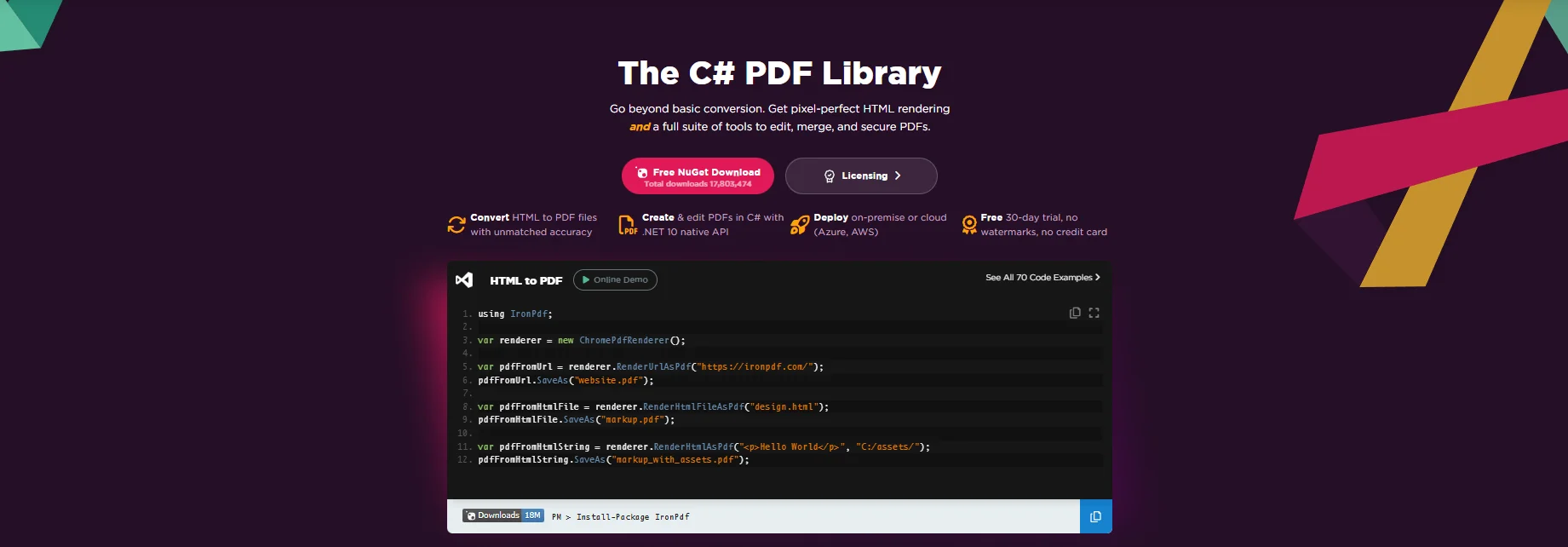
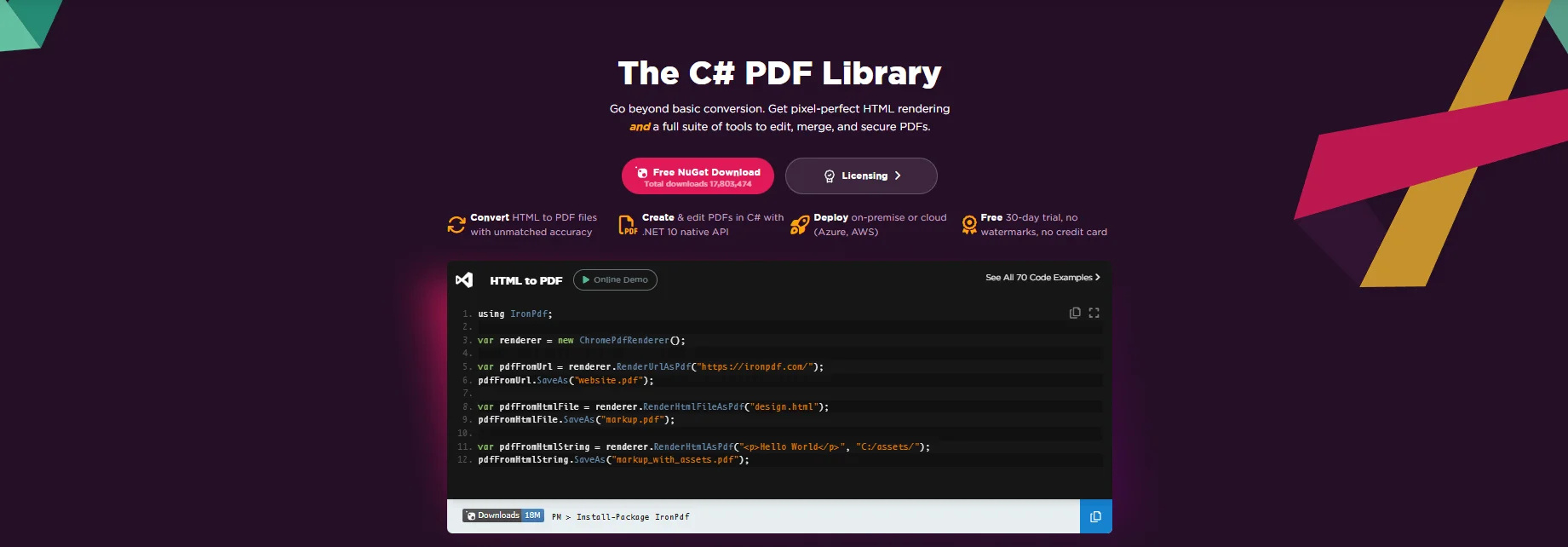
using IronPdf;

// Disable local disk access or cross-origin requests
Installation.EnableWebSecurity = true;

// Instantiate Renderer
var renderer = new ChromePdfRenderer();

// Create a PDF from a HTML string using C#
var pdf = renderer.RenderHtmlAsPdf("<h1>Hello World</h1>");

// Export to a file or Stream
pdf.SaveAs("output.pdf");

// Advanced Example with HTML Assets
// Load external html assets: Images, CSS and JavaScript.
// An optional BasePath 'C:\site\assets\' is set as the file location to load assets from
var myAdvancedPdf = renderer.RenderHtmlAsPdf("<img src='icons/iron.png'>", @"C:\site\assets\");
myAdvancedPdf.SaveAs("html-with-assets.pdf");
using IronPdf;// Disable local disk access or cross-origin requestsInstallation.EnableWebSecurity = true;// Instantiate Renderervar renderer = new ChromePdfRenderer();// Create a PDF from a HTML string using C#var pdf = renderer.RenderHtmlAsPdf("<h1>Hello World</h1>");// Export to a file or Streampdf.SaveAs("output.pdf");// Advanced Example with HTML Assets// Load external html assets: Images, CSS and JavaScript.// An optional BasePath 'C:\site\assets\' is set as the file location to load assets fromvar myAdvancedPdf = renderer.RenderHtmlAsPdf("<img src='icons/iron.png'>", @"C:\site\assets\");myAdvancedPdf.SaveAs("html-with-assets.pdf");
IronPDF, eine renommierte C#-Bibliothek, arbeitet mit Blazor-Anwendungen. Diese Überprüfung führt Sie durch die Verwendung von IronPDF, um einen PDF-Bericht in eine Blazor-Anwendung einzubetten und seine nahtlose Integration und Effektivität zu demonstrieren.
<div class="hsg-featured-snippet">
<h2>Wie man eine PDF-Datei in Blazor erstellt</h2>
<ol>
<li>
Erstellen Sie ein neues Blazor-Projekt in Visual Studio
</li>
<li>
Installieren Sie die HTML-zu-PDF-Bibliothek für Blazor-Anwendungen
</li>
<li>
Erstellen Sie PDF-Dokumente von Webseiten per URL
</li>
<li>
Erstellen Sie PDF-Dokumente aus HTML-Strings
</li>
</ol>
</div>
## 1. IronPDF-Funktionen
Entwickler können mit der robusten IronPDF for .NET PDF-Bibliothek schnell ein PDF-Dokument erstellen, lesen und verarbeiten. IronPDF verfügt über [eine eingebaute Chrome-Engine](/how-to/ironpdf-2021-chrome-rendering-engine-eap/) und bietet eine Fülle von praktischen und leistungsstarken Funktionen. Dazu gehören die Möglichkeit, HTML5, JavaScript, CSS und Bilder in PDFs zu konvertieren, die Möglichkeit, einzigartige Kopf- und Fußzeilen zu PDF-Dokumenten hinzuzufügen und die Fähigkeit, PDFs genau so zu erzeugen, wie sie in einem Webbrowser erscheinen. IronPDF unterstützt verschiedene Webtechnologien, einschließlich HTML, ASPX, Razor Pages und MVC-Frameworks.
Die wichtigsten Merkmale von IronPDF sind wie folgt:
* IronPDF bietet volle Kontrolle über die Erstellung und Änderung von PDF-Dateien innerhalb von .NET C#-Anwendungen
* IronPDF kann [PDF-Dateien von Webseiten aus ihren URLs generieren](/how-to/url-to-pdf/) unter Verwendung spezifischer User-Agent-, Proxy-, Header- und Cookie-Konfigurationen.
* IronPDF kann PDF-Dateien für Webseiten generieren, die hinter [Login-Formularen mit Formvariablen](/how-to/custom-logging/) stehen.
* IronPDF kann [Fotos extrahieren und/oder entfernen](/how-to/extract-text-and-images/) aus bereits vorhandenen PDF-Dateien
* IronPDF kann Text, Fotos, Lesezeichen, [Wasserzeichen](/how-to/custom-watermark/) und andere Elemente zu PDF-Dokumenten hinzufügen
* IronPDF macht es einfach, [Seiten eines oder mehrerer PDF-Dokumente zu verschmelzen und zu teilen](/how-to/merge-or-split-pdfs/).
* IronPDF kann Webseitenelemente wie JavaScript, CSS und Mediendateien verarbeiten und in PDF-Dokumente rendern, genau so, wie sie in einem Browser erscheinen würden.
* IronPDF unterstützt alle .NET Frameworks, einschließlich .NET Core, .NET Standard usw.
## 2. was ist Blazor?
Blazor ist ein Webanwendungs-Framework, das es ermöglicht, clientseitige Webanwendungen in C# und HTML unter Verwendung von Web Assembly zu erstellen.
Web Assembly-Apps werden in einem binären Anweisungsformat an den Browser gesendet, das mit nahezu nativer Geschwindigkeit arbeiten kann. Dies hat neue Möglichkeiten für Sprachen wie C# geschaffen, innerhalb des Browsers zu laufen.
### Erstellen eines neuen Projekts in Visual Studio
Um zu beginnen, öffnen Sie die Microsoft Visual Studio-Anwendung und wählen Sie "Neues Projekt" aus dem Datei-Menü. Dann wählen Sie "Blazor Server App".

**Erstellen eines neuen Projekts in Visual Studio**
Geben Sie einen Projektnamen ein und wählen Sie einen Dateipfad. Klicken Sie dann auf die Schaltfläche **Erstellen**.

**Auswahl des Namens und Speicherorts der neuen Blazor-Anwendung**
Wählen Sie das gewünschte .NET Framework (wir werden in diesem Tutorial .NET 6.0 verwenden), wie im unteren Screenshot gezeigt:

**Erstellen eines neuen Projekts in Visual Studio mit dem .NET 6.0 Framework**
Microsoft Visual Studio wird jetzt die Struktur für diese Blazor-Anwendung generieren.
Fügen Sie die IronPDF-Bibliothek zu diesem Projekt hinzu.
## 3. IronPDF-Bibliothek installieren
Die IronPDF-Bibliothek kann auf vier Arten heruntergeladen und installiert werden:
* Mit dem NuGet-Paketmanager von Visual Studio
* Mit der Befehlszeile von Visual Studio
* Direkt von der NuGet-Website herunterladen
* Direkt von der IronPDF-Website herunterladen
### 3.1 Verwendung des NuGet-Paketmanagers von Visual Studio
Visual Studio bietet den NuGet-Paketmanager, um beim Installieren von Bibliotheken direkt in Projekte zu helfen. Der untenstehende Screenshot zeigt, wie man den NuGet-Paket-Manager öffnet.

**Zugriff auf den NuGet-Paketmanager von Visual Studio**
Verwenden Sie das Suchfeld unter der Registerkarte "Durchsuchen", um nach "IronPDF" zu suchen, wie im unteren Screenshot gezeigt:

**Suche nach der IronPDF-Bibliothek in der NuGet-Paketmanager-GUI**
Das Bild oben zeigt die Liste der zugehörigen Suchergebnisse. Wählen Sie die erforderlichen Optionen, um das Paket in Ihrem Projekt zu installieren.
### 3.2 Verwendung der Visual Studio Befehlszeile
Gehen Sie in Visual Studio zu **Tools** > **NuGet Paketmanager** > **Package Manager Console**
Geben Sie die folgende Zeile in die Registerkarte "Package Manager Console" ein:
```shell
:ProductInstall
```
Das Paket wird jetzt im aktuellen Projekt heruntergeladen und installiert.

**Die IronPDF-Bibliothek mit der NuGet Package Manager Console installieren**
### 3.3 Direktes Herunterladen von der NuGet-Website
Der dritte Weg, die IronPDF-Bibliothek zu installieren, besteht darin, das NuGet-Paket direkt von der Website herunterzuladen.
Navigieren Sie zur [NuGet-Website für IronPDF](https://www.nuget.org/packages/IronPdf/).
* Klicken Sie auf die Option "Paket herunterladen" im Menü auf der rechten Seite.
* Öffnen Sie das heruntergeladene Paket auf Ihrem Dateisystem. Es wird automatisch installiert.
* Laden Sie die Lösung neu und beginnen Sie, sie in Ihrem Projekt zu verwenden.
### 3.4 Direktes Herunterladen von der IronPDF-Website
Besuchen Sie die IronPDF-Website, um das [IronPDF-Paket](https://ironpdf.com/packages/IronPdf.zip) direkt herunterzuladen.
Befolgen Sie nach dem Herunterladen diese Schritte, um das Paket zu Ihrem Projekt hinzuzufügen:
* Klicken Sie mit der rechten Maustaste auf das Projekt im Lösungsfenster.
* Wählen Sie die Option "Hinzufügen" > "Verweis" und navigieren Sie dann zu dem Ort, an dem Sie die Bibliothek zuvor heruntergeladen haben.
* Klicken Sie auf OK, um die Bibliothek als Verweis hinzuzufügen.
### 4. PDF-Dokumente in der Blazor Server App erstellen
Die Blazor-App in diesem Tutorial wird IronPDF verwenden, um den HTML-Inhalt einer Webseite per URL abzurufen und in ein PDF-Dokument zu konvertieren.
Geben Sie den folgenden Quellcode in die .razor-Datei ein, die im Projekt enthalten ist.
```csharp
@using IronPdf

@code {
    /// <summary>
    /// This method exports data by converting a URL to a PDF file and initiating its download.
    /// </summary>
    public async Task ExportData()
    {
        try
        {
            string fileName = "Demo.pdf";
            var renderer = new ChromePdfRenderer();

            // Render the contents of the URL as a PDF document
            var pdf = renderer.RenderUrlAsPdf("https://localhost:7018/fetchdata");

            // Save the PDF using a JavaScript function
            await JSRuntime.InvokeVoidAsync("saveAsFile", fileName, Convert.ToBase64String(pdf.Stream.ToArray()));
        }
        catch (Exception ex)
        {
            // Handle any exceptions that may occur
            Console.Error.WriteLine($"Error in ExportData: {ex.Message}");
        }
    }
}
```
Das obige Codebeispiel verwendet zwei Methoden, um PDF-Dokumente aus HTML zu generieren. Die erste Methode ist IronPDF's [`RenderUrlAsPdf`](/object-reference/api/IronPdf.ChromePdfRenderer.html#IronPdf_ChromePdfRenderer_RenderUrlAsPdf_System_String_)-Methode, die den HTML-Inhalt von einer angegebenen URL herunterlädt und in ein PDF-Format umwandelt.
Die zweite Methode ist die statische `JSRuntime.InvokeVoidAsync`-Methode, die die JavaScript-Engine eines Browsers veranlasst, eine JavaScript-Funktion im Kontext der Webseite aufzurufen, die den PDF-Inhalt auf dem Dateisystem des Clients speichert.
Diese JavaScript-Funktion ist unten aufgeführt:
```html
<script type="text/javascript">
/**
* Saves the PDF data as a file on the client's system.
* @param {string} filename - The name of the file to be created.
* @param {string} bytesBase64 - The Base64 encoded string of the PDF data.
*/
function saveAsFile(filename, bytesBase64) {
if (navigator.msSaveBlob) {
// Download the document in Microsoft Edge browser
var data = window.atob(bytesBase64);
var bytes = new Uint8Array(data.length);
for (var i = 0; i < data.length; i++) {
bytes[i] = data.charCodeAt(i);
}
var blob = new Blob([bytes.buffer], { type: "application/octet-stream" });
navigator.msSaveBlob(blob, filename);
window.navigator.msSaveOrOpenBlob(blob);
}
else {
var link = document.createElement('a');
link.download = filename;
link.href = "data:application/octet-stream;base64," + bytesBase64;
document.body.appendChild(link); // Needed for Firefox
link.click();
document.body.removeChild(link);
}
}
</script>
```
Die obige JavaScript-Funktion empfängt die Base64-Daten von Blazor und wandelt sie in einen Blob um, bevor sie an einem clientseitigen Speicherort gespeichert wird.
Alternativ kann die [`SaveAs`](/object-reference/api/IronPdf.PdfDocument.html#IronPdf_PdfDocument_SaveAs_System_String_System_Boolean_)-Methode aus der [`ChromePdfRenderer`](/object-reference/api/IronPdf.ChromePdfRenderer.html)-Klasse verwendet werden, um PDF-Dokumente im lokalen Speicher des Browsers zu speichern.
## 5. Ein PDF-Dokument aus einem HTML-String erstellen
Der folgende Codeausschnitt zeigt, wie man einen HTML-String in ein Dokument verwandelt.
```csharp
@using IronPdf
@code {
/// <summary>
/// Demonstrates turning an HTML string into a PDF document.
/// </summary>
public void GeneratePdfFromHtmlString()
{
var renderer = new ChromePdfRenderer();
var pdf = renderer.RenderHtmlAsPdf("<h1>Hello world!!</h1>");
// You can save the generated PDF locally
pdf.SaveAs("HelloWorld.pdf");
}
}
```
Das vorhergehende Beispiel verwendet die [`RenderHtmlAsPdf`](/object-reference/api/IronPdf.ChromePdfRenderer.html#IronPdf_ChromePdfRenderer_RenderHtmlAsPdf_System_String_System_String_System_String_)-Instanzmethode, um beliebige HTML-Strings in PDF-Inhalte zu verwandeln. Darüber hinaus kann die `SaveAs`-Methode in den zuvor beschriebenen Verfahren verwendet werden, um diesen Inhalt auf dem Computer des Clients zu speichern.

**Die Blazor-PDF-Generierungsanwendung, die in diesem Tutorial erstellt wurde**
Der obige Screenshot zeigt die Webanwendung, die in diesem Tutorial entwickelt wurde. Ein Klick auf den Download-Button löst den C#-Code aus, um den PDF-Inhalt zu erzeugen, und eine JavaScript-Funktion, um den PDF-Inhalt auf Client-Seite herunterzuladen.
## Abschluss
Dieser Artikel zeigte, wie man eine Blazor-Webanwendung entwickelt, die die IronPDF-Bibliothek verwendet, um PDF-Dateien von Webseiten zu generieren.
IronPDF ist nicht Open Source, jedoch ermöglicht ein [kostenloser Testschlüssel](trial-license), dass Sie es in der Produktion ohne Wasserzeichen verwenden können.
IronPDF, eine renommierte C#-Bibliothek, arbeitet mit Blazor-Anwendungen. Diese Überprüfung führt Sie durch die Verwendung von IronPDF, um einen PDF-Bericht in eine Blazor-Anwendung einzubetten und seine nahtlose Integration und Effektivität zu demonstrieren.
Wie man eine PDF-Datei in Blazor erstellt
Erstellen Sie ein neues Blazor-Projekt in Visual Studio
Installieren Sie die HTML-zu-PDF-Bibliothek für Blazor-Anwendungen
Erstellen Sie PDF-Dokumente von Webseiten per URL
Erstellen Sie PDF-Dokumente aus HTML-Strings
1. IronPDF-Funktionen
Entwickler können mit der robusten IronPDF for .NET PDF-Bibliothek schnell ein PDF-Dokument erstellen, lesen und verarbeiten. IronPDF verfügt über eine eingebaute Chrome-Engine und bietet eine Fülle von praktischen und leistungsstarken Funktionen. Dazu gehören die Möglichkeit, HTML5, JavaScript, CSS und Bilder in PDFs zu konvertieren, die Möglichkeit, einzigartige Kopf- und Fußzeilen zu PDF-Dokumenten hinzuzufügen und die Fähigkeit, PDFs genau so zu erzeugen, wie sie in einem Webbrowser erscheinen. IronPDF unterstützt verschiedene Webtechnologien, einschließlich HTML, ASPX, Razor Pages und MVC-Frameworks.
Die wichtigsten Merkmale von IronPDF sind wie folgt:
IronPDF bietet volle Kontrolle über die Erstellung und Änderung von PDF-Dateien innerhalb von .NET C#-Anwendungen
IronPDF kann Webseitenelemente wie JavaScript, CSS und Mediendateien verarbeiten und in PDF-Dokumente rendern, genau so, wie sie in einem Browser erscheinen würden.
IronPDF unterstützt alle .NET Frameworks, einschließlich .NET Core, .NET Standard usw.
2. was ist Blazor?
Blazor ist ein Webanwendungs-Framework, das es ermöglicht, clientseitige Webanwendungen in C# und HTML unter Verwendung von Web Assembly zu erstellen.
Web Assembly-Apps werden in einem binären Anweisungsformat an den Browser gesendet, das mit nahezu nativer Geschwindigkeit arbeiten kann. Dies hat neue Möglichkeiten für Sprachen wie C# geschaffen, innerhalb des Browsers zu laufen.
Erstellen eines neuen Projekts in Visual Studio
Um zu beginnen, öffnen Sie die Microsoft Visual Studio-Anwendung und wählen Sie "Neues Projekt" aus dem Datei-Menü. Dann wählen Sie "Blazor Server App".
Erstellen eines neuen Projekts in Visual Studio
Geben Sie einen Projektnamen ein und wählen Sie einen Dateipfad. Klicken Sie dann auf die Schaltfläche Erstellen.
Auswahl des Namens und Speicherorts der neuen Blazor-Anwendung
Wählen Sie das gewünschte .NET Framework (wir werden in diesem Tutorial .NET 6.0 verwenden), wie im unteren Screenshot gezeigt:
Erstellen eines neuen Projekts in Visual Studio mit dem .NET 6.0 Framework
Microsoft Visual Studio wird jetzt die Struktur für diese Blazor-Anwendung generieren.
Fügen Sie die IronPDF-Bibliothek zu diesem Projekt hinzu.
3. IronPDF-Bibliothek installieren
Die IronPDF-Bibliothek kann auf vier Arten heruntergeladen und installiert werden:
Mit dem NuGet-Paketmanager von Visual Studio
Mit der Befehlszeile von Visual Studio
Direkt von der NuGet-Website herunterladen
Direkt von der IronPDF-Website herunterladen
3.1 Verwendung des NuGet-Paketmanagers von Visual Studio
Visual Studio bietet den NuGet-Paketmanager, um beim Installieren von Bibliotheken direkt in Projekte zu helfen. Der untenstehende Screenshot zeigt, wie man den NuGet-Paket-Manager öffnet.
Zugriff auf den NuGet-Paketmanager von Visual Studio
Verwenden Sie das Suchfeld unter der Registerkarte "Durchsuchen", um nach "IronPDF" zu suchen, wie im unteren Screenshot gezeigt:
Suche nach der IronPDF-Bibliothek in der NuGet-Paketmanager-GUI
Das Bild oben zeigt die Liste der zugehörigen Suchergebnisse. Wählen Sie die erforderlichen Optionen, um das Paket in Ihrem Projekt zu installieren.
3.2 Verwendung der Visual Studio Befehlszeile
Gehen Sie in Visual Studio zu Tools > NuGet Paketmanager > Package Manager Console
Geben Sie die folgende Zeile in die Registerkarte "Package Manager Console" ein:
PM > Install-Package IronPdf
Install-Package IronPdf
Das Paket wird jetzt im aktuellen Projekt heruntergeladen und installiert.
Die IronPDF-Bibliothek mit der NuGet Package Manager Console installieren
3.3 Direktes Herunterladen von der NuGet-Website
Der dritte Weg, die IronPDF-Bibliothek zu installieren, besteht darin, das NuGet-Paket direkt von der Website herunterzuladen.
Klicken Sie auf die Option "Paket herunterladen" im Menü auf der rechten Seite.
Öffnen Sie das heruntergeladene Paket auf Ihrem Dateisystem. Es wird automatisch installiert.
Laden Sie die Lösung neu und beginnen Sie, sie in Ihrem Projekt zu verwenden.
3.4 Direktes Herunterladen von der IronPDF-Website
Besuchen Sie die IronPDF-Website, um das IronPDF-Paket direkt herunterzuladen.
Befolgen Sie nach dem Herunterladen diese Schritte, um das Paket zu Ihrem Projekt hinzuzufügen:
Klicken Sie mit der rechten Maustaste auf das Projekt im Lösungsfenster.
Wählen Sie die Option "Hinzufügen" > "Verweis" und navigieren Sie dann zu dem Ort, an dem Sie die Bibliothek zuvor heruntergeladen haben.
Klicken Sie auf OK, um die Bibliothek als Verweis hinzuzufügen.
4. PDF-Dokumente in der Blazor Server App erstellen
Die Blazor-App in diesem Tutorial wird IronPDF verwenden, um den HTML-Inhalt einer Webseite per URL abzurufen und in ein PDF-Dokument zu konvertieren.
Geben Sie den folgenden Quellcode in die .razor-Datei ein, die im Projekt enthalten ist.
@using IronPdf@code { /// <summary> /// This method exports data by converting a URL to a PDF file and initiating its download. /// </summary> public async TaskExportData() { try { string fileName = "Demo.pdf"; var renderer = new ChromePdfRenderer(); // Render the contents of the URL as a PDF document var pdf = renderer.RenderUrlAsPdf("https://localhost:7018/fetchdata"); // Save the PDF using a JavaScript function awaitJSRuntime.InvokeVoidAsync("saveAsFile", fileName, Convert.ToBase64String(pdf.Stream.ToArray())); } catch (Exception ex) { // Handle any exceptions that may occurConsole.Error.WriteLine($"Error in ExportData: {ex.Message}"); } }}
@using IronPdf

@code {
    /// <summary>
    /// This method exports data by converting a URL to a PDF file and initiating its download.
    /// </summary>
    public async Task ExportData()
    {
        try
        {
            string fileName = "Demo.pdf";
            var renderer = new ChromePdfRenderer();

            // Render the contents of the URL as a PDF document
            var pdf = renderer.RenderUrlAsPdf("https://localhost:7018/fetchdata");

            // Save the PDF using a JavaScript function
            await JSRuntime.InvokeVoidAsync("saveAsFile", fileName, Convert.ToBase64String(pdf.Stream.ToArray()));
        }
        catch (Exception ex)
        {
            // Handle any exceptions that may occur
            Console.Error.WriteLine($"Error in ExportData: {ex.Message}");
        }
    }
}
@Code ' <summary> ' This method exports data by converting a URL to a PDF file and initiating its download. ' </summary> PublicAsync Function ExportData() AsTaskTry Dim fileName AsString = "Demo.pdf" Dim renderer As New ChromePdfRenderer() ' Render the contents of the URL as a PDF document Dim pdf = renderer.RenderUrlAsPdf("https://localhost:7018/fetchdata") ' Save the PDF using a JavaScript functionAwaitJSRuntime.InvokeVoidAsync("saveAsFile", fileName, Convert.ToBase64String(pdf.Stream.ToArray()))Catch ex AsException ' Handle any exceptions that may occurConsole.Error.WriteLine($"Error in ExportData: {ex.Message}")EndTry End Function
@Code
    ' <summary>
    ' This method exports data by converting a URL to a PDF file and initiating its download.
    ' </summary>
    Public Async Function ExportData() As Task
        Try
            Dim fileName As String = "Demo.pdf"
            Dim renderer As New ChromePdfRenderer()

            ' Render the contents of the URL as a PDF document
            Dim pdf = renderer.RenderUrlAsPdf("https://localhost:7018/fetchdata")

            ' Save the PDF using a JavaScript function
            Await JSRuntime.InvokeVoidAsync("saveAsFile", fileName, Convert.ToBase64String(pdf.Stream.ToArray()))
        Catch ex As Exception
            ' Handle any exceptions that may occur
            Console.Error.WriteLine($"Error in ExportData: {ex.Message}")
        End Try
    End Function
Das obige Codebeispiel verwendet zwei Methoden, um PDF-Dokumente aus HTML zu generieren. Die erste Methode ist IronPDF's RenderUrlAsPdf-Methode, die den HTML-Inhalt von einer angegebenen URL herunterlädt und in ein PDF-Format umwandelt.
Die zweite Methode ist die statische JSRuntime.InvokeVoidAsync-Methode, die die JavaScript-Engine eines Browsers veranlasst, eine JavaScript-Funktion im Kontext der Webseite aufzurufen, die den PDF-Inhalt auf dem Dateisystem des Clients speichert.
Diese JavaScript-Funktion ist unten aufgeführt:
<script type="text/javascript"> /** * Saves the PDF data as a file on the client's system. * @param {string} filename - The name of the file to be created. * @param {string} bytesBase64 - The Base64 encoded string of the PDF data. */ function saveAsFile(filename, bytesBase64) { if (navigator.msSaveBlob) { // Download the document in Microsoft Edge browser var data = window.atob(bytesBase64); var bytes = new Uint8Array(data.length); for (var i = 0; i < data.length; i++) { bytes[i] = data.charCodeAt(i); } var blob = new Blob([bytes.buffer], { type: "application/octet-stream" }); navigator.msSaveBlob(blob, filename); window.navigator.msSaveOrOpenBlob(blob); } else { var link = document.createElement('a'); link.download = filename; link.href = "data:application/octet-stream;base64," + bytesBase64; document.body.appendChild(link); // Needed for Firefox link.click(); document.body.removeChild(link); } }</script>
<script type="text/javascript">
    /**
     * Saves the PDF data as a file on the client's system.
     * @param {string} filename - The name of the file to be created.
     * @param {string} bytesBase64 - The Base64 encoded string of the PDF data.
     */
    function saveAsFile(filename, bytesBase64) {
        if (navigator.msSaveBlob) {
            // Download the document in Microsoft Edge browser
            var data = window.atob(bytesBase64);
            var bytes = new Uint8Array(data.length);
            for (var i = 0; i < data.length; i++) {
                bytes[i] = data.charCodeAt(i);
            }
            var blob = new Blob([bytes.buffer], { type: "application/octet-stream" });
            navigator.msSaveBlob(blob, filename);
            window.navigator.msSaveOrOpenBlob(blob);
        }
        else {
            var link = document.createElement('a');
            link.download = filename;
            link.href = "data:application/octet-stream;base64," + bytesBase64;
            document.body.appendChild(link); // Needed for Firefox
            link.click();
            document.body.removeChild(link);
        }
    }
</script>
HTML
Die obige JavaScript-Funktion empfängt die Base64-Daten von Blazor und wandelt sie in einen Blob um, bevor sie an einem clientseitigen Speicherort gespeichert wird.
Alternativ kann die SaveAs-Methode aus der ChromePdfRenderer-Klasse verwendet werden, um PDF-Dokumente im lokalen Speicher des Browsers zu speichern.
5. Ein PDF-Dokument aus einem HTML-String erstellen
Der folgende Codeausschnitt zeigt, wie man einen HTML-String in ein Dokument verwandelt.
@using IronPdf@code { /// <summary> /// Demonstrates turning an HTML string into a PDF document. /// </summary> public voidGeneratePdfFromHtmlString() { var renderer = new ChromePdfRenderer(); var pdf = renderer.RenderHtmlAsPdf("<h1>Hello world!!</h1>"); // You can save the generated PDF locally pdf.SaveAs("HelloWorld.pdf"); }}
@using IronPdf

@code {
    /// <summary>
    /// Demonstrates turning an HTML string into a PDF document.
    /// </summary>
    public void GeneratePdfFromHtmlString()
    {
        var renderer = new ChromePdfRenderer();
        var pdf = renderer.RenderHtmlAsPdf("<h1>Hello world!!</h1>");

        // You can save the generated PDF locally
        pdf.SaveAs("HelloWorld.pdf");
    }
}
@UsingIronPdf@Code ''' <summary> ''' Demonstrates turning an HTML string into a PDF document. ''' </summary> Public Sub GeneratePdfFromHtmlString() Dim renderer As New ChromePdfRenderer() Dim pdf = renderer.RenderHtmlAsPdf("<h1>Hello world!!</h1>") ' You can save the generated PDF locally pdf.SaveAs("HelloWorld.pdf") End Sub
@Using IronPdf

@Code
    ''' <summary>
    ''' Demonstrates turning an HTML string into a PDF document.
    ''' </summary>
    Public Sub GeneratePdfFromHtmlString()
        Dim renderer As New ChromePdfRenderer()
        Dim pdf = renderer.RenderHtmlAsPdf("<h1>Hello world!!</h1>")

        ' You can save the generated PDF locally
        pdf.SaveAs("HelloWorld.pdf")
    End Sub
Das vorhergehende Beispiel verwendet die RenderHtmlAsPdf-Instanzmethode, um beliebige HTML-Strings in PDF-Inhalte zu verwandeln. Darüber hinaus kann die SaveAs-Methode in den zuvor beschriebenen Verfahren verwendet werden, um diesen Inhalt auf dem Computer des Clients zu speichern.
Die Blazor-PDF-Generierungsanwendung, die in diesem Tutorial erstellt wurde
Der obige Screenshot zeigt die Webanwendung, die in diesem Tutorial entwickelt wurde. Ein Klick auf den Download-Button löst den C#-Code aus, um den PDF-Inhalt zu erzeugen, und eine JavaScript-Funktion, um den PDF-Inhalt auf Client-Seite herunterzuladen.
Abschluss
Dieser Artikel zeigte, wie man eine Blazor-Webanwendung entwickelt, die die IronPDF-Bibliothek verwendet, um PDF-Dateien von Webseiten zu generieren.
IronPDF ist nicht Open Source, jedoch ermöglicht ein kostenloser Testschlüssel, dass Sie es in der Produktion ohne Wasserzeichen verwenden können.
Curtis Chau hat einen Bachelor-Abschluss in Informatik von der Carleton University und ist spezialisiert auf Frontend-Entwicklung mit Expertise in Node.js, TypeScript, JavaScript und React. Leidenschaftlich widmet er sich der Erstellung intuitiver und ästhetisch ansprechender Benutzerschnittstellen und arbeitet gerne mit modernen Frameworks sowie der Erstellung gut strukturierter, optisch ansprechender Handbücher.





 Erstellen eines neuen Projekts in Visual Studio
 Auswahl des Namens und Speicherorts der neuen Blazor-Anwendung
 Erstellen eines neuen Projekts in Visual Studio mit dem .NET 6.0 Framework
 Zugriff auf den NuGet-Paketmanager von Visual Studio
 Suche nach der IronPDF-Bibliothek in der NuGet-Paketmanager-GUI
 Die IronPDF-Bibliothek mit der NuGet Package Manager Console installieren
 Die Blazor-PDF-Generierungsanwendung, die in diesem Tutorial erstellt wurde