1.0 Introducción
El Formato de Documento Portátil (PDF) de Adobe es ampliamente utilizado para la visualización e intercambio de documentos. Los desarrolladores a menudo necesitan crear PDFs para satisfacer las necesidades de los clientes, y las bibliotecas modernas han simplificado este proceso. Al seleccionar una biblioteca para un proyecto, es importante considerar características como construcción, lectura y capacidades de conversión.
2.0 Características de IronPDF
IronPDF es una biblioteca versátil para crear, leer y editar documentos PDF, con capacidades para convertir HTML a PDF utilizando el motor Chrome. Soporta una amplia gama de componentes web y puede ser usada tanto con Aplicaciones Web de ASP.NET como con Aplicaciones de Windows tradicionales. La biblioteca permite la creación de PDFs visualmente atractivos usando HTML5, JavaScript, CSS e imágenes, y incluye un poderoso convertidor de HTML a PDF.
- La biblioteca IronPDF soporta una variedad de entradas para la producción de PDF, incluyendo conversión de archivos de imagen a PDF, conversión de HTML5 a PDF, conversión de ASPX a PDF y conversión de Vista Razor/MVC.
- La biblioteca ofrece herramientas para crear archivos PDF interactivos, editar y enviar formularios interactivos, dividir archivos PDF, extraer texto e imágenes, búsqueda de texto y rasterizar páginas PDF en imágenes.
- La biblioteca permite el uso de una URL como base de un documento PDF y soporta agentes de usuario, proxies, cookies, encabezados HTTP y variables de formulario para autenticación detrás de formularios de inicio de sesión HTML.
- IronPDF permite acceso a archivos PDF protegidos con contraseñas proporcionando nombres de usuario y contraseñas.
- La biblioteca soporta la lectura y edición de documentos PDF existentes.
- Los usuarios pueden agregar texto, gráficos, organizar marcadores, marcas de agua, personalizar encabezados y pies de página a documentos PDF con IronPDF, y extraer imágenes de archivos PDF.
- IronPDF permite dividir y fusionar páginas en un documento PDF nuevo o existente y puede producir objetos PDF a partir de texto sin la necesidad de Adobe Acrobat Reader.
- Se soportan archivos de medios CSS y conversión de archivos CSS a PDF.
- Los usuarios pueden agregar nuevos formularios PDF rellenables o completar los existentes con IronPDF.
- IronPDF también puede convertir páginas PDF en varios formatos de imagen como JPEG, PNG, etc.
3.0 Crear documentos PDF a partir de URL
Generar archivos PDF desde páginas web es fácil con el navegador Chrome incorporado y la biblioteca API de IronPDF. Simplemente proporcione la URL y conviértala en un archivo PDF usando la biblioteca API de IronPDF. La conversión de documentos se puede completar rápidamente con solo unas pocas líneas de código:
// Create a new instance of the ChromePdfRenderer class
var renderer = new IronPdf.ChromePdfRenderer();

// Convert the specified URL to a PDF
var pdf = renderer.RenderUrlAsPdf("https://www.google.co.in/");

// Save the PDF to the specified path
pdf.SaveAs("result.pdf");
// Create a new instance of the ChromePdfRenderer class
var renderer = new IronPdf.ChromePdfRenderer();

// Convert the specified URL to a PDF
var pdf = renderer.RenderUrlAsPdf("https://www.google.co.in/");

// Save the PDF to the specified path
pdf.SaveAs("result.pdf");
' Create a new instance of the ChromePdfRenderer class
Dim renderer = New IronPdf.ChromePdfRenderer()
' Convert the specified URL to a PDF
Dim pdf = renderer.RenderUrlAsPdf("https://www.google.co.in/")
' Save the PDF to the specified path
pdf.SaveAs("result.pdf")
' Create a new instance of the ChromePdfRenderer class
Dim renderer = New IronPdf.ChromePdfRenderer()

' Convert the specified URL to a PDF
Dim pdf = renderer.RenderUrlAsPdf("https://www.google.co.in/")

' Save the PDF to the specified path
pdf.SaveAs("result.pdf")
El método RenderUrlAsPdf se puede utilizar para convertir rápidamente una URL en un documento PDF. Simplemente proporcione la URL y la ubicación deseada para guardar, e IronPDF generará el archivo PDF de acuerdo con la información proporcionada anteriormente. Esto facilita la conversión de páginas web en documentos PDF con solo unas pocas líneas de código.
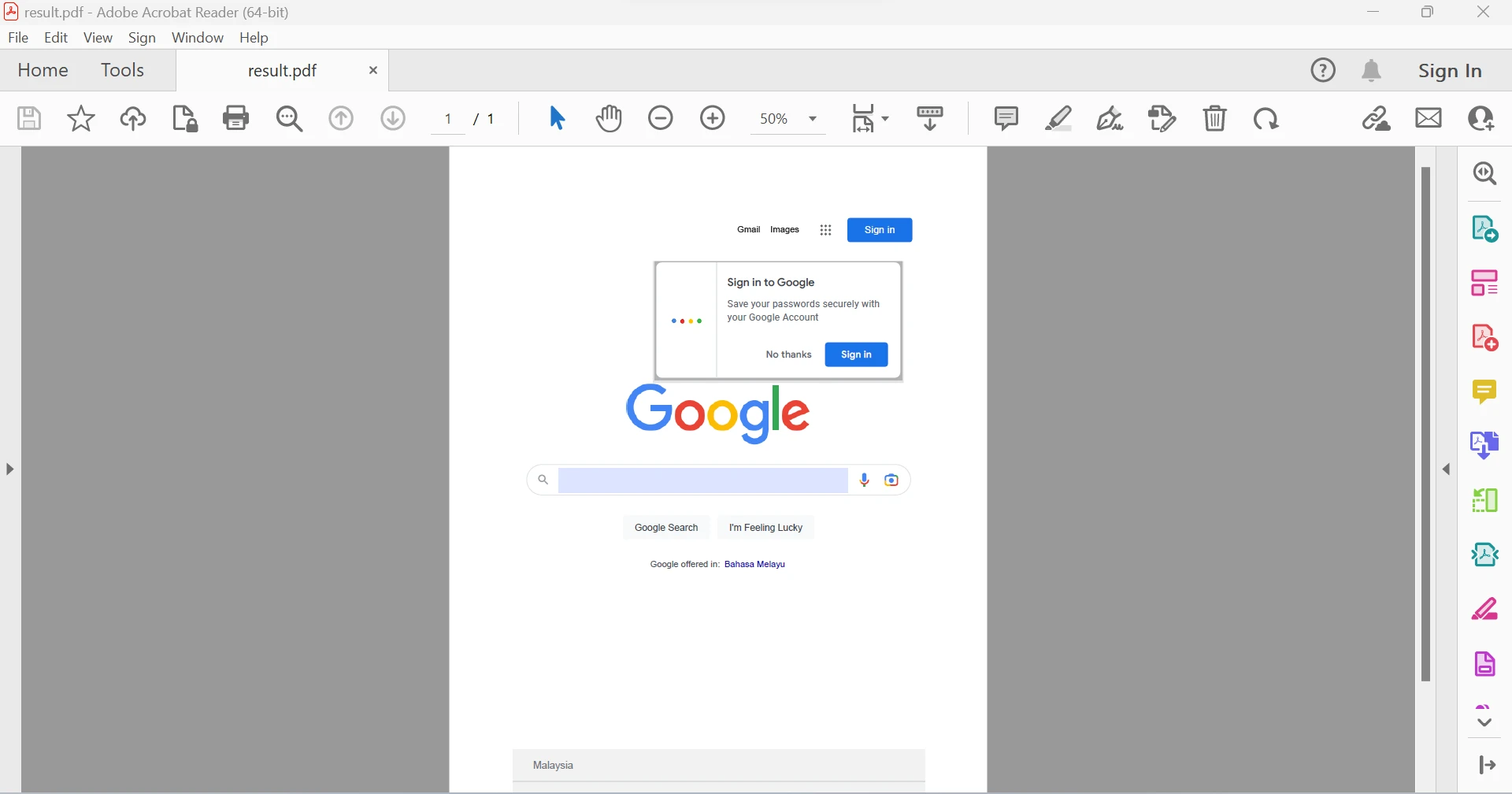 El archivo PDF generado a partir de una URL de Google
4.0 Crear un PDF a partir de cadenas HTML
Las cadenas de HTML se pueden convertir rápidamente en archivos PDF usando la biblioteca API de IronPDF. El siguiente fragmento de código puede convertir cadenas de HTML en documentos y puede traducir cualquier etiqueta HTML en un archivo PDF.
// Create a new instance of the ChromePdfRenderer class
var renderer = new IronPdf.ChromePdfRenderer();

// Convert the specified HTML string to a PDF
var pdf = renderer.RenderHtmlAsPdf("<p>Hello world!!</p>");

// Save the PDF to the specified path
pdf.SaveAs("result.pdf");
// Create a new instance of the ChromePdfRenderer class
var renderer = new IronPdf.ChromePdfRenderer();

// Convert the specified HTML string to a PDF
var pdf = renderer.RenderHtmlAsPdf("<p>Hello world!!</p>");

// Save the PDF to the specified path
pdf.SaveAs("result.pdf");
' Create a new instance of the ChromePdfRenderer class
Dim renderer = New IronPdf.ChromePdfRenderer()
' Convert the specified HTML string to a PDF
Dim pdf = renderer.RenderHtmlAsPdf("<p>Hello world!!</p>")
' Save the PDF to the specified path
pdf.SaveAs("result.pdf")
' Create a new instance of the ChromePdfRenderer class
Dim renderer = New IronPdf.ChromePdfRenderer()

' Convert the specified HTML string to a PDF
Dim pdf = renderer.RenderHtmlAsPdf("<p>Hello world!!</p>")

' Save the PDF to the specified path
pdf.SaveAs("result.pdf")
Este fragmento de código ilustra cómo utilizar la función RenderHtmlAsPdf para convertir texto HTML en PDF. La función que convierte HTML en una cadena acepta tanto código HTML como sea necesario. Luego, el proceso se puede completar rápida y fácilmente utilizando la función SaveAs para guardar el documento.
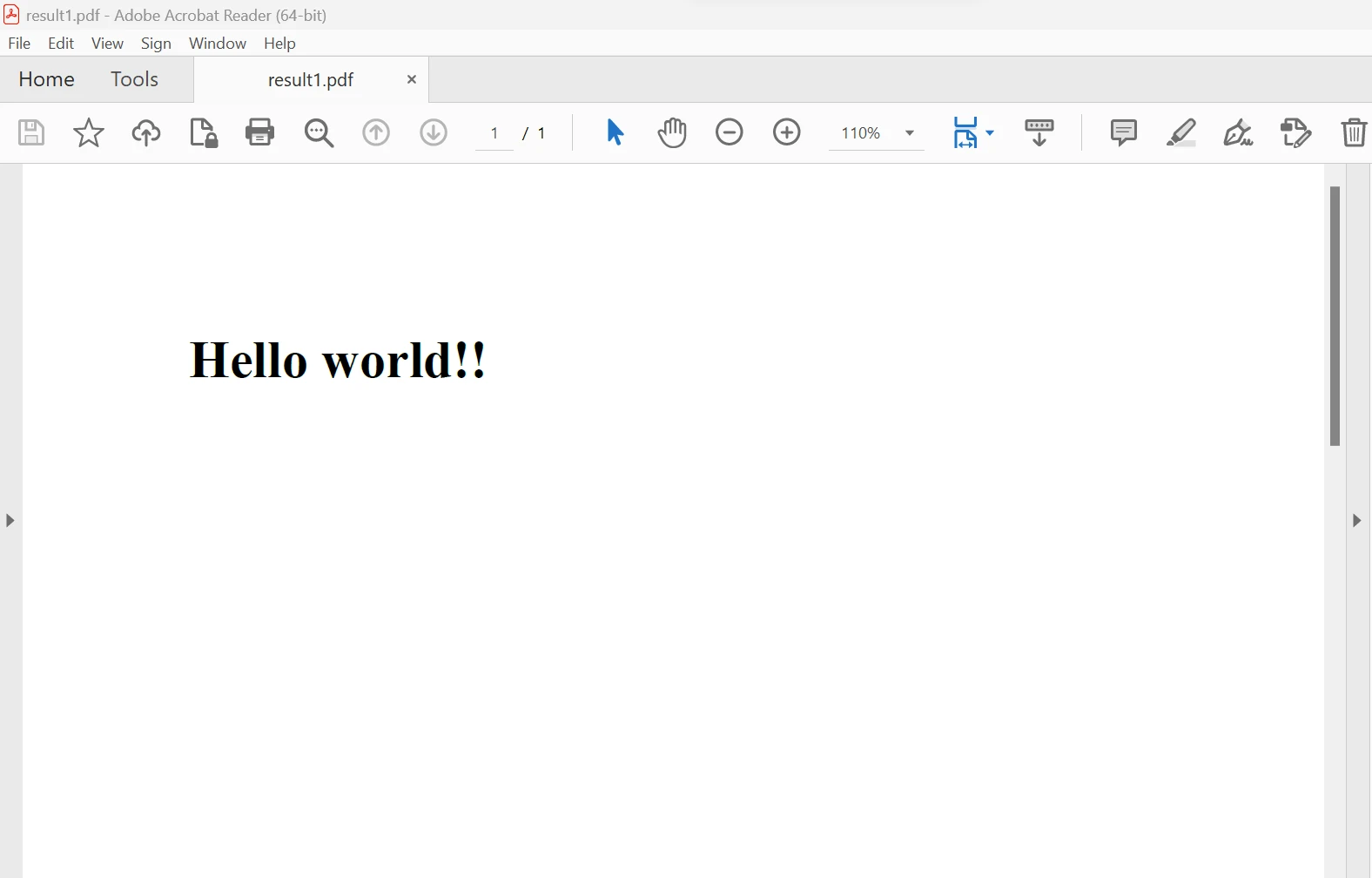 El archivo PDF de salida de una cadena HTML
5.0 Crear un archivo PDF a partir de un archivo HTML
La biblioteca API de IronPDF permite la rápida conversión de archivos HTML en archivos PDF. Cualquier etiqueta HTML se puede convertir en un archivo PDF utilizando el siguiente código de ejemplo.
// Create a new instance of the ChromePdfRenderer class
var renderer = new IronPdf.ChromePdfRenderer();

// Convert the specified HTML file to a PDF
var pdf = renderer.RenderHtmlFileAsPdf("test.html");

// Save the PDF to the specified path
pdf.SaveAs("result.pdf");
// Create a new instance of the ChromePdfRenderer class
var renderer = new IronPdf.ChromePdfRenderer();

// Convert the specified HTML file to a PDF
var pdf = renderer.RenderHtmlFileAsPdf("test.html");

// Save the PDF to the specified path
pdf.SaveAs("result.pdf");
' Create a new instance of the ChromePdfRenderer class
Dim renderer = New IronPdf.ChromePdfRenderer()
' Convert the specified HTML file to a PDF
Dim pdf = renderer.RenderHtmlFileAsPdf("test.html")
' Save the PDF to the specified path
pdf.SaveAs("result.pdf")
' Create a new instance of the ChromePdfRenderer class
Dim renderer = New IronPdf.ChromePdfRenderer()

' Convert the specified HTML file to a PDF
Dim pdf = renderer.RenderHtmlFileAsPdf("test.html")

' Save the PDF to the specified path
pdf.SaveAs("result.pdf")
El texto HTML es el siguiente:
<p style="color:red">Hello world</p>
<p style="color:red">Hello world</p>
HTML
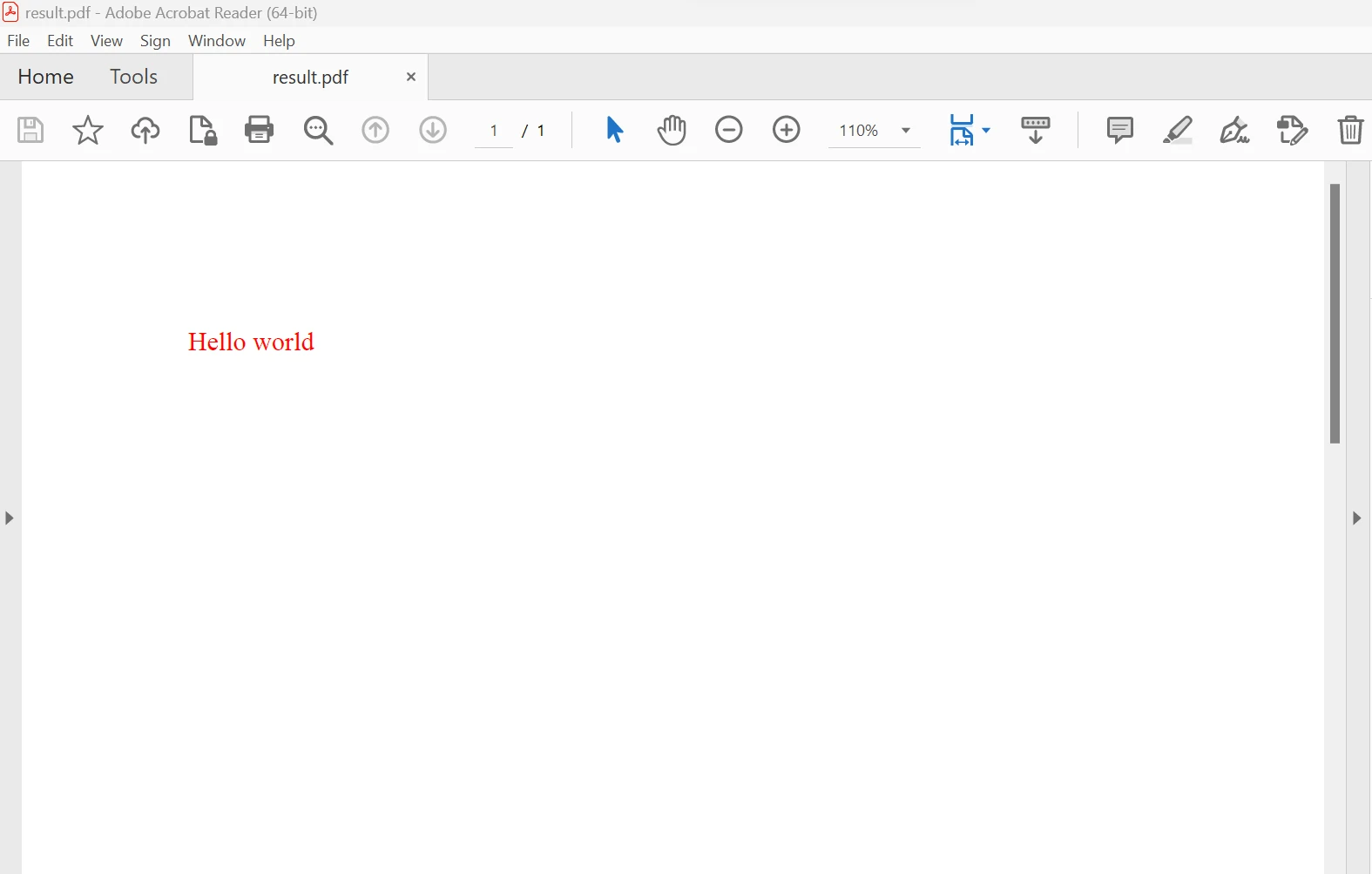 El archivo PDF de salida de un archivo HTML
6.0 Crear un archivo PDF a partir de un archivo de texto enriquecido
La biblioteca API de IronPDF también permite la creación rápida de PDFs a partir de Archivos de Texto Enriquecido (RTFs). El código de ejemplo para convertir RTFs a PDFs se puede utilizar para convertir cualquier número de RTFs en un único archivo PDF. El código se proporciona a continuación.
// Create a new instance of the ChromePdfRenderer class
var renderer = new IronPdf.ChromePdfRenderer();

// Convert the specified RTF file to a PDF
var pdf = renderer.RenderRtfFileAsPdf("test.rtf");

// Save the PDF to the specified path
pdf.SaveAs("result.pdf");
// Create a new instance of the ChromePdfRenderer class
var renderer = new IronPdf.ChromePdfRenderer();

// Convert the specified RTF file to a PDF
var pdf = renderer.RenderRtfFileAsPdf("test.rtf");

// Save the PDF to the specified path
pdf.SaveAs("result.pdf");
' Create a new instance of the ChromePdfRenderer class
Dim renderer = New IronPdf.ChromePdfRenderer()
' Convert the specified RTF file to a PDF
Dim pdf = renderer.RenderRtfFileAsPdf("test.rtf")
' Save the PDF to the specified path
pdf.SaveAs("result.pdf")
' Create a new instance of the ChromePdfRenderer class
Dim renderer = New IronPdf.ChromePdfRenderer()

' Convert the specified RTF file to a PDF
Dim pdf = renderer.RenderRtfFileAsPdf("test.rtf")

' Save the PDF to the specified path
pdf.SaveAs("result.pdf")
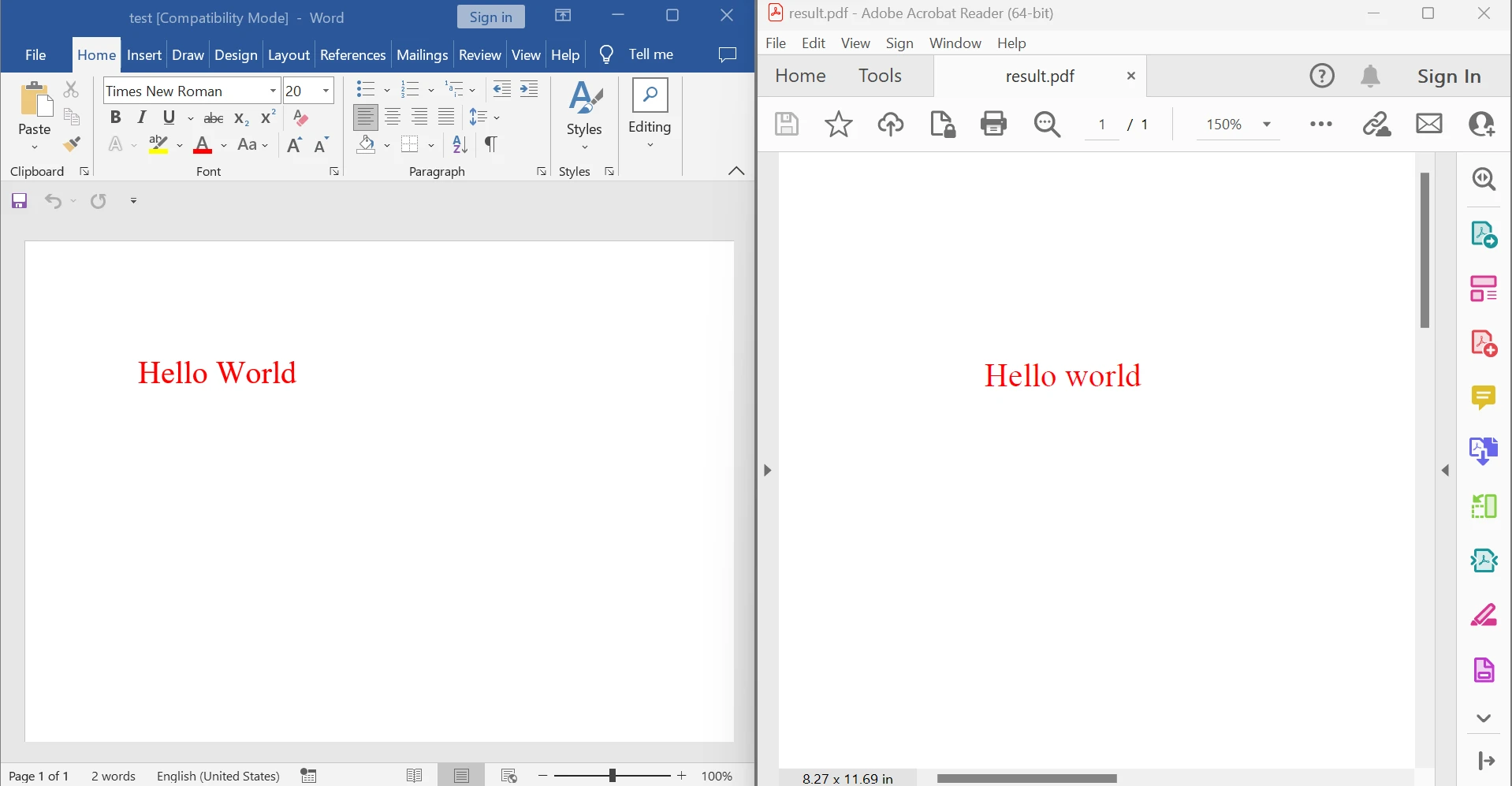 El archivo PDF de salida de un archivo RTF
En la imagen anterior, el lado izquierdo muestra el documento de origen, mientras que el lado derecho muestra el archivo PDF después de la conversión. Adicionalmente, podemos utilizar la cadena RTF para crear un PDF usando el código proporcionado a continuación.
// Create a new instance of the ChromePdfRenderer class
var renderer = new IronPdf.ChromePdfRenderer();

// Convert the specified RTF string to a PDF
var pdf = renderer.RenderRtfStringAsPdf("{\\rtf1...}");

// Save the PDF to the specified path
pdf.SaveAs("result.pdf");
// Create a new instance of the ChromePdfRenderer class
var renderer = new IronPdf.ChromePdfRenderer();

// Convert the specified RTF string to a PDF
var pdf = renderer.RenderRtfStringAsPdf("{\\rtf1...}");

// Save the PDF to the specified path
pdf.SaveAs("result.pdf");
' Create a new instance of the ChromePdfRenderer class
Dim renderer = New IronPdf.ChromePdfRenderer()
' Convert the specified RTF string to a PDF
Dim pdf = renderer.RenderRtfStringAsPdf("{\rtf1...}")
' Save the PDF to the specified path
pdf.SaveAs("result.pdf")
' Create a new instance of the ChromePdfRenderer class
Dim renderer = New IronPdf.ChromePdfRenderer()

' Convert the specified RTF string to a PDF
Dim pdf = renderer.RenderRtfStringAsPdf("{\rtf1...}")

' Save the PDF to the specified path
pdf.SaveAs("result.pdf")
7.0 Crear un archivo PDF a partir de un archivo Markdown
La producción rápida de PDFs desde archivos markdown es posible gracias al módulo API de IronPDF. Cualquier número de archivos Markdown se puede convertir en un archivo PDF utilizando el código de ejemplo para la conversión, mostrado a continuación.
// Create a new instance of the ChromePdfRenderer class
var renderer = new IronPdf.ChromePdfRenderer();

// Convert the specified Markdown file to a PDF
var pdf = renderer.RenderMarkdownFileAsPdf("Markdown.md");

// Save the PDF to the specified path
pdf.SaveAs("Markdown_result.pdf");
// Create a new instance of the ChromePdfRenderer class
var renderer = new IronPdf.ChromePdfRenderer();

// Convert the specified Markdown file to a PDF
var pdf = renderer.RenderMarkdownFileAsPdf("Markdown.md");

// Save the PDF to the specified path
pdf.SaveAs("Markdown_result.pdf");
' Create a new instance of the ChromePdfRenderer class
Dim renderer = New IronPdf.ChromePdfRenderer()
' Convert the specified Markdown file to a PDF
Dim pdf = renderer.RenderMarkdownFileAsPdf("Markdown.md")
' Save the PDF to the specified path
pdf.SaveAs("Markdown_result.pdf")
' Create a new instance of the ChromePdfRenderer class
Dim renderer = New IronPdf.ChromePdfRenderer()

' Convert the specified Markdown file to a PDF
Dim pdf = renderer.RenderMarkdownFileAsPdf("Markdown.md")

' Save the PDF to the specified path
pdf.SaveAs("Markdown_result.pdf")
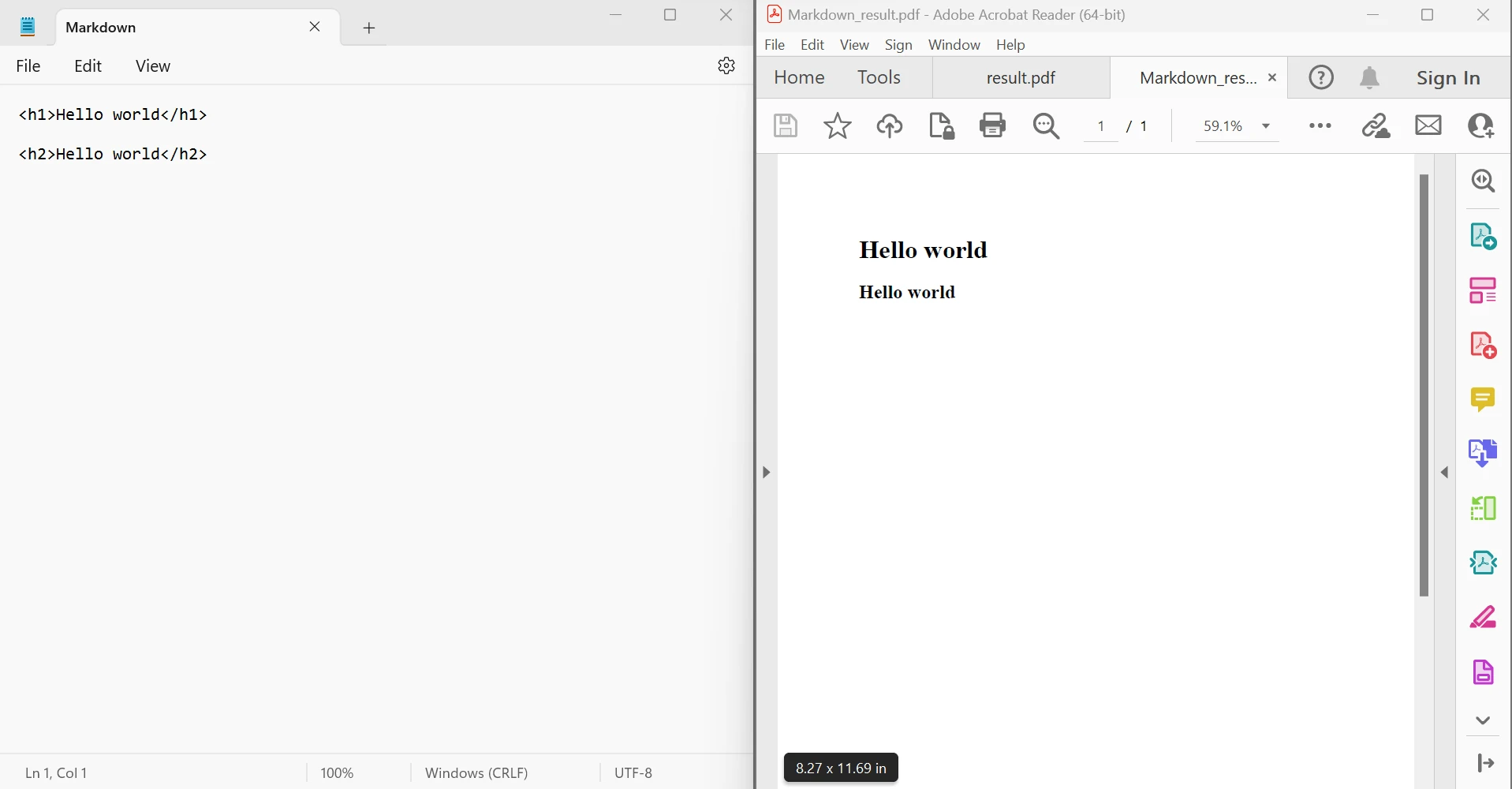 El archivo PDF de salida de un archivo Markdown
Como se muestra en la imagen anterior, el documento de origen está a la izquierda y el archivo PDF convertido está a la derecha. El código proporcionado a continuación permite la conversión de una cadena MD a un PDF. Para más información sobre la conversión HTML usando IronPDF, por favor visite este Tutorial de Conversión de HTML a PDF.
// Create a new instance of the ChromePdfRenderer class
var renderer = new IronPdf.ChromePdfRenderer();

// Convert the specified Markdown string to a PDF
var pdf = renderer.RenderMarkdownStringAsPdf("# Hello world\n\nHello world");

// Save the PDF to the specified path
pdf.SaveAs("Markdown_result.pdf");
// Create a new instance of the ChromePdfRenderer class
var renderer = new IronPdf.ChromePdfRenderer();

// Convert the specified Markdown string to a PDF
var pdf = renderer.RenderMarkdownStringAsPdf("# Hello world\n\nHello world");

// Save the PDF to the specified path
pdf.SaveAs("Markdown_result.pdf");
Imports Microsoft.VisualBasic
' Create a new instance of the ChromePdfRenderer class
Dim renderer = New IronPdf.ChromePdfRenderer()
' Convert the specified Markdown string to a PDF
Dim pdf = renderer.RenderMarkdownStringAsPdf("# Hello world" & vbLf & vbLf & "Hello world")
' Save the PDF to the specified path
pdf.SaveAs("Markdown_result.pdf")
Imports Microsoft.VisualBasic

' Create a new instance of the ChromePdfRenderer class
Dim renderer = New IronPdf.ChromePdfRenderer()

' Convert the specified Markdown string to a PDF
Dim pdf = renderer.RenderMarkdownStringAsPdf("# Hello world" & vbLf & vbLf & "Hello world")

' Save the PDF to the specified path
pdf.SaveAs("Markdown_result.pdf")
Para obtener más información sobre cómo usar la biblioteca API de IronPDF, consulte la documentación para desarrolladores Recurso de Documentación de IronPDF.
8.0 Conclusión
La biblioteca IronPDF proporciona una licencia gratuita para el desarrollo, y dependiendo de las necesidades del desarrollador, varias licencias están disponibles para su compra para su uso en un entorno de producción. El paquete Lite tiene un precio inicial de $999 y no tiene costos continuos. Las licencias vienen con una licencia permanente, una garantía de devolución de dinero de 30 días, un año de soporte y actualizaciones de producto, así como la posibilidad de redistribución para SaaS y OEM. Son compras únicas que se pueden usar para desarrollo, pruebas y producción. IronPDF también ofrece licencias gratuitas adicionales limitadas en el tiempo y licencias gratuitas para la protección de redistribución. Para una visión completa de precios e información de licencias para IronPDF, por favor visite la Página de Información de Licencias de IronPDF.