How To Print PDF Files Using Java

To print PDF files in Java, use the IronPDF library which provides simple methods like printWithoutDialog() for immediate printing and print() for showing print dialog options to users.
-
1Install IronPDF with Maven Central Repository
-
2Copy and run this code snippet.
// Add IronPDF dependency to your Maven pom.xml file // Import IronPDF classes import com.ironsoftware.ironpdf.*; // Load PDF document PdfDocument pdf = new PdfDocument(Paths.get("MyPdf.pdf")); // Print without dialog pdf.printWithoutDialog(); // Or show print dialog pdf.print();Java -
3Deploy to test on your live environment
Start using IronPDF in your project today with a free trial
What Is PDF Printing in Java?
PDF is important in Java applications because it allows developers to create and manipulate PDF documents in a platform-independent manner. The PDF format is widely used for storing and sharing documents, making it essential for Java applications that handle document management or document-based workflows.
PDF printing in Java involves programmatically sending PDF documents to physical or virtual printers. This functionality is essential for business applications that automate document printing workflows, generate invoices, reports, or other printable documents. Java developers often implement PDF printing capabilities in desktop applications, server-side applications, or batch processing systems.
There are several ways to generate and print PDF files in Java. A common approach is to use a library that provides classes for creating and manipulating PDF documents. This guide shows how to use the IronPDF library to generate and print PDF files in Java applications. For comprehensive documentation on IronPDF's capabilities, visit the Get Started Overview.
Minimal Workflow (5 steps)
- Install Java library to print PDF files
- Use
PdfDocumentclass to load existing PDF - Call
printWithoutDialogmethod for immediate printing - Configure printer settings for customized output
- Print PDF with
printmethod to show dialog
What Is IronPDF Java PDF Library?
IronPDF is a Java library used to generate, manipulate, and convert PDF documents. It is based on the IronPDF C# .NET library, which provides similar features for the .NET platform.
IronPDF provides a high-level API for working with PDF documents, allowing developers to work with PDF files without dealing with low-level file format details. It supports common PDF operations such as creating new documents, adding content, formatting text, merging PDF files, and splitting PDF files.
IronPDF supports converting HTML, CSS, and JavaScript code to PDF, making it easy to generate PDF files from web pages or HTML templates. It also offers PDF printing capabilities. The library handles all complexities of PDF generation and printing, providing a simple and intuitive API that Java developers can easily integrate into their applications. Learn more about creating PDFs in Java using IronPDF's comprehensive features.
How Do I Print PDF Documents Using IronPDF Java?
What Are the Prerequisites?
To print PDF files in Java, you need:
- Eclipse IDE or any other Java IDE (IntelliJ IDEA, NetBeans, etc.)
- A Maven Project running in Eclipse or another IDE
- A stable internet connection to install the IronPDF Java library
- Java Development Kit (JDK) 8 or higher installed
- A PDF file for testing purposes
How Do I Install IronPDF Library in Maven Project?
To install IronPDF in a Maven project, add the IronPDF dependency to your project's pom.xml file.
Add the following dependencies to the <dependencies> section of the pom.xml file:
<dependency>
    <groupId>com.ironsoftware</groupId>
    <artifactId>ironpdf</artifactId>
    <version>YOUR_VERSION_HERE</version>
</dependency>After adding the dependencies to the pom.xml file, run the mvn install command in the terminal, or press Ctrl+S to download and install IronPDF in your Maven project. The Maven build system automatically downloads all required dependencies and makes them available for your project.
Before using IronPDF, import the IronPDF classes in the main App.java source file, found in the src/main/java folder.

Package Explorer Tree for IronPDF for Java
Open the "App.java" file and add the IronPDF package using the following import statement:
import com.ironsoftware.ironpdf.*;How Do I Load a PDF in a Java Application?
IronPDF for Java provides a constructor for loading PDF content into the library. Valid arguments include a byte array and a file path. For password-protected documents, a third parameter containing the password can be provided.
The code snippet below loads a PDF located on the filesystem:
// Set the license key for IronPDF
// Learn more about licensing at https://ironpdf.com/java/get-started/license-keys/
License.setLicenseKey("Enter-Your-License");

// Load PDF from the filesystem
PdfDocument pdf = new PdfDocument(Paths.get("MyPdf.pdf"));

// Alternative: Load from byte array
// byte[] pdfBytes = Files.readAllBytes(Paths.get("MyPdf.pdf"));
// PdfDocument pdfFromBytes = new PdfDocument(pdfBytes);

// For password-protected PDFs
// PdfDocument protectedPdf = new PdfDocument(Paths.get("Protected.pdf"), "password123");How Do I Print a PDF Document With Default Settings?
IronPDF provides two ways to print PDF files. The first prints the document immediately using default printer and page settings. Use the printWithoutDialog method to perform this action. This method is useful for automated batch printing scenarios where user interaction is not required.
// Print PDF document using default printer settings without showing a print dialog
// This will immediately send the document to the default system printer
pdf.printWithoutDialog();

// The method returns immediately after sending the print job to the spooler
System.out.println("PDF document sent to default printer");This approach is ideal for server-side applications, automated workflows, or when you want to provide a quick print option without requiring user input. For more advanced printing scenarios, check the printing PDFs example in the documentation.
What Is the Print Dialog?
The second way allows the user to specify printing options before printing. Use the print method to achieve this functionality. This method displays the standard system print dialog, giving users full control over the printing process.
// Display print dialog to let the user specify printing options
// This will show the system print dialog with all available printers
pdf.print();

// The method will wait for user interaction before proceeding
// User can select printer, paper size, orientation, number of copies, etc.The print dialog window appears when this method is invoked, allowing the user to change the printer, set paper size, change the number of copies, and more. This approach is perfect for desktop applications where user control over printing options is desired. Learn more about printing to physical printers with additional options.
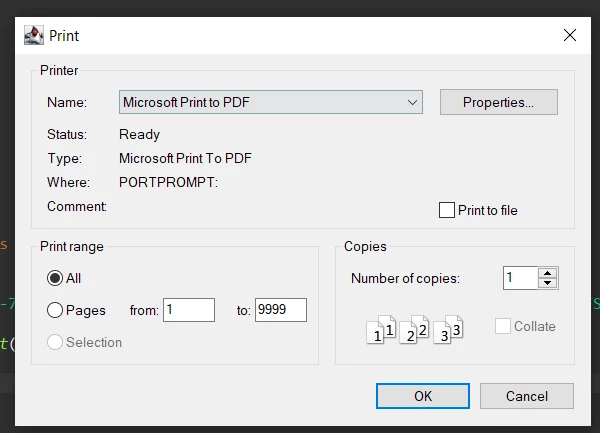
Print dialog shown after running the program using the print() method
What Is the Full Source Code?
The complete source file used in this guide is below:
package IronPDF.ironpdf_java;

// Import statement for IronPDF Java
import com.ironsoftware.ironpdf.*;
import java.awt.print.PrinterException;
import java.io.IOException;
import java.nio.file.Paths;

public class App {
    public static void main(String[] args) throws PrinterException, IOException {
        // Apply your license key
        // Get your license key from https://ironpdf.com/java/get-started/license-keys/
        License.setLicenseKey("Enter-Your-License");

        // Load PDF document from the file system
        PdfDocument pdf = new PdfDocument(Paths.get("MyPdf.pdf"));

        // Option 1: Print the PDF document without displaying a print dialog
        // Uses default printer and settings
        pdf.printWithoutDialog();

        // Option 2: Display the print dialog for the user to configure printing options
        // Allows selection of printer, copies, page range, etc.
        pdf.print();

        // Don't forget to close the document when done
        pdf.close();
    }
}For more detailed information about available printing methods and options, refer to the IronPDF API Reference.
Additional PDF Printing Considerations
When implementing PDF printing in Java applications, consider these important factors:
Error Handling
Always implement proper error handling when printing PDFs. Printers might be offline, out of paper, or experiencing other issues:
try {
    pdf.printWithoutDialog();
} catch (PrinterException e) {
    System.err.println("Printing failed: " + e.getMessage());
    // Handle the error appropriately
}Performance Optimization
For large PDF files or batch printing operations, consider compressing PDFs before printing to reduce memory usage and improve printing speed.
Cross-Platform Compatibility
IronPDF's printing functionality works across different operating systems (Windows, Linux, macOS), but printer configurations and available options may vary between platforms. Always test your printing implementation on the target deployment platform.
Learn more about PDF Printing in Java using the IronPDF library.
Why Should I Use IronPDF for PDF Printing?
IronPDF is a powerful and easy-to-use library for printing PDFs in Java applications. With its comprehensive features and extensive documentation, IronPDF simplifies generating and customizing professional-quality PDFs for printing or sharing. Whether creating invoices, reports, or other documents, IronPDF provides the tools you need.
IronPDF offers straightforward integration with existing Java applications, reliable error handling, and cross-platform compatibility. The library's simple API design allows you to implement PDF printing functionality with just a few lines of code, while still providing access to advanced features when needed.
IronPDF offers a free trial for testing in production. Pricing starts from $999. Give IronPDF a try and see how it can simplify your PDF printing workflow.
Frequently Asked Questions
How can I print PDF files in Java using IronPDF?
To print PDF files in Java using IronPDF, you can use the `printWithoutDialog()` method for direct printing without user interaction, or `print()` to display a print dialog for user input.
What is the main benefit of using IronPDF for Java?
IronPDF is a versatile Java library that allows you to generate, manipulate, and print PDF documents easily. It offers a simple API, cross-platform compatibility, and detailed documentation, making it ideal for Java applications that require PDF handling.
How do I load a PDF document using IronPDF in Java?
You can load a PDF document in IronPDF using the `PdfDocument` class. Load by passing a file path to the constructor, and it also supports loading from byte arrays and handling password-protected PDFs.
Is it possible to show a print dialog when printing PDF documents with IronPDF?
Yes, by using the `print()` method with IronPDF, you can display the system print dialog, allowing users to configure print settings before printing the document.
What prerequisites are required for using IronPDF in a Maven project?
To use IronPDF in a Maven project, you need a Java IDE like Eclipse, IntelliJ, or NetBeans, a Maven project setup, a Java Development Kit (JDK) version 8 or higher, a PDF file for testing, and the IronPDF dependency added to your `pom.xml`.
How do I handle errors while printing PDFs in Java using IronPDF?
IronPDF suggests implementing proper error handling practices, such as using try-catch blocks to handle `PrinterException`, ensuring that your application can manage printer malfunctions or job failures gracefully.
How can I optimize performance during PDF printing in Java applications?
For optimal performance, consider compressing large PDFs to reduce memory usage and speed up printing processes, especially for large batch operations.
Can IronPDF be used on different operating systems?
Yes, IronPDF is compatible across various operating systems like Windows, Linux, and macOS; however, printer configurations and options may vary, so it's advisable to test on the target platform.
What is the licensing model for IronPDF?
IronPDF offers a free trial for production testing, with pricing available starting from the 'liteLicense' option. You can explore their pricing page for more details.
Does IronPDF support converting HTML to PDF?
Yes, IronPDF supports converting HTML, CSS, and JavaScript code directly into PDF documents, making it easy to create PDFs from web pages or HTML templates.

Curtis Chau holds a Bachelor’s degree in Computer Science (Carleton University) and specializes in front-end development with expertise in Node.js, TypeScript, JavaScript, and React. Passionate about crafting intuitive and aesthetically pleasing user interfaces, Curtis enjoys working with modern frameworks and creating well-structured, visually appealing manuals.