using IronPdf;

// Disable local disk access or cross-origin requests
Installation.EnableWebSecurity = true;

// Instantiate Renderer
var renderer = new ChromePdfRenderer();

// Create a PDF from a HTML string using C#
var pdf = renderer.RenderHtmlAsPdf("<h1>Hello World</h1>");

// Export to a file or Stream
pdf.SaveAs("output.pdf");

// Advanced Example with HTML Assets
// Load external html assets: Images, CSS and JavaScript.
// An optional BasePath 'C:\site\assets\' is set as the file location to load assets from
var myAdvancedPdf = renderer.RenderHtmlAsPdf("<img src='icons/iron.png'>", @"C:\site\assets\");
myAdvancedPdf.SaveAs("html-with-assets.pdf");
using IronPdf;// Disable local disk access or cross-origin requestsInstallation.EnableWebSecurity = true;// Instantiate Renderervar renderer = new ChromePdfRenderer();// Create a PDF from a HTML string using C#var pdf = renderer.RenderHtmlAsPdf("<h1>Hello World</h1>");// Export to a file or Streampdf.SaveAs("output.pdf");// Advanced Example with HTML Assets// Load external html assets: Images, CSS and JavaScript.// An optional BasePath 'C:\site\assets\' is set as the file location to load assets fromvar myAdvancedPdf = renderer.RenderHtmlAsPdf("<img src='icons/iron.png'>", @"C:\site\assets\");myAdvancedPdf.SaveAs("html-with-assets.pdf");
PM >Install-Package IronPdf
Install-Package IronPdf
USING IRONPDF
How to Edit a PDF without Adobe (Beginner Tutorial)
# How to Edit a PDF without Adobe (Beginner Tutorial)
Edit PDF files in .NET without Adobe using IronPDF's `ReplaceTextOnPage` method to programmatically find and replace text content. This approach provides cost-effective PDF editing capabilities through simple C# code, eliminating expensive Adobe licensing.
PDFs are commonly used to maintain document formatting across platforms when sharing documents. However, editing PDF files can be challenging without specialized software. While Adobe Acrobat is popular, it can be expensive and offers more features than you might need for basic editing tasks. This tutorial demonstrates how to [edit PDF documents](/tutorials/csharp-edit-pdf-complete-tutorial/) using [**IronPDF**](/), a powerful .NET library providing comprehensive [PDF manipulation capabilities](/features/edit/) including text replacement, [annotation management](/how-to/annotations/), and [form editing](/how-to/edit-forms/).
## What Makes IronPDF a Powerful PDF Editing Solution?
1. **HTML to PDF Conversion:** IronPDF uses a built-in Chrome rendering engine to convert HTML, CSS, and JavaScript into pixel-perfect PDF documents.
2. **Comprehensive PDF Editing:** With IronPDF, you can perform numerous PDF modifications, such as adding headers and footers, inserting watermarks, updating page content, and managing document structure (adding, removing, or merging pages). You can also convert PDF files, add digital signatures, encryption, and form manipulation.
3. **Cross-Platform Compatibility:** IronPDF is compatible across various .NET frameworks, including .NET Core, .NET 8, .NET 7, and older versions. It also supports Windows, macOS, and Linux, making it suitable for applications deployed across different environments.
### Which Key Features Make IronPDF Stand Out?
1. **HTML to PDF Conversion:** Uses a built-in [Chrome rendering engine](/how-to/pixel-perfect-html-to-pdf/) to convert HTML, CSS, and JavaScript into pixel-perfect PDFs. Supports [responsive CSS](/how-to/html-to-pdf-responsive-css/), [custom fonts](/how-to/webfonts-webicons/), and [JavaScript-generated content](/how-to/javascript-to-pdf/).
2. **Comprehensive PDF Editing:** Perform numerous modifications like [adding headers and footers](/how-to/headers-and-footers/), [inserting watermarks](/how-to/custom-watermark/), updating page content, and managing document structure ([adding, copying,](/how-to/add-copy-delete-pages-pdf/) or [merging pages](/how-to/merge-or-split-pdfs/)). Also [convert various file formats to PDF](/tutorials/html-to-pdf/), add [digital signatures](/how-to/signing/), implement [encryption and security settings](/how-to/pdf-permissions-passwords/), and perform [form manipulation](/how-to/create-forms/).
3. **Cross-Platform Compatibility:** Compatible across various .NET frameworks and supports [Windows](/how-to/windows/), [macOS](/how-to/macos/), and [Linux](/get-started/linux/). Suitable for applications deployed across different environments. Also supports deployment to [Azure](/how-to/azure/) and [AWS](/get-started/aws/) cloud platforms.
### Why Choose IronPDF Over Adobe Acrobat?
IronPDF provides a developer-focused experience compared to Adobe Acrobat, with extensive API support for automating PDF generation and editing within .NET applications. Unlike Adobe, which requires manual handling or GUI-based interaction, IronPDF provides programmatic control and integration directly into software solutions. The library includes features for [batch processing](/how-to/async/), [memory-efficient operations](/how-to/pdf-memory-stream/), and [performance optimization](/troubleshooting/ironpdf-performance-assistance/). This makes IronPDF a cost-effective and efficient choice for developers needing scalable PDF operations without Adobe's licensing overhead.
## How Do I Get Started with IronPDF?
### What System Requirements Do I Need?
Before we begin, ensure your system meets these requirements:
* Windows, macOS, or Linux operating system
* .NET Framework 4.6.2 or later, or .NET Core 2.0 or later
* Visual Studio 2017 or later (for Windows users)
For specific platform requirements, review the detailed guides for [Windows installation](/get-started/windows/), [macOS setup](/get-started/macos/), or [Linux configuration](/get-started/linux/). IronPDF also supports [Docker deployments](/get-started/ironpdf-docker/) for containerized applications.
### How Do I Create a Visual Studio Project for PDF Editing?
Let's start by creating a new project in Visual Studio:
1. Open Visual Studio
2. Click on "Create a new project"
3. Select "Console App (.NET Core)" or "Console App (.NET Framework)" based on your preference
4. Choose a name for your project (`e.g`., "PDFEditorTutorial")
5. Select a location to save your project
6. Click "Create"
For developers using other IDEs or frameworks, IronPDF also supports [F# development](/get-started/fsharp-pdf-library-html-to-pdf/) and [VB.NET applications](/get-started/vb-net-pdf/).
### What's the Best Way to Install IronPDF?
Now that we have our project set up, let's install the IronPDF NuGet package:
1. Right-click on your project in the Solution Explorer
2. Select "Manage NuGet Packages"
3. In the "Browse" tab, search for "IronPDF"
4. Click on the IronPDF package by Iron Software
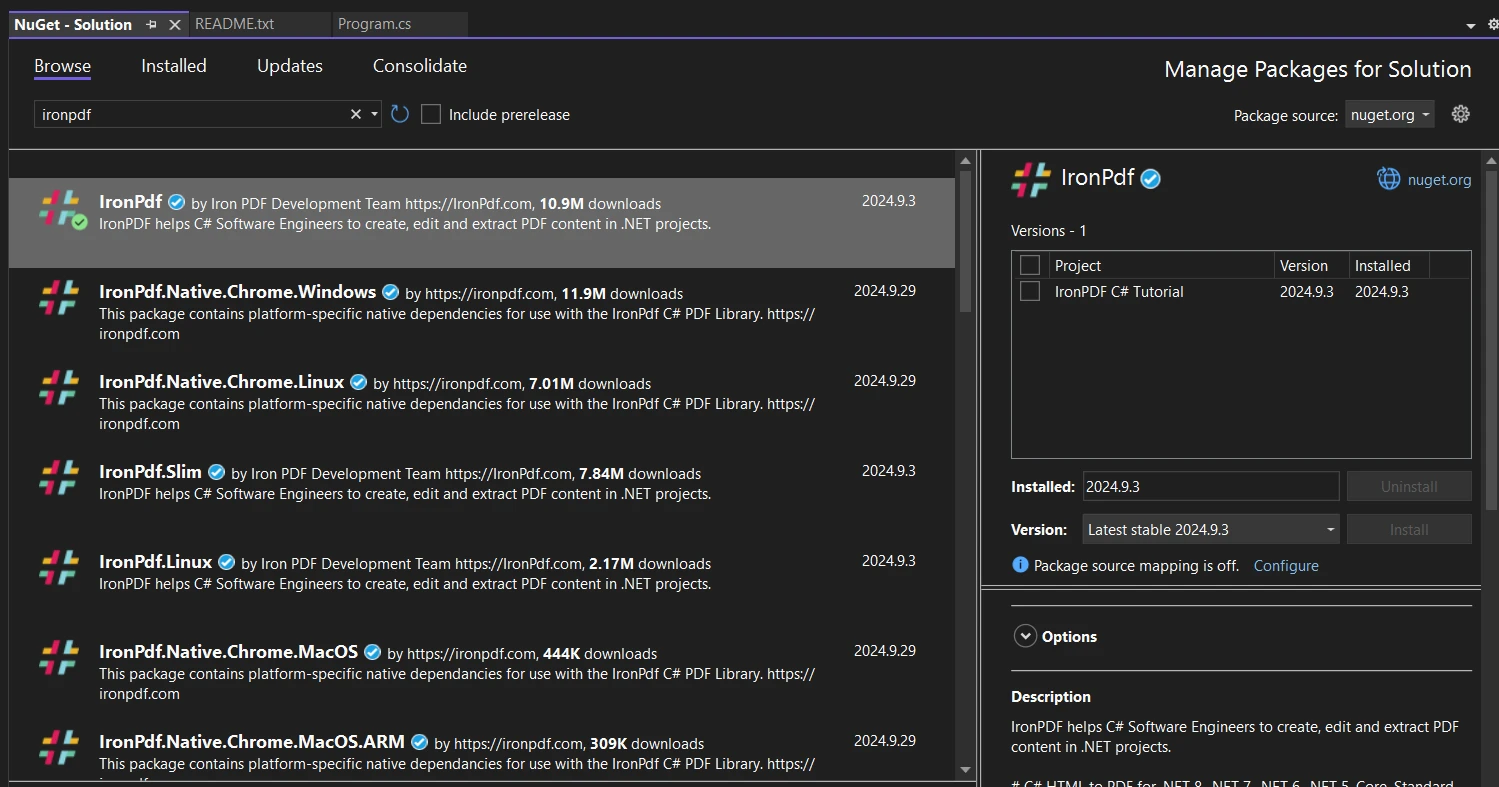
5. Click "Install" and accept any license agreements
Alternatively, install IronPDF using the Package Manager Console:
```shell
:ProductInstall
```
For advanced installation scenarios, refer to the [NuGet packages guide](/get-started/advanced-installation-nuget/) or explore [Windows installer options](/get-started/ironpdf-installer/).
### How Should I Set Up My Development Environment?
With IronPDF installed, we need to set up our development environment:
1. Open your Program.cs file
2. Add the following `using` statement at the top of your file:
```cs
using IronPdf;
```
For production environments, you'll also need to [configure your license key](/how-to/license-keys/). IronPDF offers a [free trial license](/licensing/) for testing and development purposes.
In the next section, we'll learn how to load PDF files and perform basic editing operations using IronPDF.
## How Can I Edit PDF Text with IronPDF?
In this section, we'll walk through the process of editing text in a PDF file using IronPDF. We'll use the `ReplaceTextOnPage` method to replace specific text on a given page. This method is part of IronPDF's comprehensive [text manipulation features](/how-to/find-replace-text/) that enable developers to [extract text](/how-to/extract-text-and-images/), [search for content](/examples/csharp-replace-text-in-pdf/), and modify existing PDF documents programmatically.
### Where Do I Configure the IronPDF License?
First, we need to set up the IronPDF license. This step is crucial for accessing the full capabilities of IronPDF:
```cs
using IronPdf;

License.LicenseKey = "Your-License-Key";
```
Replace this license key with your own if you have one. You can obtain a license from the [IronPDF licensing page](/licensing/) or start with a [free trial](/licensing/). For deployment scenarios, you might want to [store the license key in configuration files](/troubleshooting/license-key-web.config/) rather than hardcoding it.
### How Do I Load an Existing PDF File?
Next, we'll load an existing PDF file:
```cs
var pdf = PdfDocument.FromFile("Sample PDF.pdf");
```
Replace "**Sample PDF.pdf**" with the path to your PDF file. IronPDF supports loading PDFs from various sources including [file paths, streams](/how-to/pdf-memory-stream/), [URLs](/how-to/url-to-pdf/), and even [Azure Blob Storage](/troubleshooting/blob-storage/). The library can handle [encrypted PDFs](/how-to/pdf-permissions-passwords/) and documents with various [PDF version specifications](/how-to/pdf-versions/).
### What Parameters Do I Need for Text Replacement?
We'll set up parameters for our text replacement operation:
```cs
const int pageIndex = 0;
const string oldText = "Vestibulum neque massa, scelerisque sit amet ligula eu, congue molestie mi. Praesent ut";
const string newText = "IronPDF simplifies PDF Creating and Editing in .NET applications.";
```
* `pageIndex`: The page index where we want to replace text (0 for the first page)
* `oldText`: The text we want to replace
* `newText`: The new text that will replace the old text
When working with multi-page documents, you can use methods to [replace text across all pages](/how-to/find-replace-text/) or target specific page ranges. IronPDF also supports [Unicode and international languages](/how-to/utf-8/) for global applications.
### How Do I Replace Text on a Specific Page?
Now, we'll use the `ReplaceTextOnPage` method to perform the text replacement:
```cs
pdf.ReplaceTextOnPage(pageIndex, oldText, newText);
```
This method finds the `oldText` on the specified page and replaces it with the `newText`. For complex scenarios, IronPDF offers additional editing capabilities like [adding annotations](/how-to/annotations/), [applying stamps](/how-to/stamp-text-image/), and [redacting sensitive information](/how-to/redact-text/).
### Where Should I Save the Modified PDF?
Finally, we'll save the modified PDF to a new file:
```cs
pdf.SaveAs("Edited PDF.pdf");
```
Replace "Edited PDF.pdf" with your desired path and filename. IronPDF provides multiple saving options including [saving to memory streams](/how-to/export-save-pdf-csharp/), [creating linearized PDFs](/how-to/linearize-pdf/) for web optimization, and [exporting to different PDF versions](/how-to/pdf-versions/).
### What Does the Complete Code Look Like?
Here's the complete code for editing PDF text with IronPDF:
```cs
using System;
using IronPdf;
class Program
{
static void Main(string[] args)
{
// Set up the IronPDF license
License.LicenseKey = "Your-License-Key";
// Load the existing PDF
var pdf = PdfDocument.FromFile("Sample PDF.pdf");
// Define parameters for text replacement
const int pageIndex = 0;
const string oldText = "Vestibulum neque massa, scelerisque sit amet ligula eu, congue molestie mi. Praesent ut";
const string newText = "IronPDF simplifies PDF Creating and Editing in .NET applications.";
// Replace text on the specified page
pdf.ReplaceTextOnPage(pageIndex, oldText, newText);
// Save the modified PDF
pdf.SaveAs("Edited PDF.pdf");
Console.WriteLine("PDF edited successfully!");
}
}
```
This code demonstrates how to edit PDF text without Adobe using IronPDF. It loads an existing PDF, replaces specific text on the first page, and saves the modified document as a new file. Remember to handle exceptions and add error checking in production environments to make your code more robust. For enhanced error handling, consider implementing [custom logging](/how-to/custom-logging/) and reviewing [troubleshooting guides](/troubleshooting/quick-ironpdf-troubleshooting/).
### What Results Can I Expect from PDF Editing?
To visually demonstrate the effectiveness of our PDF editing using IronPDF, let's compare the before and after images:
#### Before Editing
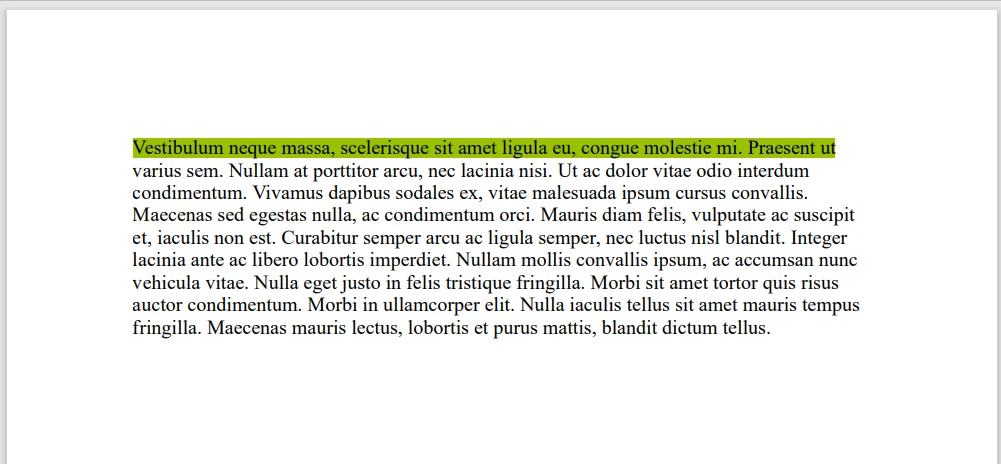
In this image, you can see the original text targeted for replacement: "**Vestibulum neque massa, scelerisque sit amet ligula eu, congue molestie mi. Praesent ut**". The highlighting shows the exact text that will be modified by our code.
#### After Editing
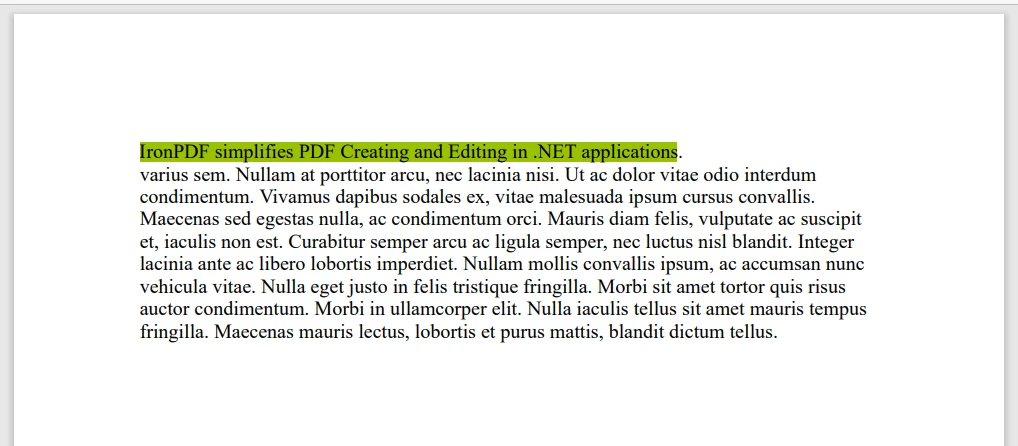
After applying our IronPDF editing code, the targeted text has been successfully replaced with: "**IronPDF simplifies PDF Creating and Editing in .NET applications.**" This comparison demonstrates how IronPDF effectively replaces text within a PDF document while maintaining the formatting and layout of surrounding content. For advanced editing operations, explore features like [drawing text and bitmaps](/how-to/draw-text-and-bitmap/), [managing fonts](/how-to/manage-fonts/), and [transforming PDF pages](/how-to/transform-pdf-pages/).
## What Are the Online Alternatives for Editing PDF Files?
While IronPDF offers powerful programmatic PDF editing capabilities through its comprehensive [API reference](/object-reference/api/), online alternatives are available for users who prefer web-based solutions or need quick PDF edits without coding. Here are two popular options that complement IronPDF's developer-focused approach:
### When Should I Use Google Docs for PDF Editing?
Google Docs is a widely used online word processor that offers basic PDF editing capabilities. While it's not specifically designed for PDF editing like IronPDF's specialized [PDF editing features](/features/edit/), it can be a convenient free option for simple text modifications. However, it lacks the programmatic control and advanced features that IronPDF provides, such as [batch processing](/how-to/parallel/), [metadata management](/how-to/metadata/), and [digital signatures](/tutorials/csharp-pdf-security-complete-tutorial/).
#### How to Edit a PDF File using Google Docs
1. Go to Google Drive and click "New" > "File upload" to upload your PDF
2. Once uploaded, right-click the PDF file and select "Open with" > "Google Docs"
3. Google Docs converts the PDF to an editable document (formatting may not be perfectly preserved)
4. Make your desired edits to the text
5. When finished, go to File > Download > PDF Document to save your edited file
For developers needing precise control over PDF formatting and structure, IronPDF's [HTML to PDF conversion](/tutorials/html-to-pdf/) offers better results than Google Docs' conversion process.
### What Makes PDF.io a Good Alternative?
PDF.io is a free online PDF editor providing various PDF-related tools, including a PDF editor. It offers a user-friendly interface for making basic edits without software installation. However, for enterprise applications requiring [security](/features/secure/), [compliance](/how-to/pdfa/), and automation, IronPDF's programmatic approach provides superior control and reliability.
#### How to Edit a PDF File using PDF.io
1. Visit the PDF.io website and select the "Edit PDF" tool
2. Click "Choose PDF file" and upload your document
3. Use the toolbar to add text, images, or shapes to your PDF
4. To edit existing text, click the "Edit" tool then click on text to modify
5. Make your desired changes
6. When done, click "Apply" then "Download" to save your edited PDF
While these online tools are convenient for quick edits, they don't offer the automation capabilities, [performance optimization](/how-to/ironpdf-2021-chrome-rendering-engine-eap/), or [enterprise-grade security](/troubleshooting/ironpdf-security-cve/) that IronPDF provides for .NET applications.
## Why Should I Choose IronPDF Over Adobe?
IronPDF offers a powerful, developer-friendly solution for editing PDFs without Adobe in .NET environments. It provides robust programmatic control for complex PDF manipulations, outperforming basic online alternatives for advanced tasks like [form creation](/how-to/create-forms/), [PDF compression](/how-to/pdf-compression/), and [multi-threaded generation](/how-to/async/). IronPDF seamlessly integrates with .NET projects through its [comprehensive documentation](/docs/) and enhances document management workflows with features like [PDF/A compliance](/how-to/pdfa/) and [accessibility support](/how-to/pdfua/).
IronPDF offers a [**free trial**](trial-license) with full functionality for testing, along with detailed [demos](/demos/) and [tutorials](/how-to/create-new-pdfs/). Licensing starts at `$liteLicense`, making it a cost-effective choice for businesses needing comprehensive PDF editing capabilities in their applications. For comparison with other solutions, explore how [IronPDF compares to Aspose](/competitors/aspose-vs-ironpdf/), [iText](/competitors/itext-vs-ironpdf/), and [other PDF libraries](/competitors/syncfusion-vs-ironpdf/).
Edit PDF files in .NET without Adobe using IronPDF's ReplaceTextOnPage method to programmatically find and replace text content. This approach provides cost-effective PDF editing capabilities through simple C# code, eliminating expensive Adobe licensing.
PDFs are commonly used to maintain document formatting across platforms when sharing documents. However, editing PDF files can be challenging without specialized software. While Adobe Acrobat is popular, it can be expensive and offers more features than you might need for basic editing tasks. This tutorial demonstrates how to edit PDF documents using IronPDF, a powerful .NET library providing comprehensive PDF manipulation capabilities including text replacement, annotation management, and form editing.
What Makes IronPDF a Powerful PDF Editing Solution?
HTML to PDF Conversion: IronPDF uses a built-in Chrome rendering engine to convert HTML, CSS, and JavaScript into pixel-perfect PDF documents.
Comprehensive PDF Editing: With IronPDF, you can perform numerous PDF modifications, such as adding headers and footers, inserting watermarks, updating page content, and managing document structure (adding, removing, or merging pages). You can also convert PDF files, add digital signatures, encryption, and form manipulation.
Cross-Platform Compatibility: IronPDF is compatible across various .NET frameworks, including .NET Core, .NET 8, .NET 7, and older versions. It also supports Windows, macOS, and Linux, making it suitable for applications deployed across different environments.
Cross-Platform Compatibility: Compatible across various .NET frameworks and supports Windows, macOS, and Linux. Suitable for applications deployed across different environments. Also supports deployment to Azure and AWS cloud platforms.
Why Choose IronPDF Over Adobe Acrobat?
IronPDF provides a developer-focused experience compared to Adobe Acrobat, with extensive API support for automating PDF generation and editing within .NET applications. Unlike Adobe, which requires manual handling or GUI-based interaction, IronPDF provides programmatic control and integration directly into software solutions. The library includes features for batch processing, memory-efficient operations, and performance optimization. This makes IronPDF a cost-effective and efficient choice for developers needing scalable PDF operations without Adobe's licensing overhead.
How Do I Get Started with IronPDF?
What System Requirements Do I Need?
Before we begin, ensure your system meets these requirements:
Windows, macOS, or Linux operating system
.NET Framework 4.6.2 or later, or .NET Core 2.0 or later
In the next section, we'll learn how to load PDF files and perform basic editing operations using IronPDF.
How Can I Edit PDF Text with IronPDF?
In this section, we'll walk through the process of editing text in a PDF file using IronPDF. We'll use the ReplaceTextOnPage method to replace specific text on a given page. This method is part of IronPDF's comprehensive text manipulation features that enable developers to extract text, search for content, and modify existing PDF documents programmatically.
Where Do I Configure the IronPDF License?
First, we need to set up the IronPDF license. This step is crucial for accessing the full capabilities of IronPDF:
using IronPdf;License.LicenseKey = "Your-License-Key";
using IronPdf;

License.LicenseKey = "Your-License-Key";
We'll set up parameters for our text replacement operation:
const int pageIndex = 0;const string oldText = "Vestibulum neque massa, scelerisque sit amet ligula eu, congue molestie mi. Praesent ut";const string newText = "IronPDF simplifies PDF Creating and Editing in .NET applications.";
const int pageIndex = 0;
const string oldText = "Vestibulum neque massa, scelerisque sit amet ligula eu, congue molestie mi. Praesent ut";
const string newText = "IronPDF simplifies PDF Creating and Editing in .NET applications.";
Const pageIndex AsInteger = 0Const oldText AsString = "Vestibulum neque massa, scelerisque sit amet ligula eu, congue molestie mi. Praesent ut"Const newText AsString = "IronPDF simplifies PDF Creating and Editing in .NET applications."
Const pageIndex As Integer = 0
Const oldText As String = "Vestibulum neque massa, scelerisque sit amet ligula eu, congue molestie mi. Praesent ut"
Const newText As String = "IronPDF simplifies PDF Creating and Editing in .NET applications."
pageIndex: The page index where we want to replace text (0 for the first page)
oldText: The text we want to replace
newText: The new text that will replace the old text
Here's the complete code for editing PDF text with IronPDF:
using System;using IronPdf;class Program{ static voidMain(string[] args) { // Set up the IronPDF licenseLicense.LicenseKey = "Your-License-Key"; // Load the existing PDF var pdf = PdfDocument.FromFile("Sample PDF.pdf"); // Define parameters for text replacement const int pageIndex = 0; const string oldText = "Vestibulum neque massa, scelerisque sit amet ligula eu, congue molestie mi. Praesent ut"; const string newText = "IronPDF simplifies PDF Creating and Editing in .NET applications."; // Replace text on the specified page pdf.ReplaceTextOnPage(pageIndex, oldText, newText); // Save the modified PDF pdf.SaveAs("Edited PDF.pdf");Console.WriteLine("PDF edited successfully!"); }}
using System;
using IronPdf;
class Program
{
static void Main(string[] args)
{
// Set up the IronPDF license
License.LicenseKey = "Your-License-Key";
// Load the existing PDF
var pdf = PdfDocument.FromFile("Sample PDF.pdf");
// Define parameters for text replacement
const int pageIndex = 0;
const string oldText = "Vestibulum neque massa, scelerisque sit amet ligula eu, congue molestie mi. Praesent ut";
const string newText = "IronPDF simplifies PDF Creating and Editing in .NET applications.";
// Replace text on the specified page
pdf.ReplaceTextOnPage(pageIndex, oldText, newText);
// Save the modified PDF
pdf.SaveAs("Edited PDF.pdf");
Console.WriteLine("PDF edited successfully!");
}
}
ImportsSystemImportsIronPdfFriend Class ProgramShared Sub Main(ByVal args() AsString) ' Set up the IronPDF licenseLicense.LicenseKey = "Your-License-Key" ' Load the existing PDF Dim pdf = PdfDocument.FromFile("Sample PDF.pdf") ' Define parameters for text replacement Const pageIndex AsInteger = 0 Const oldText AsString = "Vestibulum neque massa, scelerisque sit amet ligula eu, congue molestie mi. Praesent ut" Const newText AsString = "IronPDF simplifies PDF Creating and Editing in .NET applications." ' Replace text on the specified page pdf.ReplaceTextOnPage(pageIndex, oldText, newText) ' Save the modified PDF pdf.SaveAs("Edited PDF.pdf")Console.WriteLine("PDF edited successfully!") End SubEnd Class
Imports System
Imports IronPdf
Friend Class Program
Shared Sub Main(ByVal args() As String)
' Set up the IronPDF license
License.LicenseKey = "Your-License-Key"
' Load the existing PDF
Dim pdf = PdfDocument.FromFile("Sample PDF.pdf")
' Define parameters for text replacement
Const pageIndex As Integer = 0
Const oldText As String = "Vestibulum neque massa, scelerisque sit amet ligula eu, congue molestie mi. Praesent ut"
Const newText As String = "IronPDF simplifies PDF Creating and Editing in .NET applications."
' Replace text on the specified page
pdf.ReplaceTextOnPage(pageIndex, oldText, newText)
' Save the modified PDF
pdf.SaveAs("Edited PDF.pdf")
Console.WriteLine("PDF edited successfully!")
End Sub
End Class
This code demonstrates how to edit PDF text without Adobe using IronPDF. It loads an existing PDF, replaces specific text on the first page, and saves the modified document as a new file. Remember to handle exceptions and add error checking in production environments to make your code more robust. For enhanced error handling, consider implementing custom logging and reviewing troubleshooting guides.
What Results Can I Expect from PDF Editing?
To visually demonstrate the effectiveness of our PDF editing using IronPDF, let's compare the before and after images:
Before Editing
In this image, you can see the original text targeted for replacement: "Vestibulum neque massa, scelerisque sit amet ligula eu, congue molestie mi. Praesent ut". The highlighting shows the exact text that will be modified by our code.
After Editing
After applying our IronPDF editing code, the targeted text has been successfully replaced with: "IronPDF simplifies PDF Creating and Editing in .NET applications." This comparison demonstrates how IronPDF effectively replaces text within a PDF document while maintaining the formatting and layout of surrounding content. For advanced editing operations, explore features like drawing text and bitmaps, managing fonts, and transforming PDF pages.
What Are the Online Alternatives for Editing PDF Files?
While IronPDF offers powerful programmatic PDF editing capabilities through its comprehensive API reference, online alternatives are available for users who prefer web-based solutions or need quick PDF edits without coding. Here are two popular options that complement IronPDF's developer-focused approach:
When Should I Use Google Docs for PDF Editing?
Google Docs is a widely used online word processor that offers basic PDF editing capabilities. While it's not specifically designed for PDF editing like IronPDF's specialized PDF editing features, it can be a convenient free option for simple text modifications. However, it lacks the programmatic control and advanced features that IronPDF provides, such as batch processing, metadata management, and digital signatures.
How to Edit a PDF File using Google Docs
Go to Google Drive and click "New" > "File upload" to upload your PDF
Once uploaded, right-click the PDF file and select "Open with" > "Google Docs"
Google Docs converts the PDF to an editable document (formatting may not be perfectly preserved)
Make your desired edits to the text
When finished, go to File > Download > PDF Document to save your edited file
For developers needing precise control over PDF formatting and structure, IronPDF's HTML to PDF conversion offers better results than Google Docs' conversion process.
What Makes PDF.io a Good Alternative?
PDF.io is a free online PDF editor providing various PDF-related tools, including a PDF editor. It offers a user-friendly interface for making basic edits without software installation. However, for enterprise applications requiring security, compliance, and automation, IronPDF's programmatic approach provides superior control and reliability.
How to Edit a PDF File using PDF.io
Visit the PDF.io website and select the "Edit PDF" tool
Click "Choose PDF file" and upload your document
Use the toolbar to add text, images, or shapes to your PDF
To edit existing text, click the "Edit" tool then click on text to modify
Make your desired changes
When done, click "Apply" then "Download" to save your edited PDF
While these online tools are convenient for quick edits, they don't offer the automation capabilities, performance optimization, or enterprise-grade security that IronPDF provides for .NET applications.
Why Should I Choose IronPDF Over Adobe?
IronPDF offers a powerful, developer-friendly solution for editing PDFs without Adobe in .NET environments. It provides robust programmatic control for complex PDF manipulations, outperforming basic online alternatives for advanced tasks like form creation, PDF compression, and multi-threaded generation. IronPDF seamlessly integrates with .NET projects through its comprehensive documentation and enhances document management workflows with features like PDF/A compliance and accessibility support.
IronPDF offers a free trial with full functionality for testing, along with detailed demos and tutorials. Licensing starts at $999, making it a cost-effective choice for businesses needing comprehensive PDF editing capabilities in their applications. For comparison with other solutions, explore how IronPDF compares to Aspose, iText, and other PDF libraries.
Curtis Chau holds a Bachelor’s degree in Computer Science (Carleton University) and specializes in front-end development with expertise in Node.js, TypeScript, JavaScript, and React. Passionate about crafting intuitive and aesthetically pleasing user interfaces, Curtis enjoys working with modern frameworks and creating well-structured, visually appealing manuals.