



已更新 2026年4月23日
简化 .NET 与 Microsoft.Extensions.AI 的 LLM 集成
AI正在改变软件开发,但将大型语言模型(LLM)集成到.NET中直到现在一直很复杂。通过IronPdf.AI,将AI集成更进一步,该产品为.NET应用程序带来了OpenAI驱动的PDF解析、数据提取和内容摘要。
阅读更多

排序是任何编程语言中的基本操作,C#中的OrderBy方法是一个强大的工具,用于排列集合中的元素。 无论是处理数组、列表,还是其他可枚举结构,了解如何利用OrderBy可以大大提高代码的可读性和功能性。
在本文的后面部分,我们将介绍来自Iron Software的IronPDF库,以及如何使用LINQ的OrderBy方法和IronPDF生成格式化和排序的PDF。
OrderBy 方法是 C# 中 LINQ (Language-Integrated Query) 库的一部分,专门用于升序排序元素; 由于这是排序数据的默认方式,因此不需要升序关键字。
在C#中,可以通过方法语法或查询语法应用这种方法。 我们将使用方法语法,因为它更直接:
var sortedCollection = collection.OrderBy(item => item.OrderByProperty);Dim sortedCollection = collection.OrderBy(Function(item) item.OrderByProperty)这里,collection 是您想要排序的 IEnumerable 源集合,OrderByProperty 是您想要排序元素的属性或表达式。 OrderBy 中的 lambda 表达式指定了排序标准。
要按降序排序,您可以使用方法语法中的 OrderByDescending 方法:
var sortedCollectionDesc = collection.OrderByDescending(item => item.OrderByProperty);Dim sortedCollectionDesc = collection.OrderByDescending(Function(item) item.OrderByProperty)在实际场景中,您经常需要根据多个标准对集合进行排序。 OrderBy 通过链接多个 ThenBy 或 ThenByDescending 调用来实现这一点:
var multiSortedCollection = collection
    .OrderBy(item => item.OrderByProperty1)
.ThenByDescending(item => item.OrderByProperty2);Dim multiSortedCollection = collection.OrderBy(Function(item) item.OrderByProperty1).ThenByDescending(Function(item) item.OrderByProperty2)在此示例中,集合首先按 OrderByProperty1 升序排序。 然后,对于具有相同 OrderByProperty1 值的元素,按 OrderByProperty2 降序排序。
对于更复杂的排序需求,您可以使用自定义比较器。 OrderBy 方法允许您传递一个 IComparer<t> 实现,如以下示例所示:
var customSortedCollection = collection.OrderBy(item => item.Property, new CustomComparer());Dim customSortedCollection = collection.OrderBy(Function(item) item.Property, New CustomComparer())这里,CustomComparer 是一个实现 IComparer<t> 接口的类,提供用于比较元素的自定义逻辑。
using System;
using System.Linq;
using System.Collections.Generic;

class Program
{
    static void Main()
    {
        List<int> numbers = new List<int> { 5, 2, 8, 1, 7 };
        var sortedNumbers = numbers.OrderBy(num => num);
        Console.WriteLine("Sorted Numbers:");
        foreach (var number in sortedNumbers)
        {
            Console.WriteLine(number);
        }
    }
}Imports System
Imports System.Linq
Imports System.Collections.Generic
Friend Class Program
Shared Sub Main()
Dim numbers As New List(Of Integer) From {5, 2, 8, 1, 7}
Dim sortedNumbers = numbers.OrderBy(Function(num) num)
Console.WriteLine("Sorted Numbers:")
For Each number In sortedNumbers
Console.WriteLine(number)
Next number
End Sub
End Class在此示例中,使用 OrderBy 将整数列表按升序排序。
using System;
using System.Linq;
using System.Collections.Generic;

class Program
{
    static void Main()
    {
        List<string> names = new List<string> { "Alice", "Charlie", "Bob", "David" };
        var sortedNames = names.OrderBy(name => name);
        Console.WriteLine("Sorted Names:");
        foreach (var name in sortedNames)
        {
            Console.WriteLine(name);
        }
    }
}Imports System
Imports System.Linq
Imports System.Collections.Generic
Friend Class Program
Shared Sub Main()
Dim names As New List(Of String) From {"Alice", "Charlie", "Bob", "David"}
Dim sortedNames = names.OrderBy(Function(name) name)
Console.WriteLine("Sorted Names:")
For Each name In sortedNames
Console.WriteLine(name)
Next name
End Sub
End Class此示例演示了按字母升序排序字符串列表。
using System;
using System.Linq;
using System.Collections.Generic;

class Person
{
    public string FirstName { get; set; }
    public string LastName { get; set; }
    public int Age { get; set; }
}

class Program
{
    static void Main()
    {
        List<Person> people = new List<Person>
        {
            new Person { FirstName = "John", LastName = "Doe", Age = 30 },
            new Person { FirstName = "Alice", LastName = "Smith", Age = 25 },
            new Person { FirstName = "Bob", LastName = "Johnson", Age = 35 }
        };
        var sortedPeople = people.OrderBy(person => person.Age);
        Console.WriteLine("Sorted People by Age:");
        foreach (var person in sortedPeople)
        {
            Console.WriteLine($"{person.FirstName} {person.LastName}, Age: {person.Age}");
        }
    }
}Imports System
Imports System.Linq
Imports System.Collections.Generic
Friend Class Person
Public Property FirstName() As String
Public Property LastName() As String
Public Property Age() As Integer
End Class
Friend Class Program
Shared Sub Main()
Dim people As New List(Of Person) From {
New Person With {
.FirstName = "John",
.LastName = "Doe",
.Age = 30
},
New Person With {
.FirstName = "Alice",
.LastName = "Smith",
.Age = 25
},
New Person With {
.FirstName = "Bob",
.LastName = "Johnson",
.Age = 35
}
}
Dim sortedPeople = people.OrderBy(Function(person) person.Age)
Console.WriteLine("Sorted People by Age:")
For Each person In sortedPeople
Console.WriteLine($"{person.FirstName} {person.LastName}, Age: {person.Age}")
Next person
End Sub
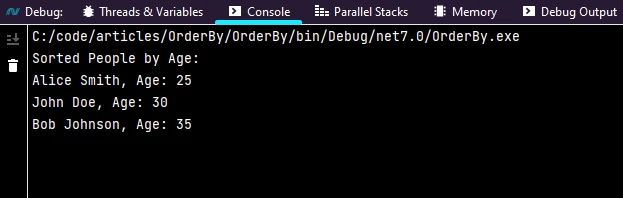
End Class在此示例中,自定义 Person 对象列表基于 Age 属性按升序排序。
以下输出在控制台中可见:
处理字符串属性时,您可能希望确保不区分大小写的排序:
var sortedPeopleByName = people.OrderBy(person => person.LastName, StringComparer.OrdinalIgnoreCase);Dim sortedPeopleByName = people.OrderBy(Function(person) person.LastName, StringComparer.OrdinalIgnoreCase)此示例使用 StringComparer.OrdinalIgnoreCase 进行基于 LastName 属性的不区分大小写排序。
虽然LINQ提供了简洁的方式来排序集合,但考虑性能影响尤其在处理大型数据集时很重要。 对于性能关键的场景,您可能会探索使用 List<t>.Sort 方法进行就地排序等替代方案。
在C# PDF库中探索IronPDF的功能,这有助于读取和生成PDF文档。 它可以轻松地将带有样式信息的格式化文档转换为PDF。 IronPDF可以从HTML字符串生成PDF,或从URL下载HTML然后生成PDF。
IronPDF在将HTML转换为PDF时表现出色,保留所有布局和样式。 它可以从各种网页内容(如报告、发票和文档)生成PDF。 该工具可处理HTML文件、URL和HTML字符串以创建PDF文件。
using IronPdf;

class Program
{
    static void Main(string[] args)
    {
        var renderer = new ChromePdfRenderer();

        // 1. Convert HTML String to PDF
        var htmlContent = "<h1>Hello, IronPDF!</h1><p>This is a PDF from an HTML string.</p>";
        var pdfFromHtmlString = renderer.RenderHtmlAsPdf(htmlContent);
        pdfFromHtmlString.SaveAs("HTMLStringToPDF.pdf");

        // 2. Convert HTML File to PDF
        var htmlFilePath = "path_to_your_html_file.html"; // Specify the path to your HTML file
        var pdfFromHtmlFile = renderer.RenderHtmlFileAsPdf(htmlFilePath);
        pdfFromHtmlFile.SaveAs("HTMLFileToPDF.pdf");

        // 3. Convert URL to PDF
        var url = "http://ironpdf.com"; // Specify the URL
        var pdfFromUrl = renderer.RenderUrlAsPdf(url);
        pdfFromUrl.SaveAs("URLToPDF.pdf");
    }
}Imports IronPdf
Friend Class Program
Shared Sub Main(ByVal args() As String)
Dim renderer = New ChromePdfRenderer()
' 1. Convert HTML String to PDF
Dim htmlContent = "<h1>Hello, IronPDF!</h1><p>This is a PDF from an HTML string.</p>"
Dim pdfFromHtmlString = renderer.RenderHtmlAsPdf(htmlContent)
pdfFromHtmlString.SaveAs("HTMLStringToPDF.pdf")
' 2. Convert HTML File to PDF
Dim htmlFilePath = "path_to_your_html_file.html" ' Specify the path to your HTML file
Dim pdfFromHtmlFile = renderer.RenderHtmlFileAsPdf(htmlFilePath)
pdfFromHtmlFile.SaveAs("HTMLFileToPDF.pdf")
' 3. Convert URL to PDF
Dim url = "http://ironpdf.com" ' Specify the URL
Dim pdfFromUrl = renderer.RenderUrlAsPdf(url)
pdfFromUrl.SaveAs("URLToPDF.pdf")
End Sub
End ClassIronPDF可以使用NuGet包管理器控制台或使用Visual Studio包管理器安装。
您还可以通过在搜索栏中搜索"IronPDF",使用NuGet包管理器安装IronPDF。

以下是使用HTML字符串和IronPDF生成器生成PDF报告的代码:
// See https://aka.ms/new-console-template for more information

using IronPdf;
using System;
using System.Collections.Generic;
using System.Linq;

class Person
{
    public string FirstName { get; set; }
    public string LastName { get; set; }
    public int Age { get; set; }
}

class Program
{
    static void Main()
    {
        List<Person> people = new List<Person>
        {
            new Person { FirstName = "John", LastName = "Doe", Age = 30 },
            new Person { FirstName = "Alice", LastName = "Smith", Age = 25 },
            new Person { FirstName = "Bob", LastName = "Johnson", Age = 35 }
        };

        // Sort people by age
        var sortedPeople = people.OrderBy(person => person.Age);

        string name = "Sam";
        var count = people.Count;

        // Generate an HTML string
        string content = $@"<!DOCTYPE html>
<html>
<body>
<h1>Hello, {name}!</h1>
<p>You have {count} people sorted by Age.</p>
" + string.Join("\n", sortedPeople.Select(person => $"{person.FirstName} {person.LastName}, Age: {person.Age}"))
+ @"
</body>
</html>";

        // Create a new PDF document and save it
        var pdfDocument = new ChromePdfRenderer();
        pdfDocument.RenderHtmlAsPdf(content).SaveAs("personByAge.pdf");
    }
}' See https://aka.ms/new-console-template for more information
Imports IronPdf
Imports System
Imports System.Collections.Generic
Imports System.Linq
Class Person
Public Property FirstName As String
Public Property LastName As String
Public Property Age As Integer
End Class
Class Program
Shared Sub Main()
Dim people As New List(Of Person) From {
New Person With {.FirstName = "John", .LastName = "Doe", .Age = 30},
New Person With {.FirstName = "Alice", .LastName = "Smith", .Age = 25},
New Person With {.FirstName = "Bob", .LastName = "Johnson", .Age = 35}
}
' Sort people by age
Dim sortedPeople = people.OrderBy(Function(person) person.Age)
Dim name As String = "Sam"
Dim count = people.Count
' Generate an HTML string
Dim content As String = $"<!DOCTYPE html>
<html>
<body>
<h1>Hello, {name}!</h1>
<p>You have {count} people sorted by Age.</p>
" & String.Join(vbLf, sortedPeople.Select(Function(person) $"{person.FirstName} {person.LastName}, Age: {person.Age}")) & "
</body>
</html>"
' Create a new PDF document and save it
Dim pdfDocument As New ChromePdfRenderer()
pdfDocument.RenderHtmlAsPdf(content).SaveAs("personByAge.pdf")
End Sub
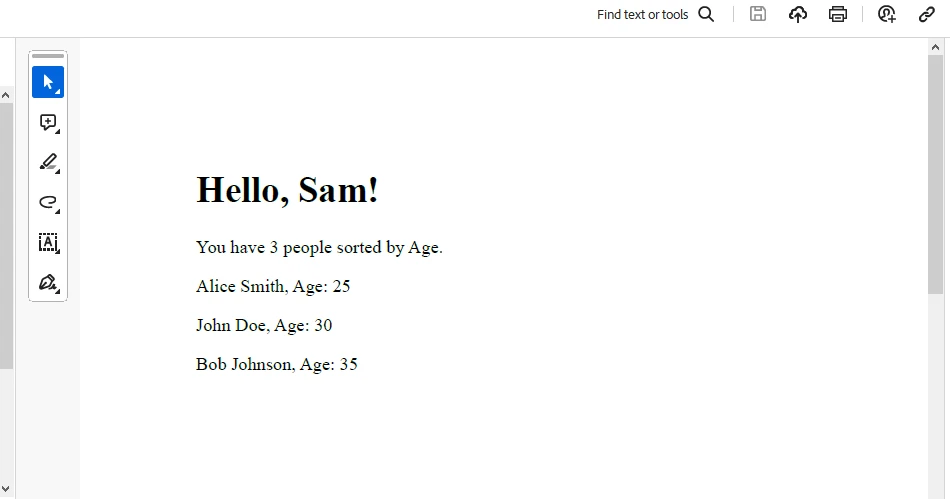
End Class在这里,我们首先从 sortedPeople 生成一个 HTML 字符串,按升序排序,并为报告所需的所有格式进行设置。 然后我们用IronPDF生成PDF文档。 我们使用 RenderHtmlAsPdf 方法将 HTML 字符串转换为 PDF 文档。
PDF中可用以下输出:
可以从IronPDF试用许可证获取试用密钥。 该密钥需要放在appsettings.json中。
"IronPdf.LicenseKey": "your license key"提供您的电子邮件以获取试用许可证。
C#中的OrderBy方法是一个可根据各种标准排序集合的多功能工具。 无论您是按升序还是降序排序,按单个标准或多个标准,还是使用自定义比较器,掌握OrderBy可以显著提高代码的清晰度和效率。
与用于生成PDF文档的IronPDF库结合使用,是生成格式优美且排序集合作为文档的完美组合。

Jacob Mellor 是 Iron Software 的首席技术官,也是一位开创 C# PDF 技术的有远见的工程师。作为 Iron Software 核心代码库的原始开发者,他从公司成立之初就开始塑造公司的产品架构,与首席执行官 Cameron Rimington 一起将公司转变为一家拥有 50 多名员工的公司,为 NASA、特斯拉和全球政府机构提供服务。

IronPDF 是 IRONSUITE的一部分
10 个 .NET API 产品用于您的办公文档

当您需要PDF看起来像HTML时,速度快。


