使用IRONPDF 如何在.NET MAUI中嵌入文本显示PDF Curtis Chau 已更新:2026年1月21日 下载 IronPDF NuGet 下载 DLL 下载 Windows 安装程序 免费试用 LLM副本 LLM副本 将页面复制为 Markdown 格式,用于 LLMs 在 ChatGPT 中打开 向 ChatGPT 咨询此页面 在双子座打开 向 Gemini 询问此页面 在 Grok 中打开 向 Grok 询问此页面 打开困惑 向 Perplexity 询问有关此页面的信息 分享 在 Facebook 上分享 分享到 X(Twitter) 在 LinkedIn 上分享 复制链接 电子邮件文章 了解如何使用IronPDF在.NET MAUI应用程序中从 PDF 文件中提取和显示嵌入文本。 这个强大的 C# 库使你能够读取 PDF 内容,只需几行代码即可将其呈现在跨平台应用程序中。 .NET Multi-platform App UI (MAUI) 简化了多平台应用程序的开发。 通过 Xamarin.Forms 的这种演进,您可以从单个项目创建适用于 Android、iOS、macOS 和 Windows 的应用程序。 PDF 文件以保留字体、图像和布局而著称,通常使用该技术进行管理。 IronPDF库提供了强大的PDF处理功能。 您可以利用IronPDF轻松处理嵌入式文本,简化生成和操作 PDF 文件的过程,同时保持默认设置的一致性渲染。 什么是PDF嵌入式文本和字体嵌入? PDF 嵌入式文本是指嵌入在 PDF 文件中的文本实体。它确保在包括 Adobe 在内的 PDF 查看器应用程序中保持一致性和准确的渲染效果。 通过将字体嵌入PDF 文档中,无论查看器应用程序如何,也无论查看器的设备上是否安装了特定字体,都能保留正确的字体。 嵌入字体可能会增加文件大小,但对于保持原始文档的外观至关重要。 Adobe PDF 设置通常决定字体是否嵌入。 PDF压缩技术可以帮助在嵌入字体时减小文件大小。 PDF 文件中嵌入的字体有三种类型: 1.嵌入式字体:整个字体嵌入到文档中。 2.嵌入字体子集:仅嵌入原始文档中使用的字体的子集。 3.无嵌入字体:文档中未嵌入任何字体。 在 Adobe Acrobat 中,您可以通过检查文档属性来验证字体嵌入情况。 默认情况下,字体嵌入在 PDF 文件中。 但是,可以使用 Adobe Acrobat Pro 或IronPDF 的字体管理功能等工具来修改这些设置。 "扁平化 PDF"包含所有嵌入字体,使其成为一个独立的文件,并确保在所有系统上呈现一致的外观。 IronPDF支持将 PDF 文档展平,以确保渲染效果一致。 IronPDF C# 是什么? IronPDF Documentation是一个功能强大的 C# PDF 库,允许您在.NET应用程序中生成、读取和编辑 PDF 文件。 您可以使用IronPDF从 HTML 生成 PDF 文件。 一项关键功能是处理PDF文件中的嵌入式文本。 将字体嵌入 PDF 中,即使在没有原始字体的系统上查看,也能保持文档的原始外观。 让我们来探讨如何在.NET MAUI中使用IronPDF显示嵌入式文本。 IronPDF提供强大的文本提取功能,可用于以编程方式处理 PDF 内容。 无论您需要在 C# 中解析 PDF ,还是将 PDF 内容转换为其他格式, IronPDF都提供了必要的工具。 .NET MAUI:微软的统一 UI 工具包,允许您使用单个共享代码库为 Android、iOS、macOS 和 Windows 创建应用程序。 您可以从微软网站下载 .NET MAUI。 Visual Studio 2022(或更高版本):功能强大且用户友好的.NET编程集成开发环境 (IDE)。 您可以从 Microsoft 网站下载 Visual Studio。确保在 Visual Studio 2022 上安装了 .NET MAUI 工作负载。 IronPDF库:这是一个用于.NET的 PDF 处理库,我们将使用它来与 PDF 文件进行交互。 您可以通过 NuGet 安装 IronPDF,NuGet 是微软开发平台的软件包管理器。 Adobe PDF 文件:为了本教程的需要,我们需要一个 PDF 文件。 开始之前,请确保您已满足以下要求: .NET MAUI :微软用于创建跨平台应用程序的统一用户界面工具包。可从微软网站下载。 Visual Studio 2022(或更高版本) :功能强大的.NET编程 IDE,已安装.NET MAUI工作负载。 IronPDF库:通过NuGet包管理器安装。 了解IronPDF NuGet包。 PDF 文件:任何用于测试目的的 PDF 文件。 针对特定平台的设置: Windows: IronPDF Windows 安装指南 macOS: macOS 安装指南 Linux: Linux 安装说明 如何创建.NET MAUI应用程序? 请按照以下步骤创建新的 .NET MAUI 应用程序: 启动 Visual Studio 2022:启动后,导航至"文件" > "新建" > "项目" 。 在项目模板窗口中,选择 .NET MAUI 应用程序,然后单击 下一步。 Visual Studio 的"新建项目"对话框显示了各种.NET MAUI项目模板,包括.NET MAUI应用程序、 .NET MAUI Blazor应用程序和.NET MAUI类库选项。 图 1:Visual Studio 新建项目对话框,其中突出显示了.NET MAUI模板,显示了创建新的.NET MAUI应用程序的第一步。 给你的项目命名:在下一个窗口中,你需要给你的项目命名。 让我们将其命名为 IronPDF_Read_and_View。 选择保存项目的位置,然后单击 下一步。 图 2:配置项目 - 设置新的.NET MAUI应用程序,集成IronPDF以实现跨平台 PDF 查看功能。 选择框架:从下拉列表中选择.NET Framework 。为确保流程顺畅,请选择最新版本的.NET Framework ,然后单击"创建"按钮。 Visual Studio 项目创建向导,显示.NET MAUI应用程序配置,已选择.NET 7.0 框架,并提供 Android、iOS、Mac Catalyst、macOS、MAUI、Tizen 和 Windows 的平台选项。 图 3:为新的.NET MAUI应用程序选择.NET Framework版本和目标平台 如何安装 IronPdf? 创建.NET MAUI应用程序后,安装IronPDF库: 1.打开NuGet程序包管理器:导航至"工具" > "NuGet程序包管理器" > "管理解决方案的NuGet程序包" 。 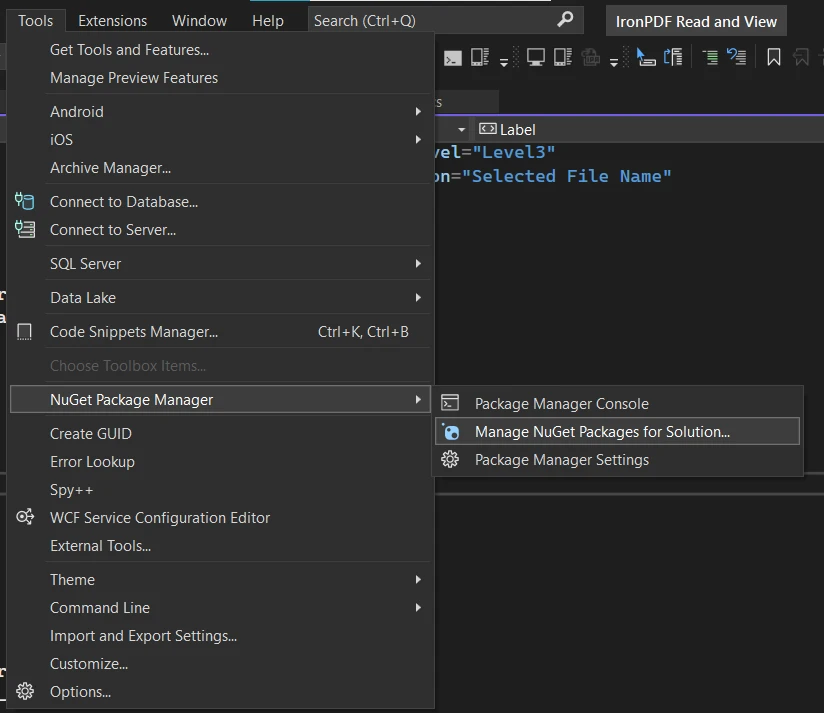 **图 4:在 Visual Studio 中,通过导航至"工具"> "NuGet包管理器">"管理解决方案的NuGet程序包"来访问NuGet程序包管理器。** 2.搜索IronPDF:在打开的窗口中,点击"浏览" ,然后在搜索框中输入IronPDF 。 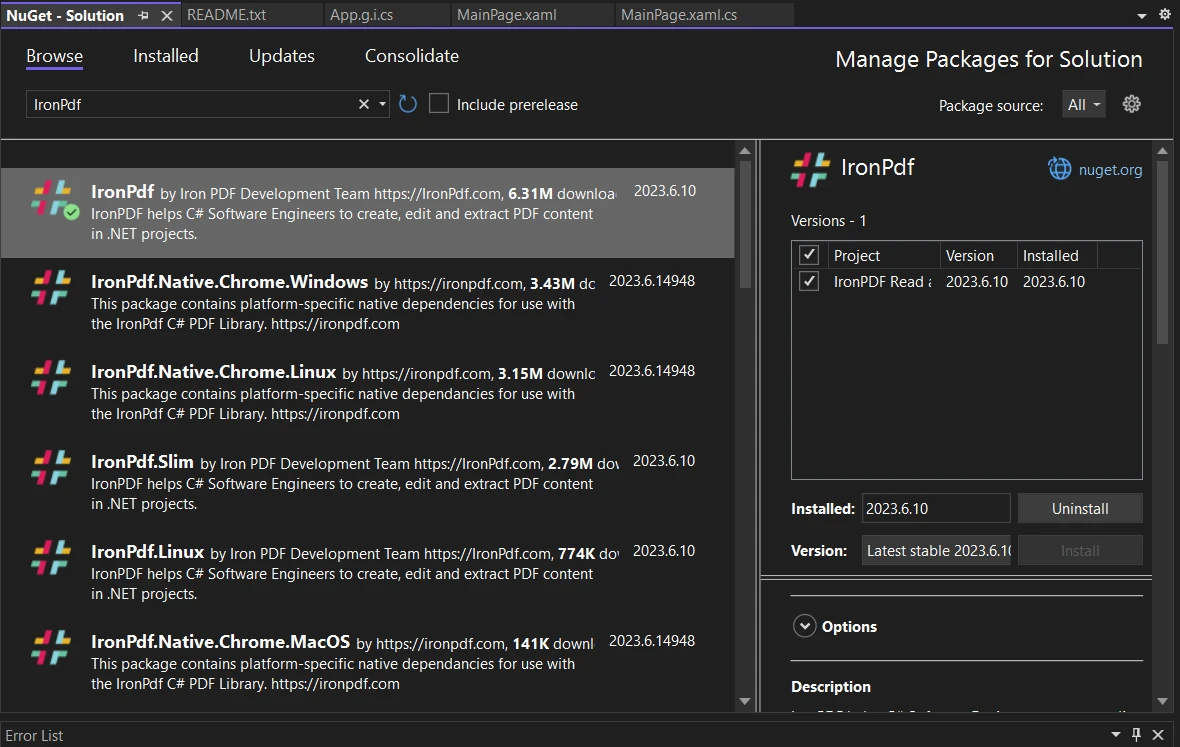 **图 5: NuGet包管理器 UI 显示IronPDF搜索结果。 已选择主IronPDF软件包(版本 2023.6.10),可以安装,显示下载量为 6.31M。** 3.安装IronPDF:在搜索结果中看到IronPDF后,点击它。 确保选中右侧面板中的项目复选框,然后点击 安装。 安装过程中接受所有提示。 您也可以使用软件包管理器控制台进行安装: Install-Package IronPdf 有关高级安装选项,包括Docker 设置和Azure 部署,请参阅IronPDF安装概述。 如何构建用户界面? 让我们来构建应用程序的用户界面。 MainPage.xaml文件将包含一个用于打开 PDF 的按钮和用于显示文件名和内容的标签。 打开 MainPage.xaml 文件:此文件包含主页的布局。 您可以在解决方案资源管理器中的页面文件夹下找到该文件。 定义布局:我们将使用一个控件,允许用户在页面内容无法完全显示在屏幕上时滚动浏览页面内容。 在 ScrollView 内部,我们将使用 <StackLayout> 来垂直堆叠控件。 在 StackLayout 中,我们有三个 <Frame> 控件。 每个框架用于固定页面的不同部分,使页面看起来整齐有序。 添加控件:第一个框架包含一个标签和一个按钮。 标签显示应用程序名称,按钮允许用户打开 PDF 文件。Clicked 属性被赋予了方法 OpenAndReadFile,该方法稍后将在代码隐藏文件中定义。 <VerticalStackLayout Spacing="25" Padding="30,0" VerticalOptions="Center"> <Label Text="IronPDF MAUI Application" SemanticProperties.HeadingLevel="Level1" SemanticProperties.Description="IronPDF MAUI Application" FontSize="30" HorizontalOptions="Center" FontAttributes="Bold" /> <Button x:Name="openFileBtn" Text="Open PDF File" SemanticProperties.Hint="Open PDF File" Clicked="OpenAndReadFile" HorizontalOptions="Center" /> </VerticalStackLayout> <VerticalStackLayout Spacing="25" Padding="30,0" VerticalOptions="Center"> <Label Text="IronPDF MAUI Application" SemanticProperties.HeadingLevel="Level1" SemanticProperties.Description="IronPDF MAUI Application" FontSize="30" HorizontalOptions="Center" FontAttributes="Bold" /> <Button x:Name="openFileBtn" Text="Open PDF File" SemanticProperties.Hint="Open PDF File" Clicked="OpenAndReadFile" HorizontalOptions="Center" /> </VerticalStackLayout> XML 第二个框架使用 <HorizontalStackLayout>,并带有两个标签:一个用于静态文本,另一个名为 fileName,用于显示选定的文件。 <HorizontalStackLayout Spacing="25" Padding="30,0" VerticalOptions="Center"> <Label Text="Selected File Name: " SemanticProperties.HeadingLevel="Level2" SemanticProperties.Description="Selected File Name" FontSize="18" HorizontalOptions="Center" FontAttributes="Bold" /> <Label x:Name="fileName" Text="" SemanticProperties.HeadingLevel="Level3" SemanticProperties.Description="Selected File Name" FontSize="18" HorizontalOptions="Center" /> </HorizontalStackLayout> <HorizontalStackLayout Spacing="25" Padding="30,0" VerticalOptions="Center"> <Label Text="Selected File Name: " SemanticProperties.HeadingLevel="Level2" SemanticProperties.Description="Selected File Name" FontSize="18" HorizontalOptions="Center" FontAttributes="Bold" /> <Label x:Name="fileName" Text="" SemanticProperties.HeadingLevel="Level3" SemanticProperties.Description="Selected File Name" FontSize="18" HorizontalOptions="Center" /> </HorizontalStackLayout> XML 第三帧包含一个 <VerticalStackLayout>,其中包含两个标签:一个用于"PDF 内容",另一个名为 content,用于显示 PDF 文本。 <VerticalStackLayout> <Label Text="PDF Content" SemanticProperties.HeadingLevel="Level2" FontSize="25" FontAttributes="Bold" HorizontalOptions="Center" /> <Label x:Name="content" FontSize="18" HorizontalTextAlignment="Start" /> </VerticalStackLayout> <VerticalStackLayout> <Label Text="PDF Content" SemanticProperties.HeadingLevel="Level2" FontSize="25" FontAttributes="Bold" HorizontalOptions="Center" /> <Label x:Name="content" FontSize="18" HorizontalTextAlignment="Start" /> </VerticalStackLayout> XML 您的完整 MainPage.xaml 应该如下所示: <?xml version="1.0" encoding="utf-8" ?> <ContentPage xmlns="___PROTECTED_URL_46___" xmlns:x="___PROTECTED_URL_47___" x:Class="IronPDF_Read_and_View.MainPage"> <ScrollView> <StackLayout> <Frame> <VerticalStackLayout Spacing="25" Padding="30,0" VerticalOptions="Center"> <Label Text="IronPDF MAUI Application" SemanticProperties.HeadingLevel="Level1" SemanticProperties.Description="IronPDF MAUI Application" FontSize="30" HorizontalOptions="Center" FontAttributes="Bold" /> <Button x:Name="openFileBtn" Text="Open PDF File" SemanticProperties.Hint="Open PDF File" Clicked="OpenAndReadFile" HorizontalOptions="Center" /> </VerticalStackLayout> </Frame> <Frame> <HorizontalStackLayout Spacing="25" Padding="30,0" VerticalOptions="Center"> <Label Text="Selected File Name: " SemanticProperties.HeadingLevel="Level2" SemanticProperties.Description="Selected File Name" FontSize="18" HorizontalOptions="Center" FontAttributes="Bold" /> <Label x:Name="fileName" Text="" SemanticProperties.HeadingLevel="Level3" SemanticProperties.Description="Selected File Name" FontSize="18" HorizontalOptions="Center" /> </HorizontalStackLayout> </Frame> <Frame> <VerticalStackLayout> <Label Text="PDF Content" SemanticProperties.HeadingLevel="Level2" FontSize="25" FontAttributes="Bold" HorizontalOptions="Center" /> <Label x:Name="content" FontSize="18" HorizontalTextAlignment="Start" /> </VerticalStackLayout> </Frame> </StackLayout> </ScrollView> </ContentPage> <?xml version="1.0" encoding="utf-8" ?> <ContentPage xmlns="___PROTECTED_URL_46___" xmlns:x="___PROTECTED_URL_47___" x:Class="IronPDF_Read_and_View.MainPage"> <ScrollView> <StackLayout> <Frame> <VerticalStackLayout Spacing="25" Padding="30,0" VerticalOptions="Center"> <Label Text="IronPDF MAUI Application" SemanticProperties.HeadingLevel="Level1" SemanticProperties.Description="IronPDF MAUI Application" FontSize="30" HorizontalOptions="Center" FontAttributes="Bold" /> <Button x:Name="openFileBtn" Text="Open PDF File" SemanticProperties.Hint="Open PDF File" Clicked="OpenAndReadFile" HorizontalOptions="Center" /> </VerticalStackLayout> </Frame> <Frame> <HorizontalStackLayout Spacing="25" Padding="30,0" VerticalOptions="Center"> <Label Text="Selected File Name: " SemanticProperties.HeadingLevel="Level2" SemanticProperties.Description="Selected File Name" FontSize="18" HorizontalOptions="Center" FontAttributes="Bold" /> <Label x:Name="fileName" Text="" SemanticProperties.HeadingLevel="Level3" SemanticProperties.Description="Selected File Name" FontSize="18" HorizontalOptions="Center" /> </HorizontalStackLayout> </Frame> <Frame> <VerticalStackLayout> <Label Text="PDF Content" SemanticProperties.HeadingLevel="Level2" FontSize="25" FontAttributes="Bold" HorizontalOptions="Center" /> <Label x:Name="content" FontSize="18" HorizontalTextAlignment="Start" /> </VerticalStackLayout> </Frame> </StackLayout> </ScrollView> </ContentPage> XML 当用户点击"打开 PDF 文件"时,会触发 OpenAndReadFile 方法。 fileName 和 content 标签将分别显示所选文件名和 PDF 内容。 对于复杂的 UI 布局, IronPDF支持在 MAUI 应用程序中直接将 XAML 转换为 PDF 。 xaml.cs 背后的代码是什么? 打开 MainPage.xaml.cs:在解决方案资源管理器的 Pages 文件夹下找到此文件。 这就是我们要添加方法的地方。 添加 filePath 字段:在 MainPage 类的顶部,声明一个名为 string 的字段。 我们将使用此字段存储所选文件的路径。 string filePath = string.Empty; string filePath = string.Empty; $vbLabelText $csharpLabel 初始化组件:在 MainPage 构造函数中,调用 InitializeComponent 方法。 该方法会被自动调用,以初始化页面及其控件。 public MainPage() { InitializeComponent(); } public MainPage() { InitializeComponent(); } $vbLabelText $csharpLabel 实现 OpenAndReadFile 方法:此方法标记为 async,因为我们将在其中使用 await 关键字。 FilePicker.PickAsync 方法用于打开文件选择器。 当用户选择一个文件时,文件名存储在 fileName 标签中,文件路径存储在 filePath 字段中。 IronPDF 库用于打开 PDF 文档并从中提取所有文本。 然后将提取的文本分配给内容标签。 private async void OpenAndReadFile(object sender, EventArgs e) { FileResult result = await FilePicker.PickAsync(); fileName.Text = result.FileName; filePath = result.FullPath; IronPdf.License.LicenseKey = "Your-License-Key"; // Read PDF File var document = PdfDocument.FromFile(filePath); var pdfContent = document.ExtractAllText(); content.Text = pdfContent; } private async void OpenAndReadFile(object sender, EventArgs e) { FileResult result = await FilePicker.PickAsync(); fileName.Text = result.FileName; filePath = result.FullPath; IronPdf.License.LicenseKey = "Your-License-Key"; // Read PDF File var document = PdfDocument.FromFile(filePath); var pdfContent = document.ExtractAllText(); content.Text = pdfContent; } $vbLabelText $csharpLabel 将"Your-License-Key"替换为您的实际IronPDF许可证密钥。 了解如何在IronPDF中使用许可证密钥。 以下是完整代码: using IronPdf; public partial class MainPage : ContentPage { string filePath = string.Empty; public MainPage() { InitializeComponent(); } private async void OpenAndReadFile(object sender, EventArgs e) { FileResult result = await FilePicker.PickAsync(); fileName.Text = result.FileName; filePath = result.FullPath; IronPdf.License.LicenseKey = "Your-License-Key"; // Read PDF File var document = PdfDocument.FromFile(filePath); var pdfContent = document.ExtractAllText(); content.Text = pdfContent; } } using IronPdf; public partial class MainPage : ContentPage { string filePath = string.Empty; public MainPage() { InitializeComponent(); } private async void OpenAndReadFile(object sender, EventArgs e) { FileResult result = await FilePicker.PickAsync(); fileName.Text = result.FileName; filePath = result.FullPath; IronPdf.License.LicenseKey = "Your-License-Key"; // Read PDF File var document = PdfDocument.FromFile(filePath); var pdfContent = document.ExtractAllText(); content.Text = pdfContent; } } $vbLabelText $csharpLabel IronPDF除了提供文本提取功能外,还提供其他功能。 您可以搜索和替换文本、提取图像、处理PDF 表单以及以编程方式添加注释。 如何运行该应用程序? 启动应用程序:要运行该应用程序,您可以按键盘上的F5 键,或者单击 Visual Studio 顶部工具栏中的绿色"开始调试"按钮。 确保在 "开始调试 "按钮旁边的下拉菜单中选择了正确的目标设备或模拟器。 使用应用程序:应用程序启动后,您将看到一个标题为"IronPDF MAUI 应用程序"的屏幕,以及一个标记为"打开 PDF 文件"的按钮。 使用应用程序:您将看到一个屏幕,上面有"IronPDF MAUI 应用程序"和一个"打开 PDF 文件"按钮。 打开PDF文件:点击"打开PDF文件"按钮。 这将打开一个文件选择器,允许您从设备或模拟器中浏览和选择 PDF 文件。 打开 PDF 文件:点击"打开 PDF 文件"打开文件选择器,然后从您的设备中选择一个 PDF 文件。 查看内容:选择 PDF 文件后,文件名将显示在"所选文件名:"下方,所选 PDF 文件的内容将显示在"PDF 内容"下方。 查看内容:选择 PDF 文件后,文件名将显示在"所选文件名:"下方,提取的文本将显示在"PDF 内容"下方。 IronPDF MAUI 应用程序成功地从选定的发票 PDF 文件中提取并显示文本内容,展示了该库在.NET MAUI桌面应用程序中的文本提取功能。 请注意,处理大型 PDF 文件可能需要几秒钟时间。 由于ExtractAllText 方法提取的是嵌入的文本内容,因此提取的文本格式可能与原始 PDF 布局不完全匹配。 为了更好地控制,可以使用页面特定的提取方法或使用PDF DOM 对象。 我们学到了什么? 本教程展示了如何使用IronPDF构建.NET MAUI应用程序来提取和显示 PDF 文本内容。 这充分展现了.NET MAUI和IronPDF在 PDF 处理方面的强大功能和多功能性。 除了文本提取之外, IronPDF还支持与 PDF 表单交互、拆分 PDF 、将页面栅格化为图像、使用 HTML 登录表单进行身份验证、自定义页眉和页脚,以及支持 CSS 以实现像素级完美的 PDF。 您可以在 MAUI 中探索 PDF 查看功能,使用UTF-8 和国际语言,并从数据生成 PDF 报告。 IronPDF是一款商业产品,提供免费试用版供用户测试其功能。 如果您发现它对生产使用有益,许可证从 $799 开始。 查看IronPDF 的全面功能概述,了解更多关于这个强大的 PDF 处理库的信息。 常见问题解答 如何在.NET MAUI应用程序中显示PDF嵌入文本? 要在.NET MAUI应用程序中显示PDF嵌入文本,您可以使用IronPDF库。IronPDF允许您从PDF文件中提取文本并在您的应用程序中呈现。您需要在.NET MAUI中设置用户界面,以便用户选择和显示PDF内容。 为什么在PDF文档中嵌入字体很重要? 在PDF文档中嵌入字体很重要,因为它确保文档的外观在不同系统和PDF查看器中保持一致,无论用户设备上是否安装了字体。 如何在.NET MAUI项目中安装IronPDF? 要在.NET MAUI项目中安装IronPDF,请使用Visual Studio的NuGet包管理器。搜索IronPDF并将其安装到您的项目中。或者,您可以使用NuGet包管理器控制台命令:Install-Package IronPDF。 在.NET MAUI应用程序中使用IronPDF有哪些好处? IronPDF为.NET MAUI应用程序提供了多种好处,包括提取和呈现PDF文本、管理嵌入字体,并确保跨不同平台的高质量PDF呈现。它还提供了一套强大的PDF操作功能,并支持跨平台开发。 IronPDF能从任何PDF文件中提取文本吗? 是的,IronPDF可以从PDF文件中提取文本。然而,提取的文本格式可能会根据PDF的创建方式而略有不同于原始PDF布局。 设置.NET MAUI应用程序以处理PDF有哪些步骤? 设置.NET MAUI应用程序以处理PDF涉及安装.NET MAUI和Visual Studio与必要的工作负载,通过NuGet集成IronPDF库,并开发用户界面与PDF文件进行交互。此过程还包括编写C#代码以提取和显示PDF内容。 有免费的IronPDF版本可用于开发吗? IronPDF提供免费的试用版本,允许开发人员测试其功能。对于生产用途,提供各种许可计划以满足不同需求。 使用IronPDF可以实现哪些类型的PDF操作? 使用IronPDF,您可以进行多种PDF操作,包括文本提取、与PDF表单交互、拆分PDF、将PDF页转换为图像,以及自定义文档页眉和页脚。 IronPDF 是否支持 .NET 10?我能否将其与 .NET 10 MAUI 项目一起使用? 是的——IronPDF 完全兼容 .NET 10。它支持 .NET 10 MAUI 项目,无需任何自定义变通方案即可立即利用 .NET 10 的性能改进和语言特性。IronPDF 同时支持 .NET 9、8、7、6、5、Core、Standard 和 Framework 版本,以及 .NET 10。(ironpdf.com) 在资源有限的设备(例如 iOS 或 Android)上使用 MAUI 中的 IronPDF 的 ExtractAllText 功能处理大型 PDF 时,是否存在任何限制或已知问题? IronPDF 的ExtractAllText虽然能很好地处理标准 PDF 文件,但在移动设备上从超大型文档中提取嵌入文本时速度会变慢,并且会占用大量内存。开发者应考虑对大型文件实现分页或分块提取,并确保设备有足够的内存。此外,为了保证 UI 的响应速度,可能需要在后台线程中使用,以避免阻塞 MAUI 应用的主线程。(以上内容基于 .NET MAUI 的通用最佳实践以及 IronPDF 对 PDF 提取的处理方式。) Curtis Chau 立即与工程团队聊天 技术作家 Curtis Chau 拥有卡尔顿大学的计算机科学学士学位,专注于前端开发,精通 Node.js、TypeScript、JavaScript 和 React。他热衷于打造直观且美观的用户界面,喜欢使用现代框架并创建结构良好、视觉吸引力强的手册。除了开发之外,Curtis 对物联网 (IoT) 有浓厚的兴趣,探索将硬件和软件集成的新方法。在空闲时间,他喜欢玩游戏和构建 Discord 机器人,将他对技术的热爱与创造力相结合。 相关文章 已更新2026年3月1日 如何在.NET中使用IronPDF创建PDF文件(C#教程) 发现为开发人员创建PDF文件的有效方法。提升您的编码技能并简化您的项目。立即阅读文章! 阅读更多 已更新2026年2月27日 如何在C#中合并PDF文件 使用IronPDF合并PDF VB NET。学习使用简单的VB.NET代码将多个PDF文件合并为一个文档。包括逐步示例。 阅读更多 已更新2026年3月1日 面向 .NET 10 开发人员的 C# PDFWriter 教程 使用这份逐步指南了解如何高效地使用C# PDFWriter创建PDF。阅读文章提升您的技能! 阅读更多 如何在ASP.NET Core中显示PDF文件如何在C#中将PDF转换为PNG