使用IRONPDF 如何在.NET MAUI中顯示嵌入文字的PDF Curtis Chau 更新:2026年1月21日 下載 IronPDF NuGet 下載 DLL 下載 Windows Installer 開始免費試用 LLM副本 LLM副本 將頁面複製為 Markdown 格式,用於 LLMs 在 ChatGPT 中打開 請向 ChatGPT 諮詢此頁面 在雙子座打開 請向 Gemini 詢問此頁面 在 Grok 中打開 向 Grok 詢問此頁面 打開困惑 向 Perplexity 詢問有關此頁面的信息 分享 在 Facebook 上分享 分享到 X(Twitter) 在 LinkedIn 上分享 複製連結 電子郵件文章 了解如何使用IronPDF在.NET MAUI應用程式中從 PDF 檔案中提取和顯示嵌入文字。 這個強大的 C# 程式庫使你能夠讀取 PDF 內容,只需幾行程式碼即可將其呈現在跨平台應用程式中。 .NET多平台應用程式 UI (MAUI) 簡化了多平台應用程式的開發。 透過 Xamarin.Forms 的這種演進,您可以從單一專案建立適用於 Android、iOS、macOS 和 Windows 的應用程式。 PDF 檔案以保留字體、圖像和佈局而聞名,通常使用這種技術進行管理。 IronPDF庫提供了強大的PDF處理功能。 您可以利用IronPDF輕鬆處理嵌入式文本,簡化生成和操作 PDF 文件的過程,同時保持預設的一致性渲染。 什麼是PDF嵌入式文字和字體嵌入? PDF 嵌入式文字是指嵌入在 PDF 檔案中的文字實體。它確保在包括 Adobe 在內的 PDF 檢視器應用程式中保持一致性和準確的渲染效果。 透過將字體嵌入PDF 文件中,無論檢視器應用程式為何,也無論檢視器的裝置上是否安裝了特定字體,都能保留正確的字體。 嵌入字體可能會增加文件大小,但對於保持原始文件的外觀至關重要。 Adobe PDF 設定通常決定字體是否嵌入。 PDF壓縮技術可以幫助在嵌入字體時減少檔案大小。 PDF 檔案中嵌入的字體有三種類型: 1.嵌入式字體:整個字體嵌入文件中。 2.嵌入字體子集:僅嵌入原始文件中使用的字體的子集。 3.無嵌入字體:文檔中未嵌入任何字體。 在 Adobe Acrobat 中,您可以透過檢查文件屬性來驗證字型嵌入情況。 預設情況下,字體嵌入在 PDF 檔案中。 但是,可以使用 Adobe Acrobat Pro 或IronPDF 的字型管理功能等工具來修改這些設定。 "扁平化 PDF"包含所有嵌入字體,使其成為一個獨立的文件,並確保在所有系統上呈現一致的外觀。 IronPDF支援將 PDF 文件展平,以確保渲染效果一致。 IronPDF C# 是什麼? IronPDF Documentation是一個功能強大的 C# PDF 庫,可讓您在.NET應用程式中產生、讀取和編輯 PDF 文件。 您可以使用IronPDF從 HTML 產生 PDF 檔案。 一項關鍵功能是處理PDF文件中的嵌入式文字。 將字體嵌入 PDF 中,即使在沒有原始字體的系統上查看,也能保持文件的原始外觀。 讓我們來探討如何在.NET MAUI中使用IronPDF顯示嵌入式文字。 IronPDF提供強大的文字擷取功能,可用於以程式設計方式處理 PDF 內容。 無論您需要在 C# 中解析 PDF ,還是將 PDF 內容轉換為其他格式, IronPDF都能提供必要的工具。 .NET MAUI:微軟的統一 UI 工具包,可讓您使用單一共用程式碼庫為 Android、iOS、macOS 和 Windows 建立應用程式。 您可以從微軟網站下載.NET MAUI 。 Visual Studio 2022(或更高版本):功能強大且使用者友善的.NET程式整合開發環境 (IDE)。 您可以從微軟網站下載 Visual Studio。請確保 Visual Studio 2022 中已安裝.NET MAUI工作負載。 IronPDF庫:這是一個用於.NET的 PDF 處理庫,我們將使用它來與 PDF 文件進行互動。 您可以透過NuGet安裝IronPDF ,NuGet 是 Microsoft 開發平台的套件管理器。 Adobe PDF 檔案:為了本教學的需要,我們需要一個 PDF 檔案。 在開始之前,請確保您已滿足以下要求: .NET MAUI :微軟用於建立跨平台應用程式的統一使用者介面工具包。可從微軟網站下載。 Visual Studio 2022(或更高版本) :功能強大的.NET程式設計 IDE,已安裝.NET MAUI工作負載。 IronPDF庫:透過NuGet套件管理器安裝。 了解IronPDF NuGet包。 PDF 檔案:任何用於測試目的的 PDF 檔案。 針對特定平台的設定: Windows: IronPDF Windows 安裝指南 macOS: macOS 安裝指南 Linux: Linux 安裝說明 如何建立.NET MAUI應用程式? 請依照以下步驟建立一個新的.NET MAUI應用程式: 啟動 Visual Studio 2022:啟動後,導覽至"檔案" > "新建" > "專案" 。 在專案範本視窗中,選擇.NET MAUI應用程序,然後按一下"下一步" 。 Visual Studio 的"新專案"對話方塊顯示了各種.NET MAUI專案模板,包括.NET MAUI應用程式、 .NET MAUI Blazor應用程式和.NET MAUI類別庫選項。 圖 1:Visual Studio 新專案對話框,其中突出顯示了.NET MAUI模板,顯示了建立新的.NET MAUI應用程式的第一步。 為你的專案命名:在下一個視窗中,你需要為你的專案命名。 我們把它命名為IronPDF_Read_and_View 。 選擇儲存項目的位置,然後按一下"下一步" 。 圖 2:設定專案 - 設定新的.NET MAUI應用程序,整合IronPDF以實現跨平台 PDF 檢視功能。 選擇框架:從下拉清單中選擇.NET Framework 。為確保流程順暢,請選擇最新版本的.NET Framework ,然後按一下"建立"按鈕。 Visual Studio 專案建立精靈,顯示.NET MAUI應用程式配置,已選擇.NET 7.0 框架,並提供 Android、iOS、Mac Catalyst、macOS、MAUI、Tizen 和 Windows 的平台選項。 圖 3:為新的.NET MAUI應用程式選擇.NET Framework版本和目標平台 如何安裝IronPDF? 建立.NET MAUI應用程式後,安裝IronPDF庫: 1.開啟NuGet套件管理員:導覽至"工具" > "NuGet套件管理器" > "管理解決方案的NuGet套件" 。 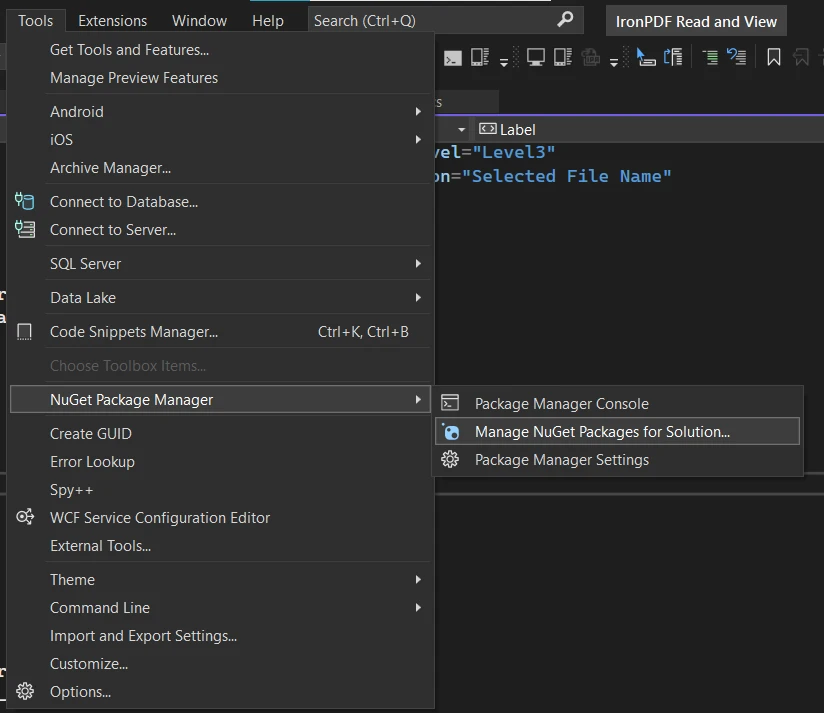 **圖 4:在 Visual Studio 中,透過導覽至"工具"> "NuGet套件管理器">"管理解決方案的NuGet套件"來存取NuGet套件管理器。** 2.搜尋IronPDF:在開啟的視窗中,點選"瀏覽" ,然後在搜尋框中輸入IronPDF 。 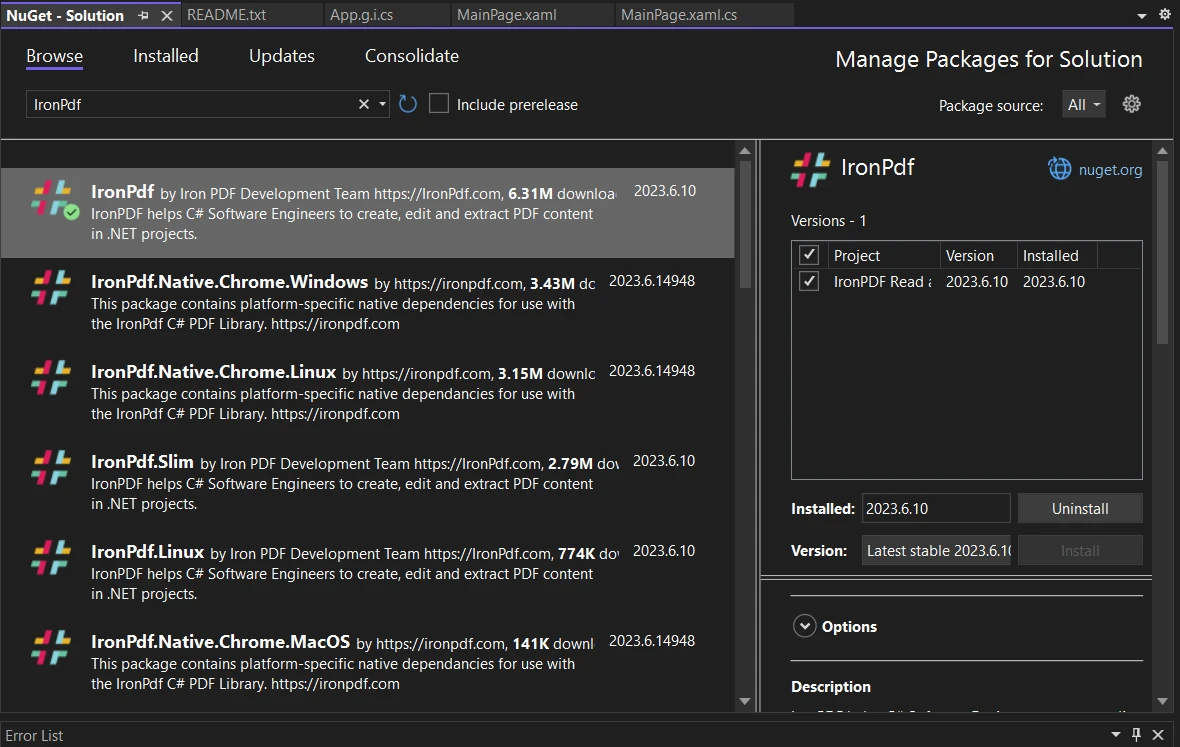 **圖 5: NuGet套件管理器 UI 顯示IronPDF搜尋結果。 已選擇主IronPDF軟體包(版本 2023.6.10),可安裝,顯示下載量為 6.31M。** 3.安裝IronPDF:在搜尋結果中看到IronPDF後,點擊它。 請確保右側面板中您的專案複選框已選中,然後按一下"安裝" 。 安裝過程中接受所有提示。 您也可以使用軟體套件管理器控制台進行安裝: Install-Package IronPdf 有關進階安裝選項,包括Docker 設定和Azure 部署,請參閱IronPDF安裝概述。 如何建構使用者介面? 讓我們來建立應用程式的使用者介面。 MainPage.xaml檔案將包含一個用於開啟 PDF 的按鈕和用於顯示檔案名稱和內容的標籤。 開啟 MainPage.xaml 檔案:此檔案包含主頁的佈局。 您可以在解決方案資源管理器的"頁面"資料夾下找到此檔案。 定義佈局:我們將使用一個控件,允許使用者在頁面內容無法完全顯示在螢幕上時滾動瀏覽頁面內容。 在 ScrollView 內部,我們將使用 <StackLayout> 來垂直堆疊控制項。 在 StackLayout 中,我們有三個 <Frame> 控制。 每個框架都用於容納我們頁面的一個不同部分,從而呈現出整潔有序的外觀。 新增控制項:第一個框架包含一個標籤和一個按鈕。 標籤顯示應用程式名稱,按鈕允許使用者開啟 PDF 檔案。 Clicked 屬性被賦予了方法 OpenAndReadFile,該方法稍後將在程式碼隱藏檔案中定義。 <VerticalStackLayout Spacing="25" Padding="30,0" VerticalOptions="Center"> <Label Text="IronPDF MAUI Application" SemanticProperties.HeadingLevel="Level1" SemanticProperties.Description="IronPDF MAUI Application" FontSize="30" HorizontalOptions="Center" FontAttributes="Bold" /> <Button x:Name="openFileBtn" Text="Open PDF File" SemanticProperties.Hint="Open PDF File" Clicked="OpenAndReadFile" HorizontalOptions="Center" /> </VerticalStackLayout> <VerticalStackLayout Spacing="25" Padding="30,0" VerticalOptions="Center"> <Label Text="IronPDF MAUI Application" SemanticProperties.HeadingLevel="Level1" SemanticProperties.Description="IronPDF MAUI Application" FontSize="30" HorizontalOptions="Center" FontAttributes="Bold" /> <Button x:Name="openFileBtn" Text="Open PDF File" SemanticProperties.Hint="Open PDF File" Clicked="OpenAndReadFile" HorizontalOptions="Center" /> </VerticalStackLayout> XML 第二個框架使用 <HorizontalStackLayout>,並帶有兩個標籤:一個用於靜態文本,另一個名為 fileName,用於顯示選定的文件。 <HorizontalStackLayout Spacing="25" Padding="30,0" VerticalOptions="Center"> <Label Text="Selected File Name: " SemanticProperties.HeadingLevel="Level2" SemanticProperties.Description="Selected File Name" FontSize="18" HorizontalOptions="Center" FontAttributes="Bold" /> <Label x:Name="fileName" Text="" SemanticProperties.HeadingLevel="Level3" SemanticProperties.Description="Selected File Name" FontSize="18" HorizontalOptions="Center" /> </HorizontalStackLayout> <HorizontalStackLayout Spacing="25" Padding="30,0" VerticalOptions="Center"> <Label Text="Selected File Name: " SemanticProperties.HeadingLevel="Level2" SemanticProperties.Description="Selected File Name" FontSize="18" HorizontalOptions="Center" FontAttributes="Bold" /> <Label x:Name="fileName" Text="" SemanticProperties.HeadingLevel="Level3" SemanticProperties.Description="Selected File Name" FontSize="18" HorizontalOptions="Center" /> </HorizontalStackLayout> XML 第三幀包含一個 <VerticalStackLayout>,其中包含兩個標籤:一個用於"PDF 內容",另一個名為 content,用於顯示 PDF 文字。 <VerticalStackLayout> <Label Text="PDF Content" SemanticProperties.HeadingLevel="Level2" FontSize="25" FontAttributes="Bold" HorizontalOptions="Center" /> <Label x:Name="content" FontSize="18" HorizontalTextAlignment="Start" /> </VerticalStackLayout> <VerticalStackLayout> <Label Text="PDF Content" SemanticProperties.HeadingLevel="Level2" FontSize="25" FontAttributes="Bold" HorizontalOptions="Center" /> <Label x:Name="content" FontSize="18" HorizontalTextAlignment="Start" /> </VerticalStackLayout> XML 您的完整 MainPage.xaml 應該如下所示: <?xml version="1.0" encoding="utf-8" ?> <ContentPage xmlns="___PROTECTED_URL_46___" xmlns:x="___PROTECTED_URL_47___" x:Class="IronPDF_Read_and_View.MainPage"> <ScrollView> <StackLayout> <Frame> <VerticalStackLayout Spacing="25" Padding="30,0" VerticalOptions="Center"> <Label Text="IronPDF MAUI Application" SemanticProperties.HeadingLevel="Level1" SemanticProperties.Description="IronPDF MAUI Application" FontSize="30" HorizontalOptions="Center" FontAttributes="Bold" /> <Button x:Name="openFileBtn" Text="Open PDF File" SemanticProperties.Hint="Open PDF File" Clicked="OpenAndReadFile" HorizontalOptions="Center" /> </VerticalStackLayout> </Frame> <Frame> <HorizontalStackLayout Spacing="25" Padding="30,0" VerticalOptions="Center"> <Label Text="Selected File Name: " SemanticProperties.HeadingLevel="Level2" SemanticProperties.Description="Selected File Name" FontSize="18" HorizontalOptions="Center" FontAttributes="Bold" /> <Label x:Name="fileName" Text="" SemanticProperties.HeadingLevel="Level3" SemanticProperties.Description="Selected File Name" FontSize="18" HorizontalOptions="Center" /> </HorizontalStackLayout> </Frame> <Frame> <VerticalStackLayout> <Label Text="PDF Content" SemanticProperties.HeadingLevel="Level2" FontSize="25" FontAttributes="Bold" HorizontalOptions="Center" /> <Label x:Name="content" FontSize="18" HorizontalTextAlignment="Start" /> </VerticalStackLayout> </Frame> </StackLayout> </ScrollView> </ContentPage> <?xml version="1.0" encoding="utf-8" ?> <ContentPage xmlns="___PROTECTED_URL_46___" xmlns:x="___PROTECTED_URL_47___" x:Class="IronPDF_Read_and_View.MainPage"> <ScrollView> <StackLayout> <Frame> <VerticalStackLayout Spacing="25" Padding="30,0" VerticalOptions="Center"> <Label Text="IronPDF MAUI Application" SemanticProperties.HeadingLevel="Level1" SemanticProperties.Description="IronPDF MAUI Application" FontSize="30" HorizontalOptions="Center" FontAttributes="Bold" /> <Button x:Name="openFileBtn" Text="Open PDF File" SemanticProperties.Hint="Open PDF File" Clicked="OpenAndReadFile" HorizontalOptions="Center" /> </VerticalStackLayout> </Frame> <Frame> <HorizontalStackLayout Spacing="25" Padding="30,0" VerticalOptions="Center"> <Label Text="Selected File Name: " SemanticProperties.HeadingLevel="Level2" SemanticProperties.Description="Selected File Name" FontSize="18" HorizontalOptions="Center" FontAttributes="Bold" /> <Label x:Name="fileName" Text="" SemanticProperties.HeadingLevel="Level3" SemanticProperties.Description="Selected File Name" FontSize="18" HorizontalOptions="Center" /> </HorizontalStackLayout> </Frame> <Frame> <VerticalStackLayout> <Label Text="PDF Content" SemanticProperties.HeadingLevel="Level2" FontSize="25" FontAttributes="Bold" HorizontalOptions="Center" /> <Label x:Name="content" FontSize="18" HorizontalTextAlignment="Start" /> </VerticalStackLayout> </Frame> </StackLayout> </ScrollView> </ContentPage> XML 當使用者點擊"開啟 PDF 檔案"時,會觸發 OpenAndReadFile 方法。 fileName 和 content 標籤將分別顯示所選檔案名稱和 PDF 內容。 對於複雜的 UI 佈局, IronPDF支援在 MAUI 應用程式中直接將 XAML 轉換為 PDF 。 xaml.cs 背後的程式碼是什麼? 開啟 MainPage.xaml.cs:在解決方案資源管理器的 Pages 資料夾下找到此檔案。 我們將在這裡添加我們的方法。 新增 filePath 欄位:在 MainPage 類別的頂部,宣告一個名為 string 的欄位。 我們將使用此欄位儲存所選文件的路徑。 string filePath = string.Empty; string filePath = string.Empty; $vbLabelText $csharpLabel 初始化元件:在 MainPage 建構子中,呼叫 InitializeComponent 方法。 此方法會自動呼叫以初始化頁面及其控制項。 public MainPage() { InitializeComponent(); } public MainPage() { InitializeComponent(); } $vbLabelText $csharpLabel 實作 OpenAndReadFile 方法:此方法標記為 async,因為我們將在其中使用 await 關鍵字。 FilePicker.PickAsync 方法用於開啟檔案選擇器。 當使用者選擇一個檔案時,檔案名稱儲存在 fileName 標籤中,檔案路徑儲存在 filePath 欄位中。 IronPDF庫用於開啟 PDF 文件並從中提取所有文字。 然後將提取的文字分配給內容標籤。 private async void OpenAndReadFile(object sender, EventArgs e) { FileResult result = await FilePicker.PickAsync(); fileName.Text = result.FileName; filePath = result.FullPath; IronPdf.License.LicenseKey = "Your-License-Key"; // Read PDF File var document = PdfDocument.FromFile(filePath); var pdfContent = document.ExtractAllText(); content.Text = pdfContent; } private async void OpenAndReadFile(object sender, EventArgs e) { FileResult result = await FilePicker.PickAsync(); fileName.Text = result.FileName; filePath = result.FullPath; IronPdf.License.LicenseKey = "Your-License-Key"; // Read PDF File var document = PdfDocument.FromFile(filePath); var pdfContent = document.ExtractAllText(); content.Text = pdfContent; } $vbLabelText $csharpLabel 將"Your-License-Key"替換為您的實際IronPDF許可證密鑰。 了解如何在IronPDF中使用許可證密鑰。 以下是完整程式碼: using IronPdf; public partial class MainPage : ContentPage { string filePath = string.Empty; public MainPage() { InitializeComponent(); } private async void OpenAndReadFile(object sender, EventArgs e) { FileResult result = await FilePicker.PickAsync(); fileName.Text = result.FileName; filePath = result.FullPath; IronPdf.License.LicenseKey = "Your-License-Key"; // Read PDF File var document = PdfDocument.FromFile(filePath); var pdfContent = document.ExtractAllText(); content.Text = pdfContent; } } using IronPdf; public partial class MainPage : ContentPage { string filePath = string.Empty; public MainPage() { InitializeComponent(); } private async void OpenAndReadFile(object sender, EventArgs e) { FileResult result = await FilePicker.PickAsync(); fileName.Text = result.FileName; filePath = result.FullPath; IronPdf.License.LicenseKey = "Your-License-Key"; // Read PDF File var document = PdfDocument.FromFile(filePath); var pdfContent = document.ExtractAllText(); content.Text = pdfContent; } } $vbLabelText $csharpLabel IronPDF除了提供文字擷取功能外,還提供其他功能。 您可以搜尋和替換文字、提取圖像、處理PDF 表單以及以程式設計方式新增註釋。 如何運行該應用程式? 啟動應用程式:要執行應用程序,您可以按鍵盤上的F5 鍵,或按一下 Visual Studio 頂部工具列中的綠色"開始偵錯"按鈕。 確保在"開始調試"按鈕旁的下拉式選單中選擇正確的目標設備或模擬器。 使用應用程式:應用程式啟動後,您將看到一個標題為"IronPDF MAUI 應用程式"的螢幕,以及一個標記為"開啟 PDF 檔案"的按鈕。 使用應用程式:您將看到一個螢幕,上面有"IronPDF MAUI 應用程式"和一個"開啟 PDF 檔案"按鈕。 開啟PDF檔案:點選"開啟PDF檔案"按鈕。 這將開啟一個文件選擇器,讓您可以從裝置或模擬器瀏覽和選擇 PDF 文件。 開啟 PDF 檔案:點擊"開啟 PDF 檔案"開啟檔案選擇器,然後從您的裝置中選擇一個 PDF 檔案。 查看內容:選擇 PDF 檔案後,檔案名稱將顯示在"所選檔案名稱:"下方,所選 PDF 檔案的內容將顯示在"PDF 內容"下方。 查看內容:選擇 PDF 檔案後,檔案名稱將顯示在"所選檔案名稱:"下方,擷取的文字將顯示在"PDF 內容"下方。 IronPDF MAUI 應用程式成功地從選定的發票 PDF 文件中提取並顯示文字內容,展示了該程式庫在.NET MAUI桌面應用程式中的文字擷取功能。 請注意,處理大型 PDF 檔案可能需要幾秒鐘。 由於ExtractAllText 方法提取的是嵌入的文字內容,因此提取的文字格式可能與原始 PDF 佈局不完全匹配。 為了更好地控制,可以使用頁面特定的提取方法或使用PDF DOM 物件。 我們學到了什麼? 本教學課程展示如何使用IronPDF建立.NET MAUI應用程式來擷取和顯示 PDF 文字內容。 這充分展現了.NET MAUI和IronPDF在 PDF 處理方面的強大功能和多功能性。 除了文字擷取之外, IronPDF還支援與 PDF 表單互動、拆分 PDF 、將頁面柵格化為圖像、使用 HTML 登入表單進行身份驗證、自訂頁首和頁腳,以及支援 CSS 以實現像素級完美的 PDF。 您可以在 MAUI 中探索 PDF 檢視功能,使用UTF-8 和國際語言,並從資料產生 PDF 報告。 IronPDF是一款商業產品,提供免費試用版供使用者測試其功能。 如果您發現它對生產使用有益,許可證從 $799 開始。 請參閱IronPDF 的全面功能概述,以了解更多關於這個強大的 PDF 處理庫的資訊。 常見問題解答 如何在 .NET MAUI 應用程式中顯示 PDF 內嵌文字? 要在 .NET MAUI 應用程式中顯示 PDF 內嵌文字,你可以使用 IronPDF 庫。IronPDF 允許你從 PDF 文件中提取文字,並在你的應用程式中顯示這些文字。你需要在 .NET MAUI 中設置用戶界面,以便用戶選擇和顯示 PDF 內容。 為什麼在 PDF 文檔中嵌入字體很重要? 在 PDF 文檔中嵌入字體很重要,因為無論用戶設備上是否安裝字體,它都能確保文檔的外觀在不同系統和 PDF 查看器上保持一致。 如何在 .NET MAUI 專案中安裝 IronPDF? 要在 .NET MAUI 專案中安裝 IronPDF,請使用 Visual Studio 的 NuGet 套件管理器。搜尋 IronPDF 並安裝到你的專案中。或者,你可以使用 NuGet 套件管理器控制台並使用此命令:Install-Package IronPDF。 使用 IronPDF 在 .NET MAUI 應用程式中的好處是什麼? IronPDF 為 .NET MAUI 應用程式提供了多項好處,包括提取和顯示 PDF 文字、管理嵌入字體、以及確保跨不同平台的高品質 PDF 渲染。它還提供了一組強大的功能用於 PDF 操作,並支持跨平台開發。 IronPDF 可以從任何 PDF 文件中提取文字嗎? 是的,IronPDF 可以從 PDF 文件中提取文字。然而,提取的文字格式可能會略有不同於原始 PDF 佈局,這取決於 PDF 的創建方式。 設置一個 .NET MAUI 應用程式以處理 PDF 的步驟有哪些? 設置一個 .NET MAUI 應用程式以處理 PDF 包括安裝 .NET MAUI 和 Visual Studio 的必要工作集,透過 NuGet 集成 IronPDF 庫,以及開發一個可以與 PDF 文件互動的用戶界面。此過程還包含編寫 C# 代碼以提取和顯示 PDF 內容。 IronPDF 是否提供開發可用的免費版本? IronPDF 提供免費試用版,允許開發人員測試其功能。用於生產用途,各種授權計劃可用以滿足不同需要。 使用 IronPDF 可以實現哪些類型的 PDF 操作? 使用 IronPDF,你可以執行多種 PDF 操作,包括文字提取、與 PDF 表單互動、拆分 PDF、將 PDF 頁面轉換為圖像以及自定義文檔的頁眉和頁腳。 IronPDF 是否支援 .NET 10,我可以在 .NET 10 MAUI 項目中使用它嗎? 是的 — IronPDF 完全兼容 .NET 10。它支援 .NET 10 MAUI 項目,立即利用 .NET 10 的性能改進和語言功能,無需使用自定義解決方案。IronPDF 支援 .NET 10,以及 .NET 9、8、7、6、5、Core、Standard 和 Framework。(ironpdf.com) 在資源有限的設備上如 iOS 或 Android,使用 IronPDF 的 ExtractAllText 提取大型 PDF 時是否有任何限制或已知問題? 雖然 IronPDF 的 ExtractAllText 在標準 PDF 上表現良好,但在行動設備上從非常大的文件中提取嵌入文本可能會變慢並消耗更多記憶體。開發者應考慮為大型文件實現分頁或分塊提取,並確保設備有足夠的記憶體。此外,UI 響應性可能需要使用背景多執行緒以避免阻塞 MAUI 應用程式中的主要執行緒。(根據 .NET MAUI 和 IronPDF PDF 提取處理的一般最佳實踐) Curtis Chau 立即與工程團隊聊天 技術作家 Curtis Chau 擁有卡爾頓大學計算機科學學士學位,專注於前端開發,擅長於 Node.js、TypeScript、JavaScript 和 React。Curtis 熱衷於創建直觀且美觀的用戶界面,喜歡使用現代框架並打造結構良好、視覺吸引人的手冊。除了開發之外,Curtis 對物聯網 (IoT) 有著濃厚的興趣,探索將硬體和軟體結合的創新方式。在閒暇時間,他喜愛遊戲並構建 Discord 機器人,結合科技與創意的樂趣。 相關文章 更新2026年3月1日 如何在.NET中使用IronPDF創建PDF檔案(C#教程) 發現用於創建C# PDF文件的有效方法,提升您的編碼技能並簡化您的項目。立即閱讀文章! 閱讀更多 更新2026年2月27日 如何在C#中合併PDF文件 使用 IronPDF 合併 PDF 文件。學習如何使用簡單的 VB.NET 程式碼將多個 PDF 文件合併成一個文檔。包含逐步範例。 閱讀更多 更新2026年3月1日 C# PDFWriter教程,適用於.NET 10開發者 通過這個面向開發人員的逐步指南,學習如何使用C# PDFWriter高效創建PDF。閱讀本文以提高您的技能! 閱讀更多 如何在 ASP.NET Core 中顯示 PDF 文件如何在 C# 中將 PDF 轉換為 PNG