using IronPdf;

// Disable local disk access or cross-origin requests
Installation.EnableWebSecurity = true;

// Instantiate Renderer
var renderer = new ChromePdfRenderer();

// Create a PDF from a HTML string using C#
var pdf = renderer.RenderHtmlAsPdf("<h1>Hello World</h1>");

// Export to a file or Stream
pdf.SaveAs("output.pdf");

// Advanced Example with HTML Assets
// Load external html assets: Images, CSS and JavaScript.
// An optional BasePath 'C:\site\assets\' is set as the file location to load assets from
var myAdvancedPdf = renderer.RenderHtmlAsPdf("<img src='icons/iron.png'>", @"C:\site\assets\");
myAdvancedPdf.SaveAs("html-with-assets.pdf");
using IronPdf;// Disable local disk access or cross-origin requestsInstallation.EnableWebSecurity = true;// Instantiate Renderervar renderer = new ChromePdfRenderer();// Create a PDF from a HTML string using C#var pdf = renderer.RenderHtmlAsPdf("<h1>Hello World</h1>");// Export to a file or Streampdf.SaveAs("output.pdf");// Advanced Example with HTML Assets// Load external html assets: Images, CSS and JavaScript.// An optional BasePath 'C:\site\assets\' is set as the file location to load assets fromvar myAdvancedPdf = renderer.RenderHtmlAsPdf("<img src='icons/iron.png'>", @"C:\site\assets\");myAdvancedPdf.SaveAs("html-with-assets.pdf");
This article will explore how to use IronPDF to save PDF files from a Windows Forms Application or any .NET Application.
[The IronPDF Library](https://ironpdf.com) is a .NET library that provides easy-to-use classes and methods for generating and working with PDF files in C# applications. It allows developers to create, modify, and save PDF files with just a few lines of code, making it an excellent choice for Windows Forms Applications.
## Step 1: Create a New Windows Forms application
First, create a new Visual Studio Project. Here are the steps to create a new C# Windows Forms Application in Visual Studio 2022.
1. Open Visual Studio 2022 as shown below.
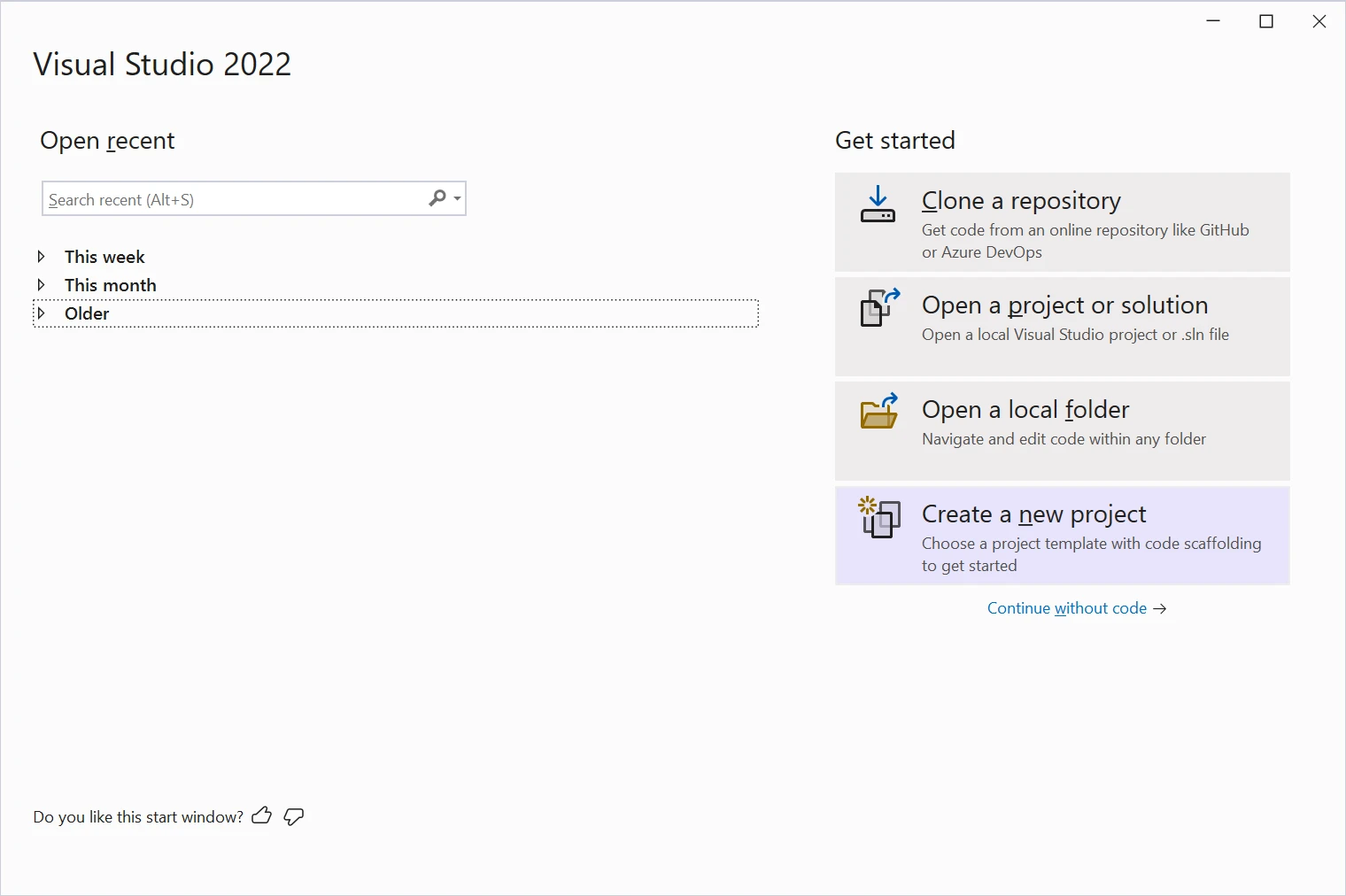
**Visual Studio 2022**
2. Click on "Create a new project" on the start page or go to "File" > "New" > "Project".
3. In the "Create a new project" dialog box, select "Windows Forms App" or "Windows Forms App (.NET Framework)" under "Create a new project" as shown below.
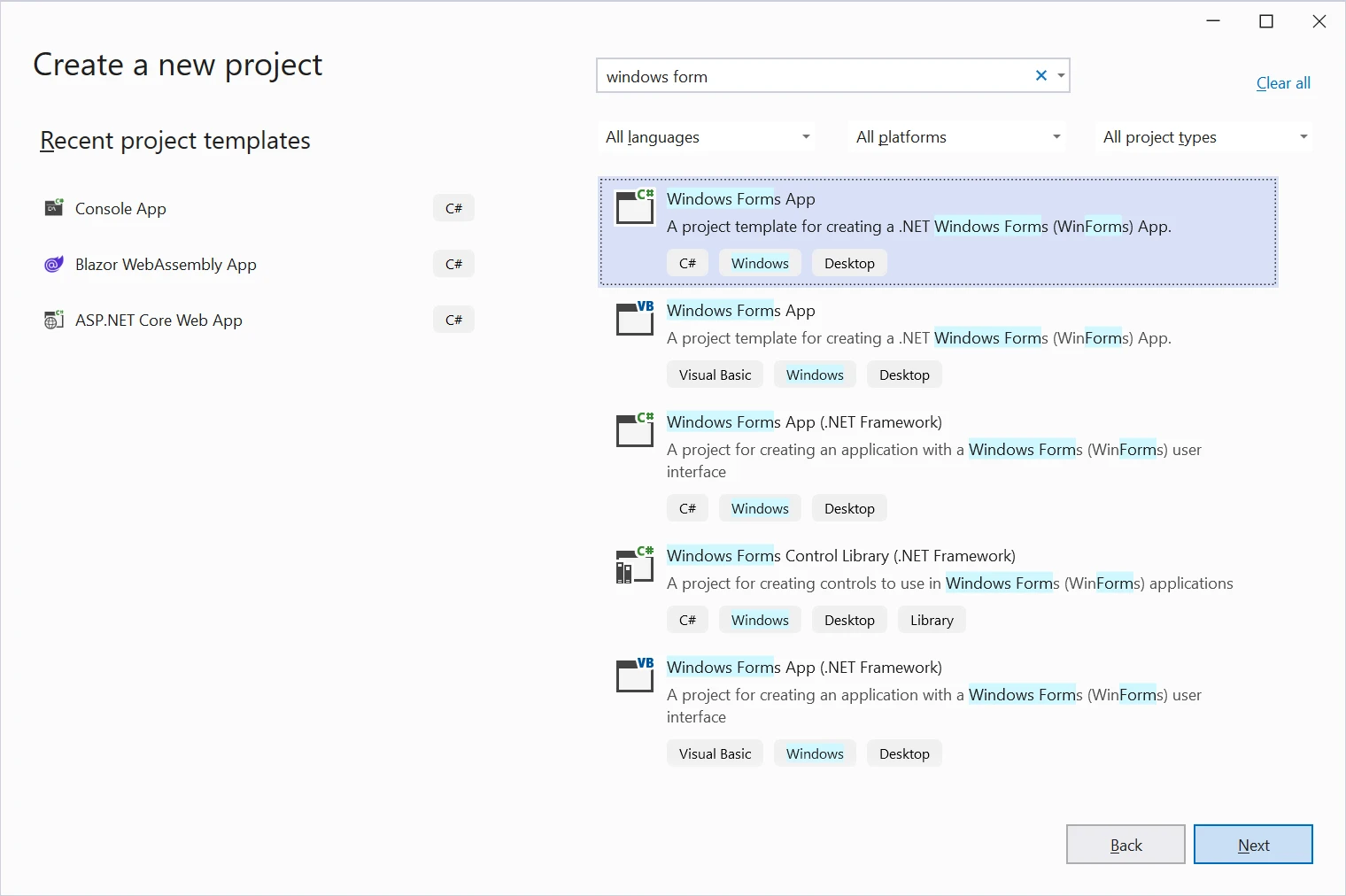
**New Forms App**
4. Enter a name for your project and choose a location to save it to.
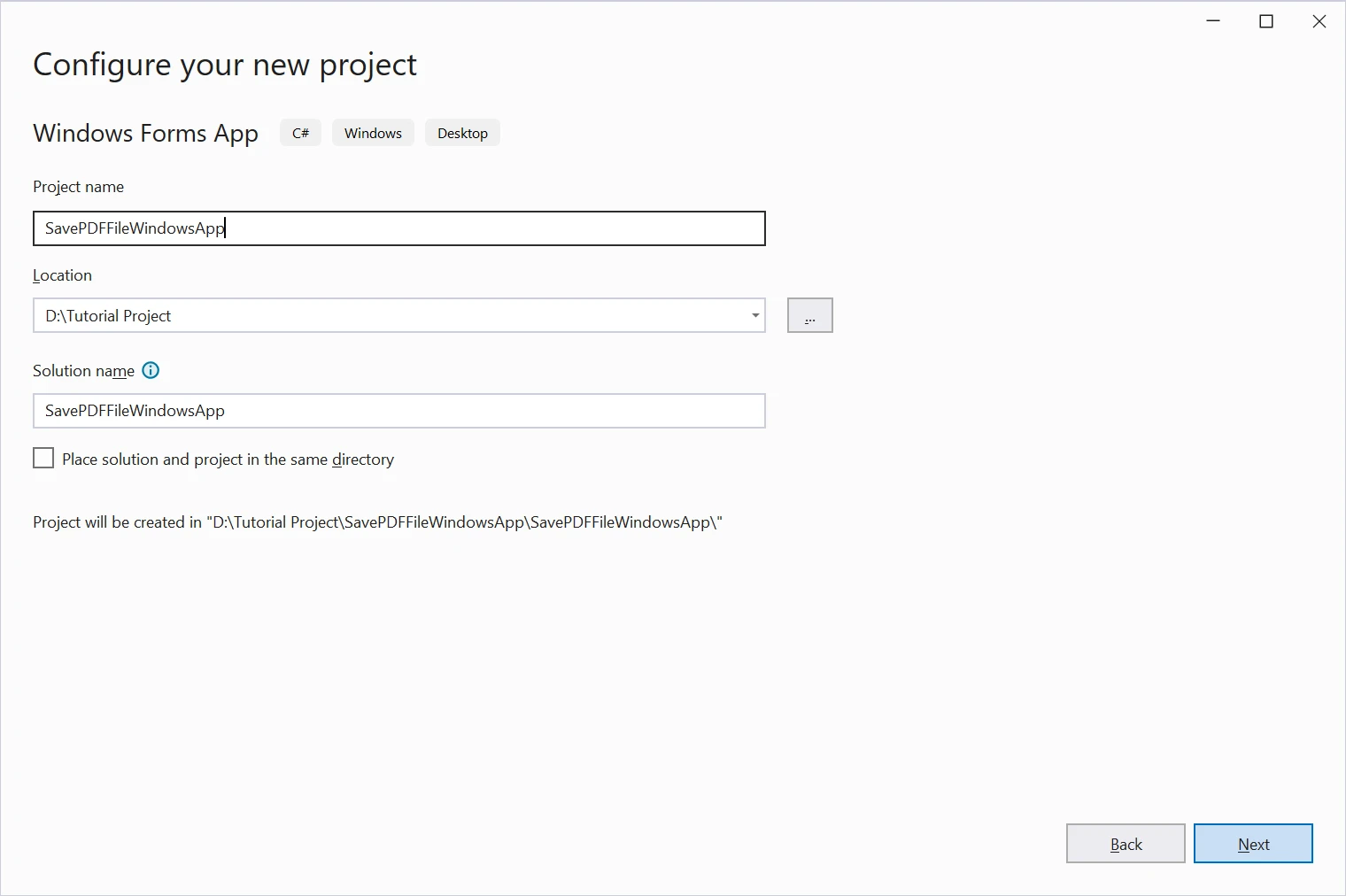
**Project location**
5. Choose .NET Framework. Select .NET 7.0 from the drop-down menu.
6. Click on the **Create** button.
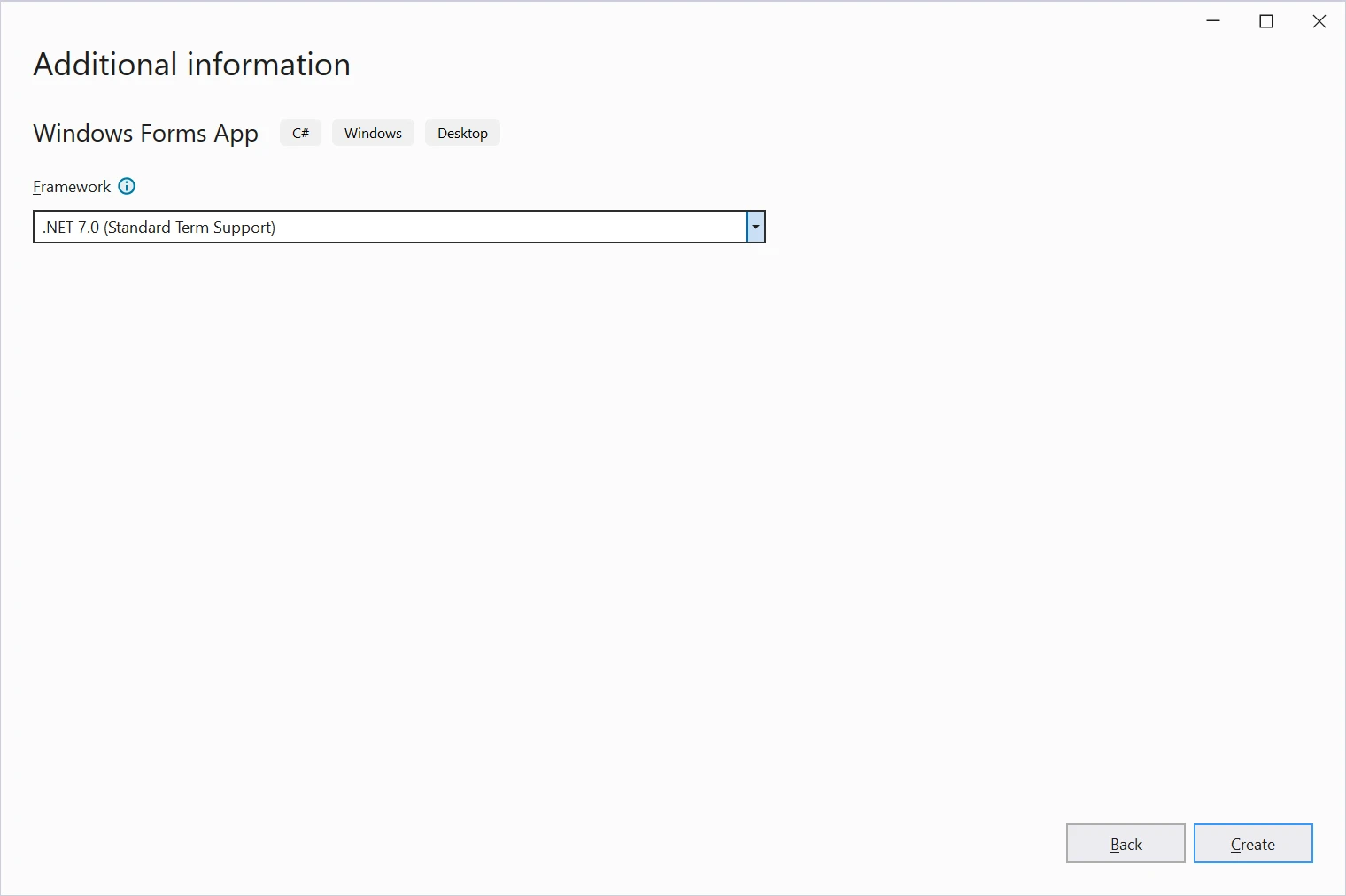
**Additional Information**
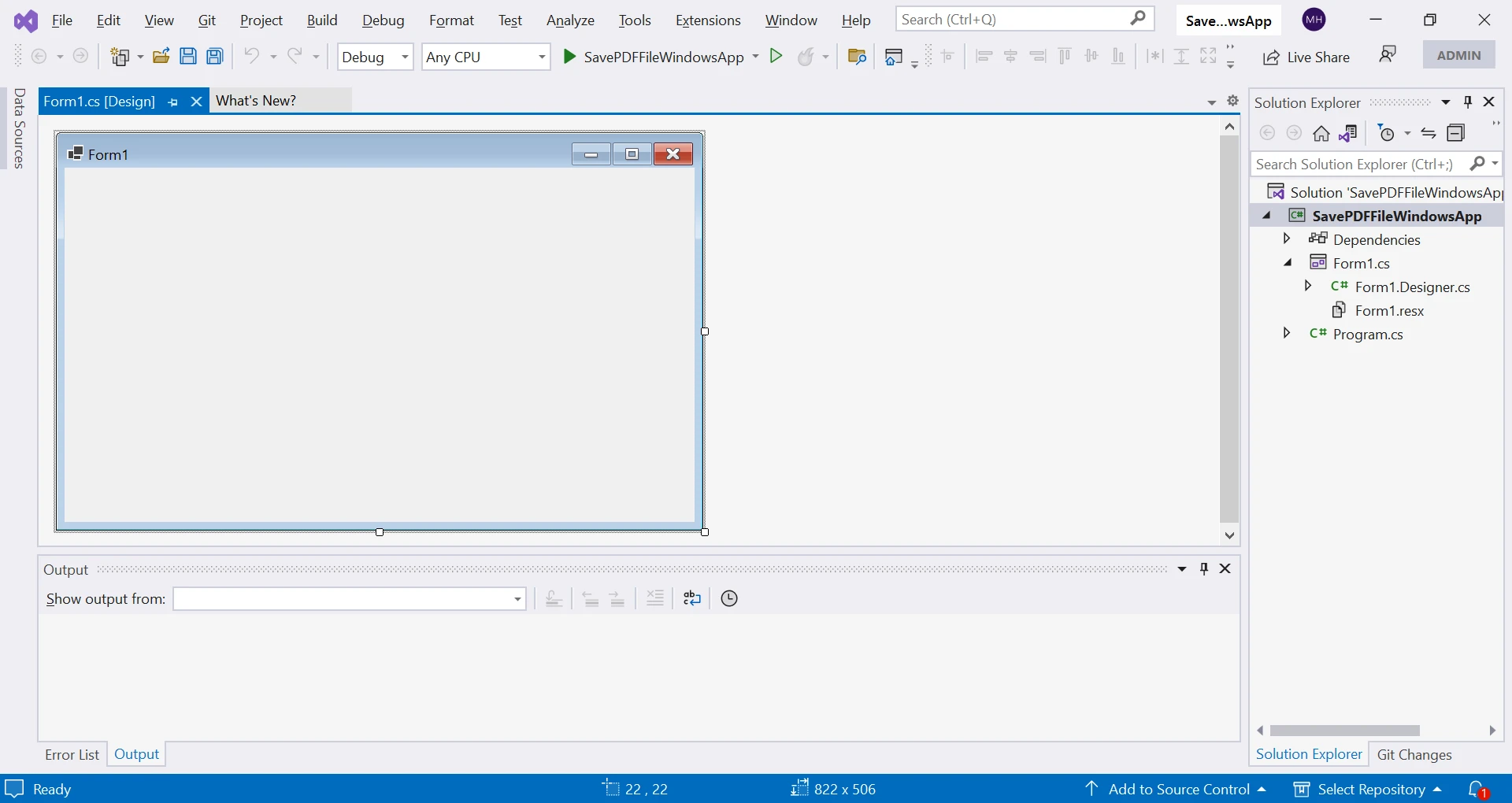
7. Visual Studio will create a new C# Windows Forms Application project for you, with a default form named "Form1" added to the project as shown below.
**Form1 project**
That's it! Now we will start building the Windows Forms Application using the designer, adding controls and functionality for creating and saving a PDF document file.
## Step 2: Design the Form
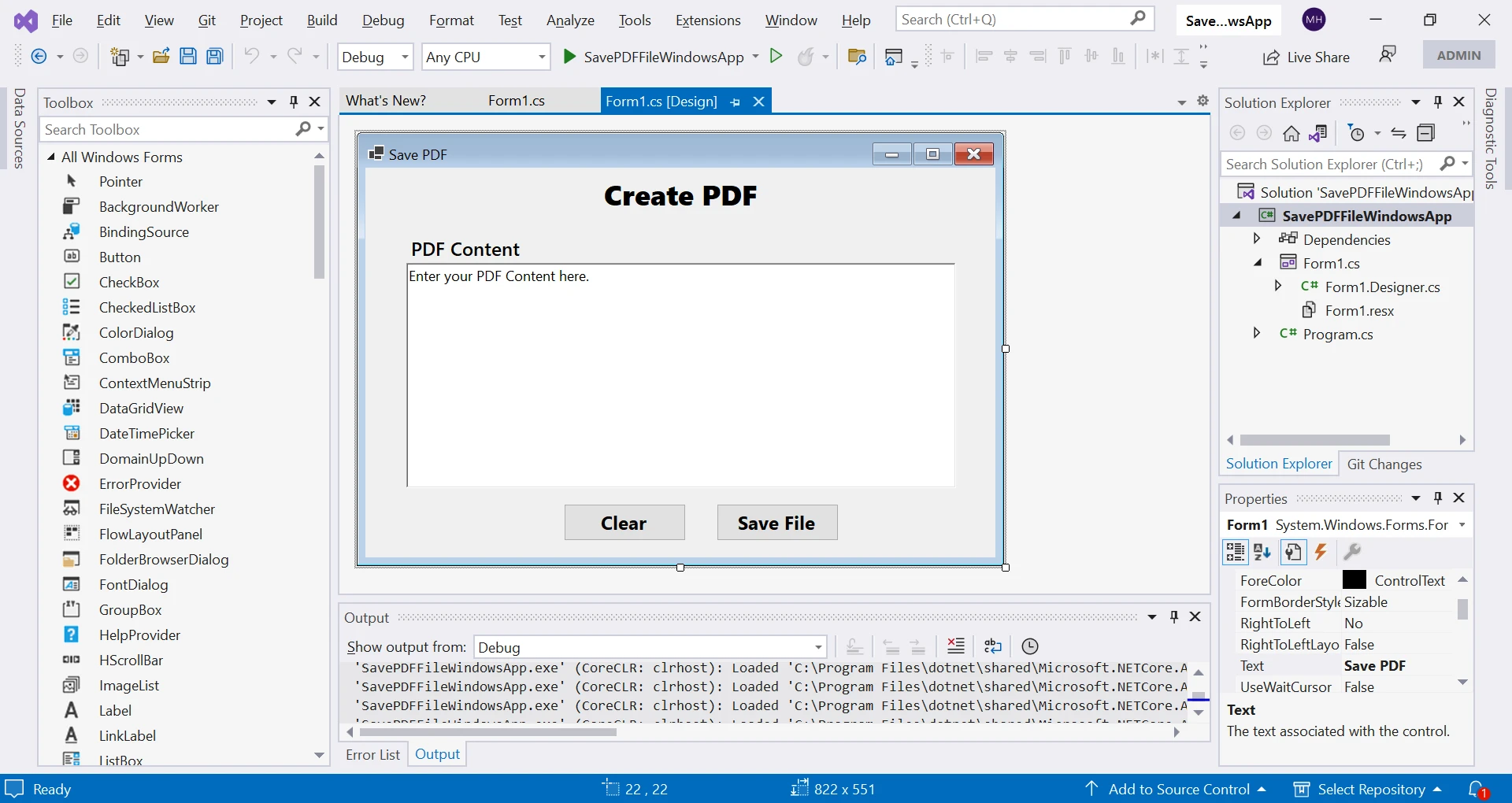
You can design the form as per your preferences. This tutorial will make a minimalistic design by adding two labels, one rich text box, and two buttons.
**Adding buttons to form**
## Step 3: Install IronPDF
The next step is to install IronPDF in this project to use its rich functionalities.
IronPDF can be installed using NuGet Package Manager in Visual Studio. You can navigate to the NuGet Package Manager Console by going to **Tools** > **NuGet Package Manager** > **Package Manager Console**.
Type the following command and press Enter:
```shell
:ProductInstall
```
This command will download and install the IronPDF package in your project. Once installed, we can start using IronPDF.
## Write Code to Create and Save PDF File
To start with the flow, write two methods: `Save_Click` and `getFilePath` in the `Form1.cs` class. These methods are used together to save the content of a text box as a PDF file using the [ChromePdfRenderer Class](/object-reference/api/IronPdf.ChromePdfRenderer.html) library. Let's go through each method to understand how it works.
### Save_Click Method (Create PDF Document)
The following method is an event handler for a button-click event. The purpose of this method is to save the content of a text box as a PDF file.
```csharp
private void Save_Click(object sender, EventArgs e)
{
    // Get the file path to save the PDF file.
    string filename = getFilePath();

    // If the file path is not empty or null, proceed with saving the PDF file.
    if (!String.IsNullOrEmpty(filename))
    {
        // Create a new instance of the ChromePdfRenderer class.
        var renderer = new ChromePdfRenderer();

        // Render the file contents of the text box as a PDF document using the ChromePdfRenderer.
        var pdfDocument = renderer.RenderHtmlAsPdf(pdfContent.Text);

        // Save the PDF document to the specified file path using the SaveAs method.
        pdfDocument.SaveAs(filename);

        // Show a message box to indicate that the PDF file has been saved successfully.
        MessageBox.Show("PDF has been saved Successfully!");
    }
}
```
Here's a step-by-step breakdown of what this method does:
1. The method calls the `getFilePath` method to get the file path where the PDF file will be saved.
2. If the file path is not empty or null, the method proceeds with saving the PDF file.
3. The method creates a new instance of the `ChromePdfRenderer` class. This is a library that provides a way to convert HTML content into PDF documents using the Google Chrome browser engine.
4. The method then uses the [RenderHtmlAsPdf Method](/object-reference/api/IronPdf.ChromePdfRenderer.html#IronPdf_ChromePdfRenderer_RenderHtmlAsPdf_System_String_System_String_System_String_) of the `ChromePdfRenderer` class to convert the HTML content of the text box `pdfContent` into a PDF document. This PDF document is assigned to the [PdfDocument Variable](/object-reference/api/IronPdf.PdfDocument.html).
5. The method saves the PDF document to the specified file path using the [SaveAs Method](/object-reference/api/IronPdf.PdfDocument.html#IronPdf_PdfDocument_SaveAs_System_String_System_Boolean_) of the `PdfDocument` class.
6. Finally, the method shows a message box to indicate that the PDF file has been saved successfully.
### getFilePath Method (Save PDF Files)
This method is used to display a `SaveFileDialog` to the user to select a file path where the PDF file will be saved.
```csharp
public string getFilePath()
{
// Create a new instance of the SaveFileDialog class.
SaveFileDialog saveFileDialog1 = new SaveFileDialog();
// Set the initial directory where the SaveFileDialog will open.
saveFileDialog1.InitialDirectory = @"D:\";
// Set the title of the SaveFileDialog.
saveFileDialog1.Title = "Save the PDF Files";
// Set the SaveFileDialog to check if the specified path exists.
saveFileDialog1.CheckPathExists = true;
// Set the default extension for the file type.
saveFileDialog1.DefaultExt = ".pdf";
// Set the filter to display only PDF files or all files.
saveFileDialog1.Filter = "PDF files (*.pdf)|*.pdf|All files (*.*)|*.*";
// Set the filter index to display the PDF filter as the default.
saveFileDialog1.FilterIndex = 2;
// Set the RestoreDirectory property to true so that the SaveFileDialog
// restores the current directory before closing.
saveFileDialog1.RestoreDirectory = true;
// Show the SaveFileDialog and get the result.
if (saveFileDialog1.ShowDialog() == DialogResult.OK)
{
// If the user clicked the OK button in the SaveFileDialog, return the selected file path.
return saveFileDialog1.FileName;
}
// If the user did not click the OK button, return an empty string.
return String.Empty;
}
```
Here's a step-by-step breakdown of what this method does:
1. The method creates a new instance of the `SaveFileDialog` class. This class is part of the Windows Forms library and provides a dialog box that allows the user to select a file path where the PDF file will be saved.
2. The method sets several properties of the `SaveFileDialog` object to customize its behavior. The `InitialDirectory` property sets the directory where the dialog box will first open. The `Title` property sets the title of the dialog box. The `CheckPathExists` property specifies whether the dialog box should check if the specified path exists. The `DefaultExt` property sets the default file extension for the file type. The `Filter` property sets the file type filters that are displayed in the dialog box. The `FilterIndex` property sets the default filter to display. Finally, the `RestoreDirectory` property specifies whether the dialog box should restore the current directory before closing.
3. The method shows the `SaveFileDialog` by calling its `ShowDialog` method. This method displays the dialog box and returns a `DialogResult` value that indicates whether the user clicked the "OK" button or the Cancel button.
4. If the user clicks the "OK" button, the method returns the file path that the user selected by accessing the `FileName` property of the `SaveFileDialog`.
5. If the user clicks the "Cancel" button or closes the dialog box, the method returns an empty string.
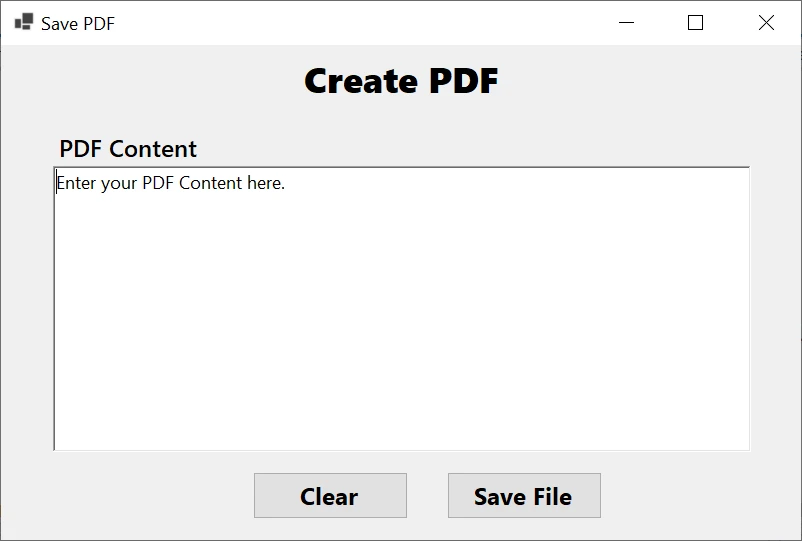
Let's run the project and see the output. Run the project, and the following form will open.
**Running Windows Forms project**
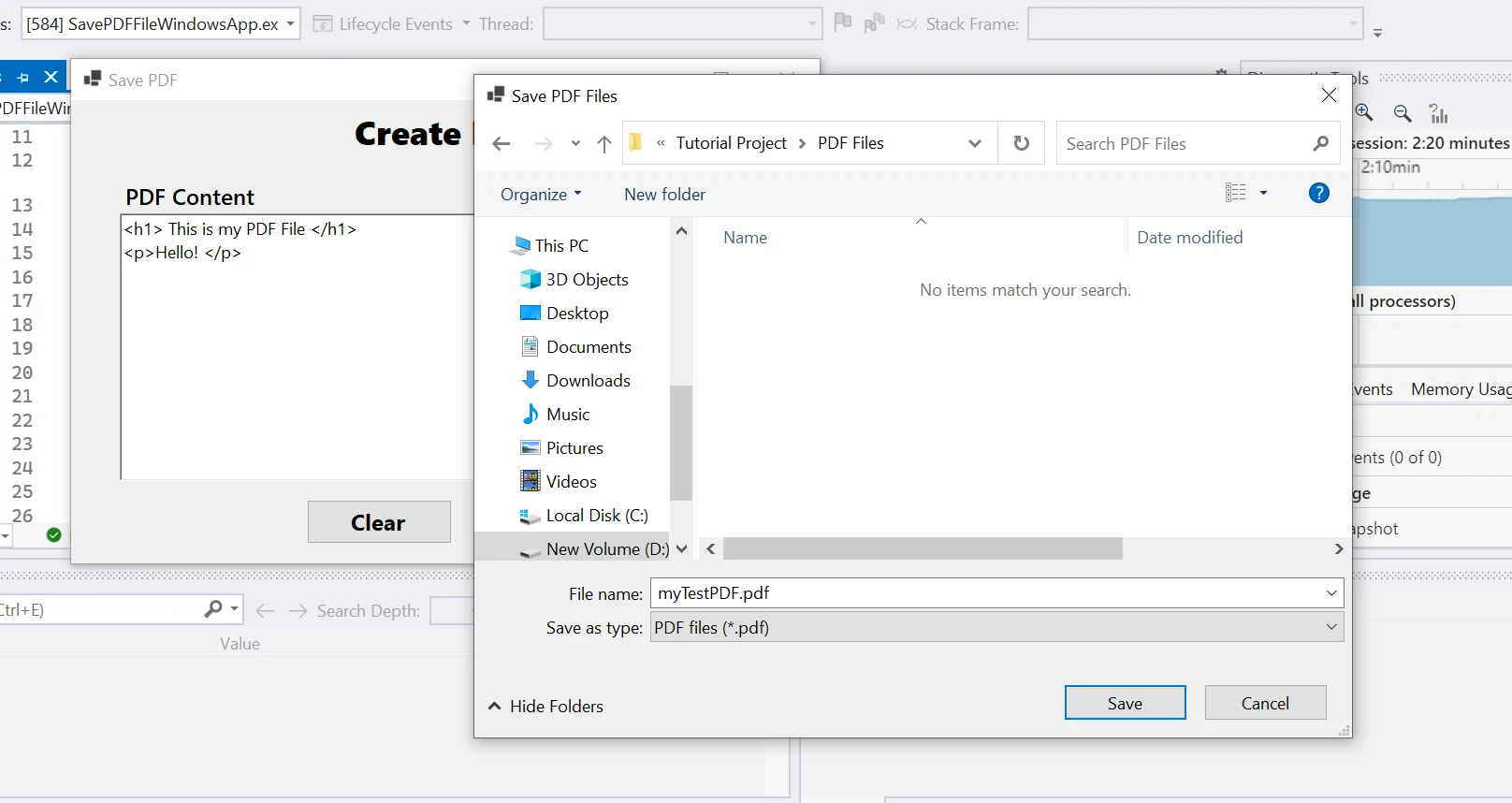
Enter your PDF content and click on the "Save" button as shown below.
**Save dialog box**
The following PDF is created.
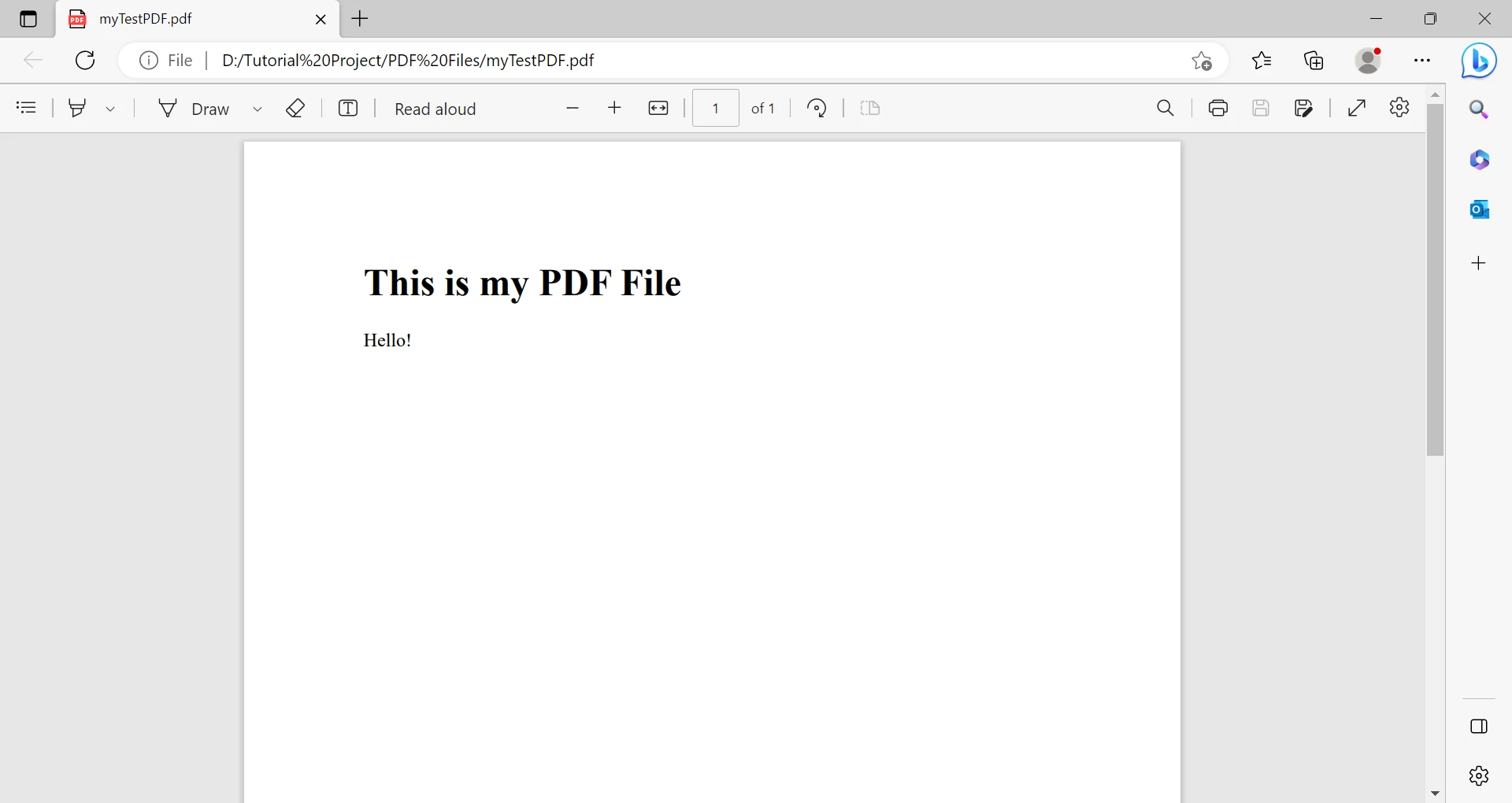
**Created PDF file**
IronPDF provides a simple way to convert HTML content into PDF documents and save them to a user-selected file path using the `ChromePdfRenderer` class and the `SaveFileDialog` dialog box.
## Conclusion
Saving PDF files from a Windows Forms Application is a common requirement, and IronPDF provides an easy-to-use and flexible method to accomplish this task. This article demonstrated how to use IronPDF to create, add content, and save files in a C# Windows Forms Application. With IronPDF, developers can generate high-quality PDF files from their applications with just a few lines of code.
IronPDF offers a range of features such as [HTML to PDF Conversion Tutorial](/tutorials/html-to-pdf/), PDF [Merging Example Code](/examples/merge-pdfs/), [Splitting PDF Pages Guide](/examples/split-pdf-pages-csharp/), and [Extracting Text and Images How-to](/how-to/extract-text-and-images/), and more. IronPDF is free for development and available under a [Commercial License](licensing) with [a Free Trial](trial-license), which allows developers to use it in commercial projects and includes dedicated support and updates.
Additionally, IronPDF is part of the [Iron Suite](https://ironsoftware.com/enterprise/), which is a bundle of .NET software components that includes libraries for:
- Barcode generation ([IronBarcode](https://ironsoftware.com/csharp/barcode/)),
- Excel management ([IronXL](https://ironsoftware.com/csharp/excel/)),
- Text extraction ([IronOCR](https://ironsoftware.com/csharp/ocr/))
[Purchasing the complete Iron Suite](ironsuite) is a cost-effective solution as you can get all five products for the price of two.
This article will explore how to use IronPDF to save PDF files from a Windows Forms Application or any .NET Application.
The IronPDF Library is a .NET library that provides easy-to-use classes and methods for generating and working with PDF files in C# applications. It allows developers to create, modify, and save PDF files with just a few lines of code, making it an excellent choice for Windows Forms Applications.
Step 1: Create a New Windows Forms application
First, create a new Visual Studio Project. Here are the steps to create a new C# Windows Forms Application in Visual Studio 2022.
Open Visual Studio 2022 as shown below.
Visual Studio 2022
Click on "Create a new project" on the start page or go to "File" > "New" > "Project".
In the "Create a new project" dialog box, select "Windows Forms App" or "Windows Forms App (.NET Framework)" under "Create a new project" as shown below.
New Forms App
Enter a name for your project and choose a location to save it to.
Project location
Choose .NET Framework. Select .NET 7.0 from the drop-down menu.
Click on the Create button.
Additional Information
Visual Studio will create a new C# Windows Forms Application project for you, with a default form named "Form1" added to the project as shown below.
Form1 project
That's it! Now we will start building the Windows Forms Application using the designer, adding controls and functionality for creating and saving a PDF document file.
Step 2: Design the Form
You can design the form as per your preferences. This tutorial will make a minimalistic design by adding two labels, one rich text box, and two buttons.
Adding buttons to form
Step 3: Install IronPDF
The next step is to install IronPDF in this project to use its rich functionalities.
IronPDF can be installed using NuGet Package Manager in Visual Studio. You can navigate to the NuGet Package Manager Console by going to Tools > NuGet Package Manager > Package Manager Console.
Type the following command and press Enter:
PM > Install-Package IronPdf
Install-Package IronPdf
This command will download and install the IronPDF package in your project. Once installed, we can start using IronPDF.
Write Code to Create and Save PDF File
To start with the flow, write two methods: Save_Click and getFilePath in the Form1.cs class. These methods are used together to save the content of a text box as a PDF file using the ChromePdfRenderer Class library. Let's go through each method to understand how it works.
Save_Click Method (Create PDF Document)
The following method is an event handler for a button-click event. The purpose of this method is to save the content of a text box as a PDF file.
private voidSave_Click(object sender, EventArgs e){ // Get the file path to save the PDF file. string filename = getFilePath(); // If the file path is not empty or null, proceed with saving the PDF file. if (!String.IsNullOrEmpty(filename)) { // Create a new instance of the ChromePdfRenderer class. var renderer = new ChromePdfRenderer(); // Render the file contents of the text box as a PDF document using the ChromePdfRenderer. var pdfDocument = renderer.RenderHtmlAsPdf(pdfContent.Text); // Save the PDF document to the specified file path using the SaveAs method. pdfDocument.SaveAs(filename); // Show a message box to indicate that the PDF file has been saved successfully.MessageBox.Show("PDF has been saved Successfully!"); }}
private void Save_Click(object sender, EventArgs e)
{
    // Get the file path to save the PDF file.
    string filename = getFilePath();

    // If the file path is not empty or null, proceed with saving the PDF file.
    if (!String.IsNullOrEmpty(filename))
    {
        // Create a new instance of the ChromePdfRenderer class.
        var renderer = new ChromePdfRenderer();

        // Render the file contents of the text box as a PDF document using the ChromePdfRenderer.
        var pdfDocument = renderer.RenderHtmlAsPdf(pdfContent.Text);

        // Save the PDF document to the specified file path using the SaveAs method.
        pdfDocument.SaveAs(filename);

        // Show a message box to indicate that the PDF file has been saved successfully.
        MessageBox.Show("PDF has been saved Successfully!");
    }
}
Private Sub Save_Click(ByVal sender AsObject, ByVal e AsEventArgs) ' Get the file path to save the PDF file. Dim filename AsString = getFilePath() ' If the file path is not empty or null, proceed with saving the PDF file. IfNotString.IsNullOrEmpty(filename) Then ' Create a new instance of the ChromePdfRenderer class. Dim renderer = New ChromePdfRenderer() ' Render the file contents of the text box as a PDF document using the ChromePdfRenderer. Dim pdfDocument = renderer.RenderHtmlAsPdf(pdfContent.Text) ' Save the PDF document to the specified file path using the SaveAs method. pdfDocument.SaveAs(filename) ' Show a message box to indicate that the PDF file has been saved successfully.MessageBox.Show("PDF has been saved Successfully!") End IfEnd Sub
Private Sub Save_Click(ByVal sender As Object, ByVal e As EventArgs)
	' Get the file path to save the PDF file.
	Dim filename As String = getFilePath()

	' If the file path is not empty or null, proceed with saving the PDF file.
	If Not String.IsNullOrEmpty(filename) Then
		' Create a new instance of the ChromePdfRenderer class.
		Dim renderer = New ChromePdfRenderer()

		' Render the file contents of the text box as a PDF document using the ChromePdfRenderer.
		Dim pdfDocument = renderer.RenderHtmlAsPdf(pdfContent.Text)

		' Save the PDF document to the specified file path using the SaveAs method.
		pdfDocument.SaveAs(filename)

		' Show a message box to indicate that the PDF file has been saved successfully.
		MessageBox.Show("PDF has been saved Successfully!")
	End If
End Sub
Here's a step-by-step breakdown of what this method does:
The method calls the getFilePath method to get the file path where the PDF file will be saved.
If the file path is not empty or null, the method proceeds with saving the PDF file.
The method creates a new instance of the ChromePdfRenderer class. This is a library that provides a way to convert HTML content into PDF documents using the Google Chrome browser engine.
The method then uses the RenderHtmlAsPdf Method of the ChromePdfRenderer class to convert the HTML content of the text box pdfContent into a PDF document. This PDF document is assigned to the PdfDocument Variable.
The method saves the PDF document to the specified file path using the SaveAs Method of the PdfDocument class.
Finally, the method shows a message box to indicate that the PDF file has been saved successfully.
getFilePath Method (Save PDF Files)
This method is used to display a SaveFileDialog to the user to select a file path where the PDF file will be saved.
public string getFilePath(){ // Create a new instance of the SaveFileDialog class. SaveFileDialog saveFileDialog1 = new SaveFileDialog(); // Set the initial directory where the SaveFileDialog will open. saveFileDialog1.InitialDirectory = @"D:\"; // Set the title of the SaveFileDialog. saveFileDialog1.Title = "Save the PDF Files"; // Set the SaveFileDialog to check if the specified path exists. saveFileDialog1.CheckPathExists = true; // Set the default extension for the file type. saveFileDialog1.DefaultExt = ".pdf"; // Set the filter to display only PDF files or all files. saveFileDialog1.Filter = "PDF files (*.pdf)|*.pdf|All files (*.*)|*.*"; // Set the filter index to display the PDF filter as the default. saveFileDialog1.FilterIndex = 2; // Set the RestoreDirectory property to true so that the SaveFileDialog // restores the current directory before closing. saveFileDialog1.RestoreDirectory = true; // Show the SaveFileDialog and get the result. if (saveFileDialog1.ShowDialog() == DialogResult.OK) { // If the user clicked the OK button in the SaveFileDialog, return the selected file path. return saveFileDialog1.FileName; } // If the user did not click the OK button, return an empty string. returnString.Empty;}
public string getFilePath()
{
    // Create a new instance of the SaveFileDialog class.
    SaveFileDialog saveFileDialog1 = new SaveFileDialog();

    // Set the initial directory where the SaveFileDialog will open.
    saveFileDialog1.InitialDirectory = @"D:\";

    // Set the title of the SaveFileDialog.
    saveFileDialog1.Title = "Save the PDF Files";

    // Set the SaveFileDialog to check if the specified path exists.
    saveFileDialog1.CheckPathExists = true;

    // Set the default extension for the file type.
    saveFileDialog1.DefaultExt = ".pdf";

    // Set the filter to display only PDF files or all files.
    saveFileDialog1.Filter = "PDF files (*.pdf)|*.pdf|All files (*.*)|*.*";

    // Set the filter index to display the PDF filter as the default.
    saveFileDialog1.FilterIndex = 2;

    // Set the RestoreDirectory property to true so that the SaveFileDialog
    // restores the current directory before closing.
    saveFileDialog1.RestoreDirectory = true;

    // Show the SaveFileDialog and get the result.
    if (saveFileDialog1.ShowDialog() == DialogResult.OK)
    {
        // If the user clicked the OK button in the SaveFileDialog, return the selected file path.
        return saveFileDialog1.FileName;
    }
    // If the user did not click the OK button, return an empty string.
    return String.Empty;
}
Public Function getFilePath() AsString ' Create a new instance of the SaveFileDialog class. Dim saveFileDialog1 As New SaveFileDialog() ' Set the initial directory where the SaveFileDialog will open. saveFileDialog1.InitialDirectory = "D:\" ' Set the title of the SaveFileDialog. saveFileDialog1.Title = "Save the PDF Files" ' Set the SaveFileDialog to check if the specified path exists. saveFileDialog1.CheckPathExists = True ' Set the default extension for the file type. saveFileDialog1.DefaultExt = ".pdf" ' Set the filter to display only PDF files or all files. saveFileDialog1.Filter = "PDF files (*.pdf)|*.pdf|All files (*.*)|*.*" ' Set the filter index to display the PDF filter as the default. saveFileDialog1.FilterIndex = 2 ' Set the RestoreDirectory property to true so that the SaveFileDialog ' restores the current directory before closing. saveFileDialog1.RestoreDirectory = True ' Show the SaveFileDialog and get the result. If saveFileDialog1.ShowDialog() = DialogResult.OKThen ' If the user clicked the OK button in the SaveFileDialog, return the selected file path. Return saveFileDialog1.FileName End If ' If the user did not click the OK button, return an empty string. ReturnString.EmptyEnd Function
Public Function getFilePath() As String
	' Create a new instance of the SaveFileDialog class.
	Dim saveFileDialog1 As New SaveFileDialog()

	' Set the initial directory where the SaveFileDialog will open.
	saveFileDialog1.InitialDirectory = "D:\"

	' Set the title of the SaveFileDialog.
	saveFileDialog1.Title = "Save the PDF Files"

	' Set the SaveFileDialog to check if the specified path exists.
	saveFileDialog1.CheckPathExists = True

	' Set the default extension for the file type.
	saveFileDialog1.DefaultExt = ".pdf"

	' Set the filter to display only PDF files or all files.
	saveFileDialog1.Filter = "PDF files (*.pdf)|*.pdf|All files (*.*)|*.*"

	' Set the filter index to display the PDF filter as the default.
	saveFileDialog1.FilterIndex = 2

	' Set the RestoreDirectory property to true so that the SaveFileDialog
	' restores the current directory before closing.
	saveFileDialog1.RestoreDirectory = True

	' Show the SaveFileDialog and get the result.
	If saveFileDialog1.ShowDialog() = DialogResult.OK Then
		' If the user clicked the OK button in the SaveFileDialog, return the selected file path.
		Return saveFileDialog1.FileName
	End If
	' If the user did not click the OK button, return an empty string.
	Return String.Empty
End Function
Here's a step-by-step breakdown of what this method does:
The method creates a new instance of the SaveFileDialog class. This class is part of the Windows Forms library and provides a dialog box that allows the user to select a file path where the PDF file will be saved.
The method sets several properties of the SaveFileDialog object to customize its behavior. The InitialDirectory property sets the directory where the dialog box will first open. The Title property sets the title of the dialog box. The CheckPathExists property specifies whether the dialog box should check if the specified path exists. The DefaultExt property sets the default file extension for the file type. The Filter property sets the file type filters that are displayed in the dialog box. The FilterIndex property sets the default filter to display. Finally, the RestoreDirectory property specifies whether the dialog box should restore the current directory before closing.
The method shows the SaveFileDialog by calling its ShowDialog method. This method displays the dialog box and returns a DialogResult value that indicates whether the user clicked the "OK" button or the Cancel button.
If the user clicks the "OK" button, the method returns the file path that the user selected by accessing the FileName property of the SaveFileDialog.
If the user clicks the "Cancel" button or closes the dialog box, the method returns an empty string.
Let's run the project and see the output. Run the project, and the following form will open.
Running Windows Forms project
Enter your PDF content and click on the "Save" button as shown below.
Save dialog box
The following PDF is created.
Created PDF file
IronPDF provides a simple way to convert HTML content into PDF documents and save them to a user-selected file path using the ChromePdfRenderer class and the SaveFileDialog dialog box.
Conclusion
Saving PDF files from a Windows Forms Application is a common requirement, and IronPDF provides an easy-to-use and flexible method to accomplish this task. This article demonstrated how to use IronPDF to create, add content, and save files in a C# Windows Forms Application. With IronPDF, developers can generate high-quality PDF files from their applications with just a few lines of code.
Curtis Chau holds a Bachelor’s degree in Computer Science (Carleton University) and specializes in front-end development with expertise in Node.js, TypeScript, JavaScript, and React. Passionate about crafting intuitive and aesthetically pleasing user interfaces, Curtis enjoys working with modern frameworks and creating well-structured, visually appealing manuals.





 Visual Studio 2022
 New Forms App
 Project location
 Additional Information
 Form1 project
 Adding buttons to form
 Running Windows Forms project
 Save dialog box
 Created PDF file