In the world of software development, managing PDF documents is a ubiquitous requirement. From generating invoices to securing contracts with electronic and digital signatures, developers constantly seek efficient ways to integrate PDF functionality into their applications.
While the term "PDF SDK" is often used to describe a comprehensive suite of tools, it's crucial to understand that a powerful PDF library like IronPDF can offer the full PDF functionality developers expect, often with greater flexibility and ease of use than traditional, monolithic SDKs.
PDF SDK vs. PDF Library: A Quick Refresher
As discussed, an SDK (Software Development Kit) is a broad collection of tools, libraries, documentation, and samples designed for building applications on a specific platform. A library, on the other hand, is a focused collection of code designed to perform specific tasks.
Many perceive a "PDF SDK" as a complete package for all things PDF. However, for .NET developers, IronPDF exemplifies how a high-performance PDF library can serve as your de facto PDF SDK, providing comprehensive capabilities without the unnecessary bloat of a broader kit. It's a specialized tool that empowers you with complete control over your PDF files and document workflows.
IronPDF: Your Comprehensive .NET PDF Library for SDK-Level Functionality
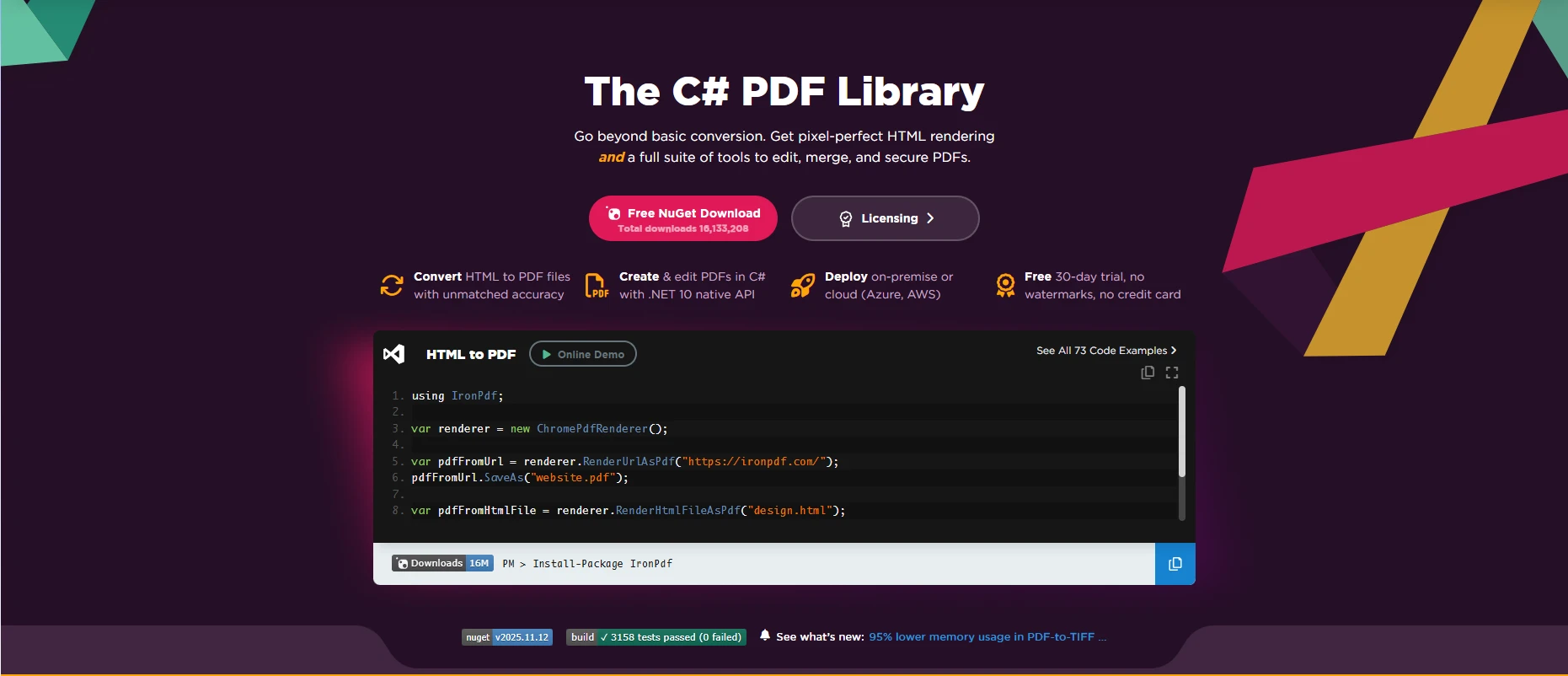
IronPDF is a leading .NET (including .NET Core) PDF library built for software development across multiple platforms. It allows developers to create PDF files, perform PDF editing, extract data, and manage PDF security within their applications, all with just a few lines of code. It's the go-to solution for integrating advanced PDF functionality into web app, desktop, and even future mobile apps (via React Native or Xamarin integration).
Key Features and How IronPDF Delivers
Let's explore how IronPDF provides the core API features you'd expect from the best PDF SDK:
Document Generation
- From HTML/CSS: IronPDF excels at rendering HTML and CSS directly into high fidelity viewing PDFs. This means you can leverage existing web designs or dynamically generate content from your web applications. It supports modern CSS3, JavaScript, and responsive layouts, ensuring your generated documents look exactly as intended.
- From Microsoft Office Documents: Easily convert Microsoft Office documents (DOCX) into PDFs, streamlining document generation workflows.
- Adding Content: Developers can dynamically add content like text, images, headers, footers, page numbers (e.g., to the first page or all pages), and complex layouts.
PDF Editing and Manipulation
- Modify Existing PDFs: IronPDF provides robust APIs for editing existing PDF documents. You can add or remove pages, merge multiple files, split large PDFs, and update text or image formats.
- Annotations and Forms: Add annotations, work with existing form fields, and even create new forms programmatically. This is crucial for interactive documents and data extraction.
- Watermarking and Redaction: Enhance PDF security by applying watermarks or redacting sensitive information and personally identifiable information (PII) to ensure compliance and privacy.
- Text and Image Extraction: Efficiently extract data from PDFs, whether it's plain text, structured data, or even images. This is vital for document management systems that need to process the PDF content of files.
- Form Field Data: Programmatically read and write data to and from form fields, facilitating automated workflows.
Security and Digital Signatures
- Password Protection: Secure your PDF documents with encryption and password protection.
- Electronic and Digital Signatures: IronPDF supports adding electronic signatures and digital signatures to PDFs (sign PDFs), ensuring document authenticity and non-repudiation. This is essential for legal and financial institutions.
- Signature Fields: Create and manage signature fields within your PDFs, enabling users to sign documents directly.
IronPDF vs. The Alternatives: A Comparison
When evaluating a "best PDF SDK," developers often compare native C# libraries to older Java-based solutions or heavyweight vendors like Adobe PDF Library developer tools. IronPDF consistently provides key advantages in ease of use, performance, and deployment.
Key Differentiators:
- HTML Rendering Quality: Unlike older PDF libraries that rely on complex, low-level APIs to add content and structure, IronPDF uses a Chromium engine. This ensures that documents generated from complex HTML and CSS are pixel-perfect and fully compliant with modern web standards, mirroring what you see in a browser.
- Simplified .NET Ecosystem: Development teams working in the .NET ecosystem avoid the overhead, performance hit, and deployment complexity associated with integrating external Java-based or unmanaged C++ SDK components. You use the same codebase and the same functionality.
- Deployment: Being a pure .NET library, it offers flexible deployment options. It is simple to deploy to a server environment without needing external services or complex installers, unlike some other tools that might bundle large, platform-specific binaries.
Why Choose IronPDF for Your Development Needs?
- Seamless Integration: Designed specifically for .NET Core and .NET (Framework), IronPDF offers seamless integration into your existing projects.
- Cross-Platform Support: With cross platform support, you can develop on Windows, Linux, macOS, and deploy your solutions consistently. The same functionality and same codebase can be used across different environments.
- High Performance: Built for speed and efficiency, IronPDF handles large files and complex rendering tasks with high performance, eliminating months of development time optimizing slower engines.
- Fully Compliant: IronPDF generates fully compliant PDFs, ensuring compatibility with Acrobat and other industry-standard tools.
- Developer-Friendly: Boasting clear documentation, numerous sample applications, and a straightforward core API, IronPDF empowers developers to achieve their goals quickly. You don't need to be a PDF expert; the library handles the complexities as building blocks.
- No Adobe PDF Library Dependency: Unlike solutions that might require an Adobe PDF Library, IronPDF is completely self-contained, offering a simpler deployment model.
Code Examples: SDK Functionality Delivered with Library Simplicity
The true measure of a powerful PDF library like IronPDF is its ability to provide SDK-level functionality - handling complex tasks such as rendering, security, and data extraction - through simple, high-level commands. This consolidation is what allows IronPDF to function as a highly efficient PDF SDK replacement for .NET developers.
1. Document Generation: Abstracting Complex PDF Rendering
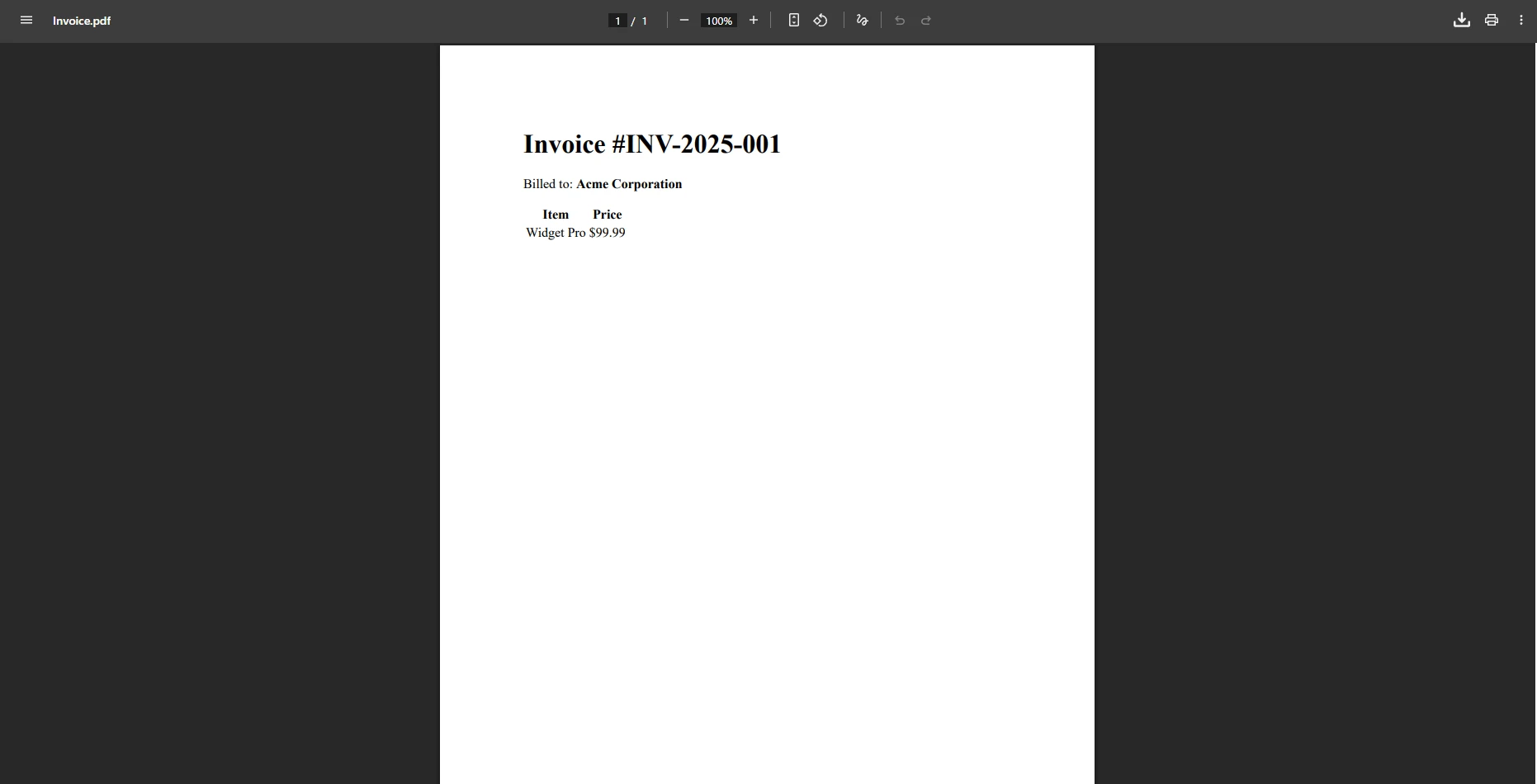
A comprehensive PDF SDK must provide reliable, high-fidelity viewing document generation across various formats. Instead of complex APIs for rendering fonts, layouts, and color spaces, IronPDF uses a single, powerful method to turn modern web technology (HTML) into a complete PDF, giving developers complete control over the final output.
using IronPdf;

// SDK Functionality: The ChromePdfRenderer acts as the specialized rendering engine
// found within a robust PDF SDK.
var renderer = new ChromePdfRenderer();

// Data Input: Seamlessly integrate dynamic data from your web app or server.
string customerName = "Acme Corporation";
string invoiceNumber = "INV-2025-001";

string htmlContent = $@"
    <html>
        <body>
            <h1>Invoice #{invoiceNumber}</h1>
            <p>Billed to: <strong>{customerName}</strong></p>
            <table>
                <thead><tr><th>Item</th><th>Price</th></tr></thead>
                <tbody>
                    <tr><td>Widget Pro</td><td>$99.99</td></tr>
                </tbody>
            </table>
        </body>
    </html>";

// Core API: Create PDF (SDK feature) from HTML/CSS in just a few lines of code.
var pdfDocument = renderer.RenderHtmlAsPdf(htmlContent);

// Output: SDK-level capability to save the generated PDF file.
pdfDocument.SaveAs("Invoice.pdf");
using IronPdf;

// SDK Functionality: The ChromePdfRenderer acts as the specialized rendering engine
// found within a robust PDF SDK.
var renderer = new ChromePdfRenderer();

// Data Input: Seamlessly integrate dynamic data from your web app or server.
string customerName = "Acme Corporation";
string invoiceNumber = "INV-2025-001";

string htmlContent = $@"
    <html>
        <body>
            <h1>Invoice #{invoiceNumber}</h1>
            <p>Billed to: <strong>{customerName}</strong></p>
            <table>
                <thead><tr><th>Item</th><th>Price</th></tr></thead>
                <tbody>
                    <tr><td>Widget Pro</td><td>$99.99</td></tr>
                </tbody>
            </table>
        </body>
    </html>";

// Core API: Create PDF (SDK feature) from HTML/CSS in just a few lines of code.
var pdfDocument = renderer.RenderHtmlAsPdf(htmlContent);

// Output: SDK-level capability to save the generated PDF file.
pdfDocument.SaveAs("Invoice.pdf");
Imports IronPdf
' SDK Functionality: The ChromePdfRenderer acts as the specialized rendering engine
' found within a robust PDF SDK.
Dim renderer As New ChromePdfRenderer()
' Data Input: Seamlessly integrate dynamic data from your web app or server.
Dim customerName As String = "Acme Corporation"
Dim invoiceNumber As String = "INV-2025-001"
Dim htmlContent As String = $"
<html>
<body>
<h1>Invoice #{invoiceNumber}</h1>
<p>Billed to: <strong>{customerName}</strong></p>
<table>
<thead><tr><th>Item</th><th>Price</th></tr></thead>
<tbody>
<tr><td>Widget Pro</td><td>$99.99</td></tr>
</tbody>
</table>
</body>
</html>"
' Core API: Create PDF (SDK feature) from HTML/CSS in just a few lines of code.
Dim pdfDocument = renderer.RenderHtmlAsPdf(htmlContent)
' Output: SDK-level capability to save the generated PDF file.
pdfDocument.SaveAs("Invoice.pdf")
Imports IronPdf

' SDK Functionality: The ChromePdfRenderer acts as the specialized rendering engine
' found within a robust PDF SDK.
Dim renderer As New ChromePdfRenderer()

' Data Input: Seamlessly integrate dynamic data from your web app or server.
Dim customerName As String = "Acme Corporation"
Dim invoiceNumber As String = "INV-2025-001"

Dim htmlContent As String = $"
    <html>
        <body>
            <h1>Invoice #{invoiceNumber}</h1>
            <p>Billed to: <strong>{customerName}</strong></p>
            <table>
                <thead><tr><th>Item</th><th>Price</th></tr></thead>
                <tbody>
                    <tr><td>Widget Pro</td><td>$99.99</td></tr>
                </tbody>
            </table>
        </body>
    </html>"

' Core API: Create PDF (SDK feature) from HTML/CSS in just a few lines of code.
Dim pdfDocument = renderer.RenderHtmlAsPdf(htmlContent)

' Output: SDK-level capability to save the generated PDF file.
pdfDocument.SaveAs("Invoice.pdf")
Output PDF
2. PDF Security: Simplifying Digital Signatures
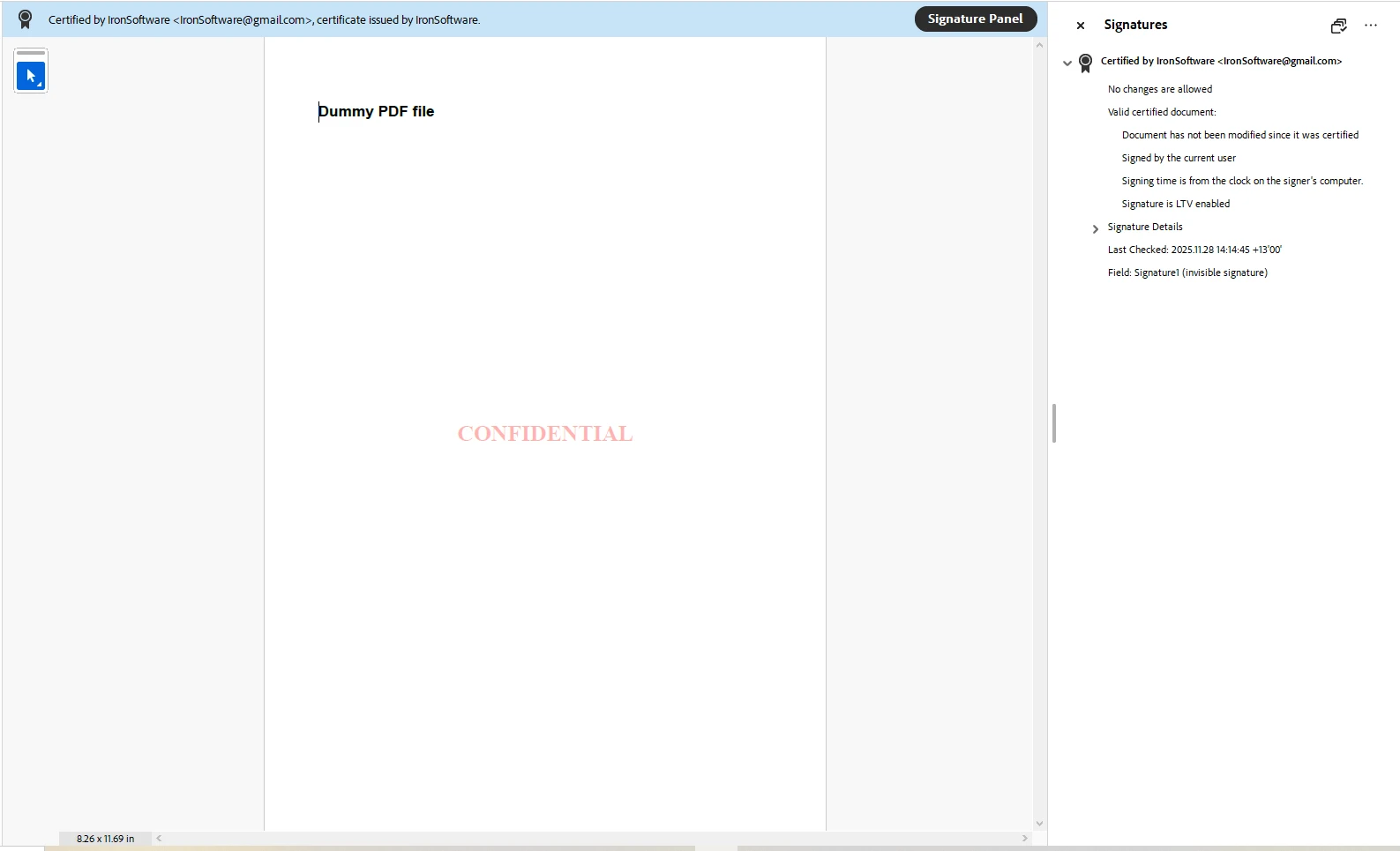
Implementing digital signatures is a complex, cryptographic task that is non-negotiable for pdf security in modern document workflows. A true PDF SDK simplifies this. IronPDF abstracts the complexity of X.509 certificates and PDF byte manipulation into a clear, dedicated API for applying electronic signatures.
using IronPdf;
using IronPdf.Signing;

// SDK Input: Load the existing PDF file that requires securing.
var pdf = PdfDocument.FromFile("input.pdf");

// SDK Component: Instantiate the Signing Tool, handling private key access and certificate setup.
var signature = new PdfSignature("certificate.pfx", "password")
{
    // SDK Feature: Adding mandatory metadata to the digital signatures.
    SigningContact = "legal@mycompany.com",
    SigningLocation = "Server Farm, USA",
    SigningReason = "Contractual Agreement"
};

// Core API: Apply the digital signature (SDK feature) to the PDF's signature fields.
pdf.Sign(signature);

// Output: A fully compliant, signed PDF, demonstrating high-performance security features.
pdf.SaveAs("Signed_Contract.pdf");
using IronPdf;
using IronPdf.Signing;

// SDK Input: Load the existing PDF file that requires securing.
var pdf = PdfDocument.FromFile("input.pdf");

// SDK Component: Instantiate the Signing Tool, handling private key access and certificate setup.
var signature = new PdfSignature("certificate.pfx", "password")
{
    // SDK Feature: Adding mandatory metadata to the digital signatures.
    SigningContact = "legal@mycompany.com",
    SigningLocation = "Server Farm, USA",
    SigningReason = "Contractual Agreement"
};

// Core API: Apply the digital signature (SDK feature) to the PDF's signature fields.
pdf.Sign(signature);

// Output: A fully compliant, signed PDF, demonstrating high-performance security features.
pdf.SaveAs("Signed_Contract.pdf");
Imports IronPdf
Imports IronPdf.Signing
' SDK Input: Load the existing PDF file that requires securing.
Dim pdf = PdfDocument.FromFile("input.pdf")
' SDK Component: Instantiate the Signing Tool, handling private key access and certificate setup.
Dim signature As New PdfSignature("certificate.pfx", "password") With {
' SDK Feature: Adding mandatory metadata to the digital signatures.
.SigningContact = "legal@mycompany.com",
.SigningLocation = "Server Farm, USA",
.SigningReason = "Contractual Agreement"
}
' Core API: Apply the digital signature (SDK feature) to the PDF's signature fields.
pdf.Sign(signature)
' Output: A fully compliant, signed PDF, demonstrating high-performance security features.
pdf.SaveAs("Signed_Contract.pdf")
Imports IronPdf
Imports IronPdf.Signing

' SDK Input: Load the existing PDF file that requires securing.
Dim pdf = PdfDocument.FromFile("input.pdf")

' SDK Component: Instantiate the Signing Tool, handling private key access and certificate setup.
Dim signature As New PdfSignature("certificate.pfx", "password") With {
    ' SDK Feature: Adding mandatory metadata to the digital signatures.
    .SigningContact = "legal@mycompany.com",
    .SigningLocation = "Server Farm, USA",
    .SigningReason = "Contractual Agreement"
}

' Core API: Apply the digital signature (SDK feature) to the PDF's signature fields.
pdf.Sign(signature)

' Output: A fully compliant, signed PDF, demonstrating high-performance security features.
pdf.SaveAs("Signed_Contract.pdf")
Signed PDF
3. PDF Security: Watermarking and Redaction
An effective PDF SDK replacement must enable automated workflows for protecting sensitive information. Watermarking is a critical feature for document management. IronPDF allows this PDF editing with a single line of code using its HTML engine, giving you granular control over rotation, opacity, and styling.
using IronPdf;

// SDK Input: Load the existing PDF file containing sensitive data.
var pdf = PdfDocument.FromFile(@"signed-contract.pdf");

// Core API: Apply the watermark across all pages (SDK feature for bulk editing).
pdf.ApplyWatermark("<h2 style='color:red'>Confidential</h2>", 65, IronPdf.Editing.VerticalAlignment.Middle, IronPdf.Editing.HorizontalAlignment.Center);

// Output: Save the securely watermarked PDF file.
pdf.SaveAs("Secured_Watermarked.pdf");
using IronPdf;

// SDK Input: Load the existing PDF file containing sensitive data.
var pdf = PdfDocument.FromFile(@"signed-contract.pdf");

// Core API: Apply the watermark across all pages (SDK feature for bulk editing).
pdf.ApplyWatermark("<h2 style='color:red'>Confidential</h2>", 65, IronPdf.Editing.VerticalAlignment.Middle, IronPdf.Editing.HorizontalAlignment.Center);

// Output: Save the securely watermarked PDF file.
pdf.SaveAs("Secured_Watermarked.pdf");
Imports IronPdf
' SDK Input: Load the existing PDF file containing sensitive data.
Dim pdf = PdfDocument.FromFile("signed-contract.pdf")
' Core API: Apply the watermark across all pages (SDK feature for bulk editing).
pdf.ApplyWatermark("<h2 style='color:red'>Confidential</h2>", 65, IronPdf.Editing.VerticalAlignment.Middle, IronPdf.Editing.HorizontalAlignment.Center)
' Output: Save the securely watermarked PDF file.
pdf.SaveAs("Secured_Watermarked.pdf")
Imports IronPdf

' SDK Input: Load the existing PDF file containing sensitive data.
Dim pdf = PdfDocument.FromFile("signed-contract.pdf")

' Core API: Apply the watermark across all pages (SDK feature for bulk editing).
pdf.ApplyWatermark("<h2 style='color:red'>Confidential</h2>", 65, IronPdf.Editing.VerticalAlignment.Middle, IronPdf.Editing.HorizontalAlignment.Center)

' Output: Save the securely watermarked PDF file.
pdf.SaveAs("Secured_Watermarked.pdf")
Watermarked PDF

Conclusion
While the term "PDF SDK" might imply a monolithic package, modern development often benefits from specialized, powerful libraries. IronPDF stands out as an exceptional .NET PDF library that provides comprehensive, SDK-level PDF functionality. For developers looking to create, edit, secure, and manage PDF documents efficiently across various formats, IronPDF offers a high-performance solution that truly puts complete control in your hands, often with just a few lines of code.
Try IronPDF today with its free trial! Discover how IronPDF can transform your document workflows and unlock the full potential of PDF in your applications today.