How to Print PDF Files in Java

IronPDF for Java enables you to print PDF files programmatically with or without user interaction. You can send PDFs directly to physical printers, control print settings like copies and page ranges, and automate document printing workflows in Java applications. Whether you're building enterprise document management systems or automating invoice generation, IronPDF provides printing capabilities that integrate cleanly with Java's printing infrastructure. You can also use it alongside other PDF tasks such as digitally signing PDFs or converting images to PDF as part of a broader document processing pipeline.

- Add IronPDF dependency to your project
- Set your license key with
License.setLicenseKey() - Load or create a PDF using
PdfDocument - Call
pdf.print()for dialog-based printing orpdf.printWithoutDialog()for direct printing - The PDF is sent to your selected or default printer
-
1Install IronPDF with Maven Central Repository
-
2Copy and run this code snippet.
:path=/static-assets/ironpdf-java/content-code-examples/how-to/print-pdf/quickstart.javaJava -
3Deploy to test on your live environment
Start using IronPDF in your project today with a free trial
Minimal Workflow (5 steps)
- Install the Java library to print PDF files
- Load an existing PDF or render a new one
- Use the
printmethod to print with a dialog - Use the
printWithoutDialogmethod to print without a dialog - Check the printed PDF document
How Do I Print PDFs with User Interaction?
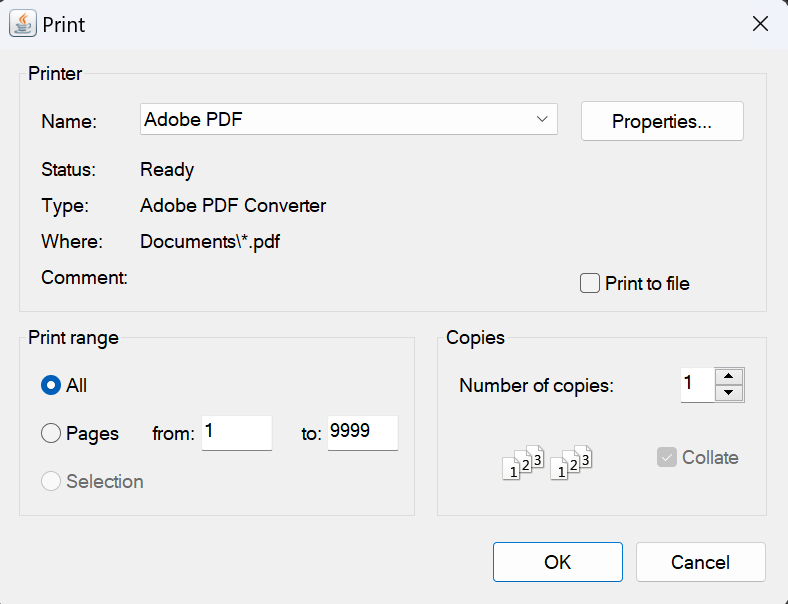
Load the PDF document you want to print, then call pdf.print(). The method opens the standard print dialog, allowing users to select the printer, page range, and other options before the job is sent. This integrates with the operating system's native print functionality, so every printer installed on the machine (including network and virtual printers) appears in the dialog automatically.
import com.ironsoftware.ironpdf.License;
import com.ironsoftware.ironpdf.PdfDocument;
import java.io.IOException;

public class InteractivePrinting {
    public static void main(String[] args) {
        // Set the license key for IronPDF
        License.setLicenseKey("IRONPDF-MYLICENSE-KEY-1EF01");

        try {
            // Option 1: Create a new PDF from HTML
            PdfDocument pdf = PdfDocument.renderHtmlAsPdf("<h1>Monthly Report</h1><p>Sales data...</p>");

            // Option 2: Load an existing PDF file
            // PdfDocument pdf = PdfDocument.fromFile(Paths.get("report.pdf"));

            // Print the PDF with a print dialog for user interaction
            pdf.print();

            System.out.println("Print job sent to selected printer");

        } catch (IOException e) {
            System.err.println("Error printing PDF: " + e.getMessage());
        }
    }
}The print dialog accepts user-selected settings before dispatching the job to the printer.
When Should You Use Dialog-Based Printing?
Dialog-based printing gives users control over settings like printer selection, page range, number of copies, and paper orientation. This approach fits desktop applications, document management systems, or any scenario where users need to review and adjust settings before the job is dispatched.
Common situations that call for print():
- Desktop applications with print preview functionality
- Document workflow systems where users select specific page ranges
- Office environments where different printers serve different purposes
- Applications requiring user confirmation before printing sensitive documents
For applications that need to merge multiple PDFs before printing, combine documents first, then pass the unified result to the print dialog. Review IronPDF's HTML to PDF tutorial for Java for guidance on generating print-ready PDFs from web content.
What Configuration Does the Print Dialog Expose?
The standard Java print dialog surfaces the full set of OS-level print attributes, including page orientation, media size, print quality, and collation order. IronPDF defers to the underlying javax.print API for attribute negotiation, so the available options depend on each printer's reported capabilities. On Windows, the native Win32 print dialog appears; on Linux and macOS, the GTK or Cocoa dialog is used instead. Your Java application requires no custom UI code because the OS handles presentation automatically.
How Can I Print PDFs Without User Prompts?
The printWithoutDialog() method bypasses the print dialog and sends the document straight to the default printer. No user interaction is required at any point in the flow. This makes it the right choice for server-side applications, batch processing systems, and scheduled workflows where consistent, unattended output is the goal.
import com.ironsoftware.ironpdf.License;
import com.ironsoftware.ironpdf.PdfDocument;
import java.io.IOException;
import java.nio.file.Paths;
import java.time.LocalDateTime;

public class AutomatedPrinting {
    public static void main(String[] args) {
        // Set the license key for IronPDF
        License.setLicenseKey("IRONPDF-MYLICENSE-KEY-1EF01");

        try {
            // Create a batch of invoices
            for (int i = 1; i <= 10; i++) {
                String html = String.format(
                    "<h1>Invoice #%d</h1>" +
                    "<p>Date: %s</p>" +
                    "<p>Amount: $%.2f</p>",
                    i, LocalDateTime.now(), i * 100.0
                );

                // Render HTML to PDF
                PdfDocument pdf = PdfDocument.renderHtmlAsPdf(html);

                // Print directly without showing dialog
                pdf.printWithoutDialog();

                System.out.println("Printed invoice #" + i);

                // Save a copy for records
                pdf.saveAs(Paths.get("invoices/invoice_" + i + ".pdf"));
            }

        } catch (IOException e) {
            System.err.println("Printing error: " + e.getMessage());
        }
    }
}The loop above renders each invoice from an HTML template and dispatches it immediately to the default printer. Because no dialog blocks the loop, the entire batch completes without interruption.
What Are the Benefits of Silent Printing?
Silent printing eliminates user prompts, enabling fully automated workflows. The key advantages are:
- Speed: No user interaction means faster processing for large batches
- Consistency: The same print settings apply every time
- Automation: Works for scheduled tasks and background services
- Integration: Fits into existing automated workflows without modification
When processing large documents, apply IronPDF's PDF compression for Java first to reduce file sizes before sending them to the printer, which lowers both print time and resource usage.
When Is Direct Printing Most Effective?
Use printWithoutDialog() for automated document workflows, scheduled print jobs, or backend services where printing must occur without manual intervention. Common use cases include:
- Point-of-Sale Systems: Print receipts automatically after transactions
- Report Generation: Schedule and print daily or weekly reports
- Label Printing: Print shipping labels in warehouse management systems
- Document Processing: Batch print contracts or legal documents
For applications that need to add watermarks in Java or stamp content before printing, process the PDFs first, then send them directly to the printer.
How Do I Handle Print Errors in Automated Workflows?
When printing without dialogs, proper error handling is essential. Printer availability issues, paper jams, and connection problems can all interrupt a batch. Wrapping print calls in try-catch blocks and implementing a retry strategy keeps workflows running when transient errors occur.
import com.ironsoftware.ironpdf.*;
import java.io.IOException;
import java.util.logging.*;

public class RobustPrintHandler {
    private static final Logger logger = Logger.getLogger(RobustPrintHandler.class.getName());

    public static void safePrint(PdfDocument pdf, int maxRetries) {
        int attempts = 0;
        boolean success = false;

        while (attempts < maxRetries && !success) {
            try {
                attempts++;
                pdf.printWithoutDialog();
                success = true;
                logger.info("Print successful on attempt " + attempts);

            } catch (Exception e) {
                logger.warning("Print attempt " + attempts + " failed: " + e.getMessage());

                if (attempts < maxRetries) {
                    try {
                        // Wait before retrying
                        Thread.sleep(2000);
                    } catch (InterruptedException ie) {
                        Thread.currentThread().interrupt();
                    }
                } else {
                    // Max retries reached
                    logger.severe("Print failed after " + maxRetries + " attempts");
                }
            }
        }
    }
}The safePrint method retries up to maxRetries times with a two-second pause between attempts. Each attempt is logged so you can trace failures back to specific jobs. Once the retry limit is reached, the method logs a severe message. From there, your application can save the document to disk, queue it for later, or notify an administrator.
javax.print API, part of the Java standard library, underpins IronPDF's printing integration. For low-level printer discovery and attribute configuration, consult the Java SE javax.print documentation on Oracle's website.What Logging and Monitoring Practices Should You Follow?
When implementing production print workflows, consider these practices:
- Printer Monitoring: Check printer status before sending jobs to avoid queueing against an offline device
- Queue Management: Monitor the print queue to prevent overloading a single printer
- Audit Logging: Record every print job (timestamp, document name, printer, and outcome) for compliance purposes
- Fallback Options: Configure alternative printers or a save-to-file fallback for when the primary printer is unavailable
For complex printing requirements, explore IronPDF's features for creating PDF forms in Java or generating documents from HTML templates before printing. The Apache PDFBox project is also a useful reference for understanding how Java interacts with the underlying PDF specification.
How Should You Structure Print Job Queuing?
For high-throughput systems, decoupling print job submission from execution protects against printer saturation. A producer-consumer pattern, where your application enqueues PdfDocument objects and a dedicated print thread dequeues and dispatches them, keeps the main application responsive even under heavy load. Java's BlockingQueue from java.util.concurrent works well here: the print thread calls queue.take() in a loop, printing each document as it arrives and logging the result. This pattern also makes it straightforward to add priority levels, rate limiting, or a dead-letter queue for jobs that exhaust their retry budget.
What Are the Next Steps for Printing PDFs in Java?
This guide covered two approaches: interactive printing via print() for desktop applications where users need control, and silent printing via printWithoutDialog() for automated batch workflows. Both methods integrate with Java's standard printing infrastructure and work with any printer installed on the operating system.
To add IronPDF to your project and start printing, start your free trial. No credit card required. When you're ready to deploy, view licensing options for your team or organization.
Ready to see what else IronPDF can do? Check out the full tutorial page here: Java Print PDF Tutorial
Frequently Asked Questions
How does IronPDF enable PDF printing in Java?
IronPDF allows you to print PDF files in Java with methods like 'print()' for dialog-based printing, and 'printWithoutDialog()' for automated printing without user interaction.
Can I print PDFs directly to a printer without user interaction using IronPDF?
Yes, using IronPDF's 'printWithoutDialog()' method, you can send PDF documents straight to the default printer without needing any user intervention.
What are the benefits of using dialog-based printing with IronPDF?
Dialog-based printing with IronPDF allows users to select print settings like printer choice, page range, and number of copies, making it suitable for desktop applications where user control is essential.
What are the advantages of silent printing using IronPDF?
Silent printing with IronPDF, achieved using 'printWithoutDialog()', provides faster and consistent outcomes ideal for server-side applications, batch processing, and automated workflows.
How can error handling be implemented in automated print workflows using IronPDF?
IronPDF supports error handling through try-catch blocks and retry strategies to manage issues like printer unavailability, ensuring your automated workflows run smoothly despite interruptions.
What is required to start using IronPDF for PDF printing in Java?
To start using IronPDF, add the necessary dependency to your Java project, set your license key, and utilize the 'PdfDocument' class for loading or creating PDFs before printing.
Which applications benefit most from IronPDF's direct print functionality?
Applications such as point-of-sale systems, report generation, label printing, and document processing can benefit from IronPDF's direct print functionality, which allows straightforward integration into existing workflows.
How does IronPDF handle printing configuration in Java?
IronPDF leverages the 'javax.print' API to interact with the operating system's print dialog, exposing settings like page orientation and print quality to users, thus fully integrating with Java’s printing infrastructure.
What should be considered for effective logging and monitoring when printing with IronPDF?
Effective practices involve monitoring printer status, managing print queues, keeping audit logs, and configuring fallback printing options to ensure reliable and compliant print operations.
How can print job queuing be structured for high-throughput systems using IronPDF?
For high-throughput systems, use a producer-consumer pattern with a 'BlockingQueue' to manage print jobs and maintain application responsiveness, enabling features like priority levels and rate limiting.

Curtis Chau holds a Bachelor’s degree in Computer Science (Carleton University) and specializes in front-end development with expertise in Node.js, TypeScript, JavaScript, and React. Passionate about crafting intuitive and aesthetically pleasing user interfaces, Curtis enjoys working with modern frameworks and creating well-structured, visually appealing manuals.