



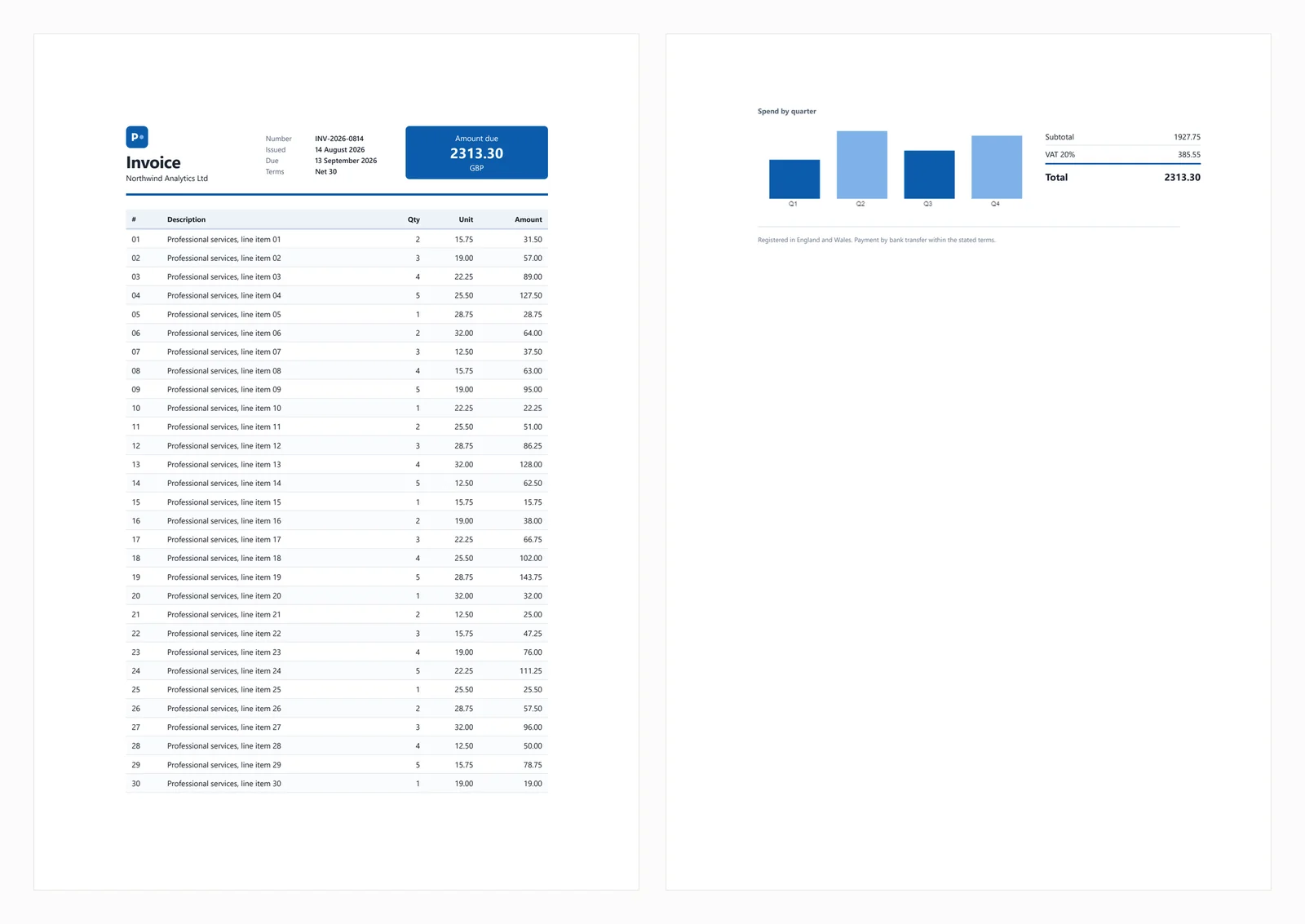
Updated September 2, 2026
HTML to PDF in C#: Benchmarking 7 .NET Libraries (2026)
Compare 7 C# HTML to PDF libraries on .NET 10 for cold start, throughput, memory and rendering accuracy. Only 3 rendered the test invoice correctly.
Read More

IronPDF employs Chrome rendering for HTML-to-PDF conversion, using a familiar HTML/CSS workflow that reduces the amount of code needed for common tasks compared to Aspose.PDF's document object model approach. This makes it particularly suitable for .NET developers seeking rapid development and precise output.
When evaluating PDF libraries for .NET applications, understanding the fundamental architectural differences aids in making informed decisions. This detailed comparison examines both libraries across essential criteria relevant to production systems.
| Criteria | IronPDF | Aspose.PDF |
|---|---|---|
| Architecture | HTML/CSS rendering with Chrome engine | Document Object Model (DOM) approach |
| Learning Curve | Minimal - uses web technologies | Steep - requires PDF internals knowledge |
| Code Complexity | Less code for HTML-based tasks | Verbose, explicit positioning required |
| Performance | Tailored for web content | Suitable for programmatic document construction |
| Cross-Platform | Windows, Linux, macOS, Docker, Cloud | Windows, Linux, macOS |
| Licensing Cost | Starting at $999 with support | Starting at $1,199, support extra |
| Best For | Web-to-PDF, reports, invoices | Low-level PDF manipulation |
Before implementing PDF generation in production systems, ensure the environment meets these requirements:
Modern .NET applications demand reliable PDF generation across diverse deployment scenarios. Both libraries support:
Both libraries support deployment to Azure, AWS Lambda, and Docker containers, making them suitable for cloud-native architectures. IronPDF's native engine ensures consistent rendering across different platforms, while supporting async operations for high-performance scenarios.
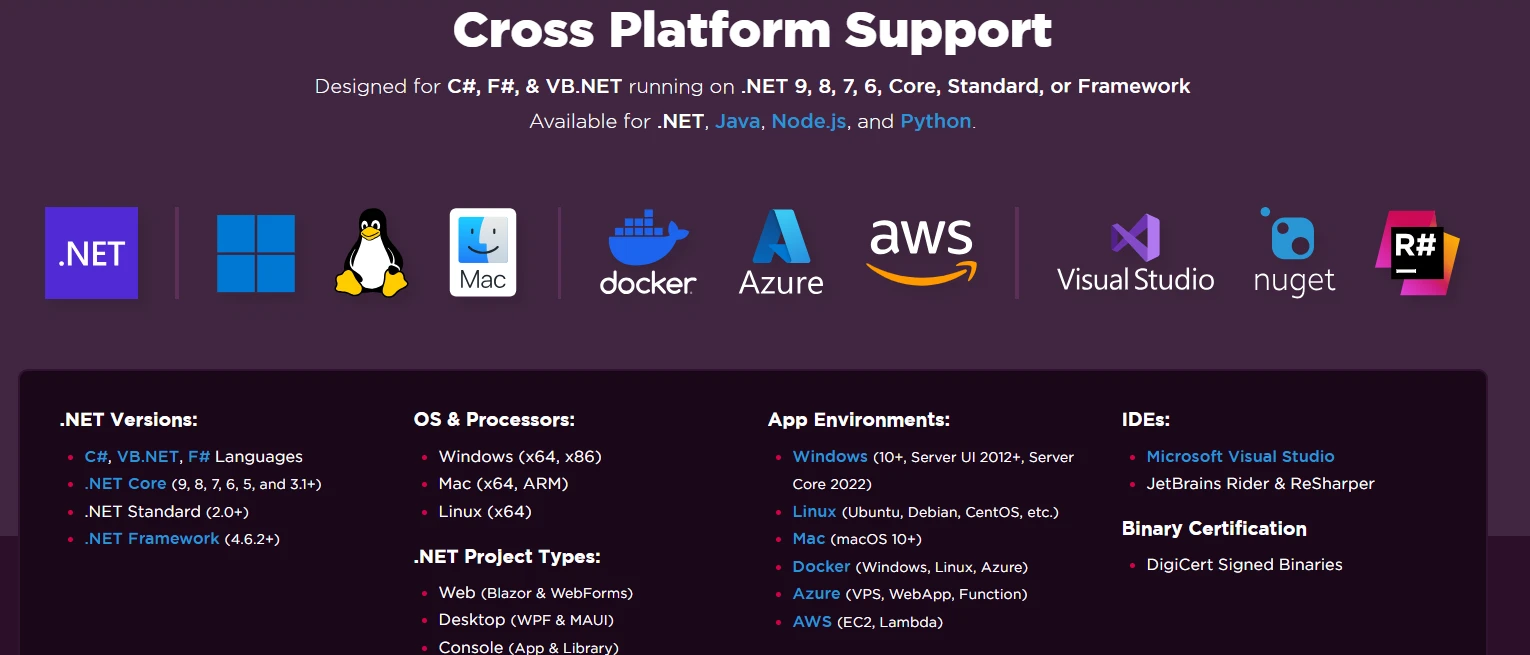
IronPDF provides extensive platform support:
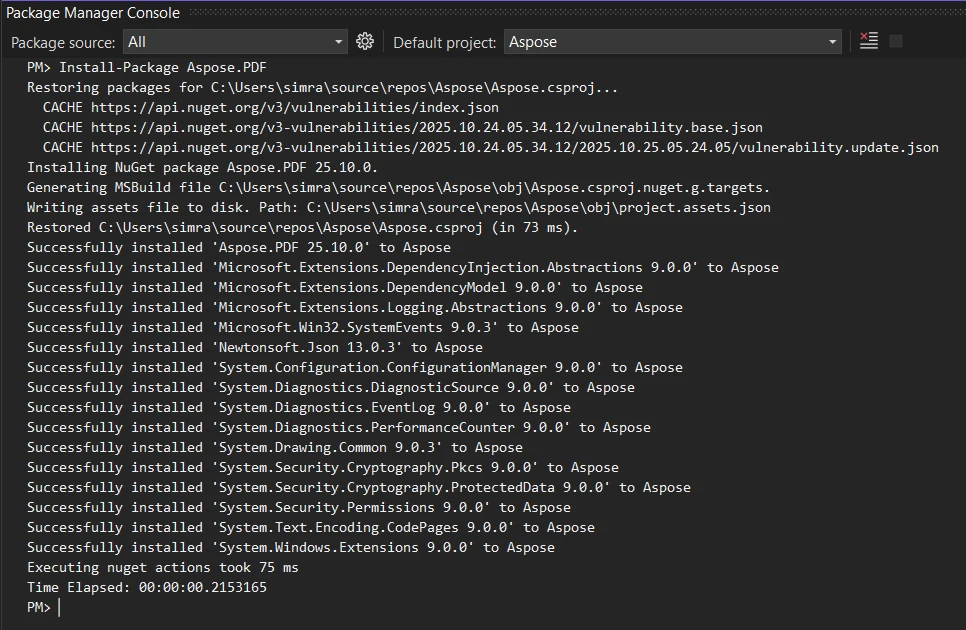
Installation through NuGet Package Manager provides the most straightforward approach for integrating PDF libraries into .NET solutions. Open the Package Manager Console in Visual Studio and execute:
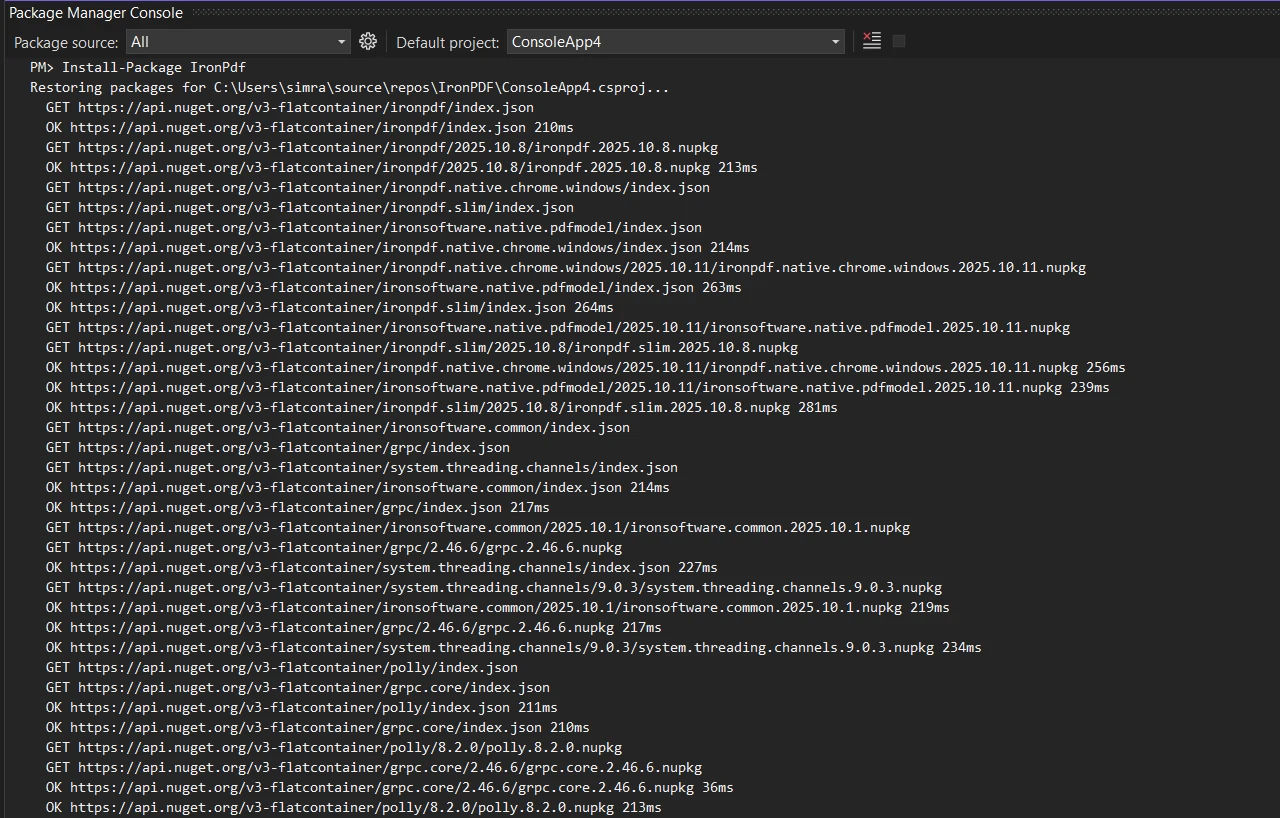
IronPDF installation follows the same straightforward process through Package Manager:
For advanced installation scenarios, refer to the NuGet packages guide or Windows installer options. IronPDF also supports F# development and VB.NET applications.
IronPDF includes an embedded Chrome engine for HTML rendering, with support for Windows, Linux, macOS, Docker containers, and cloud platforms. The Chrome rendering engine ensures precise output with UTF-8 support for international languages.
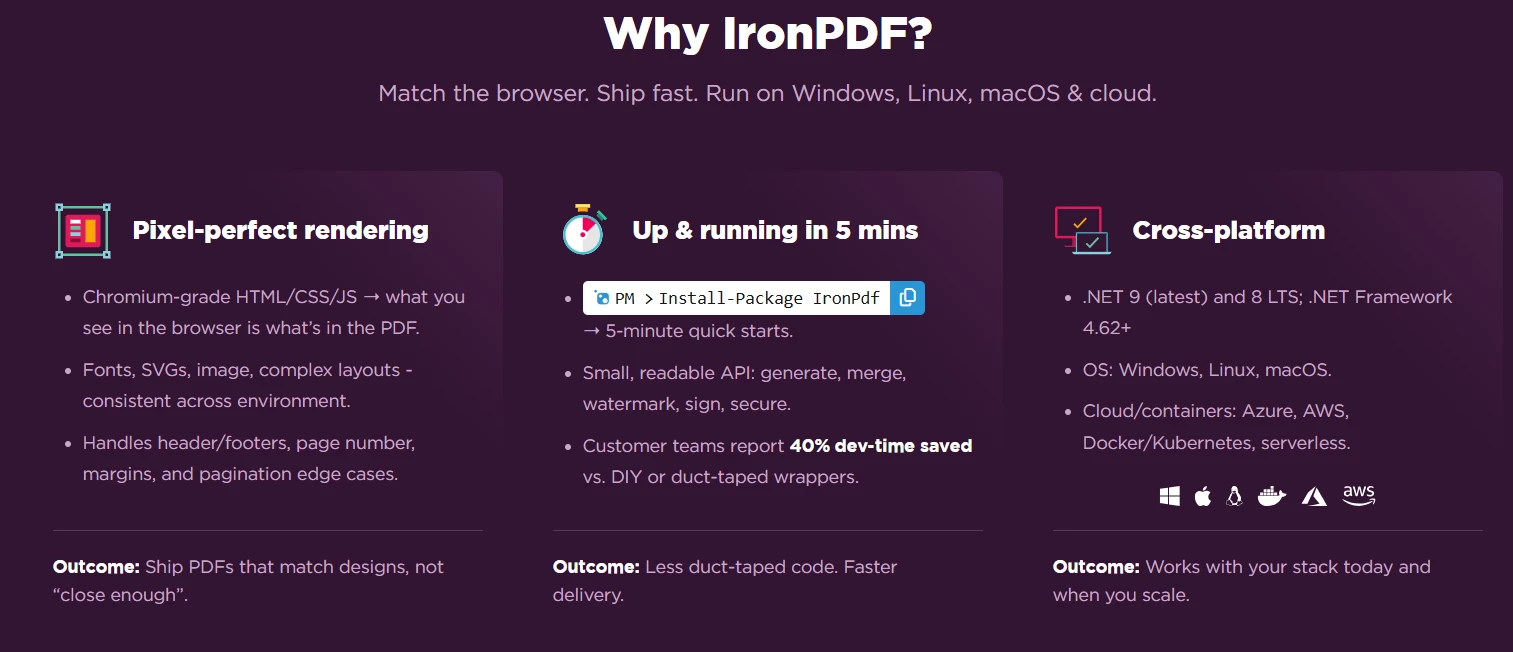
The Chrome rendering engine automatically handles:
FontAwesome, and custom typefacesUnderstanding the fundamental approaches of each library helps architects make informed technology decisions. These examples demonstrate core API patterns and architectural philosophies.
using Aspose.Pdf;
using Aspose.Pdf.Text;

// Create new instance of Document class
var document = new Aspose.Pdf.Document();

// Add pages to the document object
var page = document.Pages.Add();

// Create new TextFragment with Hello World text
var textFragment = new TextFragment("Hello World!");
textFragment.TextState.FontSize = 24;
textFragment.TextState.Font = FontRepository.FindFont("Arial");

// Add text to paragraphs collection
page.Paragraphs.Add(textFragment);

// Save the generated PDF document
document.Save("output.pdf");Imports Aspose.Pdf
Imports Aspose.Pdf.Text
' Create new instance of Document class
Dim document As New Aspose.Pdf.Document()
' Add pages to the document object
Dim page = document.Pages.Add()
' Create new TextFragment with Hello World text
Dim textFragment As New TextFragment("Hello World!")
textFragment.TextState.FontSize = 24
textFragment.TextState.Font = FontRepository.FindFont("Arial")
' Add text to paragraphs collection
page.Paragraphs.Add(textFragment)
' Save the generated PDF document
document.Save("output.pdf")This code creates PDF documents by building a document object model. Developers create a new document, add pages to the collection, and then add content to those pages. The Aspose.Pdf.Document class provides the foundation, while paragraphs hold the content. This Hello World example demonstrates the basic process. The API requires explicit font management and positioning calculations.
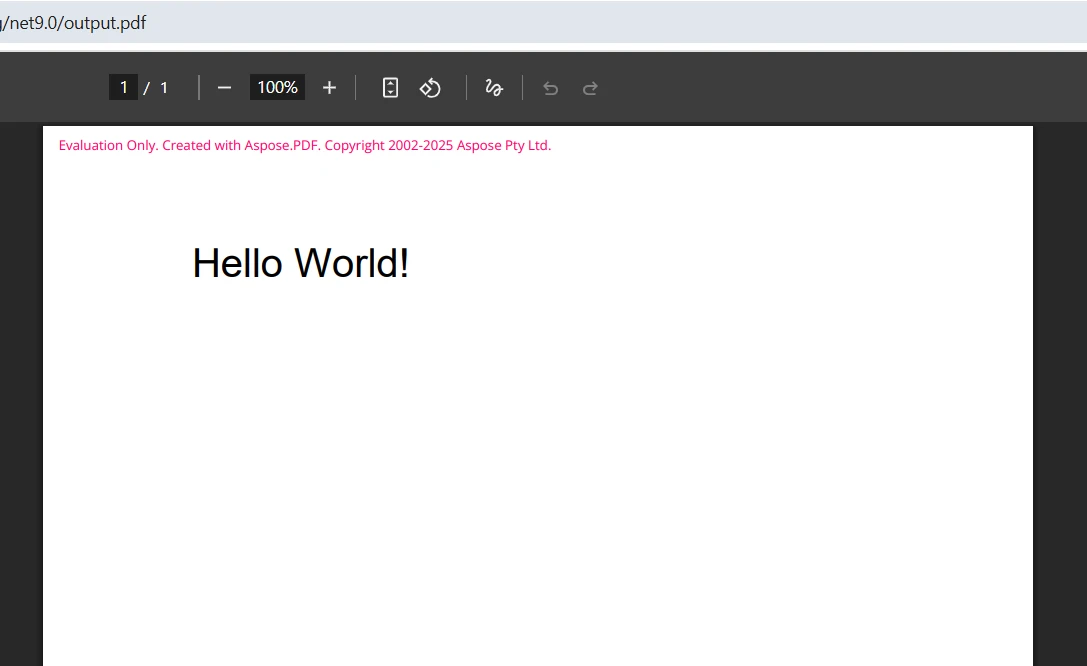 Aspose.PDF generates documents with evaluation watermarks until licensed
Creating PDFs with IronPDF uses familiar web technologies for rapid development:
using IronPdf;

// Create new instance of ChromePdfRenderer
var renderer = new ChromePdfRenderer();

// Configure rendering options for production
renderer.RenderingOptions.CssMediaType = IronPdf.Rendering.PdfCssMediaType.Print;
renderer.RenderingOptions.PrintHtmlBackgrounds = true;

// Convert HTML string to PDF file
var html = @"
    <h1 style='color: #333; font-family: Arial;'>Hello World!</h1>
    <p>This PDF was generated using IronPDF's Chrome rendering engine.</p>";

var pdf = renderer.RenderHtmlAsPdf(html);

// Save PDF files using SaveAs method
pdf.SaveAs("output.pdf");
IronPDF takes a different approach to create a PDF - it renders HTML directly to PDF format using Chrome. This API allows developers to convert web content and implement complex layouts easily. The library handles all rendering complexities, including CSS media types, JavaScript execution, and web fonts, making it simpler to achieve professional results.
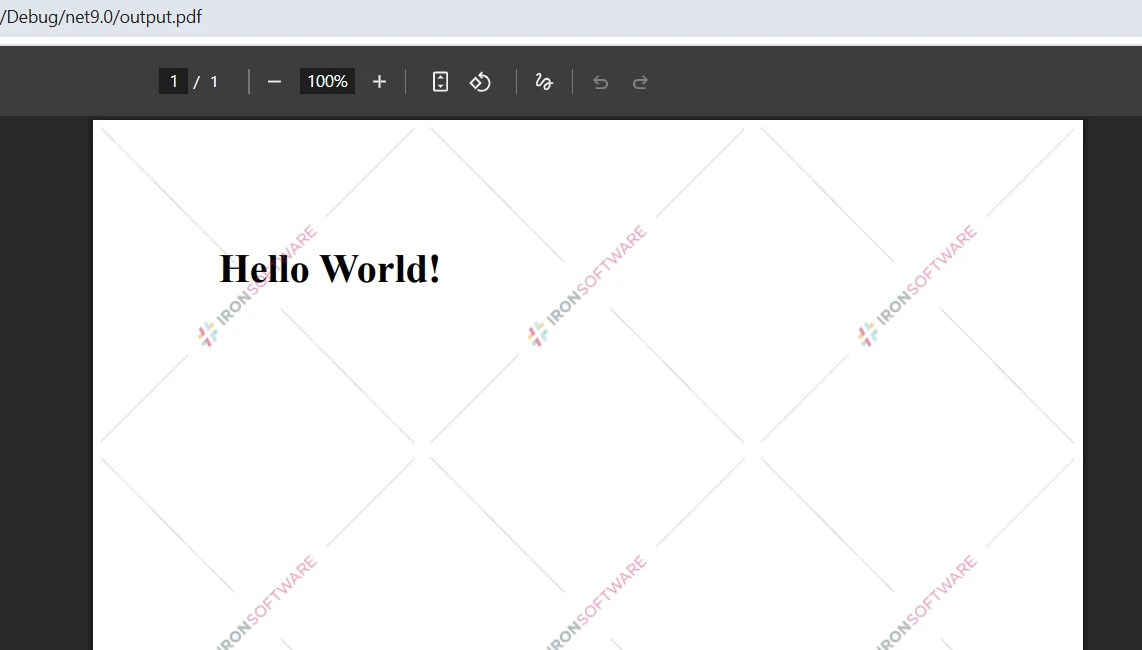 IronPDF renders HTML with Chrome for precise accuracy
The HTML approach provides several architectural advantages:
Production applications require sophisticated layouts with tables, styling, and dynamic content. These examples demonstrate how each library handles complex document requirements.
using Aspose.Pdf;
using Aspose.Pdf.Text;

// Create new Document instance
var document = new Document();
var page = document.Pages.Add();

// Set page margins
page.PageInfo.Margin = new MarginInfo(72, 72, 72, 72);

// Add title text
var title = new TextFragment("INVOICE");
title.TextState.FontSize = 28;
title.TextState.Font = FontRepository.FindFont("Arial Bold");
title.HorizontalAlignment = HorizontalAlignment.Center;

// Add to paragraphs
page.Paragraphs.Add(title);

// Add space
page.Paragraphs.Add(new TextFragment("\n"));

// Create table object for invoice items
var table = new Table();
table.ColumnWidths = "200 100 100";
table.Border = new BorderInfo(BorderSide.All, 0.5f, Color.Black);
table.DefaultCellBorder = new BorderInfo(BorderSide.All, 0.5f, Color.Black);
table.DefaultCellPadding = new MarginInfo(5, 5, 5, 5);

// Add header row to table
var headerRow = table.Rows.Add();
headerRow.Cells.Add("Description");
headerRow.Cells.Add("Quantity");
headerRow.Cells.Add("Price");

// Style header cells
foreach (Cell headerCell in headerRow.Cells)
{
    headerCell.BackgroundColor = Color.Gray;
    var headerText = (TextFragment)headerCell.Paragraphs[0];
    headerText.TextState.ForegroundColor = Color.White;
    headerText.TextState.Font = FontRepository.FindFont("Arial Bold");
}

// Add data rows
var dataRow = table.Rows.Add();
dataRow.Cells.Add("Product A");
dataRow.Cells.Add("2");
dataRow.Cells.Add("$50.00");

// Add table to page paragraphs
page.Paragraphs.Add(table);

// Save the PDF document
document.Save("invoice.pdf");Imports Aspose.Pdf
Imports Aspose.Pdf.Text
' Create new Document instance
Dim document As New Document()
Dim page As Page = document.Pages.Add()
' Set page margins
page.PageInfo.Margin = New MarginInfo(72, 72, 72, 72)
' Add title text
Dim title As New TextFragment("INVOICE")
title.TextState.FontSize = 28
title.TextState.Font = FontRepository.FindFont("Arial Bold")
title.HorizontalAlignment = HorizontalAlignment.Center
' Add to paragraphs
page.Paragraphs.Add(title)
' Add space
page.Paragraphs.Add(New TextFragment(vbCrLf))
' Create table object for invoice items
Dim table As New Table()
table.ColumnWidths = "200 100 100"
table.Border = New BorderInfo(BorderSide.All, 0.5F, Color.Black)
table.DefaultCellBorder = New BorderInfo(BorderSide.All, 0.5F, Color.Black)
table.DefaultCellPadding = New MarginInfo(5, 5, 5, 5)
' Add header row to table
Dim headerRow As Row = table.Rows.Add()
headerRow.Cells.Add("Description")
headerRow.Cells.Add("Quantity")
headerRow.Cells.Add("Price")
' Style header cells
For Each headerCell As Cell In headerRow.Cells
headerCell.BackgroundColor = Color.Gray
Dim headerText As TextFragment = CType(headerCell.Paragraphs(0), TextFragment)
headerText.TextState.ForegroundColor = Color.White
headerText.TextState.Font = FontRepository.FindFont("Arial Bold")
Next
' Add data rows
Dim dataRow As Row = table.Rows.Add()
dataRow.Cells.Add("Product A")
dataRow.Cells.Add("2")
dataRow.Cells.Add("$50.00")
' Add table to page paragraphs
page.Paragraphs.Add(table)
' Save the PDF document
document.Save("invoice.pdf")The Aspose.PDF .NET API requires building each element programmatically. Developers create the document object, add pages, and then add content to the paragraphs collection. This gives precise control but requires more code to implement complex layouts. Managing table formatting, borders, and styling requires explicit configuration. For more complex scenarios, developers might need to handle page breaks manually.
using IronPdf;

var renderer = new ChromePdfRenderer();

// Configure PDF output settings
renderer.RenderingOptions.MarginTop = 25;
renderer.RenderingOptions.MarginBottom = 25;
renderer.RenderingOptions.MarginLeft = 25;
renderer.RenderingOptions.MarginRight = 25;
renderer.RenderingOptions.PaperOrientation = IronPdf.Rendering.PdfPaperOrientation.Portrait;

// Enable JavaScript for dynamic calculations
renderer.RenderingOptions.EnableJavaScript = true;
renderer.RenderingOptions.RenderDelay = 500; // Wait for JS execution

// HTML string with invoice content
var html = @"
<html>
<head>
    <style>
        body { font-family: Arial, sans-serif; }
        h1 { color: #333; text-align: center; }
        table { width: 100%; border-collapse: collapse; }
        th, td { padding: 12px; text-align: left; border-bottom: 1px solid #ddd; }
        th { background-color: #4CAF50; color: white; }
        tr:hover { background-color: #f5f5f5; }
        .total { font-weight: bold; font-size: 18px; }
    </style>
</head>
<body>
    <h1>INVOICE</h1>
    <p>Invoice Date: <span id='date'></span></p>

    <table>
        <tr>
            <th>Description</th>
            <th>Quantity</th>
            <th>Unit Price</th>
            <th>Total</th>
        </tr>
        <tr>
            <td>Product A</td>
            <td>2</td>
            <td>$25.00</td>
            <td>$50.00</td>
        </tr>
        <tr>
            <td>Product B</td>
            <td>3</td>
            <td>$15.00</td>
            <td>$45.00</td>
        </tr>
        <tr>
            <td colspan='3' class='total'>Total:</td>
            <td class='total'>$95.00</td>
        </tr>
    </table>

    <script>
        document.getElementById('date').innerText = new Date().toLocaleDateString();
    </script>
</body>
</html>";

// Generate PDF from HTML
var pdf = renderer.RenderHtmlAsPdf(html);

// Add metadata
pdf.MetaData.Author = "Your Company";
pdf.MetaData.Title = "Invoice";

pdf.SaveAs("invoice.pdf");Imports IronPdf
Dim renderer = New ChromePdfRenderer()
' Configure PDF output settings
renderer.RenderingOptions.MarginTop = 25
renderer.RenderingOptions.MarginBottom = 25
renderer.RenderingOptions.MarginLeft = 25
renderer.RenderingOptions.MarginRight = 25
renderer.RenderingOptions.PaperOrientation = IronPdf.Rendering.PdfPaperOrientation.Portrait
' Enable JavaScript for dynamic calculations
renderer.RenderingOptions.EnableJavaScript = True
renderer.RenderingOptions.RenderDelay = 500 ' Wait for JS execution
' HTML string with invoice content
Dim html = "
<html>
<head>
<style>
body { font-family: Arial, sans-serif; }
h1 { color: #333; text-align: center; }
table { width: 100%; border-collapse: collapse; }
th, td { padding: 12px; text-align: left; border-bottom: 1px solid #ddd; }
th { background-color: #4CAF50; color: white; }
tr:hover { background-color: #f5f5f5; }
.total { font-weight: bold; font-size: 18px; }
</style>
</head>
<body>
<h1>INVOICE</h1>
<p>Invoice Date: <span id='date'></span></p>
<table>
<tr>
<th>Description</th>
<th>Quantity</th>
<th>Unit Price</th>
<th>Total</th>
</tr>
<tr>
<td>Product A</td>
<td>2</td>
<td>$25.00</td>
<td>$50.00</td>
</tr>
<tr>
<td>Product B</td>
<td>3</td>
<td>$15.00</td>
<td>$45.00</td>
</tr>
<tr>
<td colspan='3' class='total'>Total:</td>
<td class='total'>$95.00</td>
</tr>
</table>
<script>
document.getElementById('date').innerText = new Date().toLocaleDateString();
</script>
</body>
</html>"
' Generate PDF from HTML
Dim pdf = renderer.RenderHtmlAsPdf(html)
' Add metadata
pdf.MetaData.Author = "Your Company"
pdf.MetaData.Title = "Invoice"
pdf.SaveAs("invoice.pdf")With IronPDF, developers write standard HTML and the system handles rendering. This method makes it easier to create PDF files with professional layouts. Developers can reference external stylesheets, add images, and include JavaScript for dynamic content. The rendering options provide fine control over output quality, including custom margins and paper sizes.
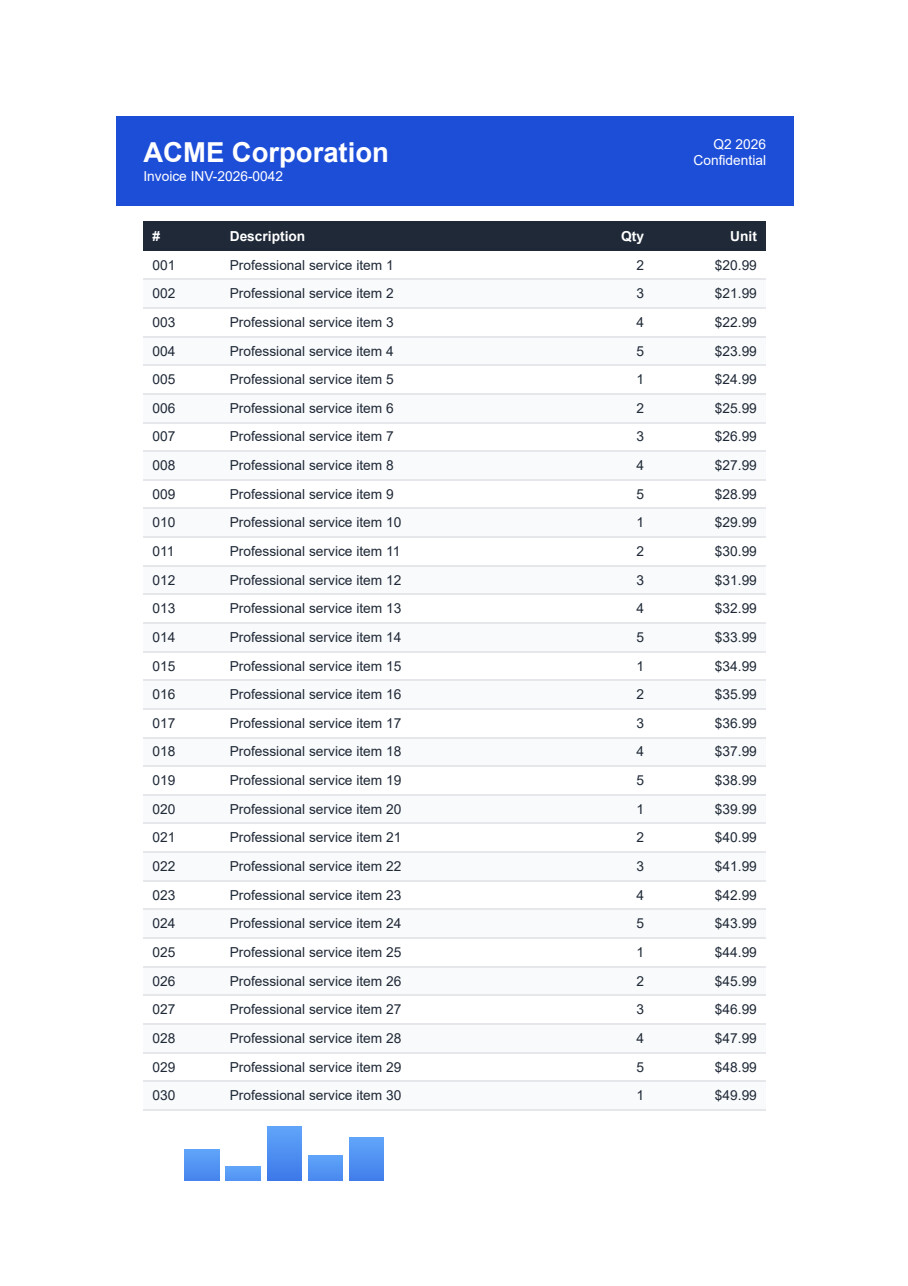
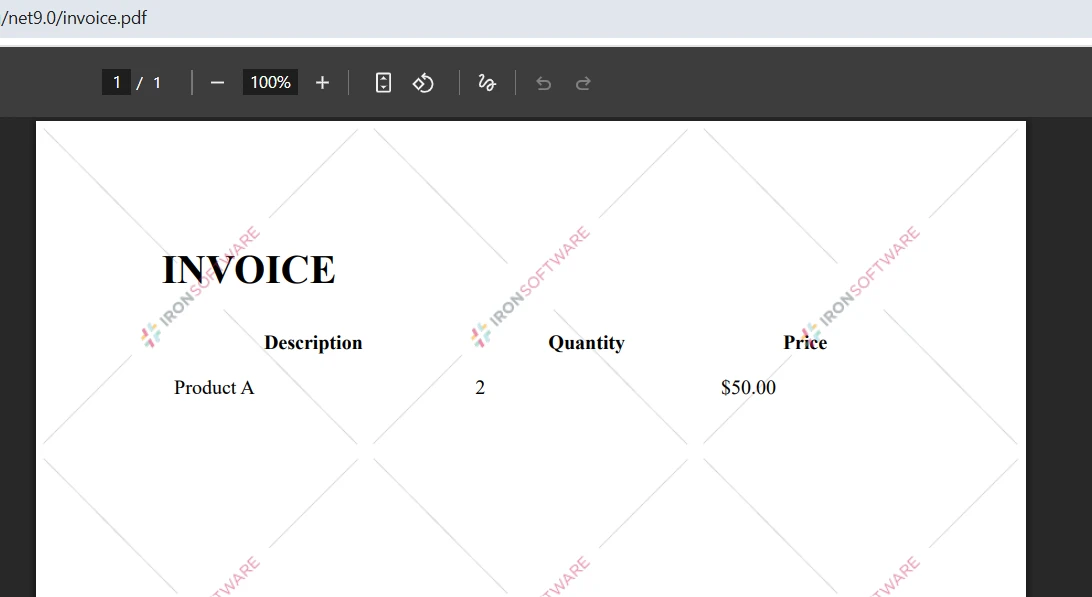 Professional invoice rendered from HTML with automatic table formatting
Comparing the two approaches reveals significant differences in development effort:
Aspose.PDF Requirements:
IronPDF Advantages:
Both libraries offer extensive capabilities beyond basic PDF creation. Understanding these features helps architects design complete document solutions.
// IronPDF - Convert any URL to PDF
var renderer = new ChromePdfRenderer();

// Configure for improved web page capture
renderer.RenderingOptions.ViewPortWidth = 1920;
renderer.RenderingOptions.ViewPortHeight = 1080;
renderer.RenderingOptions.PrintHtmlBackgrounds = true;
renderer.RenderingOptions.WaitFor.RenderDelay(2000); // Wait for dynamic content

// Load and convert URL to PDF
var pdf = renderer.RenderUrlAsPdf("https://ironpdf.com");

// Apply post-processing
pdf.CompressImages(90); // Optimize file size
pdf.SaveAs("website.pdf");IronPDF excels at URL to PDF conversion with its Chrome engine, supporting JavaScript charts, Angular applications, and responsive CSS. The WaitFor options ensure dynamic content loads completely. Developers can also render WebGL content and handle TLS authentication.
// Create PDF document
var pdf = renderer.RenderHtmlAsPdf(html);

// Implement complete security settings
pdf.SecuritySettings.UserPassword = "user123";
pdf.SecuritySettings.OwnerPassword = "owner456";

// Configure permissions
pdf.SecuritySettings.AllowUserPrinting = IronPdf.Security.PdfPrintSecurity.FullPrintRights;
pdf.SecuritySettings.AllowUserEdits = IronPdf.Security.PdfEditSecurity.NoEdit;
pdf.SecuritySettings.AllowUserCopyPasteContent = false;
pdf.SecuritySettings.AllowUserFormData = true;

// Add digital signature
pdf.SignWithFile("/path/to/certificate.pfx", "password");

// Save secured file
pdf.SaveAs("secured.pdf");IronPDF provides intuitive methods to add security, digital signatures, headers and footers, and other features to PDF documents. Developers can also merge PDFs, extract content, or add watermarks. For enterprise scenarios, IronPDF supports signing with HSM and sanitizing PDFs for security.
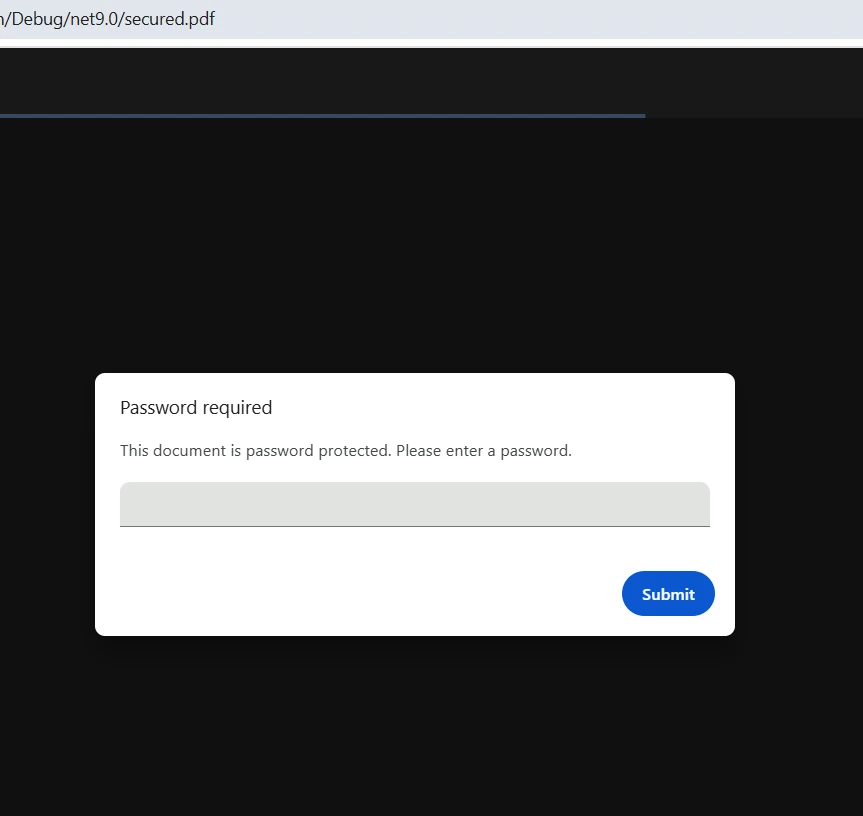 Enterprise-grade security with password protection and digital signatures
Here's a comparison of creating PDFs with forms using both libraries:
// Aspose PDF - Creating forms requires manual positioning
var document = new Document();
var page = document.Pages.Add();

// Create text field
var textField = new TextBoxField(page, new Rectangle(100, 700, 200, 720));
textField.PartialName = "name";
textField.Value = "Enter your name";
document.Form.Add(textField);

// IronPDF - Use HTML forms naturally
var html = @"
<form>
    <label>Name: <input type='text' name='name' required></label>
    <label>Email: <input type='email' name='email' required></label>
    <input type='submit' value='Submit'>
</form>";

var pdf = renderer.RenderHtmlAsPdf(html);
// Forms are automatically interactive in the PDF' Aspose PDF - Creating forms requires manual positioning
Dim document As New Document()
Dim page As Page = document.Pages.Add()
' Create text field
Dim textField As New TextBoxField(page, New Rectangle(100, 700, 200, 720))
textField.PartialName = "name"
textField.Value = "Enter your name"
document.Form.Add(textField)
' IronPDF - Use HTML forms naturally
Dim html As String = "
<form>
<label>Name: <input type='text' name='name' required></label>
<label>Email: <input type='email' name='email' required></label>
<input type='submit' value='Submit'>
</form>"
Dim pdf As PdfDocument = renderer.RenderHtmlAsPdf(html)
' Forms are automatically interactive in the PDFIronPDF's approach to creating PDF forms uses HTML form elements, while Aspose requires programmatic construction. This pattern extends to other features like annotations, bookmarks, and backgrounds. IronPDF also supports filling forms programmatically and working with PDF/A compliance.
IronPDF provides complete PDF manipulation features through its intuitive API:
// Load existing PDF
var pdf = PdfDocument.FromFile("existing.pdf");

// Add pages from another PDF
var anotherPdf = PdfDocument.FromFile("append.pdf");
pdf.AppendPdf(anotherPdf);

// Add watermark
pdf.ApplyWatermark(@"
    <div style='opacity: 0.5; font-size: 48px; color: red; transform: rotate(-45deg);'>
        CONFIDENTIAL
    </div>", 30, VerticalAlignment.Middle, HorizontalAlignment.Center);

// Compress for web
pdf.CompressImages(70);
pdf.SaveAs("optimized.pdf");These operations showcase IronPDF's strengths in PDF compression, page manipulation, and image optimization. The library also supports extracting text and images, redacting content, and transforming pages.
IronPDF excels in these production scenarios:
Financial Services:
Healthcare Systems:
E-commerce Platforms:
Aspose.PDF fits specific technical requirements:
Document Processing:
Legacy System Integration:
IronPDF excels when developers:
Development Speed Requirements:
Platform and Deployment Needs:
Compliance and Accessibility:
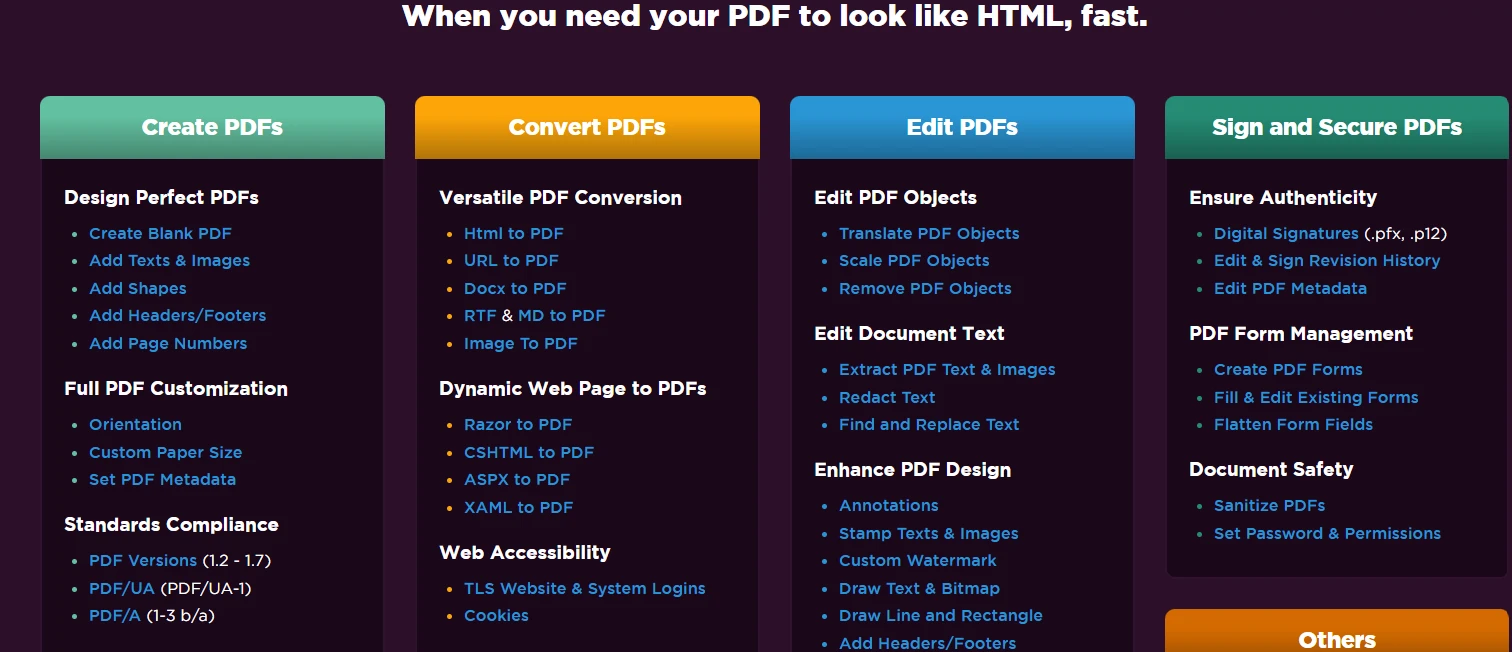 IronPDF provides complete PDF features through an intuitive API
Aspose.PDF for .NET applications works well when developers:
Technical Requirements:
Architectural Constraints:
Performance characteristics vary by use case and should be validated in your specific environment:
| Metric | IronPDF | Aspose.PDF |
|---|---|---|
| HTML to PDF | Chrome-based rendering; suited for web content | DOM-based approach; suited for programmatic construction |
| Simple text PDF | Suitable for all document types | Efficient for programmatic text-heavy documents |
| Memory usage | Varies by document complexity | Varies by document complexity |
| Concurrent operations | Async API available | Synchronous API, multi-threading requires care |
| Development approach | HTML/CSS-based; familiar to web developers | API-driven; requires learning PDF internals |
IronPDF's HTML-based approach provides:
Aspose's document model provides:
Understanding licensing models helps budget for long-term project costs and scalability requirements.
IronPDF offers straightforward licensing starting at $999, including support and updates. The free trial includes all features without watermarks.
Transparent pricing with no hidden costs or annual fees
| License Feature | IronPDF | Aspose.PDF |
|---|---|---|
| Starting Price | $999 | $1,199 |
| Support Included | 24/5 professional support | Support costs extra |
| Updates | 1 year included | Annual renewal required |
| Deployment | Unlimited on tier | Per-developer seats |
| Royalty-Free | Yes on higher tiers | Additional licensing |
| Trial Period | 30 days full features | Limited evaluation |
Key licensing differences:
For teams needing multiple products, IronPDF's licensing extensions and upgrade options provide flexibility. The complete API documentation ensures smooth implementation.
Consider these factors when evaluating total cost of ownership:
IronPDF Cost Advantages:
Aspose Hidden Costs:
Based on production deployments across various industries, developers report these experiences:
Common IronPDF Advantages Cited by Developers:
Aspose.PDF Use Cases: Aspose.PDF is commonly chosen for scenarios requiring low-level PDF structure access, fine-grained positioning control, or tight integration with existing Aspose product suites.
Both libraries effectively create PDF documents in C#. Aspose.PDF provides granular control through its document object model and TextFragment class, while IronPDF excels with HTML-to-PDF conversion using familiar web technologies.
For most modern .NET applications, IronPDF offers strong value through:
Development Efficiency:
Technical Capabilities:
Business Value:
Whether developers need to load web pages, add images, or implement complex layouts, IronPDF's Chrome-based rendering simplifies the process.
IronPDF particularly excels in these scenarios:
Modern Web Applications:
Enterprise Deployments:
Advanced Requirements:
When evaluating PDF libraries, consider these decision factors:
Choose IronPDF When:
Consider Aspose.PDF When:
For questions about implementation, contact IronPDF's engineering team or review their complete documentation, tutorials, and code examples to resolve any challenges.
Start with IronPDF's free trial to evaluate how it can meet PDF generation needs. The trial includes all features without limitations, allowing thorough testing in specific environments. Access complete resources including quick start guides, deployment documentation, and performance optimization tips to ensure successful implementation.
The choice between IronPDF and Aspose.PDF ultimately depends on architectural requirements and team capabilities. IronPDF's HTML-based approach with Chrome rendering provides faster development, better maintainability, and broad cross-platform support for modern applications. Aspose.PDF's document object model offers precise control for specialized requirements but requires significantly more development effort.
For .NET developers focused on performance, reliability, and architectural patterns, IronPDF delivers a strong balance of power, simplicity, and business value. Its complete feature set, transparent licensing, and included professional support make it a compelling choice for production PDF generation in contemporary .NET architectures.
[Aspose is a registered trademark of its respective owner. This site is not affiliated with, endorsed by, or sponsored by Aspose. All product names, logos, and brands are property of their respective owners. Comparisons are for informational purposes only and reflect publicly available information at the time of writing.]

Curtis Chau holds a Bachelor’s degree in Computer Science (Carleton University) and specializes in front-end development with expertise in Node.js, TypeScript, JavaScript, and React. Passionate about crafting intuitive and aesthetically pleasing user interfaces, Curtis enjoys working with modern frameworks and creating well-structured, visually appealing manuals.

IronPDF is a part of IRONSUITE
10 .NET API products for your office documents











When you need your PDF to look like HTML, fast.


