
Transform PDF Pages using IronPDF in C# and .NET

IronPDF enables .NET developers to transform PDF pages by scaling and translating content without modifying page dimensions. Use the Transform method with parameters for horizontal/vertical translation and scaling factors to reposition and resize page content programmatically.
Learn how to easily transform PDF pages using the IronPDF library in .NET. With just a few lines of code, you can scale and translate page content without affecting the original page dimensions. This guide demonstrates how to apply transformations to enhance your PDF documents.
-
1Install IronPDF with NuGet Package Manager
-
2Copy and run this code snippet.
IronPdf.PdfDocument pdf = IronPdf.PdfDocument.FromFile("input.pdf"); pdf.Pages[0].Transform(50, 50, 0.8, 0.8); pdf.SaveAs("output-transformed.pdf");C# -
3Deploy to test on your live environment
Start using IronPDF in your project today with a free trial
Minimal Workflow (5 steps)
- Download IronPDF's C# PDF Library to
TransformPages - Prepare the target PDF document
- Use the
Transformmethod to move and scale PDF pages - Further edit the PDF by adding HTML or image stamps
- Export the PDF as a new file
How Do I Transform PDF Pages in C#?
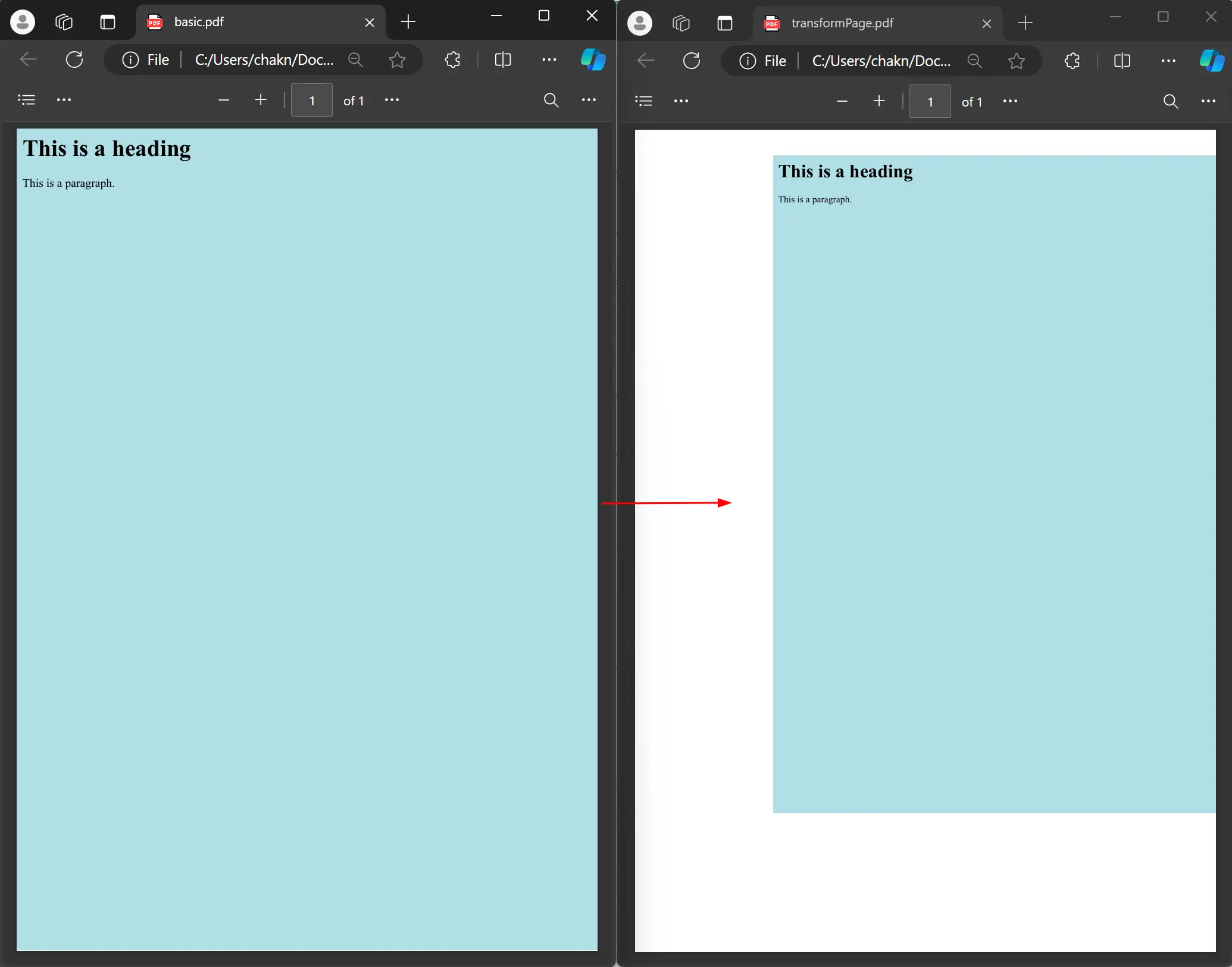
The Transform method can move and resize content. This only affects the appearance of content displayed on the page and does NOT change the physical page dimensions. Unlike page orientation and rotation which modify the entire page structure, transformations adjust only the content positioning. Let's try the Transform method on a basic PDF document example.
using IronPdf;

PdfDocument pdf = PdfDocument.FromFile("basic.pdf");

pdf.Pages[0].Transform(50, 50, 0.8, 0.8);

pdf.SaveAs("transformPage.pdf");Imports IronPdf
Dim pdf As PdfDocument = PdfDocument.FromFile("basic.pdf")
pdf.Pages(0).Transform(50, 50, 0.8, 0.8)
pdf.SaveAs("transformPage.pdf")The Transform method is particularly useful when you need to reposition content after merging multiple PDFs or when preparing documents for specific custom paper sizes. This functionality complements other layout features like setting custom margins to achieve precise document formatting.
What Parameters Does the Transform Method Accept?
The Transform method accepts four key parameters that control content positioning and sizing:
- Horizontal Translation (
TranslateX): Moves content horizontally across the page. Positive values shift content right, while negative values move it left. The measurement unit follows PDF standards (typically points, where 1 point = 1/72 inch). - Vertical Translation (
TranslateY): Controls vertical movement of page content. Positive values move content downward, and negative values shift it upward. This is useful when you need to create space for headers and footers. - Horizontal Scale (
ScaleX): A decimal value that resizes content width. A value of 1.0 maintains original size, 0.5 reduces to half width, and 2.0 doubles the width. This parameter helps fit content within specific boundaries without affecting the aspect ratio when used with matching vertical scale. - Vertical Scale (
ScaleY): Similar toScaleXbut affects height. Maintaining equalScaleXandScaleYvalues preserves the original aspect ratio of your content.
Here's an advanced example demonstrating multiple transformations:
using IronPdf;
using System;

// Load an existing PDF or create a new one
PdfDocument pdf = PdfDocument.FromFile("invoice.pdf");

// Apply different transformations to multiple pages
for (int i = 0; i < pdf.Pages.Count; i++)
{
    if (i % 2 == 0)
    {
        // Even pages: Create margin space and reduce size slightly
        pdf.Pages[i].Transform(30, 30, 0.9, 0.9);
    }
    else
    {
        // Odd pages: Center content with larger margins
        pdf.Pages[i].Transform(40, 60, 0.85, 0.85);
    }
}

// Save the transformed document
pdf.SaveAs("invoice_transformed.pdf");

// You can also export to memory stream for web applications
var memoryStream = pdf.Stream;Imports IronPdf
Imports System
' Load an existing PDF or create a new one
Dim pdf As PdfDocument = PdfDocument.FromFile("invoice.pdf")
' Apply different transformations to multiple pages
For i As Integer = 0 To pdf.Pages.Count - 1
If i Mod 2 = 0 Then
' Even pages: Create margin space and reduce size slightly
pdf.Pages(i).Transform(30, 30, 0.9, 0.9)
Else
' Odd pages: Center content with larger margins
pdf.Pages(i).Transform(40, 60, 0.85, 0.85)
End If
Next
' Save the transformed document
pdf.SaveAs("invoice_transformed.pdf")
' You can also export to memory stream for web applications
Dim memoryStream = pdf.StreamWhy Would I Need to Transform PDF Pages?
PDF page transformation serves numerous practical applications in document processing:
1. Creating Print-Ready Documents: When preparing PDFs for professional printing, you often need to adjust content positioning to accommodate bleed areas, binding margins, or specific printer requirements. The Transform method allows precise positioning without recreating the document.
2. Form Field Alignment: After creating or editing PDF forms, you might need to reposition entire sections to align with pre-printed stationery or templates. Transformation ensures all form elements maintain their relative positions.
3. Multi-Document Compilation: When combining documents from various sources, each may have different margin settings. Using Transform helps standardize the appearance across all pages, especially useful when stamping text or images on consolidated documents.
4. Responsive PDF Generation: In dynamic applications where PDFs are generated based on user preferences or device specifications, Transform enables real-time adjustments to ensure optimal viewing on different screen sizes.
Best Practices for PDF Transformation
When implementing PDF transformations, consider these optimization strategies:
Preserve Aspect Ratios: Always use identical ScaleX and ScaleY values unless intentional distortion is required. This maintains the professional appearance of text and images.
Test Boundary Conditions: Before applying transformations, verify that scaled content won't exceed page boundaries. Calculate the effective content area after transformation to prevent clipping.
Batch Processing Efficiency: When transforming multiple pages, consider using parallel processing for large documents:
using IronPdf;
using System.Linq;
using System.Threading.Tasks;

public async Task TransformLargeDocument(string filePath)
{
    PdfDocument pdf = PdfDocument.FromFile(filePath);

    // Process pages in parallel for better performance
    var tasks = pdf.Pages.Select((page, index) =>
        Task.Run(() =>
        {
            // Apply consistent transformation to all pages
            page.Transform(25, 25, 0.95, 0.95);
        })
    ).ToArray();

    await Task.WhenAll(tasks);

    // Save with optimized settings
    pdf.SaveAs("transformed_optimized.pdf");
}Imports IronPdf
Imports System.Linq
Imports System.Threading.Tasks
Public Async Function TransformLargeDocument(filePath As String) As Task
Dim pdf As PdfDocument = PdfDocument.FromFile(filePath)
' Process pages in parallel for better performance
Dim tasks = pdf.Pages.Select(Function(page, index) _
Task.Run(Sub()
' Apply consistent transformation to all pages
page.Transform(25, 25, 0.95, 0.95)
End Sub)
).ToArray()
Await Task.WhenAll(tasks)
' Save with optimized settings
pdf.SaveAs("transformed_optimized.pdf")
End FunctionMemory Management: For large documents, consider processing in chunks and saving to memory streams to optimize resource usage in server environments.
Common Transformation Scenarios
Here are practical examples for specific use cases:
Creating Thumbnails: Generate PDF page previews by scaling down content while maintaining readability:
// Create thumbnail-sized versions of pages
pdf.Pages[0].Transform(10, 10, 0.3, 0.3);' Create thumbnail-sized versions of pages
pdf.Pages(0).Transform(10, 10, 0.3, 0.3)Adding Binding Margins: Shift content to accommodate spiral binding or three-ring binders:
// Add 0.5 inch (36 points) binding margin on left
pdf.Pages[0].Transform(36, 0, 1.0, 1.0);' Add 0.5 inch (36 points) binding margin on left
pdf.Pages(0).Transform(36, 0, 1.0, 1.0)Centering Undersized Content: When content doesn't fill the page, center it professionally:
// Calculate centering offset (assuming standard letter size)
double pageWidth = 612; // points
double contentWidth = 500; // estimated content width
double centerOffset = (pageWidth - contentWidth) / 2;

pdf.Pages[0].Transform(centerOffset, 50, 1.0, 1.0);' Calculate centering offset (assuming standard letter size)
Dim pageWidth As Double = 612 ' points
Dim contentWidth As Double = 500 ' estimated content width
Dim centerOffset As Double = (pageWidth - contentWidth) / 2
pdf.Pages(0).Transform(centerOffset, 50, 1.0, 1.0)The Transform method integrates with IronPDF's comprehensive feature set, allowing you to create new PDFs with precise layouts and modify existing documents to meet specific requirements. Whether you're building automated document processing systems or creating custom reporting solutions, mastering PDF transformations enhances your ability to deliver professional, precisely formatted documents.
Frequently Asked Questions
How can I transform PDF pages using IronPDF in C#?
You can transform PDF pages using IronPDF by employing the `Transform` method, which allows you to scale and translate content without changing the page dimensions. Simply specify parameters for translation and scaling to move and resize elements within the document.
What is the purpose of the `Transform` method in IronPDF?
The `Transform` method is used to reposition and resize content on a PDF page, helping align elements without altering the physical page size. It is particularly useful for customizing document layouts after merging PDFs or when preparing for custom print requirements.
What parameters does the `Transform` method accept?
The `Transform` method accepts four parameters: horizontal translation (`TranslateX`), vertical translation (`TranslateY`), horizontal scale (`ScaleX`), and vertical scale (`ScaleY`). These allow you to control the content's positioning and size on the page.
Why would I need to apply transformations to PDF pages?
Transformations can help create print-ready documents, align form fields accurately, ensure consistency when compiling documents from different sources, or make real-time adjustments for responsive PDF generation.
How can I ensure content remains within page boundaries when transforming PDFs?
Before applying transformations, calculate the effective content area after scaling to avoid exceeding page boundaries. Use identical scale values for `ScaleX` and `ScaleY` to maintain aspect ratios and prevent clipping.
Can I use IronPDF to transform only specific pages in a document?
Yes, IronPDF allows you to apply transformations to specific pages by iterating through the `Pages` collection of a `PdfDocument` object and calling the `Transform` method on selected pages.
How does the `Transform` method affect a PDF's overall page size?
The `Transform` method does not modify the overall page size; it only changes the appearance and positioning of content displayed on the page.
What are some best practices for transforming PDF pages using IronPDF?
Some best practices include preserving aspect ratios by using equal scale values, testing boundary conditions to prevent clipping, and using parallel processing for batch operations to enhance performance.
How can transformations help in creating standardized document layouts?
Transformations allow you to standardize document layouts by adjusting content positions without altering original page settings, ideal for compiling multi-source documents or applying consistent headers, footers, or margins.
Can I use transformations to create thumbnail previews of PDF pages?
Yes, you can create thumbnail-sized versions of PDF pages by applying small scaling transformations to maintain readability while reducing content size significantly.

Curtis Chau holds a Bachelor’s degree in Computer Science (Carleton University) and specializes in front-end development with expertise in Node.js, TypeScript, JavaScript, and React. Passionate about crafting intuitive and aesthetically pleasing user interfaces, Curtis enjoys working with modern frameworks and creating well-structured, visually appealing manuals.



