

A Developer's Guide to Digitally Signing PDFs with C#

This comprehensive guide shows C# developers how to digitally sign PDFs using IronPDF, covering certificate-based signatures, visual stamps, and interactive form fields to ensure document authenticity and security.
Adding a signature to a PDF document is a common requirement in many applications, but "signing" can mean different things. For some, it's about applying a tamper-proof digital signature using a security certificate. For others, it might be stamping a visual, handwritten signature image onto a document or adding an interactive form field for users to sign electronically.
This guide provides a comprehensive walkthrough for C# developers on how to accomplish all of these tasks using the IronPDF for .NET library. We will cover everything from applying a secure X509Certificate2 digital signature to stamping graphical signatures and creating interactive signature fields, ensuring your PDF documents are authentic, secure, and professional.
Quickstart: Effortlessly Digitally Sign a PDF Using IronPDF
Get started quickly with IronPDF to digitally sign your PDF documents using a simple, straightforward process. This example demonstrates how to use a .pfx certificate to authenticate and sign a PDF file, ensuring document integrity and authenticity. Follow these steps to seamlessly integrate digital signing into your application.
 Get started making PDFs with NuGet now:
Install IronPDF with NuGet Package Manager
Copy and run this code snippet.
new IronPdf.Signing.PdfSignature("certificate.pfx", "password").SignPdfFile("input.pdf");Deploy to test on your live environment

Minimal Workflow (5 steps)
- Install the IronPDF library for .NET.
- Apply a digital signature using an `X509Certificate2` object.
- Add a visual image to represent the digital signature.
- Stamp a graphical or handwritten signature onto a PDF file.
- Add an interactive signature form field for electronic signing.
How Do I Apply a Digital Signature to a PDF with a Certificate?
You can apply a digital signature to a PDF document using a digital certificate file (such as .pfx or .p12) to guarantee the document's authenticity and integrity. This process ensures that the document has not been altered since it was signed. For a complete overview of digital signing capabilities, explore our comprehensive digital signatures guide.
IronPDF provides a straightforward API for this purpose, supporting multiple ways to apply a digital signature. The core of this functionality revolves around the PdfSignature class, which encapsulates the certificate and all associated metadata for the signature.
| Signing Method | Description |
|---|---|
Sign | Signs a PDF with a PdfSignature object that you create and configure. |
SignWithFile | Signs a PDF using a digital signature certificate file (.pfx or .p12) located on disk. |
SignWithStore | Signs a PDF with a digital signature from your computer's certificate store, identified by its thumbprint ID. |
Using an X509Certificate2 Object
For maximum control, you can create an X509Certificate2 object from your certificate file. IronPDF fully complies with the X509Certificate2 standard, providing a robust and secure method for digital signature implementation. When creating the certificate object, ensure the X509KeyStorageFlags are set to Exportable, as this is required by the underlying cryptographic APIs. Check out practical examples of digital signatures in our code repository.
Install-Package IronPdf
using IronPdf;
using IronPdf.Signing;
using System.Security.Cryptography.X509Certificates;

// Create a new PDF from an HTML string for demonstration.
var renderer = new ChromePdfRenderer();
var pdf = renderer.RenderHtmlAsPdf("<h1>Signed Document</h1><p>This document has been digitally signed.</p>");

// Load the certificate from a .pfx file with its password.
// The X509KeyStorageFlags.Exportable flag is crucial for allowing the private key to be used in the signing process.
var cert = new X509Certificate2("IronSoftware.pfx", "123456", X509KeyStorageFlags.Exportable);

// Create a PdfSignature object using the loaded certificate.
var signature = new PdfSignature(cert);

// Apply the signature to the PDF document.
pdf.Sign(signature);

// Save the securely signed PDF document.
pdf.SaveAs("Signed.pdf");
using IronPdf;
using IronPdf.Signing;
using System.Security.Cryptography.X509Certificates;
// Create a new PDF from an HTML string for demonstration.
var renderer = new ChromePdfRenderer();
var pdf = renderer.RenderHtmlAsPdf("<h1>Signed Document</h1><p>This document has been digitally signed.</p>");
// Load the certificate from a .pfx file with its password.
// The X509KeyStorageFlags.Exportable flag is crucial for allowing the private key to be used in the signing process.
var cert = new X509Certificate2("IronSoftware.pfx", "123456", X509KeyStorageFlags.Exportable);
// Create a PdfSignature object using the loaded certificate.
var signature = new PdfSignature(cert);
// Apply the signature to the PDF document.
pdf.Sign(signature);
// Save the securely signed PDF document.
pdf.SaveAs("Signed.pdf");The code above first generates a simple PDF. It then loads a .pfx certificate file into an X509Certificate2 object. This object, which represents the digital identity, is passed to the PdfSignature constructor. Finally, the pdf.Sign method applies this signature to the document before saving it. For more information on the X509Certificate2 class, you can refer to the official Microsoft documentation.
Adding Granular Details to a Digital Signature
A digital signature can contain more than just the certificate; you can embed rich metadata to provide context about the signature. This includes the signing location, reason, contact information, and a secure timestamp from a trusted authority. You can also set and edit metadata for additional document properties.
Adding these details improves the document's audit trail and provides verifiers with valuable information. IronPDF also supports timestamping servers that use modern SHA256 and SHA512 hash algorithms.
using IronPdf;
using IronPdf.Signing;
using IronSoftware.Drawing;
using System;

// Load an existing PDF document to be signed.
var pdf = PdfDocument.FromFile("invoice.pdf");

// Create a PdfSignature object directly from the certificate file and password.
var signature = new PdfSignature("IronSoftware.pfx", "123456");

// Add detailed metadata to the signature for a comprehensive audit trail.
// These properties enhance the signature's credibility and provide context
signature.SignatureDate = DateTime.Now;
signature.SigningContact = "legal@ironsoftware.com";
signature.SigningLocation = "Chicago, USA";
signature.SigningReason = "Contractual Agreement";

// Add a secure timestamp from a trusted Time Stamp Authority (TSA).
// This provides cryptographic proof of the signing time.
signature.TimeStampUrl = new Uri("[http://timestamp.digicert.com](http://timestamp.digicert.com)");
signature.TimestampHashAlgorithm = TimestampHashAlgorithms.SHA256;

// Apply a visual appearance to the signature. (More on this in the next section)
signature.SignatureImage = new PdfSignatureImage("assets/visual-signature.png", 0, new Rectangle(350, 750, 200, 100));

// Sign the PDF document with the configured signature object.
pdf.Sign(signature);

// Save the final, signed PDF document.
pdf.SaveAs("DetailedSignature.pdf");
using IronPdf;
using IronPdf.Signing;
using IronSoftware.Drawing;
using System;
// Load an existing PDF document to be signed.
var pdf = PdfDocument.FromFile("invoice.pdf");
// Create a PdfSignature object directly from the certificate file and password.
var signature = new PdfSignature("IronSoftware.pfx", "123456");
// Add detailed metadata to the signature for a comprehensive audit trail.
// These properties enhance the signature's credibility and provide context
signature.SignatureDate = DateTime.Now;
signature.SigningContact = "legal@ironsoftware.com";
signature.SigningLocation = "Chicago, USA";
signature.SigningReason = "Contractual Agreement";
// Add a secure timestamp from a trusted Time Stamp Authority (TSA).
// This provides cryptographic proof of the signing time.
signature.TimeStampUrl = new Uri("[http://timestamp.digicert.com](http://timestamp.digicert.com)");
signature.TimestampHashAlgorithm = TimestampHashAlgorithms.SHA256;
// Apply a visual appearance to the signature. (More on this in the next section)
signature.SignatureImage = new PdfSignatureImage("assets/visual-signature.png", 0, new Rectangle(350, 750, 200, 100));
// Sign the PDF document with the configured signature object.
pdf.Sign(signature);
// Save the final, signed PDF document.
pdf.SaveAs("DetailedSignature.pdf");You may notice a warning icon in some PDF viewers if the signing certificate is not in the system's trusted store. To get a green checkmark, the certificate must be added to the viewer's trusted identities.
How Can I Add a Visual Representation to a Digital Signature?
While a digital signature is cryptographically embedded in the PDF, it's often useful to have a visual representation on the page. This can be a company logo, a handwritten signature image, or other graphics. IronPDF makes it easy to add an image to a PdfSignature object.
You can load an image from a file or a stream and position it precisely on any page of the PDF. Supported image formats include PNG, JPEG, GIF, BMP, TIFF, and WebP. This technique is similar to how you might stamp text and images on PDF documents.
using IronPdf.Signing;
using IronSoftware.Drawing;

// This example demonstrates various ways to add a visual image to a PDF signature.

// Create a PdfSignature object.
var signature = new PdfSignature("IronSoftware.pfx", "123456");

// Define the position and size for the signature image on the first page (index 0).
// Rectangle parameters: x position, y position, width, height
var signatureRectangle = new Rectangle(350, 750, 200, 100);

// Option 1: Set the SignatureImage property directly.
// This is the most straightforward approach
signature.SignatureImage = new PdfSignatureImage("assets/visual-signature.png", 0, signatureRectangle);

// Option 2: Use the LoadSignatureImageFromFile method.
// This method provides the same functionality with a different syntax
signature.LoadSignatureImageFromFile("assets/visual-signature.png", 0, signatureRectangle);

// Option 3: Load an image from a stream. This is useful for images generated in memory.
// Perfect for scenarios where images are retrieved from databases or web services
AnyBitmap image = AnyBitmap.FromFile("assets/visual-signature.png");
using (var imageStream = image.ToStream())
{
    signature.LoadSignatureImageFromStream(imageStream, 0, signatureRectangle);
}

// After configuring the signature image, apply it to a PDF.
var pdf = PdfDocument.FromFile("invoice.pdf");
pdf.Sign(signature);
pdf.SaveAs("VisualSignature.pdf");
using IronPdf.Signing;
using IronSoftware.Drawing;
// This example demonstrates various ways to add a visual image to a PDF signature.
// Create a PdfSignature object.
var signature = new PdfSignature("IronSoftware.pfx", "123456");
// Define the position and size for the signature image on the first page (index 0).
// Rectangle parameters: x position, y position, width, height
var signatureRectangle = new Rectangle(350, 750, 200, 100);
// Option 1: Set the SignatureImage property directly.
// This is the most straightforward approach
signature.SignatureImage = new PdfSignatureImage("assets/visual-signature.png", 0, signatureRectangle);
// Option 2: Use the LoadSignatureImageFromFile method.
// This method provides the same functionality with a different syntax
signature.LoadSignatureImageFromFile("assets/visual-signature.png", 0, signatureRectangle);
// Option 3: Load an image from a stream. This is useful for images generated in memory.
// Perfect for scenarios where images are retrieved from databases or web services
AnyBitmap image = AnyBitmap.FromFile("assets/visual-signature.png");
using (var imageStream = image.ToStream())
{
signature.LoadSignatureImageFromStream(imageStream, 0, signatureRectangle);
}
// After configuring the signature image, apply it to a PDF.
var pdf = PdfDocument.FromFile("invoice.pdf");
pdf.Sign(signature);
pdf.SaveAs("VisualSignature.pdf");This code showcases three equivalent ways to add a visual component to a digital signature. Whether you have an image on disk or in memory, you can easily stamp it onto the PDF as part of the signing process. This bridges the gap between invisible cryptographic security and visible document approval.
How Can I Control Document Permissions After Signing?
When you sign a document, you might want to specify what changes, if any, are permitted afterward. For example, you might want to lock the document completely or only allow users to fill in form fields. IronPDF lets you set these permissions using the SignaturePermissions enumeration. For more advanced permission control, see our guide on setting PDF passwords and permissions.
Setting signature permissions is a key part of managing a document's lifecycle. It ensures that the document's integrity is maintained according to your rules after your signature is applied. If a user performs a disallowed action, the signature will be invalidated.
SignaturePermissions Member | Definition |
|---|---|
NoChangesAllowed | No changes of any kind are permitted. The document is effectively locked. |
FormFillingAllowed | Only filling in existing form fields and signing is allowed. |
AnnotationsAndFormFillingAllowed | Allows form filling, signing, and creating or modifying annotations. |
Saving and Signing a Specific PDF Revision
PDFs can store a history of changes, much like a version control system. This is known as incremental saving. When you sign a PDF, the signature applies to a specific revision of the document. This is crucial for workflows where a document goes through multiple stages of approval. Learn more about managing PDF revision history in our detailed guide.
In the following example, we load a PDF, make edits, and then sign the current revision while allowing only form-filling as a future change. We use SaveAsRevision to commit the current state to the document's history before saving the file.
using IronPdf.Signing;

// Load a PDF file with change tracking enabled.
// This enables incremental save functionality for revision management
var pdf = PdfDocument.FromFile("annual_census.pdf", ChangeTrackingModes.EnableChangeTracking);

// Placeholder for edits: You might add text, fill forms, or add annotations here.
// For example: pdf.Annotations.Add(new TextAnnotation(...));
// Or: pdf.Form["fieldName"].Value = "New Value";

// Sign the current state of the document using SignWithFile for convenience.
// We set permissions to allow further signatures and form filling.
pdf.SignWithFile(
    "assets/IronSignature.p12",
    "password",
    SignaturePermissions.AdditionalSignaturesAndFormFillingAllowed);

// Save the current state as a distinct revision within the PDF's history.
// This creates a snapshot that can be referenced later
PdfDocument pdfWithRevision = pdf.SaveAsRevision();

// Save the final PDF with its full revision history to a new file.
pdfWithRevision.SaveAs("annual_census_signed.pdf");
using IronPdf.Signing;
// Load a PDF file with change tracking enabled.
// This enables incremental save functionality for revision management
var pdf = PdfDocument.FromFile("annual_census.pdf", ChangeTrackingModes.EnableChangeTracking);
// Placeholder for edits: You might add text, fill forms, or add annotations here.
// For example: pdf.Annotations.Add(new TextAnnotation(...));
// Or: pdf.Form["fieldName"].Value = "New Value";
// Sign the current state of the document using SignWithFile for convenience.
// We set permissions to allow further signatures and form filling.
pdf.SignWithFile(
"assets/IronSignature.p12",
"password",
SignaturePermissions.AdditionalSignaturesAndFormFillingAllowed);
// Save the current state as a distinct revision within the PDF's history.
// This creates a snapshot that can be referenced later
PdfDocument pdfWithRevision = pdf.SaveAsRevision();
// Save the final PDF with its full revision history to a new file.
pdfWithRevision.SaveAs("annual_census_signed.pdf");Understanding incremental saves is key to advanced PDF workflows. While a simple viewer might only show the latest version, a tool like Adobe Acrobat can reveal the entire revision history, showing who signed which version and what changes were made between signatures. IronPDF gives you full programmatic control over this process.
For businesses managing complex document workflows that require high security and compliance, a comprehensive solution may be needed. Iron Software offers Iron Suite, which includes IronPDF for signing and manipulation, plus other libraries for a wide range of document processing tasks, available for a single one-time payment.
How Can I Manage and Verify Signatures Across Revisions?
A PDF document can have multiple signatures applied across its various revisions. IronPDF provides tools to manage this history effectively.
- Roll Back to a Previous Revision: You can revert a document to an earlier state using the
GetRevisionmethod. This will discard all changes and signatures made after that revision. - Verify All Signatures: The
VerifySignaturesmethod checks the validity of all signatures across all revisions of the document. It returnstrueonly if every signature is valid and no unauthorized changes have been made. - Remove Signatures: The
RemoveSignaturesmethod will strip all digital signatures from every revision of the document, creating a clean, unsigned version.
// Load a PDF with a complex signature history.
var pdf = PdfDocument.FromFile("multi_signed_report.pdf");

// Verify all signatures across all revisions.
// This ensures document integrity throughout its entire history
bool allSignaturesValid = pdf.VerifySignatures();
Console.WriteLine($"All signatures are valid: {allSignaturesValid}");

// Roll back to the first revision (index 0).
// Useful for reviewing the original document state
if (pdf.RevisionCount > 1)
{
    PdfDocument firstRevision = pdf.GetRevision(0);
    firstRevision.SaveAs("report_first_revision.pdf");
}

// Create a completely unsigned version of the document.
// This removes all digital signatures while preserving content
pdf.RemoveSignatures();
pdf.SaveAs("report_unsigned.pdf");
// Load a PDF with a complex signature history.
var pdf = PdfDocument.FromFile("multi_signed_report.pdf");
// Verify all signatures across all revisions.
// This ensures document integrity throughout its entire history
bool allSignaturesValid = pdf.VerifySignatures();
Console.WriteLine($"All signatures are valid: {allSignaturesValid}");
// Roll back to the first revision (index 0).
// Useful for reviewing the original document state
if (pdf.RevisionCount > 1)
{
PdfDocument firstRevision = pdf.GetRevision(0);
firstRevision.SaveAs("report_first_revision.pdf");
}
// Create a completely unsigned version of the document.
// This removes all digital signatures while preserving content
pdf.RemoveSignatures();
pdf.SaveAs("report_unsigned.pdf");How Do I Stamp a Handwritten Signature onto a PDF?
Sometimes, you don't need the cryptographic security of a digital signature but simply want to apply a visual, electronic signature, like a scanned handwritten signature. This is often referred to as stamping. IronPDF can do this using its Watermark or Stamp features. For more advanced watermarking options, explore our custom watermarks guide.
Let's start with a sample invoice PDF and a .png image of a handwritten signature.
The original invoice PDF before stamping a signature.
Here is the signature image we will apply:
 A sample handwritten signature image.
The following code uses the Watermark property to stamp this image onto the bottom-right corner of the PDF.
using IronPdf.Editing;

// Load the existing PDF document.
var pdf = PdfDocument.FromFile("invoice.pdf");

// Create an HtmlStamp containing our signature image.
// HtmlStamp allows us to position HTML content precisely on the page
var signatureStamp = new HtmlStamp("<img src='assets/signature.png'/>")
{
    // Configure the stamp's position and appearance.
    VerticalAlignment = VerticalAlignment.Bottom,
    HorizontalAlignment = HorizontalAlignment.Right,
    Margin = 10,  // Add some space from the edge.
    Opacity = 90  // Make it slightly transparent for a more authentic look.
};

// Apply the stamp to all pages of the PDF.
// You can also specify specific page numbers if needed
pdf.ApplyStamp(signatureStamp);

// Save the modified PDF document.
pdf.SaveAs("official_invoice.pdf");
using IronPdf.Editing;
// Load the existing PDF document.
var pdf = PdfDocument.FromFile("invoice.pdf");
// Create an HtmlStamp containing our signature image.
// HtmlStamp allows us to position HTML content precisely on the page
var signatureStamp = new HtmlStamp("<img src='assets/signature.png'/>")
{
// Configure the stamp's position and appearance.
VerticalAlignment = VerticalAlignment.Bottom,
HorizontalAlignment = HorizontalAlignment.Right,
Margin = 10, // Add some space from the edge.
Opacity = 90 // Make it slightly transparent for a more authentic look.
};
// Apply the stamp to all pages of the PDF.
// You can also specify specific page numbers if needed
pdf.ApplyStamp(signatureStamp);
// Save the modified PDF document.
pdf.SaveAs("official_invoice.pdf");What Does the Stamped PDF Result Look Like?
After running the code, the signature image is stamped onto the document, creating a visually signed invoice.
The final PDF with the handwritten signature image stamped in the bottom-right corner.
How Can I Add an Interactive Signature Field to a PDF?
For documents that need to be signed by an end-user in a PDF viewer like Adobe Acrobat, you can add an interactive signature form field. This creates an empty, clickable area that prompts the user to apply their own digital signature. For a complete guide on PDF forms, see our creating PDF forms tutorial.
You can create a SignatureFormField and add it to the PDF's form collection. You have precise control over its location and size on the page. This is particularly useful for documents that require multiple signatures or when you need to collect signatures from external parties.
using IronPdf.Forms;
using IronSoftware.Drawing;

// Create a new PDF to add the signature field to.
var renderer = new ChromePdfRenderer();
var pdf = renderer.RenderHtmlAsPdf("<h1>Please Sign Below</h1>");

// Define the properties for the signature form field.
string fieldName = "ClientSignature";  // Unique identifier for the field
int pageIndex = 0;  // Add to the first page (zero-indexed)
var fieldRect = new Rectangle(50, 200, 300, 100);  // Position: (x, y), Size: (width, height)

// Create the SignatureFormField object.
// This creates an interactive field that users can click to sign
var signatureField = new SignatureFormField(fieldName, pageIndex, fieldRect);

// Add the signature field to the PDF's form.
pdf.Form.Add(signatureField);

// Save the PDF with the new interactive signature field.
pdf.SaveAs("interactive_signature.pdf");
using IronPdf.Forms;
using IronSoftware.Drawing;
// Create a new PDF to add the signature field to.
var renderer = new ChromePdfRenderer();
var pdf = renderer.RenderHtmlAsPdf("<h1>Please Sign Below</h1>");
// Define the properties for the signature form field.
string fieldName = "ClientSignature"; // Unique identifier for the field
int pageIndex = 0; // Add to the first page (zero-indexed)
var fieldRect = new Rectangle(50, 200, 300, 100); // Position: (x, y), Size: (width, height)
// Create the SignatureFormField object.
// This creates an interactive field that users can click to sign
var signatureField = new SignatureFormField(fieldName, pageIndex, fieldRect);
// Add the signature field to the PDF's form.
pdf.Form.Add(signatureField);
// Save the PDF with the new interactive signature field.
pdf.SaveAs("interactive_signature.pdf");When a user opens this PDF, they will see a clickable field, allowing them to complete the signing process using their own digital ID. You can learn more about creating and managing interactive forms in our How-To guide on creating PDF forms.
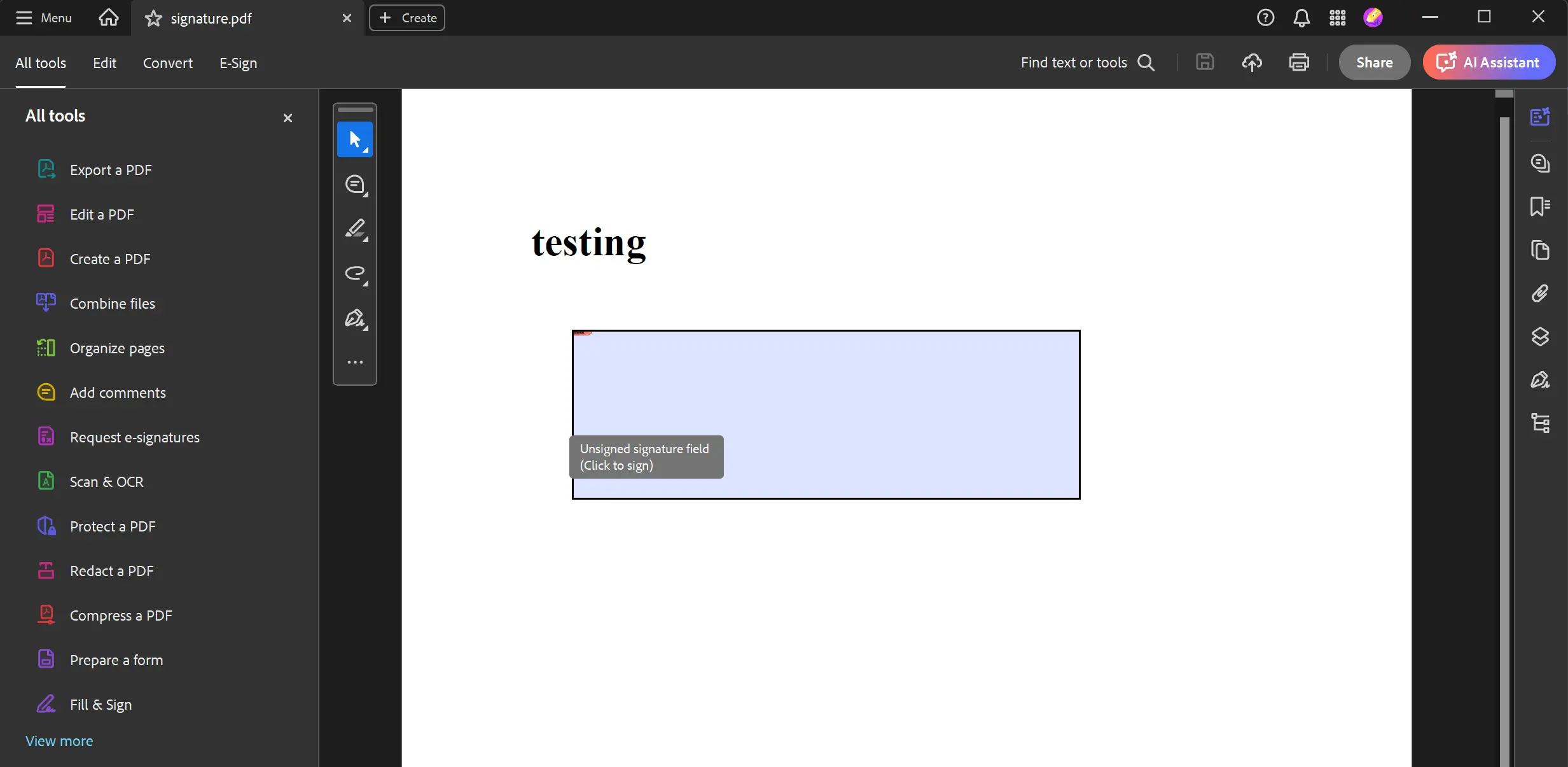 An unsigned, interactive signature field added programmatically to a PDF document.
How Do I Retrieve the Signer Name from Verified Signatures?
To obtain the common name of the certificate owner who signed a signature, we can use the VerifiedSignature class to access the SignerName property. Below is a code snippet demonstrating how to accomplish this.
:path=/static-assets/pdf/content-code-examples/how-to/signing-find-signer-name.csusing IronPdf;
using System;
// Import the Signed PDF report
var pdf = PdfDocument.FromFile("multi_signed_report.pdf");
// Using GetVerifiedSignatures() obtain a list of `VerifiedSignature` objects from the PDF
pdf.GetVerifiedSignatures().ForEach(signature =>
{
// Print out the SignerName of each `VerifiedSignature` object
Console.WriteLine($"SignatureName: {signature.SignerName}");
});After importing the signed PDF file, we utilize the GetVerifiedSignatures method to retrieve a list of VerifiedSignature objects within the report and print the SignerName for each signature.
Please note that this value is extracted from the certificate's Subject Distinguished Name (SubjectDN) and will return null if the CN field is not present.
What Are the Next Steps for PDF Signing with IronPDF?
This guide has demonstrated the powerful and flexible PDF signing capabilities of IronPDF. Whether you need to apply secure digital signatures with detailed metadata, manage document revisions, stamp visual signatures, or create interactive forms, IronPDF provides a comprehensive and developer-friendly API to get the job done.
To continue exploring, you can download the IronPDF library for .NET and get a free trial license to test out all its features in your projects. For more advanced document manipulation techniques, including adding annotations and working with form fields, check out our extensive documentation and tutorials.
Ready to see what else you can do? Check out our tutorial page here: Sign and Secure PDFs
Frequently Asked Questions
How do I digitally sign a PDF using a certificate in C#?
With IronPDF, you can digitally sign a PDF in just one line of code using the PdfSignature class. Simply create a new PdfSignature object with your certificate file (.pfx or .p12) and password, then call SignPdfFile() method. For example: new IronPdf.Signing.PdfSignature("certificate.pfx", "password").SignPdfFile("input.pdf"). This applies a tamper-proof digital signature using your X509Certificate2 to ensure document authenticity.
What types of PDF signatures are supported?
IronPDF supports three main types of PDF signatures: 1) Digital signatures using X509Certificate2 certificates for authentication and tamper-proofing, 2) Visual signature stamps that add graphical or handwritten signature images to documents, and 3) Interactive signature form fields that allow users to electronically sign PDFs. Each type serves different purposes for document security and workflow requirements.
What certificate formats can be used for digital signing?
IronPDF supports common digital certificate formats including .pfx (Personal Information Exchange) and .p12 files. These certificate files contain both the public key and private key needed for digital signing. The PdfSignature class in IronPDF can work with any X509Certificate2 object, providing flexibility in how you load and manage your signing certificates.
Can I add a visual representation to my digital signature?
Yes, IronPDF allows you to add visual elements to your digital signatures. You can include a graphical representation such as a handwritten signature image, company logo, or custom stamp alongside the cryptographic signature. This combines the security of digital certificates with visual confirmation, making signed documents both secure and professionally presentable.
How do I create an interactive signature field for users to sign electronically?
IronPDF enables you to add interactive signature form fields to PDF documents. These fields allow users to sign documents electronically by clicking and drawing their signature or uploading a signature image. This feature is perfect for creating documents that require signature collection, such as contracts or forms that need to be signed by multiple parties.
Does signing a PDF ensure document integrity?
Yes, when you digitally sign a PDF using IronPDF with an X509Certificate2, it creates a tamper-proof seal that ensures document integrity. The digital signature guarantees that the document has not been altered since it was signed. Any modifications to the PDF after signing will invalidate the signature, alerting recipients that the document may have been compromised.










 Get started for FREE
 Get started for FREE
 Book Free Live Demo



 No credit card or account creation required